Carole Farmer, ASU System Board of Trustees. Image courtesy of the ASU System.
LITTLE ROCK — Gov. Sarah Huckabee Sanders has appointed Carole Farmer of Fayetteville to a seven-year term on the Arkansas State University System Board of Trustees.
Farmer succeeds immediate past board chair Christy Clark of Little Rock, who served seven years after being appointed by Gov. Asa Hutchinson in 2018 and reappointed by Gov. Sanders in 2023.
ASU System President Brendan Kelly said he welcomes Farmer to the board.
“Carole Farmer will be an outstanding addition to our Board of Trustees,” Kelly said. “Her experiences in health care, management and finance will be welcome on the board and in the ASU System. We look forward to working with her in the years ahead.”
“I’m also grateful to Christy Clark for her service during the past seven years,” Kelly added. “She has been part of many significant achievements in the ASU System, and I worked closely with her as board chair during the last six months as I came on board as president. She’s been a tremendous resource and asset to the ASU System.”
Farmer is a Certified Medical Practice Executive (CMPE) and owns Arkansas Medical Management Consulting, LLC, a medical consulting firm that provides support for physician-owned practices. She worked 17 years for the largest multi-specialty physician medical clinic in northeast Arkansas. Her last seven years, she served as the clinic’s administrator and managed more than 120 employees.
She served for five years on the Board of Directors for Arkansas Medical Group Managers Association, her last year as chair of the organization. Prior to her medical management career, she worked in the banking industry focusing on internal auditing and regulatory compliance. She is a member of the board of directors of Farmer Enterprises Inc.
“First, I want to thank Governor Sanders for her confidence in me,” Farmer said. “I look forward to working with President Kelly and the other trustees to improve educational and workforce opportunities for our students and all Arkansans.”
Farmer is a graduate of Arkansas State University with both her bachelor’s degree in accounting (2005) and master’s in business administration (2008). She also served as an adjunct professor of accounting at A-State for two years, primarily focused on managerial accounting.
A native of Palestine, she is married to Alec Farmer, a 1986 Arkansas State University graduate. They are 1924 Sustaining Life Members of the A-State Alumni Association and endowed the Dalton A. Farmer Family Scholarship in 2015.
Together they have four adult daughters. Emily, their youngest daughter, is an A-State graduate. The ASU System, based in Little Rock, serves 35,000 students annually through on-site and online options. Member institutions include Arkansas State University in Jonesboro with an additional campus in Queretaro, Mexico; ASU-Beebe, with additional campuses in Heber Springs and Searcy and an instructional site at the Little Rock Air Force Base; ASU-Mountain Home; ASU-Newport, with additional campuses in Jonesboro and Marked Tree; ASU Mid-South in West Memphis; ASU Three Rivers in Malvern; and Henderson State University in Arkadelphia. For more information about the ASU System, visit ASUSystem.edu or follow on X @ASUSystem.
Rendering of the forthcoming College of Veterinary Medicine at Arkansas State University.
Story by DDNS Reporter Shailey Wooldridge.
The Arkansas State University College of Veterinary Medicine (CVM) will open in Fall 2026, pending accreditation, giving students an experience differing from the average veterinary medical school.
Heidi Banse, dean of the College of Veterinary Medicine, said the college will have unique aspects based on how they have structured their curriculum, such as using a distributive model where students participate in clinicals in their final year of schooling.
Dr. Heidi Banse, Dean for the College of Veterinary Medicine at Arkansas State University
“It’s a very community-centered program, which I think fits the state of Arkansas and does position us with some educational elements that other programs may not be able to offer. All programs have their niches and own areas that they emphasize, and for us, it’s community.“ Banse said.
Banse formerly served as associate dean for educational strategy at Louisiana State University School of Veterinary Medicine (LSU Vet Med).
At LSU Vet Med, Banse led implementation of a new competency-based veterinary program by restructuring the educational framework to ensure students are prepared to enter practice when they graduate.
“The thing that enticed me here at Arkansas State University was the opportunity to build a program, really starting at the ground floor,” Banse said. “Having just built a new curriculum at LSU, it seemed the next logical step in a career progression to build an entire program.”
In the first three years, Banse said A-State’s vet school curriculum will focus on developing skills, communication, ethics, practice management, and clinical reasoning. In the final year, students will go out into community practices across Arkansas and in other states to hone their skills and prepare to enter into practice.
Len Frey, senior advisor for strategic initiatives and senior associate dean of the CVM, said the distributive model of structuring veterinary medical schools is becoming more common.
“We’re very comfortable with the distributed model because we saw it work at NYIT (New York Institute of Technology),” Frey said. “Again, it’s not the norm. It’s not the way it’s always been done. It’s a newer theory on delivering practice-ready doctors or practice-ready veterinary medicine physicians.”
Banse said one of the college’s primary goals is to train veterinarians across the breadth of species to prepare them to enter general practice. To accomplish this, something she wants to leave behind as much as they can is the traditional lecture format of education.
“Our goal is to ensure that our students are engaged in learning and have active learning experiences,” Banse said. “Our classrooms that we’re constructing in our new building are flexible-use classrooms so they can be used for lectures, but we hope we’re doing a lot of small group learning to support some of the clinical reasoning.”
Banse said around 190 practices, 85 in Arkansas, have signed up to be part of the clinical year teaching network.
Since there is no veterinary school in Arkansas, students hoping to become veterinarians must go to college out of state to finish their schooling in veterinary medicine.
“We are one of the most underserved states regarding the number of veterinarians per capita. We have 10 counties currently with no veterinarians, making it harder for clients to seek care,” Banse said.
Amy Schmidt, director of the Northeast Arkansas Humane Society (NEAHS), said one of the reasons veterinary costs are so high right now is the lack of veterinarians. She said one of the problems in the community they see often is people who love their animals but can’t afford to take care of them.
“The more vets we have in the area, the more we’ll be able to service the community in an accessible way,” Schmidt said. “I think there’s a great need to have a vet school in the area, and I’m super excited that we’re getting it here in Jonesboro.”
NEAHS is one practice that will partner with the veterinary school for students in clinicals to give them hands-on experience.
Banse said students will be able to practice doing physical exams on dogs and cats at the shelter and learn to provide veterinary care under the oversight of a practicing veterinarian.
“They’ll get lots of experience talking to clients, working with animals in the community to make the quality of life for animals and hopefully make client experiences meaningful,” Banse said.
Schmidt said a room in the isolation building on-site at NEAHS will be explicitly remodeled so students can learn isolation protocols.
The NEAHS does a low-cost clinic three days a week that offers spays, neuters, and vaccinations. Schmidt said they have difficulty keeping up with the demand, with low-cost surgeries booked until May.
“The vet school is going to help us with some of that volume so that they will be helping with low-cost surgeries. Not just helping us, but helping the community,” Schmidt said. “We also have that indoor dog kennel area; they’ve talked about using that to teach students how to make clinical rounds and assess everyone, especially post op.”
Banse said the vet school will include two flexible-use classrooms with tables that can be set up in multiple ways to easily change the room’s configuration.
The building will also feature an almost 3000-square-foot clinical skills lab where students will learn procedures, an anatomy lab, cooler, freezer, a place to store anatomy specimens, a clinical skills laboratory space, storage for models from suture pads to full sized horses and cows, a practice lab for students that will be set up with 24/7 key-card access, a surgical skills training suite with a pre operative area, a sterile surgical area for their spay experience, for their spay surgeries and kennels for dogs and cats in case they need to be housed overnight.
Banse said plans for continuous improvement include collecting feedback from students, instructors, and course coordinators as the program is built and as students go through and making adjustments as needed. She said they will also use the national standardized exams, the veterinary education assessment, and the North American Veterinary Licensing Examination, all veterinarians take as part of their licensure, to help inform changes immediately.
“One of the things that’s important for us too is once our students go out into the community, we then collect feedback from them one year out and five years out as well as from their employers one year out, to see how prepared they were when they entered into practice,” Banse said.
She said it will also be vital for them to keep tabs on the changes and anticipated changes in the field of veterinary medicine and industry trends to ensure they’re responding to any needs within Arkansas.
The college has collaborated with the College of Agriculture and will continue to do so. Banse said they will use the Equine Center and one of the bovine barns to teach students skills-based training.
“Hopefully, that creates better facilities for animal science students, too. It’s not like those are ours only; we share all of that,” Banse said. “I’m grateful that the College of Ag has invited us in. And feel like part of the same part of the same team training students.”
Sarah Hooper, associate dean for student programs and admissions, joined the CVM on February 27. She will oversee student programs from recruitment through graduation and refine admission processes and the recruitment of students when that time comes.
Hooper said she will be working on creating new website content for admissions.
“I’m just excited to be able to help start the first state vet school in Arkansas. I had the advantage of going to a state university with a vet school in my home state, and it’s beneficial and advantageous when students like myself have our support systems,” Hooper said. “It’s exciting in my mind to help initiate this new school and to give the residents of Arkansas something that they’ve not been able to access before.”
The proposed class size is 120 students admitted once per year in the fall. In-state tuition will be $35,000 yearly, and out-of-state tuition will be $55,000 yearly.
The groundbreaking ceremony for the CVM was held today at 11 a.m., and construction will begin later this month to early April.
Banse said they can start recruiting students after receiving a letter of reasonable assurance from the Council of Education, which they may receive after a comprehensive visit this summer.
“I’m most excited to have students. It’s exciting to build a program and think about how we construct a student-centered curriculum, but ultimately, it doesn’t feel real until the students are on site,” Banse said. “We’re doing it for the students, and it’s really fun to hear the excitement on campus from our students about the vet school, and I just can’t wait for them to get here.”
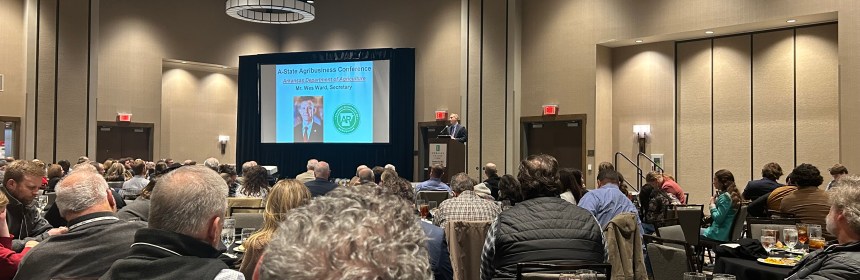
Keynote speaker, Arkansas Department of Agriculture secretary, Wes Wardaddresses water infrastructure, food insecurity and trade initiatives at the Agribusiness Conference. Photo by DDNS Reporter Shailey Wooldridge.
Agriculture officials at Arkansas State University predict a challenging year for Arkansas agriculture. Farmers are expected to face difficulties in three areas: farm economy, agricultural and trade policy, and commodity markets.
Bert Greenwalt is a professor of agricultural economics at Arkansas State University. He said Arkansas agriculture is facing headwinds this year as farmers struggle with commodity prices decreasing over past years while farm input prices have declined very little.
“Farmers are in a cost-price squeeze situation, as it’s referred to, low profitability, struggling to make ends meet and looking to government, farm policy, the farm bill for some assistance,” Greenwalt said. “Unfortunately, our Farm Bill expired a couple of years ago and Congress has yet to address updates in the farm bill that would address the current situation.”
The Farm Bill is federal legislation passed by Congress governing various agricultural and food policies. It’s passed approximately every five years and covers a wide range of topics, from farm subsidies to food assistance programs. The bill affects farmers, ranchers, rural communities, consumers, and the environment.
“Agriculture is a cyclical business. Historically, there are ups and downs, like in some other businesses, and so we’re going through that downturn down cycle right now,” Greenwalt said. “Agriculture will continue to be an important industry in the United States and globally, but not all producers will remain in the industry over time.”
Greenwalt said one of the factors contributing to uncertainty in the agricultural economy today is the shifting trade policy in Washington. Since U.S. agriculture relies heavily on export markets, any disruptions, such as tariffs or trade wars, that affect trade or access to global markets are a significant concern for the industry.
“Farmers this time of year are making many plans for the coming year, what to plant, how to renew their lines of credit with lenders. So hopefully, some of this information will be useful to them as they complete their business planning for the season,” Greenwalt said.
Greenwalt is the co-founder and director of the annual Agribusiness Conference at Arkansas State University, which was held earlier in February. Keynote speaker at the conference Wes Ward addressed water infrastructure, food insecurity, and trade initiatives.
The Arkansas Department of Agriculture (ADA) secretary highlighted problems with water and wastewater systems across the state, including broken systems that have made it hard for people to access clean water.
He also addressed a decline in groundwater levels and the importance of ensuring enough water for irrigation in agriculture, which is crucial for the state’s economy.
“In August last year, we signed an executive order to update the state water plan. The deal is a comprehensive way to look at the needs for water resources throughout the state, both short term and long term,” Ward said. “Right now, there’s about $13 billion in water and wastewater infrastructure needs that impact every single one of us throughout the entire state.”
To address this, he said the state is working on two large irrigation projects to shift water use from groundwater to surface water for agriculture in eastern Arkansas. This will help ensure farmers have the water they need to grow crops.
In 2023, the USDA ranked Arkansas the worst state for food insecurity. Ward said the ADA staff is working to address this.
“A lot of what we’re focusing on this legislative session is just efficiency. We are working a lot about ensuring we’re working on food insecurity issues, but more so trying to identify and correct inefficiencies in government,” Ward said. “I would just ask if people are aware of issues on the state level, if there are things that we can do differently from an agriculture department, please don’t hesitate to visit us.”
Ward said there have been discussions about improving trade relations and access to markets for U.S. agricultural products. The ADA is working with NASDA and USDA to overcome barriers in international trade.
In January, a group from several U.S. states, including Arkansas, Montana, South Dakota, and Connecticut, traveled to India. Ward said the trip aimed to help open markets for U.S. agriculture, tackle trade challenges, and advocate for U.S. farmers.
“We can have a long conversation about India and what that might mean, but India’s the most populated country in the world; hopefully, in the future, there will be some good market opportunities, “ Ward said.
Haleigh Jackson, a graduate student majoring in Agriculture Business and Economics from Leachville, Arkansas, said staying current on agricultural issues and policy is crucial because they affect everyone in the farm sector.
“Agriculture touches everything,” Jackson said. “I think it’s good for everybody to come and learn about the things they use in everyday life.”
Scott Adams, land manager for Adams Land Company in Leachville, Arkansas, and owner of Buffalo Island Farms in Manila, Arkansas, has attended this conference for the past 19 years.
“The major take from it is, we’re going to have to get creative on restructuring entities, market, our crop during rallies, watch our inputs, where we can watch our inputs and just mind the situation and do our best to weather the storm if this is what we’re going to continue to try o do,” Adams said. “My biggest concern is the family farmer going away, smaller farms being dissolved into bigger farms, and it affecting our direct economy.”
JONESBORO — The seventh annual Living Legends Awards will be held at Arkansas State University to honor five new recipients as well as honor two individuals posthumously.
The ceremony honors those who have enriched the community, excelled at their fields, and inspired younger generations.
This year, honorees include the following:
Dr. Jenifer Rice-Mason retired from A-State in 2020 after serving more than 40 years where she led the department of Access and Accommodation Services.
Dr. Wilbert Gaines, an emeritus professor of physical education, was one of the first Black professors on campus. During his tenure he taught countless numbers of students and helped guide them to success through his work in the classroom and with campus organizations.
Shamal C. Carter, has spent his career working in the non-profit sector, volunteering in the community, and serving on various boards to benefit Jonesboro residents.
Dr. Nikesha Nesbitt is dean of the University College at A-State. She is part of several committees on campus and in the community.
Jervonne Newsome is an A-State graduate who remains the highest-ranked moot court competitor in university history. She works as a partner at a law firm in Dallas.
Legacy Awards will be presented to the families of two late members of the community:
Rennell Woods was an A-State graduate and a longtime member of the Jonesboro community. He was a licensed minister and received numerous accolades due to his giving nature.
Tierre Hamilton, a 2005 A-State graduate, was part of Kappa Alpha Psi where he provided metorship and support for others. He was known for volunteering and being an active member of the community.
“Selections are made by a committee and are based not on the quantity of nominations but the quality of the submitted nominations. We deliberate on both the A-State influence and the impact the nominee has made on the community,” said Ian Buchanan, Living Legends committee chairman.
“This event shines light on those who may not get it elsewhere. It also shows students that the impact they make can be legendary in the future. We believe this honor and distinction help recognize the work and footprints that are sometimes not noticed or given their proper due,” Buchanan added.
This event is held in conjunction with events at A-State for Black History Month. The Multicultural Center oversees the month of activities with the assistance of campus employees and student organizations.
The Arkansas Dr. Martin Luther King Junior Commission partners with the Dr. Martin Luther King Junior Commission in Nevada. This partnership bridges the most active commission in the nation (Arkansas) and the world’s largest Dr. Martin Luther King Junior parade in Las Vegas. The parade in Las Vegas started in 1981 and has attracted commissions from across the nation to Las Vegas for the parade.
As part of the work done in Nevada around the celebration of the late Dr. Martin Luther King Junior, a technology summit is held annually to inform freshman through high school seniors about job opportunities. The technology summit was started seven years ago by Duana Malone, known as the Tech Queen.
“We wanted to serve by letting students know about the technology opportunities available,” says Malone. “This was especially important for outreach to go toward students who are in underserved and underrepresented communities. Back then, students did not know about high-tech opportunities, robotics, and other areas. We want to ensure that today’s students know about all available technological opportunities”.
Malone said that when the community started learning about the technology summit, it grew exponentially. One challenge was finding a space large enough to hold it. The Friday summit was held at Las Vegas City Hall in the city council chambers, which was large enough to hold a couple hundred students from area high schools to learn about technology and jobs.
The Arkansas Dr. Martin Luthe King Junior Commission is one of the most active commissions in the nation. Executive Director of the Commission Dushun Scarbrough has been excited about the partnership between Arkansas and Nevada.
“We have one of the largest days of service on Dr. Martin Luther King, Junior’s Day, and we participate in over 70 activities statewide through the year,” says Scarbrough. Scarbrough has been grateful for the partnership and says the Technology Summit coming to Arkansas will be a game changer. “Just as this did for Nevada, we are going to do the same thing in Arkansas and positively impact the children in Arkansas.”
Malone expects to be in Arkansas later this year to help with the establishment of a technology summit in Arkansas. More details on the technology summit in Arkansas will be released as soon as everything is finalized.
JONESBORO – Several events will take place around Jonesboro and the Arkansas State University campus to honor the life and legacy of Dr. Martin Luther King Jr. as part of the annual NEA Dr. Martin Luther King Jr. celebrations.
The NEA Dr. Martin Luther King Jr. Day Parade Committee will host a youth program kickoff at 4 p.m. Sunday, Jan. 19, at the Jonesboro High School Performing Arts Center, 301 Hurricane Drive.
“This program will highlight the voices and talents of our youth, fostering the next generation of leaders inspired by Dr. King’s values,” said Ashley Wilson, committee co-chairman.
The community is invited to attend and celebrate the legacy of the civil rights leader.
The festivities will begin at 10 a.m. on Monday, Jan. 20, with the annual Martin Luther King Jr. Day Parade. The parade will start at the Lt. Col. Frederick Turner Jr. Military Science Building on the A-State campus.
It will depart the military science building, travel up Marion Berry Parkway to Johnson Avenue, proceed down University Loop, and conclude at the Fowler Center.
Performances from the Forrest City High School Band, Osceola High School Band, Jonesboro High School Steppers, and Drumline will be featured during the parade.
“We encourage community organizations to bring banners and participate in the parade to showcase their commitment to Dr. King’s vision of freedom, justice and democracy,” said Wilson.
Following the parade, the public is encouraged to gather at noon at Fowler Center, 201 Olympic Drive, for the 23rd annual Dr. Martin Luther King Jr. Day celebration.
The theme for the program this year is “Mission Possible: Protecting Freedom, Justice & Democracy in the Spirit of Nonviolence.”
Jonesboro native Jervonne Newsome will serve as the keynote speaker for the event.
“As a licensed attorney, minister and community advocate, Elder Newsome will deliver an empowering and thought-provoking message aligned with Dr. King’s mission of unity and social justice,” said Wilson. “The program will also feature inspiring performances, reflections on Dr. King’s legacy, and a call to action for continued community activism.”
Jonesboro Mayor Harold Copenhaver and A-State leadership will also speak during the program.
Dr. Carlitta Moore, vice chancellor for access and institutional engagement, says it’s a time to unite, reflect and carry on Dr. King’s vision.
“We are thrilled to be able to embark on this wonderful opportunity bringing together our community in partnership with Arkansas State University while honoring and celebrating the enduring legacy of Dr. Martin Luther King Jr. This event not only serves as a chance to gather and strengthen bonds, but to reflect on the vision of Dr. King. Together, we look forward to creating a meaningful and inspiring experience which will continue to realize his ideals and ignite our shared values,” said Moore.
Officials with the Arkansas Martin Luther King Junior Commission will celebrate the King Holiday in both Las Vegas and Arkansas, honoring the legacy of the late Dr. Martin Luther King, Jr. The Arkansas Martin Luther King, Jr. Commission is recognized as one of the most active commissions in the nation. In recognition of the service of the Arkansas Commission, an invitation was extended for the Arkansas Commission to come to Las Vegas to participate in the world’s largest King Holiday Parade, which occurs on Monday, January 20.
The national partnership will bring the MLK Tech Summit to Arkansas, introducing high school students to technology careers. The Las Vegas City Council will also honor the Arkansas Martin Luther King Junior Commission for its work, with a special salute from the city of North Las Vegas and a presentation of the city’s key.
Some of the events that will occur in Las Vegas involving the Arkansas Martin Luther King Junior Commission include:
The Ultimate Measure of a Man at the West Las Vegas Library on Thursday, January 16
The 7th Annual MLK Tech Summit at the Las Vegas City Hall on Friday, January 17
The Interfaith Service at the Nehemiah Ministries Christian Church in Las Vegas on Friday, January 17
43rd annual Dr. Martin Luther King, Junior Scholarship Banquet at the Orleans Hotel and Casino, Las Vegas, Friday, January 17
43rd annual Dr. Martin Luther King Junior Parade in Downtown Las Vegas on January 20
Additionally, the Executive Director of the Arkansas Martin Luther King Junior Commission, Dushun Scarbrough, will be recognized for his work with the commission. KASU and DDNS will cover these events from Las Vegas across multiple platforms starting Friday, January 17th, and running through Monday, January 20th.
This year’s events theme is “Living the Dream: Honoring the Past, Embracing the Future.”
Story by DDNS Reporters Shailey Wooldridge and Jerry Burton
Photo by Jerry Don Burton, DDNS
In its final meeting of the semester, the Student Government Association (SGA) reflected on the work accomplished, including passing a resolution to create a committee for a housing scholarship at the Nov. 20, meeting
Micayla McGowen, SGA president and a senior marketing major from East End, Arkansas, said she is very thankful that they are finally having a good conversation about the housing scholarship.
Louis Gonzalez, a sophomore biology major from Kansas City, Missouri, said the recently passed housing scholarship committee resolution has the potential to help many people.
“I fought so hard for just the scholarship committee. I would say that out of everything I’ve done this semester, it is probably the most rewarding one because I can continue to work with that, and it can turn out to be something big,” Gonzalez said.
McGowen said SGA is still determining the right direction for the housing scholarship, but she hopes students will see more progress and impact from it next semester.
Gonzalez said he plans to continue working on the housing scholarship during the Spring semester.
“If I don’t do it, nobody else will, so I’m most definitely behind that. I’m rooting for that so it doesn’t get abolished,” Gonzalez said.
Gonzalez said students can expect progress when it comes to the housing scholarship next semester, but it probably wouldn’t be active for another year because there is a lot of foundational work that needs to be put in.
Gonzalez said the next steps will be finding donors, forming a scholarship committee, and adding a subsection on the SGA website with scholarship guidelines. He said there is no concrete plan yet on how to get donors for the scholarship, and some senators still oppose the scholarship committee.
“It’s gonna take some time to build up some confidence from the senate and the senators to have a functioning scholarship committee,” Gonzalez said. “If I’m not working on it constantly and making consistent progress, I believe it might end up like the previous housing scholarship, abolished.”
Micayla McGowen, president of SGA and a senior marketing major from East End, Arkansas, said the resolution passing is excellent news because it means SGA is moving in the right direction to make a substantial impact.
“Considering that this is something that has started, I want to say, fall of 2023, this is honestly fantastic,” McGowen said. “It’s getting to a point where we’re going to make some progress, and there’s going to be something that actually happens now.”
Gonzalez said he thinks the reason the resolution didn’t pass unanimously is that some senators believe the scholarship will be detrimental. He said this is because the former housing scholarship resolution proposed pulling from the SGA budget.
“We formed it this way, so it’s not taking anything away from SGA. Rather, it’s just giving to the student body,” Gonzalez said. “It’s a donation-based scholarship, so we’re hoping for donations from alumni and local businesses, which we can give to students.”
McGowen said the resolution was well-written when initially proposed and that Gonzalez did a great job ensuring the resolution had content that would benefit students in need.
The SGA president said she hopes the scholarship committee will help the SGA find a solution for students struggling to pay for housing. This issue has become prominent over the past year, so she is glad SGA is making progress toward helping these students.
Chauncy Betts, a sophomore strategic communications major from McGee, Arkansas, is one of the senators who helped create this resolution.
Betts said he helped Gonzalez with the resolution’s grammar and content. He said they thought a lot about how future senators would react to the resolution, and he is happy it was passed.
“We have all worked on it for a long time, but especially Louis, he’s very passionate about SGA and this scholarship resolution,” Betts said. “College can be costly, and many students now tend to continue to live on campus. So, this resolution will help decrease the amount the students will have to pay.”
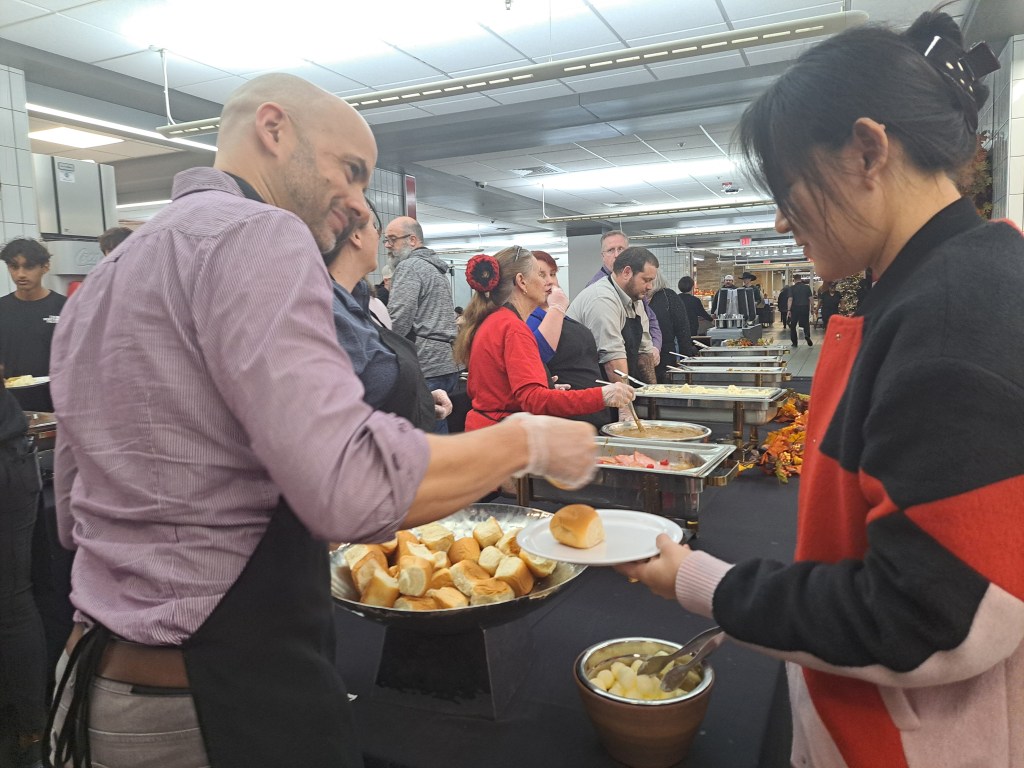
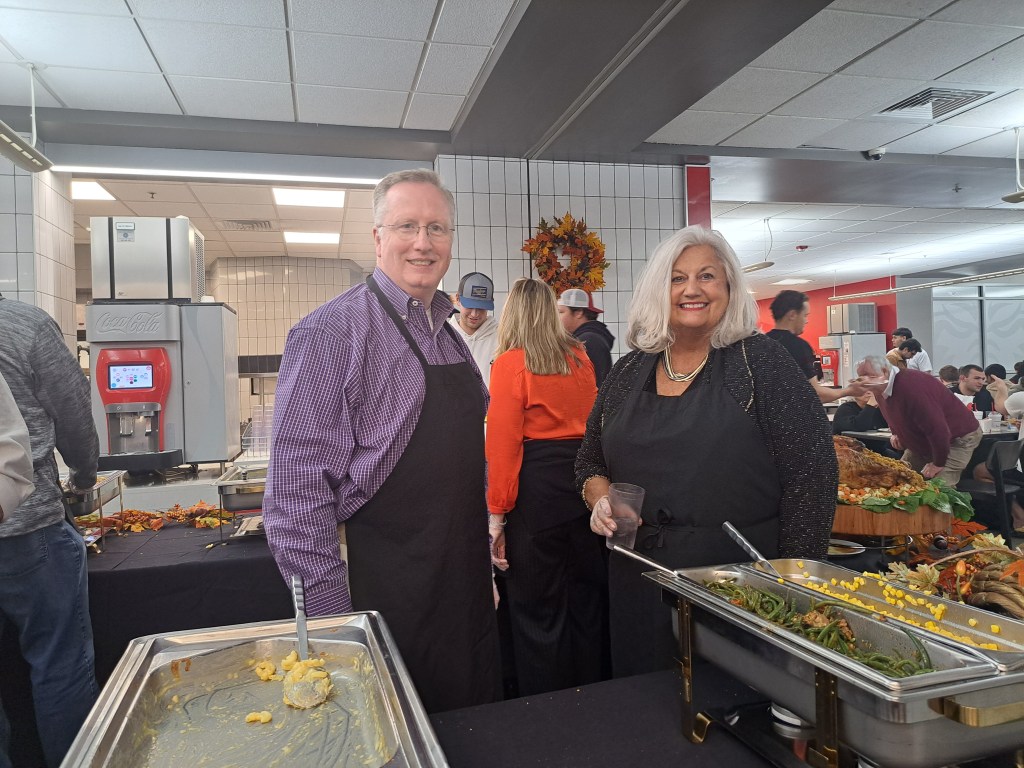
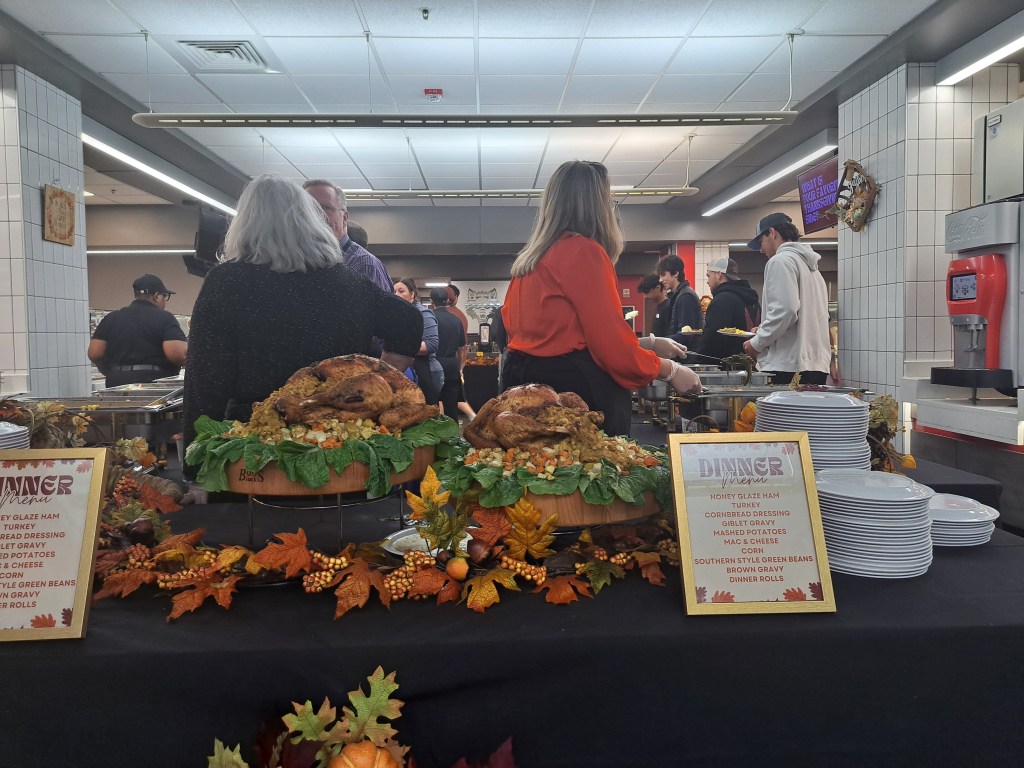
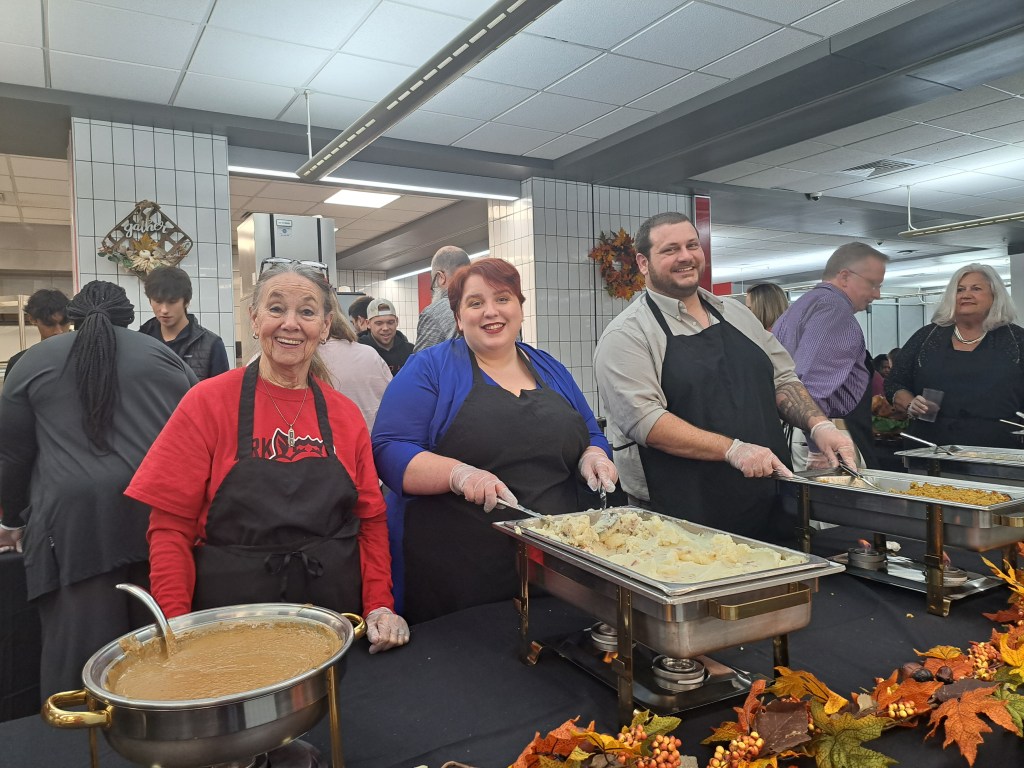
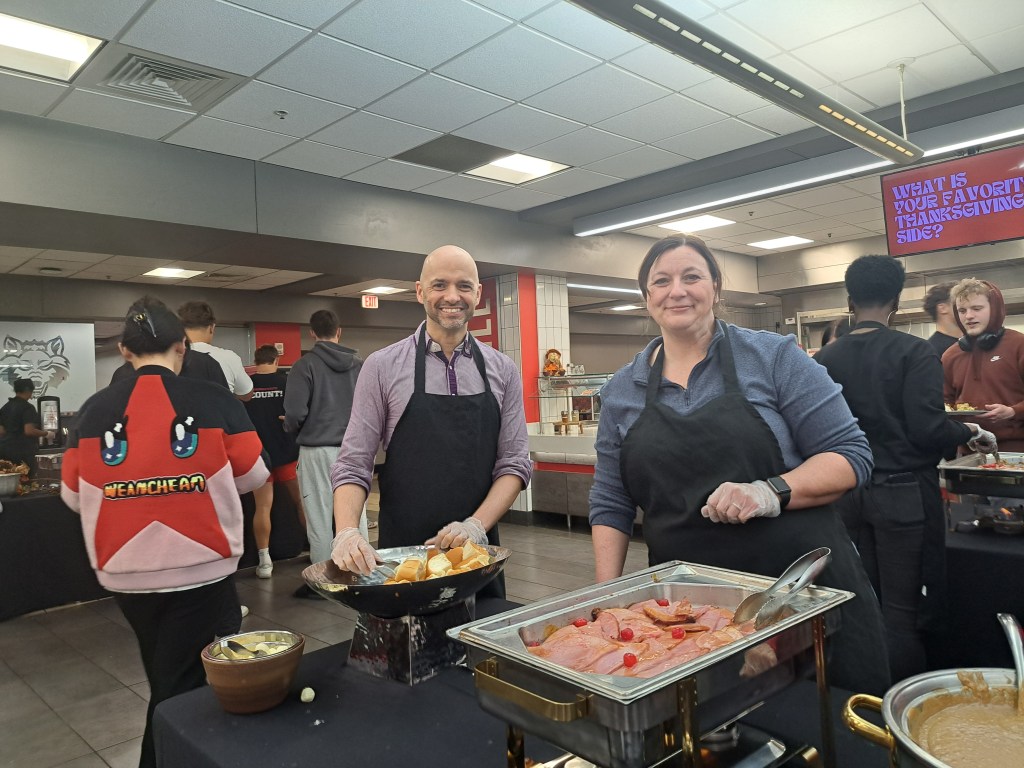
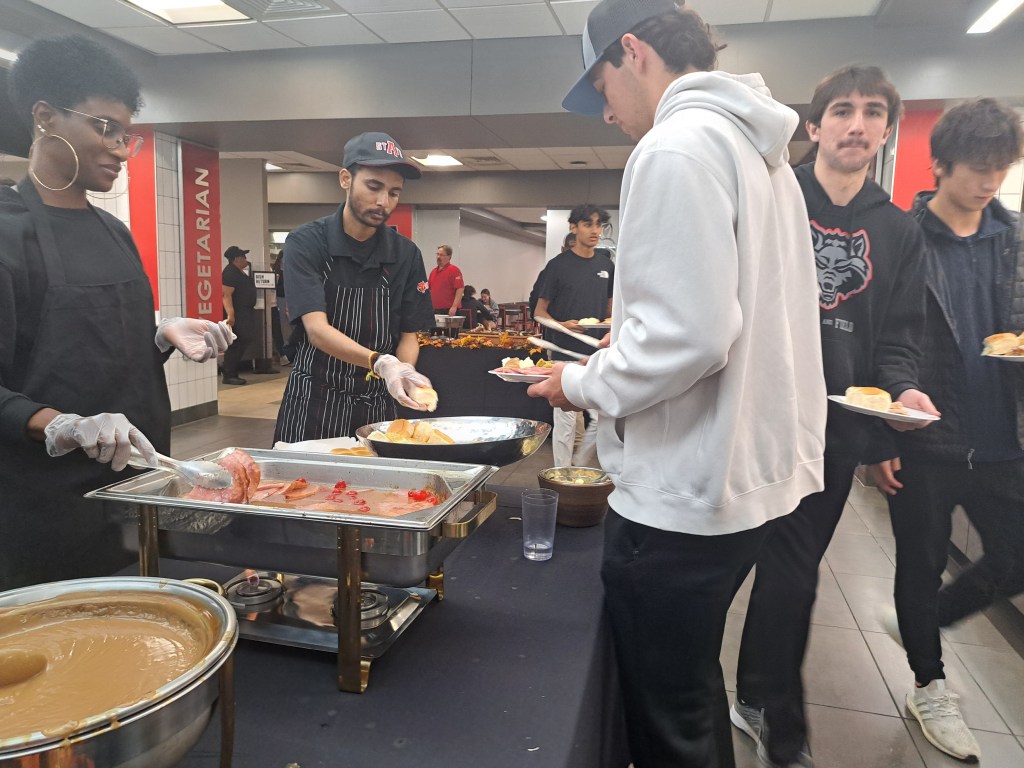
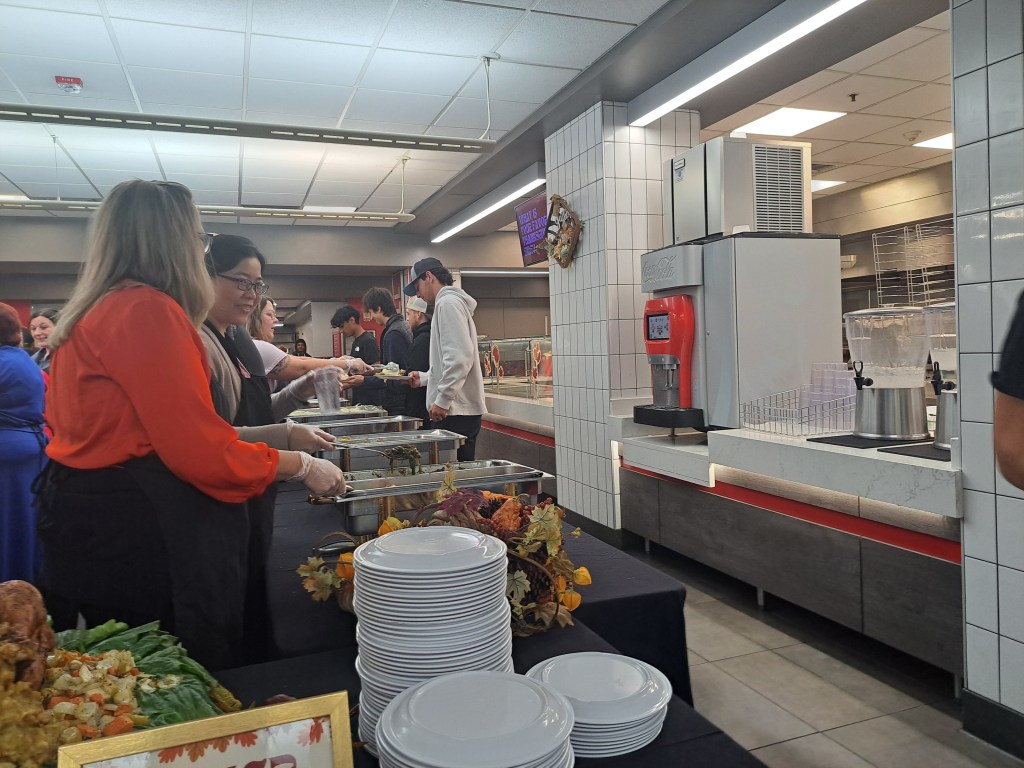
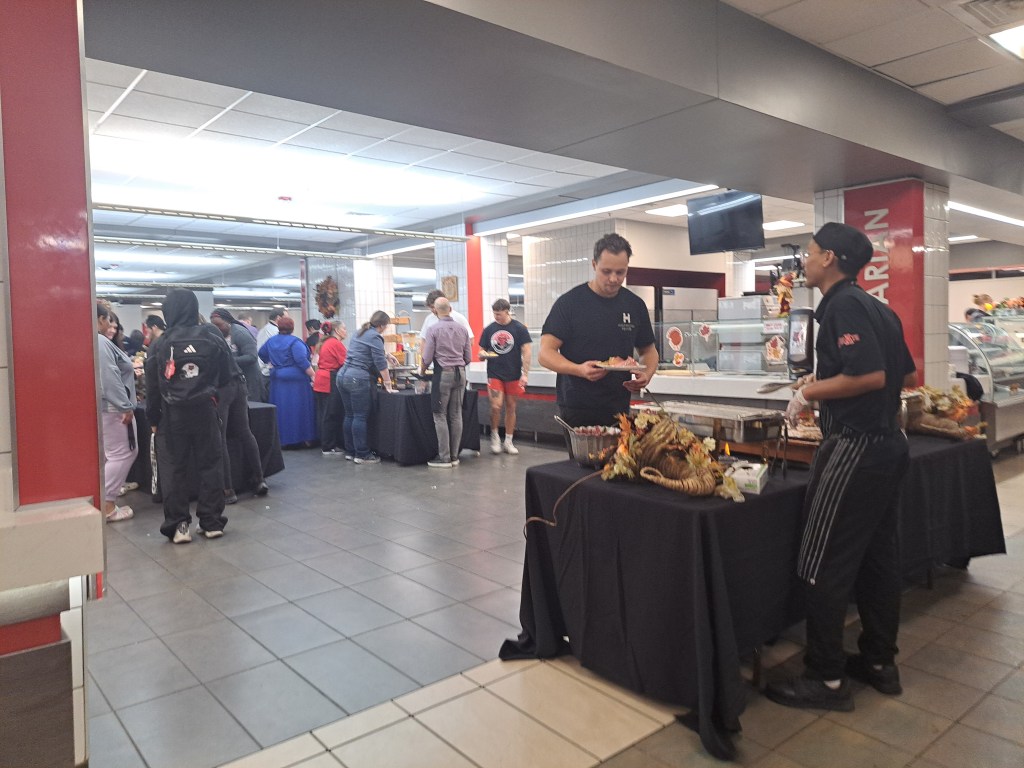
Arkansas State University held the annual Thanksgiving dinner in the Acansa Dining Hall Wednesday.
Craig Johnson, assistant vice chancellor for auxiliary services and volunteer coordinator for the Thanksgiving dinner, said the event provides for faculty, staff and students alike.
“For faculty, this gives them interactions outside of the classroom or outside of the offices,” Johnson said. “For our students, it gives them an opportunity to meet with faculty and staff in a different environment. It provides for those folks who can’t be able to go home for Thanksgiving.”
Emily Martin, a first-year nursing major from Viola, Arkansas, attended the Thanksgiving dinner. She said her favorite food served at the event was the macaroni and cheese, while her least favorite was the stuffing. Martin said the food lines never felt slow and the servers were very hospitable.
“We probably got here at a good time, we got in right after the initial people,” Martin said. “I had to go back and get mac and cheese because they were out, though.”
Yurizzia Macias, a first-year nursing major from Little Rock, said the food was great overall. She also said the stuffing was her least favorite food served at the event. She said while the food for the Thanksgiving dinner was being served in the middle of the Acansa Dining Hall, the space never felt claustrophobic and the food lines were never congested.
Johnson said he has helped plan the annual Thanksgiving dinner for 27 years. He said it was harder to find volunteers in the early 2000s. This year, Johnson said he had to turn people away because so many wanted to help.
The volunteer coordinator said he sent an email at 9 a.m. asking faculty and staff to help with the event and by 9:19, the first shift of volunteers was already full.
43 volunteers comprising faculty and staff members helped serve food at the event. Johnson said volunteers receive no formal training other than guidance on giving equal food portion sizes to students.
“We really just put an apron on, put gloves on and say ‘serve’”, Johnson said.
The volunteer coordinator said 100 students were already through the line in only the first half hour of the event. He said he thinks the volunteers served about 600 to 650 students during the event.
Johnson said it was fun to see a full cafeteria again. He said A-State is still rebounding from COVID-19, which caused a drop in the on-campus student population
“I consider a place like this to be the heartbeat, where folks have the ability to engage and interact,” Johnson said.
Macias said she thinks the Thanksgiving dinner will have a positive impact on students, especially those who won’t be able to go home or see their family during Thanksgiving or Christmas break.
“If they see how it is all family-friendly, they will be more motivated to stay here,” Macias said.
Johnson said he hopes the Thanksgiving dinner provided a warm holiday experience for students who cannot travel home while on break.
“I don’t think you can ever replace what it means to go home, we just can’t match that,” Johnson said. “But it does give that holiday feeling that you have during Thanksgiving.”
Johnson said since Thanksgiving is a holiday based on American history, some international students may not celebrate it. He said this event still serves to give these students another taste of American culture and what the holiday is all about.
Martin said while she enjoyed the event, she did notice areas that could be improved. Martin and Macias said having another table for serving food would have helped students get more food. Five volunteers couldn’t attend the event to help because they had the flu. Johnson said their absence didn’t affect the event very much because he probably had more volunteers than he needed anyway.
Johnson said he would like to see more food options served next year when the event is held again. He said he told the head of operations for the event he would particularly like to have candied yams available for students next year.
Macias said she would be interested in coming to the same event next year and similar events in the future.
JONESBORO – The Department of Military Science at Arkansas State University will induct three new members into the ROTC Hall of Heroes at the 28th annual ceremony, announced Lt. Col. Morgan Weatherly, professor of military science.
The induction will start at 9 a.m. Saturday, Nov. 23, in Cooper Alumni Center, 2600 Alumni Blvd.
The three to be honored with the prestigious recognition are Albert (Al) G. Martin, former Captain (Promotable), U.S. Army; Robert A. Barker, retired Colonel, U.S. Army; and Jerry W. Cheatom, retired Lieutenant Colonel, U.S. Army.
Following the ceremony, placards will be hung in the Hall of Heroes by the inductees. The honorees also will be recognized during halftime of the 2 p.m. Red Wolves football game against UL-Monroe at Centennial Bank Stadium.
All three are alumni of the ROTC program in the A-State Department of Military Science. Here are the profiles of this year’s inductees:
Albert (Al) G. Martin, Captain (Promotable), U.S. Army Special Mission Force, Strategic Technical Directorate Assistance Team-158
Former Captain (Promotable) Al Martin is a native of Helena. In 1969, upon graduation from A-State with a degree in political science and as a member of Tau Kappa Epsilon fraternity, he was commissioned as a Distinguished Military Graduate into the Active Duty force as a Military Intelligence officer.
2nd Lt. Martin attended his MI Officer Basic Course and volunteered for Airborne and Special Forces training. As a lieutenant, he served with the 6th and 5th Special Forces Group (Airborne) at Fort Bragg, N.C. While there, he earned his Green Beret and completed U.S. Army Ranger School and Vietnamese language school prior to his deployment to Vietnam.
In Vietnam, 1st Lt. Martin served with Special Mission Force, Strategic Technical Directorate Assistance Team-158. SMF had a classified mission of POW, MIA, and Downed-Pilot Recovery. They also ran other non-classified company and platoon-size operations. SMF was composed of 124 indigenous mercenary Montagnards, 41 of which were in 1st Lt. Martin’s platoon.
Upon redeploying to the states, 1st Lt. Martin attended his MI Officer Advance Course and was promoted to captain. He then attended flight school to receive a rotary and fixed-wing pilot rating at Fort Rucker, AL. His follow-on assignment was with the First Army Security Agency Aviation Company (CEFIRM Leader) as the operations officer at Ft. Bliss, Texas. The unit flew modified U-21 aircraft with direction-finding, signal intelligence, and radio signal jamming capabilities.
Capt. Martin was reassigned to the 25th Infantry Division, 3/4 Cavalry at Schofield Barracks, Hawaii, as a rotary-wing pilot. Following his tour in Hawaii, Capt. Martin resigned his commission and began a 42-year career as a commercial real estate agent, in Honolulu, and Austin, Texas, retiring in 2019.
His awards and decorations include the Special Forces tab with Green Beret, Ranger tab, Combat Infantryman Badge, Aviator Wings, Senior Jump Wings and Jumpmaster Qualification, Bronze Star Medal, Air Medal (numeral “2”), Army Commendation Medal (1 OLC), Vietnam Service and Campaign Medals, Vietnam Cross of Gallantry w/Palm (Unit), and National Defense Service Medal.
Martin is a 100% Disabled American Veteran living with his wife, Joyce, in Austin. They have three children, and they now engage in Christian ministry and travel.
Robert A. Barker, Colonel, U.S. Army Chief of Staff to the CG, Fort Gordon And Cyber Center of Excellence
Retired Col. Barker is a native of Jonesboro. In 1985, he was commissioned through the A-State ROTC program with a reserve commission as an Army Signal Corps officer. He graduated Arkansas State in 1986 with a degree in mechanical engineering.
Col. Barker was the Distinguished Honor Graduate of his Signal Officer Advance Course. He also completed Command and General Staff College (2000)—receiving an M.S. in computer resources and information technology (Webster University); the U.S. Army War College (2009)—earning an M.A. in strategic studies, and the U.S. Army War College Senior Leader Seminar (2014).
Col. Barker’s notable assignments include Operations Officer, Theater Communications Control Cell (TCCC) (Fwd), Dhahran, Saudi Arabia. As part of an eight-person Army cell operating at Khobar Towers in Dhahran the night of the Khobar Towers bombing, he was instrumental during recovery operations and the reactivation of the operations center after the terrorist attack. In 2004, he commanded the 63rd Signal Battalion during combat operations in Iraq. In 2008, Col. Barker was tasked to deploy to Moscow, Russia, in support of a Joint Operation’s exercise with the Russian General Staff to develop a working relationship with Russia for future joint operations. He served as the director, Concepts, Requirements, and Doctrine Division (CRDD) and the director, Capabilities Development Integration Division (CDID) of the Signal Center of Excellence, and was the garrison commander at Ft. Gordon, Ga. Col. Barker retired in 2016 as the chief of staff to the Commanding General Cyber Center of Excellence (CCoE) and Ft. Gordon, where he was directly involved in the activation of the CCoE, Cyber School, and the new command and control, and training facilities for Ft. Gordon to support the transition to Cyberspace Operations and the move of Army Cyber Command to Ft. Gordon. He wore the uniform for over 30 years.
His noteworthy awards and decorations include the Legion of Merit (1 OLC), Bronze Star (1 OLC), Defense Meritorious Service Medal, Meritorious Service Medal (1 Silver OLC), Air Force Achievement Medal with “V” Device, Joint Staff Officer’s Badge, and Basic Parachutist Badge.
Col. Barker now resides in Harrisburg with his wife Barbara and two granddaughters, Kya and Aunna. He manages the family business, Brasco Service Inc.
Jerry W. Cheatom, Lieutenant Colonel, U.S. Army Director of Army Instruction, San Antonio Independent School District
Retired Lt. Col. Jerry Cheatom is a native of El Dorado. In 1976, upon graduation from Arkansas State University with a degree in printing technology, he was commissioned as a Distinguished Military Graduate into the Active Duty force as an Infantry officer. A recipient of the Distinguished Service Award, he was also the president of the Black Students Association and a member of Omega Psi Phi fraternity and Scabbard and Blade Military Society.
Lt. Col. Cheatom’s education includes a master’s degree in adult education (Kansas State University) and a master’s in school administration (Trinity University), as well as a doctorate in educational leadership (UT-San Antonio).
His senior level assignments included Space Surveillance Commander, Space Defense Commander, and Chief, Training Evaluations, Standardization, and Exercises, U.S. Space Command, Cheyenne Mountain Space Force Base, Colo.; and professor of military science, Florida Agriculture and Mechanical University, Tallahassee.
Lt. Col. Cheatom has served an additional 22 years in uniform with JROTC as Senior Army Instructor (SAI) at Theodore Roosevelt and Sam Houston High Schools in San Antonio, and as director of Army Instruction for San Antonio Independent School District, where he continues service today. He also served as assistant principal for five years at Roosevelt High. He concurrently serves as a senior counselor for Texas American Legion Boys State and is a member of the Alamo Area, Texas, and National Alliances of Black School Educators. In essence, Lt. Col. Cheatom transformed 21 years of military experience into 27 years and counting of youth mentorship.
His awards include the Ranger Tab, Expert Infantry Badge, Basic Parachutist Badge, Air Assault Badge, and U.S. Army Space Operations Badge.
His civilian awards and recognitions include the North East Independent School District Superintendent’s Award, induction into Phi Delta Kappa Educators Hall of Fame, the Lifetime Achievement Award, Psi Alpha Chapter of Omega Psi Phi Fraternity, National Board of Rocks Incorporated Chairman’s Award for Exceptional Service, and Rocks Incorporated Robert B. Burke Award.
Lt. Col. Cheatom and his wife Judith are the parents of four daughters—Keyna, Amber, Mila and Asante, and five grandchildren—Quinten, Camryn Lane, Grayson, Julius and Cassian.
Photos and story courtesy of Cooper Melder and Tristan Harlen/ASU-TV Red Wolf Roundtable
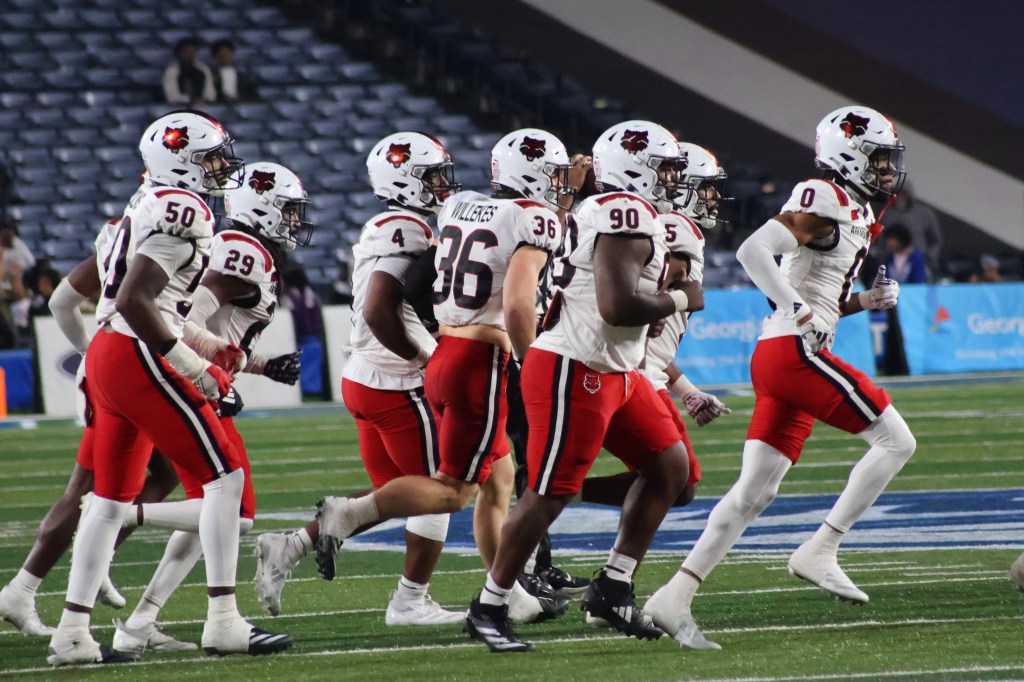
The Arkansas State Red Wolves secured bowl eligibility for the second-consecutive season by defeating the Georgia State Panthers this past Saturday, 27-20, behind a dominate performance by the Red Wolves’ run game. The Red Wolves’ running game would account for 261 total yards of offense and three touchdowns against the Panthers at Center Parc Stadium in Atlanta, Georgia.
With the win, Arkansas State moves to 6-4 on the season with their final two games of the season at home against Louisiana-Monroe and Old Dominion.
A-State quarterback Jaylon Raynor lead the Red Wolves with 97 passing yards and 114 rushing yards on the night. Red Wolves’ running back Zak Wallace lead the team with two touchdowns, while running the ball for 62 yards.
The first half did not start well for A-State as the Red Wolves could not capitalize on a 10-play, 40-yard opening drive as they were stopped on a forth and short distance down to come up empty-handed on their first possession of the game. Georgia State would then take the ball on the ensuing possession and score the game’s first touchdown on a 24-yard pass from Zach Gibson to Ted Hurst, giving the Panthers a 7-0 lead. A-State quarterback Jaylen Raynor would lead the Red Wolves with the ground game late in the first quarter, putting up 58 yards on the ground in leading Arkansas State to tie the game at 7-7 when running back Zak Wallace would also use his running abilities on a 13-yard touchdown with 3:34 left in the first quarter.
A Red Wolves’ interception by Justin Parks would halt an 11-play, 45-yard drive by Georgia State in the second quarter. Parks’ second interception of the season would keep the score at 7-7.
At halftime with the score 7-7, Arkansas State’s offense would only account for 176 yards of total offense and 29 passing yards. Before halftime, Georgia State starting quarterback Gibson would suffer a leg injury and would be replaced by backup quarterback Christian Veilleux.
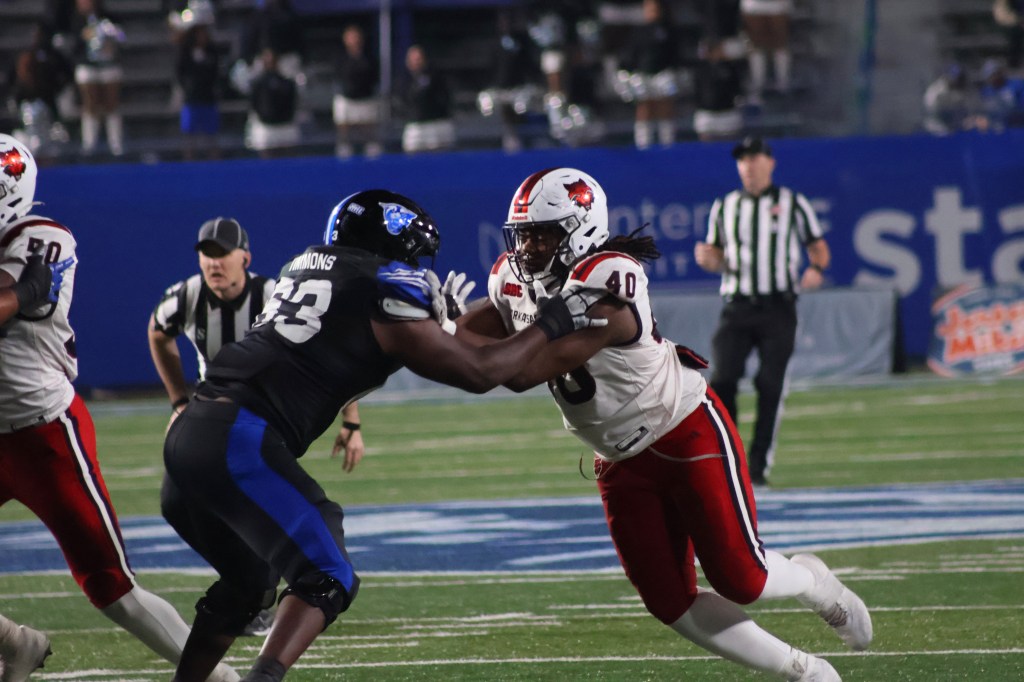
Arkansas State’s defense made key stops to secure the win.
The second half started with Arkansas State’s defense keeping Georgia State from scoring on the opening drive, highlighted by a key stop by Charles Willekes on a fourth and short to halt the Panthers. The Red Wolves would capitalize on the turnover on downs with a Zak Wallace one-yard touchdown to give A-State a 14-7 left with 9:32 left in the third.
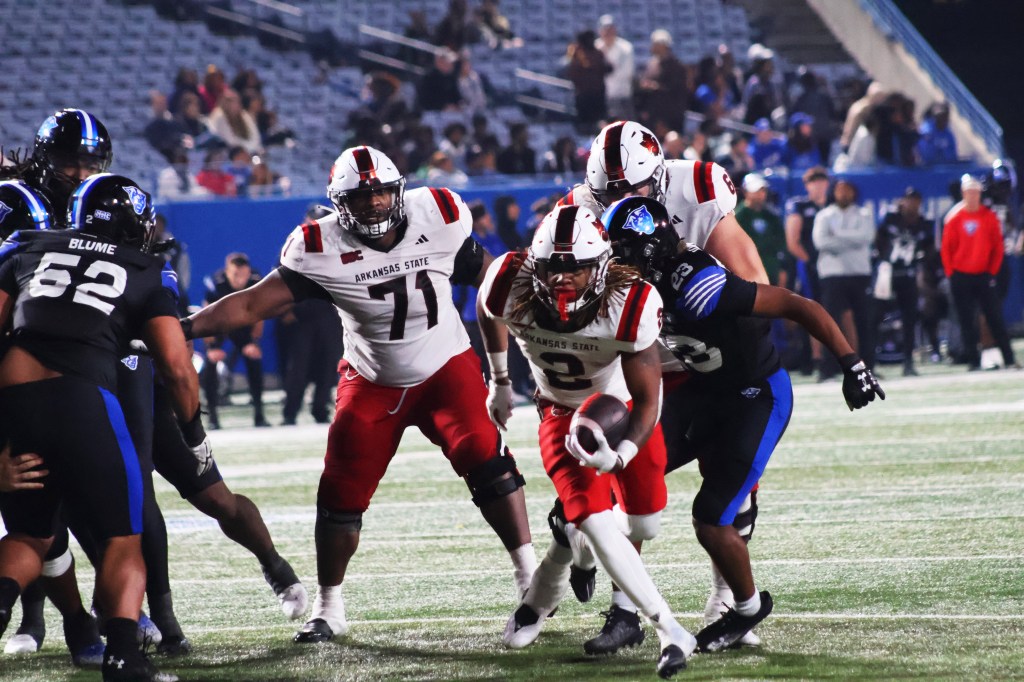
The Red Wolves’ offense would be in sync all throughout the second half, outscoring Georgia State, 20-13 in the third and fourth quarters, to secure the win. Touchdowns by running backs Wallace and Ja’Quez Cross would end up putting the Red Wolves in the win column in Atlanta.
Arkansas State running back Ja’Quez cross on the move.Ja’Quez Cross celebrates after a key touchdown for the Red Wolves.
While Georgia State outgained the Red Wolves in total offensive yards, 419-336, the Red Wolves would out rush the Panthers, 261-73. The A-State defense would sack Georgia State quarterbacks twice and force two interceptions in the win.
The Red Wolves will be back in action on Saturday, November 23, as they take on the Louisiana-Monroe Warhawks at 2 PM at Centennial Bank Stadium.
By Garrett Finnicum for Delta Digital News Service
Garrett: Hello everyone, my name is Garrett Finnicum. Today, we take you behind the scenes with Evan Ellenburg, a senior standout from Ridgefield Christian and a true “Warrior” on the basketball court. With his sights set on playing at the college level, Evan’s journey is about more than just stats. It’s a story of passion, resilience, and leadership.
Garrett: Evan’s commitment to the game goes beyond high school. He is driven by a dream to play college basketball, a goal he has worked towards since he first stepped on the court. This is the next chapter in his story, one he is ready to face with unshakeable dedication.
Garrett: On the court, Evan’s strengths shine through. His ability to sink tough shots and tenacity on defense make him a formidable opponent, but he is also a player who acknowledges where he can grow, always striving to sharpen his skills and refine his game.
Garrett’s question: So, what are some short-term goals that you would like to accomplish before the season begins, or going back to what you were working on during the offseason?
Evan’s answer: Getting stronger is something a lot of teams have pushed us to do, and it’s something I need to be as well.
Garrett’s question: Are there any specific skills you didn’t have last year that you want to improve this year, going into your senior season?
Evan’s answer: I think getting to the rim a lot more, just going in, creating contact, and finishing.
Garrett’s question: So those are kind of talking about your weaknesses. What strengths would you say you have on the court?
Evan’s answer: Shooting. I think I’m a pretty good shooter, and I can see the floor and make the right pass, which I think helps us out a lot.
Garrett: As a senior, Evan has taken on the role of a mentor, guiding younger teammates with a steady hand and a positive example.
Evan: Just telling them what’s expected and showing them, since they don’t have the most experience, and just showing them what to do.
Garrett: At the core of Evan’s drive is a deep sense of purpose. His motivation comes not just from his dreams of college basketball, but from the support of his family, teammates, and coaches. Every practice, every game, is a step towards proving to himself what he is capable of achieving.
Garrett: With his senior year in full swing, Evan Ellenburg is ready to leave his mark for Ridgefield Christian and improve on his individual stats from his junior season, as shown on the screen: averaging 15.3 PPG, 2.8 APG, and 5.3 RPG.
Garrett: He is more than just a player, he’s a leader, a motivator, and a Warrior. The future looks bright for Evan and any team lucky enough to have him will gain not only a talent player, but a true team leader.
JONESBORO – The Women’s Business Leadership Center (WBLC) at Arkansas State University strives to positively impact the lives and futures of young women on campus. The center, founded in 2016, provides many opportunities for ladies attending the university including mentoring, scholarships, internships and other educational opportunities.
“This year has been one of rapid growth and change,” said Dr. Patricia Quinn Robertson Johnston, executive director of the Women’s Business Leadership Center.
Johnston said they have added Gwennette Confer in a new position as director of student engagement and outreach.
“I want to focus on building strong, meaningful connections between students, mentors and the broader community,” said Confer.
Confer said she will work to create and facilitate a wide range of opportunities for student engagement, including leadership academies, mentoring events, conferences, workshops and retreats.
“A significant part of my work will be leading initiatives that connect university students, high school and junior high girls to participate in leadership development at an early stage. Additionally, I will oversee WBLC service projects, ensuring leadership interns gain valuable, hands-on learning experiences,” she continued.
The number of students who participate in the variety of programs offered by WBLC has quadrupled. Students across campus from different majors have been part of programs such as step up, reach back; career readiness; service project “Leadership Interns” and scholarships.
This year, 23 students traveled to New York and 11 students traveled to Atlanta for a conference this month.
“Since 2016 we have provided thousands of hours of mentoring and career preparation for WBLC Leadership Interns who are A-State students,” Johnston added.
The annual Women’s Leadership Conference, which is free for all attendees, usually hosts about 500 people including high school students, college students and professionals.
“I want students to know that the WBLC is a welcoming and inclusive space where they can grow both personally and professionally, regardless of their major. While the center focuses on leadership development, it is open to all students, not just those in business-related fields,” Confer added.
She added that they typically award more than 20 scholarships each year and expect the funding for those scholarships to continue to grow.
More information on the WBLC may be found at AState.edu/wblc.