Story, photos, and video by DDNS Reporter Allie Carson
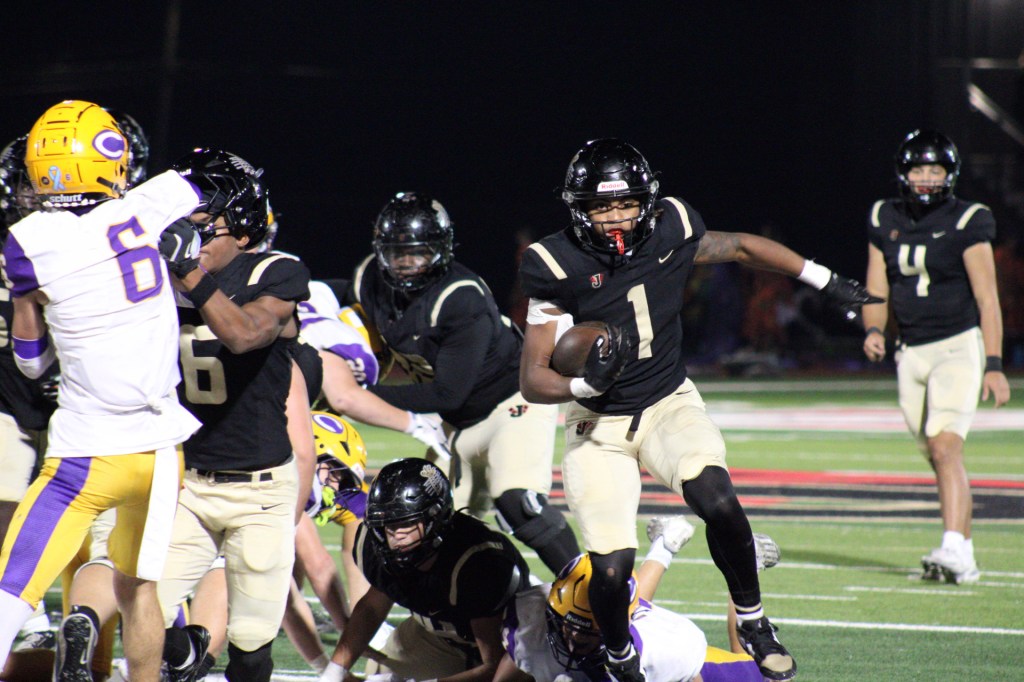
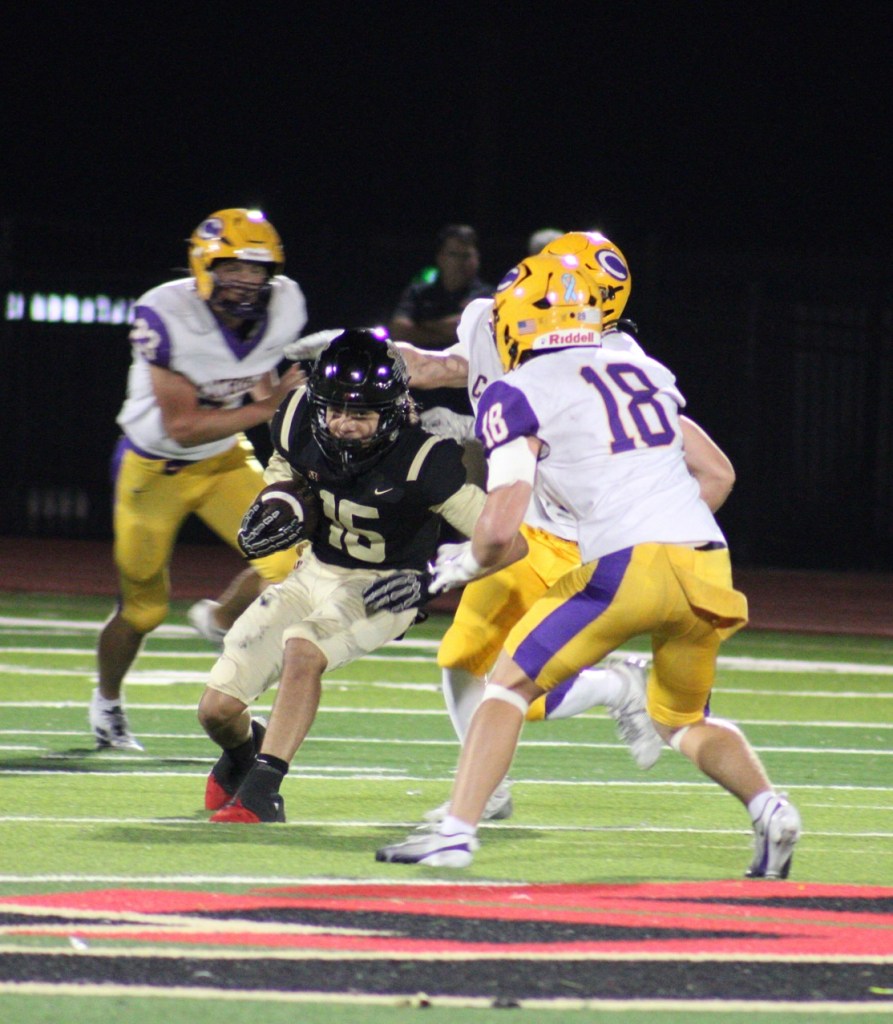
Jonesboro High School running back T.J. Brown scores a touchdown during homecoming. Video by DDNS Reporter Allie Carson.
For Jonesboro’s “Hurricane Hits” Homecoming Week, the Golden Hurricane played Little Rock Catholic after a week of events.
With dress up days throughout the week, a parade on Wednesday followed by the seniors vs juniors and sophomores Powderpuff matchup, a pep rally on Friday afternoon and then a dance following the football matchup against Catholic, the Hurricane schedule was packed.
Hurricane Homecoming celebrated all things music: From hip hop to country to rock to headliners. Just in time for gameday, the Golden Hurricane ended the week off with a black and gold theme.
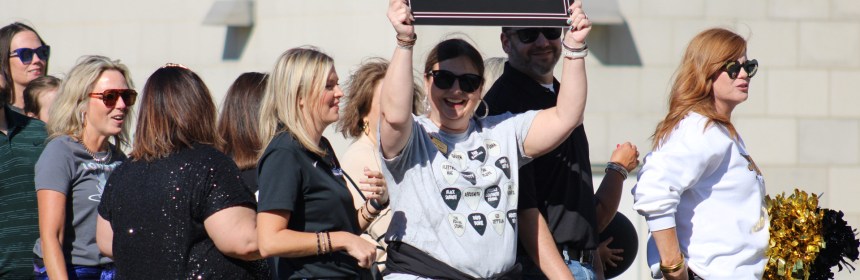
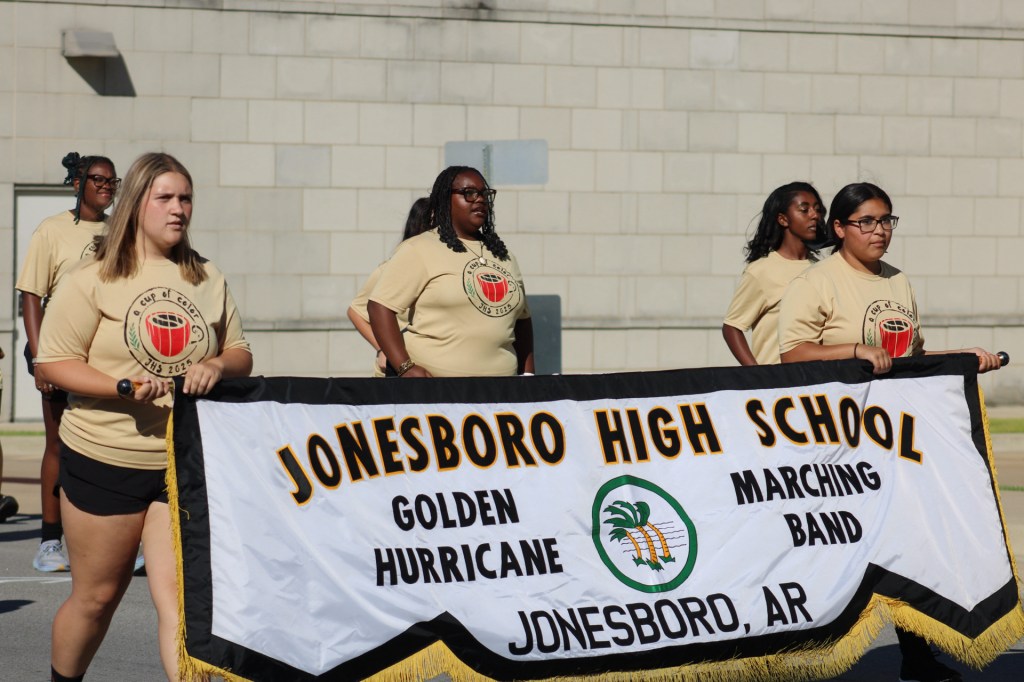
The parade, which took place on Wednesday instead of the usual Friday, blocked off Main Street in Jonesboro for the entirety of Jonesboro Public Schools.
The Jonesboro band led the parade with Cane the mascot not far behind.
Photo by DDNS Reporter Allie Carson.
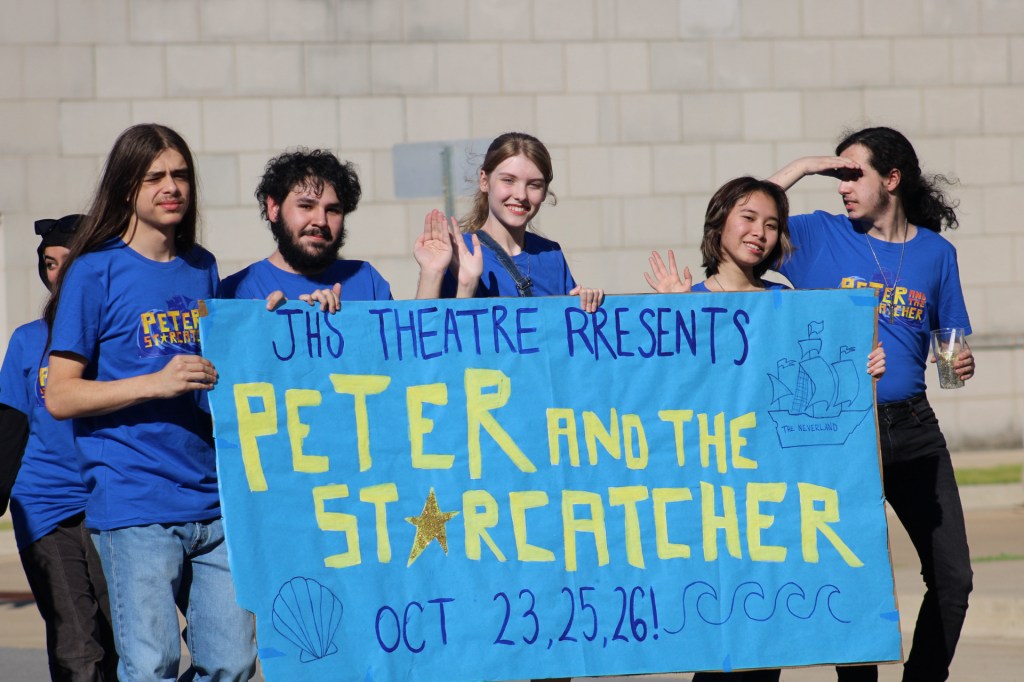
The Kindergarten Center brought their Taylor Swift “Showgirl” themed float, Visual and Performing Arts had a country themed float. The cheer and dance teams walked the route and the Jonesboro High theatre troupe entered the parade and promoted their upcoming play, “Peter and the Starcatcher.”
Photo by DDNS Reporter Allie Carson.
The Homecoming Court wrapped up the parade, riding in style at the end of the route.
Later that day, the senior class took home the victory against the underclassmen in the annual Powderpuff match.
The pep rally would headline the crowning of the Homecoming King and Queen after presenting the Homecoming Court for the second time that week and performances from the Jonesboro band and spirit squads.
Homecoming Day came on Friday with a parking lot full and Hurricane alumni packing the stands, hoping to see a win from their alma mater.
And a win is what the Jonesboro fans got.
Getting their first back-to-back win since October of 2023, the Golden Hurricane played like they had something to prove.
“It’s Homecoming Week. There’s a lot going on. But I thought our kids did a good job of staying focused for the most part. It was a good week of practice and I thought they were ready to come out and perform,” Jonesboro head coach Tyler George said. “We really challenged them. You have people coming back from almost every decade. You have to perform and put a show on for them and they did that tonight.”
After a defensive first quarter where a field goal by Jonesboro kicker Alex Glomski, offense showed more in the second, Catholic scoring a touchdown on their first drive of the quarter off a quarterback keeper.
Jonesboro would score with three minutes to go in the half after running back K’Den Hawkins ran fifteen yards and proceeded to run it in for a touchdown on the next play, giving Jonesboro the lead back going into half.
The Golden Hurricane decided to go for it on fourth and seven on Catholic’s 36 yard line, too far to kick a field goal and too close to feel the need to punt.
It worked out for the Golden Hurricane, however, after wide receiver Jaylen Heard gave them a first down and running back TJ Brown would break free at the five yard line to give Jonesboro another touchdown.
Jonesboro running back T.J. Brown. Photo by DDNS Reporter Allie Carson.
Catholic would have a turnover on downs on their next drive, trying and failing to repeat what Jonesboro had just done.
Jonesboro was given the ball at their 44 yard line but wouldn’t be there for long as on the first play of the drive, Brown would complete a 56 yard run, breaking multiple tackles from defenders, to give Jonesboro his second touchdown of the quarter.
It would go back to defense for both teams for the last four minutes of the quarter. A hard hitting block by Catholic cornerback Walt Menefee against Jonesboro wide receiver Kamari Fisher would give them the ball back.
Jonesboro wide receiver Jamarius Jackson evades Little Rock Catholic defenders during a drive. Photo by DDNS Reporter Allie Carson.
However, an interception by Jonesboro defensive back Clarence Mucherson, his third interception of the year, at the Golden Hurricane 8 yard line would bring in the final quarter of Homecoming Night.
Catholic would score their second touchdown of the night after multiple quarterback keepers by Phillips Blair on their first drive of the fourth would get them to the goal line before Blair would throw to middle linebacker Brock Hatchett for the score.
“We didn’t want the quarterback to beat us,” George said. “He’s a phenomenal player. Can really beat you with his legs and his arm. We lost contain on him but for the most part of the night, I thought we did a really good job at keeping him contained and not letting him beat us with his legs.”
After having the lead be cut to only 14, Jonesboro would run down the clock while getting enough first downs to get downfield and score after a five minute drive. Brown would get his third touchdown of the night on a fourth and three at the goal line.
“I wanted to kick the field. The kids wanted to go for it. Really challenged them. I put my trust in them and they got it. And then they let me know about it after,” George said. “Sometimes you gotta let the kids play, and that’s what we did right there. And it paid off for us big.”
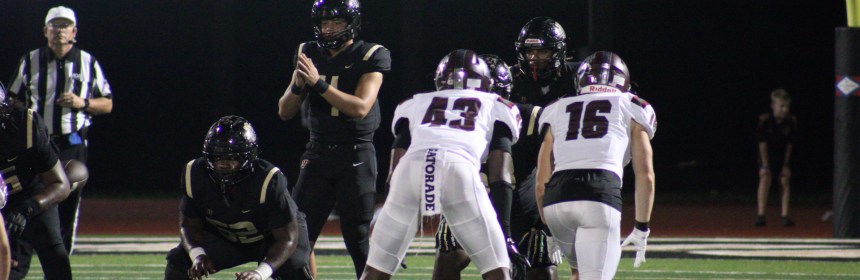
A kickoff return that hit Catholic receivers in the helmet would be recovered by Jonesboro at Catholic’s 21 yard line. However, Jonesboro quarterback Asa Myers would take a knee to end the game, securing a 31-14 victory for the Golden Hurricane.
The Golden Hurricane would improve to 3-3 and 2-1 in conference on Homecoming Night.
Jonesboro moves on to play at Marion on Oct 17 while 2-4 Catholic plays Sheridan at home.
One of the touchdowns Benton scored against Jonesboro. Video courtesy of Allie Carson, DDNS Reporter.
After their first win of the season, the Jonesboro Golden Hurricane stayed at home to face off against Benton, a team they have always fallen short against. This meeting was no different, losing 55-24.
Jonesboro decided to defer to the second half so Benton started with the ball. And a touchdown.
Within the first 12 seconds of the game, Benton quarterback Drew Davis hit wide receiver Karson Collatt for a 55 yard gain to set the Panthers up at the Jonesboro 2. Free safety Gunner Deaton would sneak into the endzone on the very next play for a touchdown.
While running back TJ Brown would bring the Golden Hurricane to the Panthers’ 11 yard line off the kick return, Jonesboro would be forced to kick a field goal.
The Panthers wouldn’t give the Golden Hurricane time to breathe as the next drive ends in another quick touchdown and Jonesboro doesn’t get in good enough field position to score on their drive.
A fumble on Benton’s next drive would push them away from the Jonesboro 37 yard line all the way back to their own 26 yard line. While Jonesboro had all the opportunity to jump or scoop up the ball, they were unable to get under it, causing QB Davis to jump on the ball.
However, Benton wouldn’t be able to do anything on their drive, giving the ball back to Jonesboro.
A perfect slant pass to wide receiver Kameron Davis from Jonesboro quarterback Asa Myers gives the Golden Hurricane team their first touchdown of the night after Davis was given the opening for a 25 yard run.
After a made extra point, the deficit would be cut 14-10 Benton until the Panthers would break multiple tackles on their next drive, scoring their third touchdown of the quarter, the second touchdown run by QB Davis.
The second quarter was off to a slow start until Benton’s ball at the eight minute mark. QB Davis throws the ball up the middle, intended for wide receiver Easton Snellings, but is intercepted by defensive back Jaylen Alexander, his fourth interception of the season.
It’s Jonesboro’s ball at the 41 yard line of Benton. An overthrown pass intended for Jaylen Heard is awarded with a defensive pass interference call, giving the Golden Hurricane 15 yards and getting to the Panthers’ 30 yard line.
Brown would soon have back to back 15 yard runs, giving Jonesboro their second touchdown of the night. A made extra point would bring the Golden Hurricane their edge back, closing the Panthers’ lead to 21-17.
After penalties and breaking tackles, the Panthers scored another touchdown, Jon Curtis Barger breaking through multiple Jonesboro defenders to make it to the end zone.
The Golden Hurricane go into halftime down 28-17 but come out quickly like a second half team.
After a penalty on Benton, Jonesboro started at their own 16. QB Myers launched a deep ball down field into the hands of WR Davis who would catch it just past the Jonesboro 45 and reached the Benton 20, with a horsecaller penalty moving the Golden Hurricane into the Panthers’ 14.
While that early second half touchdown seemed promising for the Golden Hurricane, it’s where they stalled out, not scoring anything else the entire game. Instead, Jonesboro QB Myers would get hurt and taken out of the game early in the fourth quarter for a hamstring injury.
“He’s fine. I was proud of him for battling as long as he did tonight. We’ve got to get him back to 100 percent,” Jonesboro coach Tyler George said. “He’s kind of tweaked it throughout the week.”
Jonesboro would watch as Benton scored two field goals and three more touchdowns, making the 55 points the most the Panthers have ever scored all season.
This would include a 64 yard rushing touchdown by Panthers’ QB Davis, a 57 yard pass to Collatt and even a 49 yard field goal during the last minute of the game.
“Came out of half playing good on defense and it got away from us in the fourth,” George said. “I say it every week. Our kids are gonna continue to fight,”
With the final score being 55-24, this marks Jonesboro’s sixth straight loss to Benton and puts their season record at 1-3 with a game at Sheridan next on the schedule.
Benton would improve to eight straight away game wins and become 3-1 on the season before heading home to play rival Sylvan Hills.
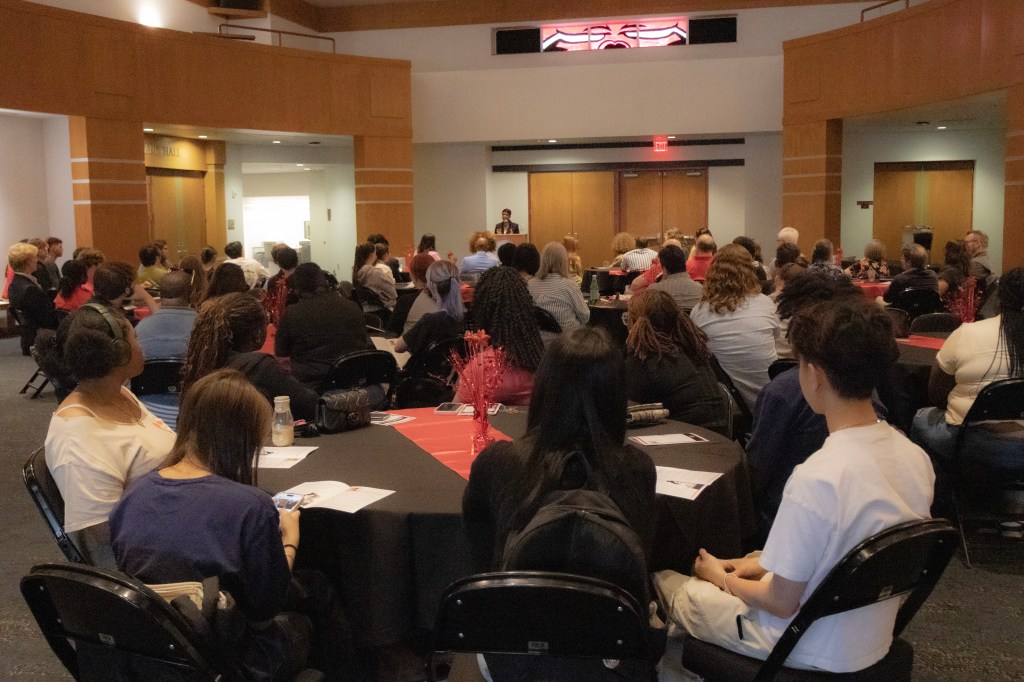
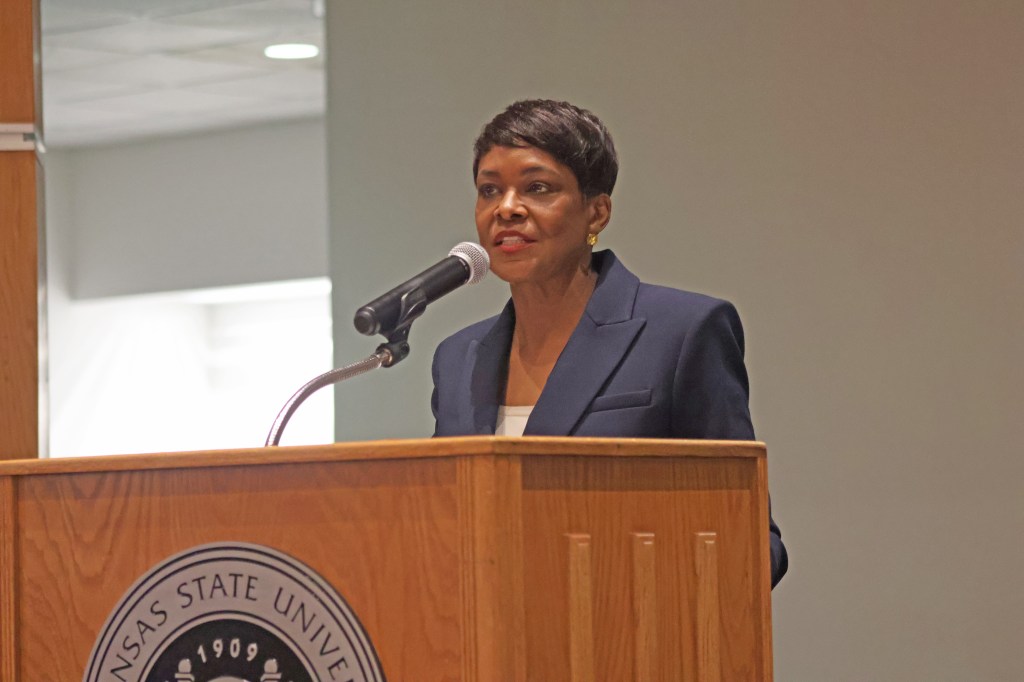
Students, faculty, staff, friends, and other Greenfield Lecture attendees listen to Rose Stuckey Kirk’s speech. Kirk is an Arkansas State University journalism alumna with a successful corporate career spanning 35 years. Photo courtesy of Ibuki Hinohara, Photo Editor, The Herald.
JONESBORO – Rose Stuckey Kirk, an Arkansas State University journalism alumna with a successful corporate career spanning 35 years, presented the annual Corinne Sternheimer Greenfield Lecture, sharing her journey with struggle, support, and success.
Kirk’s speech, titled “From Innocence to Innovation: A Lattice (not Ladder) Climb to the Top of Corporate America,” was given at 6:30 p.m. Sept. 17 in the Fowler Center at A-State.
Audio Story by DDNS Reporter Jerry Don Burton.
At the start of her speech, Kirk listed three things she wished to accomplish: break down the title of her speech, describe how she uses her support systems to have a successful corporate career and suggest how attendees can build on the platform of success she has laid out.
“It struck me a number of years ago that I was never climbing the corporate ladder, because when you are climbing a ladder, you are either going up or down and there are huge gaps in between those rungs and one wrong move, and you can seriously hurt yourself,” Kirk said. “Instead, I was clinging to a lattice. This grid-like structure is flexible and organic; its lines are sometimes diagonal, sometimes curved.”
The Greenfield Lecture speaker said she always made slow and steady progress, despite many missteps and lateral movements. She said that as she climbed, she never forgot her childhood aspirations.
“I never stopped remembering that little girl from Pine Bluff, Arkansas, who just knew one day she would take New York City by storm,” Kirk said.
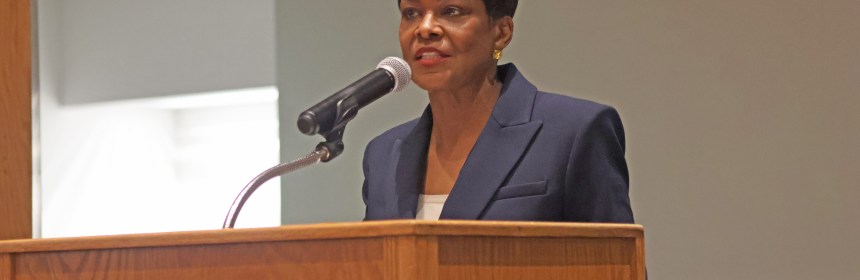
Rose Stuckey Kirk, presents her speech at the 2025 Greenfield Lecture. In her speech, titled “From Innocence to Innovation: A Lattice (not Ladder) Climb to the Top of Corporate America,” Kirk shared her journey with struggle, support, and success. Photo courtesy of Ibuki Hinohara, Photo Editor, The Herald.
Kirk said that while in elementary school, her teacher showed her class a picture of the Statue of Liberty and told everyone to remember what it looks like, because most of them would never make it to New York City to see the statue. She said this stirred something up inside her innocent self.
Decades later, Kirk said she lived in New Jersey and would drive to New York multiple times a week. Every single time the Statue of Liberty came into view during her commute, she said she would pause whatever she was doing and look at it until she could not see it anymore.
Kirk said she does not think her teacher meant any harm, but she would not let her life experiences be based upon what she saw in a book, but instead what she had personally experienced.
“Sometimes in life we look for signs, these big moments of lightning flashing or fireworks to affirm for us those dreams,” Kirk said. “But it’s often the quiet moments, the little things that come into your world that can and will set a path to live your best life.”
Kirk said her strategic mindset and self-reliance, developed from her childhood as one of eight children, helped her succeed as a student at A-State.
Lillie Fears, professor and interim director of the School of Media and Journalism at A-State, said she met Kirk when they were both undergraduates.
“I thought she was very energetic, very outgoing, popular, one of those outgoing personalities. When she said she was an introvert [during her speech], I thought, ‘you sure fooled me,’” Fears said.
Cherisse Jones-Branch, College of Liberal Arts and Communication (CLAC) dean, said Kirk’s status as an alum of A-State and CLAC set her apart from previous lecture hosts.
While hosts for the Greenfield Lecture series are not limited to A-State alumni, Jones-Branch said bringing successful graduates back to A-State to host the Greenfield Lecture is important.
“I like people like that to come back and talk to our students so that they can see what’s possible,” Jones-Branch said. “We saw someone who came from small-town Arkansas, who’s talking to students, many of whom come from small-town Arkansas. The way she was able to connect with them, because they come from the same place, was really special.”
During her time at A-State, Kirk worked at The Herald student newspaper, tutored students and attended a full course load, in addition to working as a clerk for the Social Security Administration. Kirk said college was one of the most impactful times of her life.
“I learned curiosity and how to translate that curiosity into written words that allowed me to explain both simple and complicated issues to the mass population,” Kirk said. “So you can only imagine how amusing it was to me when corporate America began to talk about attributes of successful leaders, and one of those key attributes is that great leaders, often, are great at storytelling.”
Before Kirk could face the corporate world, however, she first had to face rejection.
After graduating, Kirk said her eyes were set on working at the Southwestern Bell Telephone Company, one of the predecessor companies of AT&T. She sent her resume and was served back a rejection letter, stating they only hired people with at least two years of experience.
So, Kirk began work at the Pine Bluff Commercial newspaper. Eight months later, she moved out of state to work for The Times Daily, a set up from her hometown paper. However, she would soon face struggles again.
While working in Alabama, Kirk said she received news of her sister’s death. She said she grieved for weeks and was lost at work, which annoyed all but one of her coworkers.
She said one peer, a quiet man who was a Vietnam veteran, pulled her aside and spent time with her.
“He let me know he saw my suffering. He didn’t pry into my struggle, but instead, he told me a story about his own struggle,” Kirk said. “I learned from him the value of empathy and compassion in the workplace and the need to speak up for others when no one else will.”
Fears said the way Kirk confronted challenges, dealt with tragedy and helped others impressed her. Fears said a friend was having a hard time recently and she did not know how to help beyond listening. But, she said Kirk’s speech touched her and helped her understand what she can do to help in the future.
“It let me know that when I see somebody, it’s okay to reach out and help them,” Fears said.
While working in the journalism industry, Kirk earned awards from the Associated Press and the New York Times. Eventually, she updated her resume and applied again for a position at Southwestern Bell. Within weeks, she was hired.
“Rejection is not bad. What you do with it, how you learn from it, how you respond to feedback, is your choice,” Kirk said.
Even in the corporate industry, Kirk was not free from struggle. She said she spent six months under the leadership of someone who did not believe she was worthy of her position.
John Thompson, a sophomore political science pre-law major from Pine Bluff, Arkansas, attended the lecture. He said struggle was the most important theme Kirk explored in her speech.
“She really didn’t hold back on all the struggles that she experienced in her life. She claims that it did, in fact, shape her, but it shaped her in the best ways possible,” Thompson said.
John Thompson, a sophomore political science pre-law major from Pine, Bluff, Arkansas, asks Rose Stuckey Kirk a question following her speech. Thompson said he will take what he learned from Kirk’s speech about the inevitability of struggle and rejection and apply it going forward in his life. Photo courtesy of Ibuki Hinohara, Photo Editor, The Herald.
Years later, after Kirk said her career surpassed his, she bumped into her old boss. She said he was surprised by how far she had come in her career.
“I thought to myself, ‘my success is based upon my opinion of me.’ There will be many people along the way, for whatever reason, will not be your supporters. Sometimes you can change their minds, many times you cannot. Your goal is to build a massive amount of support in your circle so that non-believers don’t have the votes or the voice to block you.”
Thompson, a CLAC ambassador, said Kirk’s definition of success initially confused him. He said people usually gauge success by comparing themselves to others.
“I think I’m struggling with that concept of success,” Thompson said. “However, I do think that that is beneficial to me, because success really is in you and it is what you want out of this world.”
Carson Campbell, a junior creative media production major from Jonesboro, met Kirk during a breakfast event held before her speech. He said Kirk was very personable.
“She was a very down-to-earth person and very successful, so it was cool for her to come in and spend time with us and try to get to know us before her busy day,” Campbell said.
Kirk said she wanted to exhaust her life of all it has to give.
“When I die, I want the people at my funeral to go ‘yup, she did it. She exhausted this life,’” Kirk said.
Fears, Thompson and Jones-Branch said this phrase resonated with them.
Kirk concluded her speech by addressing A-State students.
“I hope that what you take from this is that you’ve got to believe in this institution. You’ve got to lean into whatever your professors are trying to teach you. You have to take advantage of everything that is here,” Kirk said. “Be flexible, build your lattice, network, be a good person and launch yourself into society in a way that you can make this institution proud and you can be proud that you are a graduate of Arkansas State University.”
Fears said one of the most important messages Kirk touched on is to take advantage of everything being taught in class.
“Even if you’re bored to death, you might be very surprised at how it’s going to help you later,” Fears said. “You can take the skills that you get here and take them to any workplace and keep developing them.”
Thompson said he anticipates rejection in his career and faces struggles already in college. However, he said he will take what he learned from Kirk’s speech about the inevitability of struggle and rejection and apply it going forward.
“In front of me was a woman who had struggled, not only in her adult life, but also as a young child, and here she is giving a lecture on 60 years of success,” Thompson said. “What I take from this is that struggle is going to be on my career path, but that’s just a part of the path itself.”
Thompson said he did not know much about Kirk before her speech, but loved her story. He said he had never been to a Greenfield lecture before, but believes the series is a great tradition because it allows students to spend a night listening to a success story from an A-State graduate.
Fears said even though she and Kirk are near the same age, she was still inspired by her speech.
“That lets me know you can never be too old, or too advanced, to get some inspiration from people,” Fears said.
After numerous promotions, setbacks and movements in all directions on the lattice, Kirk is successfully retired and said she is excited to work on her garden.
-30-
Rose Stuckey Kirk presents her award for hosting the 2025 Greenfield Lecture. The Greenfield Lecture is funded by an endowment established to honor Corinne Sternheimer Greenfield. Photo courtesy of Ibuki Hinohara, Photo Editor, The Herald.
JONESBORO – KASU is welcoming photographer Art Meripol to Arkansas State University with a reception and “art talk” for his photo exhibit, “We Shall Overcome.”
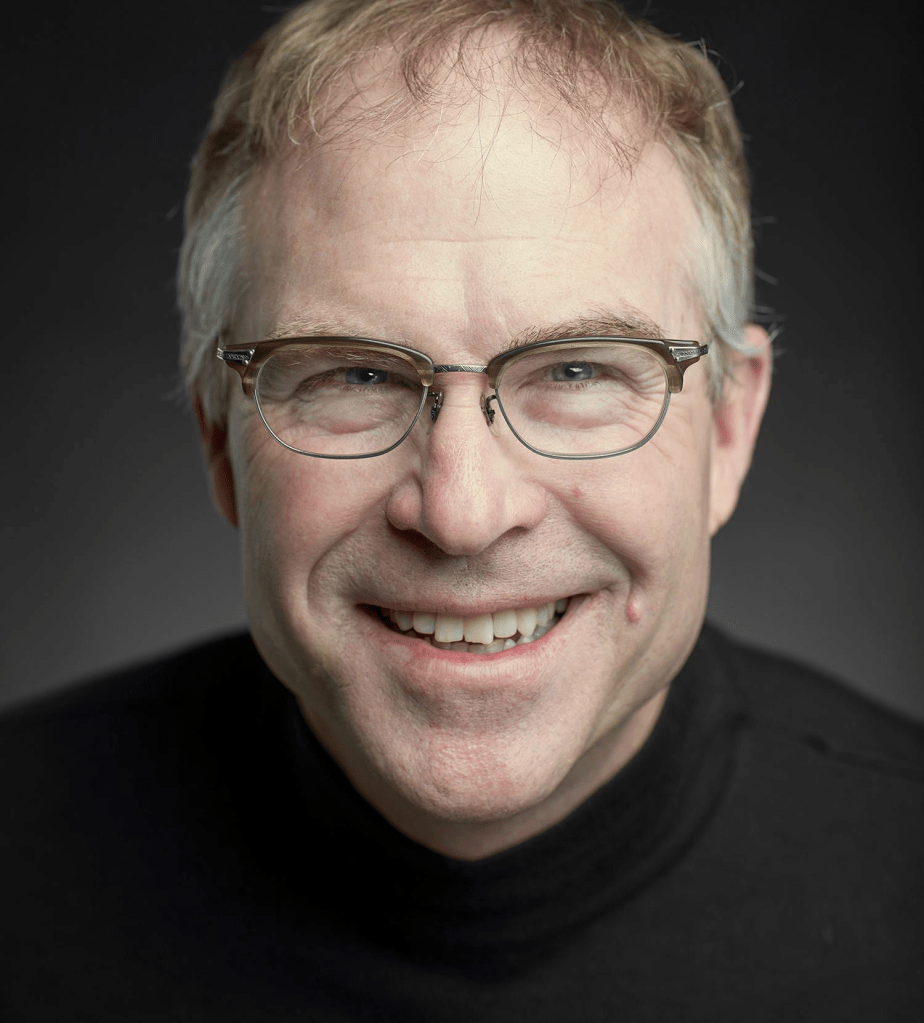
Headshot photo of Art Meripol. Photo courtesy of Art Meripol
The reception, hosted by KASU, will be held from 5:30 p.m. to 7:30 p.m., Oct. 29, in the Humanities and Social Sciences building atrium.
The photo exhibit, also located in the humanities building and presented by KASU, comprises 25 photographs of various landmarks along the Civil Rights Trail. The exhibit opened to the public June 13. Meripol said his Civil Rights Trail photography is some of his most rewarding work.
“I’ve had a 50-year career and I’m more proud of this work than probably anything I’ve done in those 50 years, and I wanted to share it,” Meripol said.
LaDawn Lee Fuhr, KASU corporate relations specialist, said Meripol’s background in journalism, passion for history and skill in photography will be of interest to a wide range of people at the “art talk” and reception.
“We feel like bringing this history and this art together is great for the overall community,” Fuhr said. “We’re hoping that people will come out and see it and meet Art, talk to him, and understand his process.”
Audio story by DDNS Reporter Jerry Don Burton
Mosaic Templars Cultural Center. Meripol said he woke up at 4:30 a.m. to capture the center in pre-dawn light. Photo courtesy of Art Meripol.
Fuhr was a major force in bringing Meripol’s photography to A-State. She said the concept of the exhibit and reception blossomed from a conversation between her and Meripol.
After not having seen each other for decades, Fuhr and Meripol reconnected at the Old State House Museum in Little Rock on July 12, 2024. Fuhr said she was impressed by his photography work on “The Official United States Civil Rights Trail: What Happened Here Changed the World,” a book published in 2021 by Alabama tourism director Lee Sentell, and wanted to create an exhibit of his Civil Rights Trail photographs.
Meripol said he knew the project would be worthwhile, but was initially daunted by the work, time and logistics it would take to complete such an exhibit.
“Once I got started, I got pretty excited about the possibilities to go through all the work I did on the U.S. Civil Rights Trail and narrow it down,” Meripol said. “I think that was what intimidated me more than anything was trying to pick 20 or 25 pictures out of all that.”
A majority of the photos featured in the exhibit were taken in 2017, when Meripol said he traveled to 10 states in 12 days to expand coverage of the Civil Rights Trail. Starting in Alabama, where he is based currently, Meripol covered sites in Louisiana, Mississippi, Arkansas, Kansas, Washington, D.C., Virginia, North Carolina, South Carolina, Georgia and Tennessee.
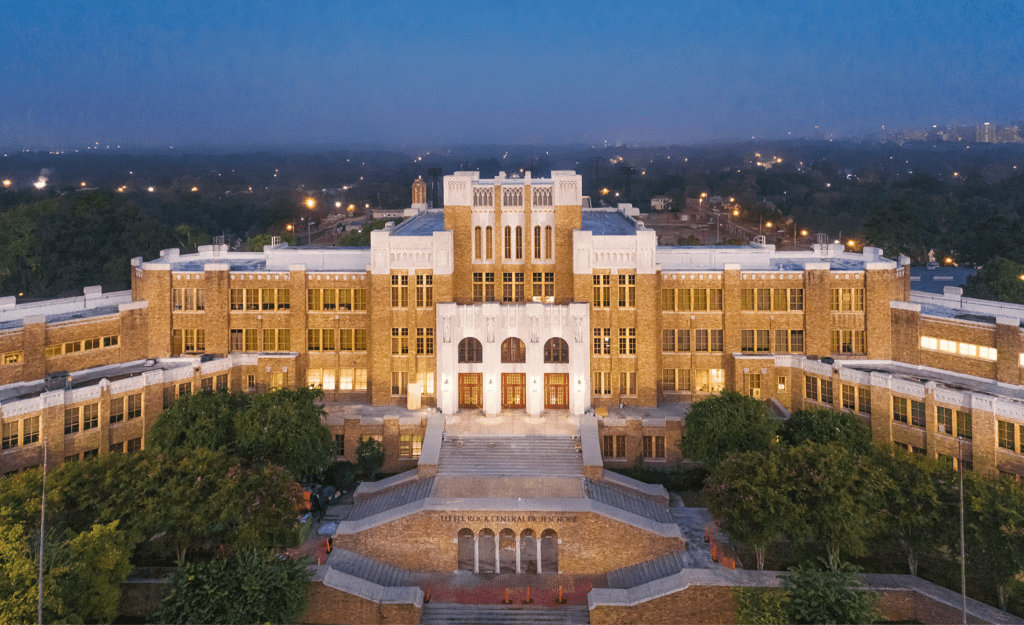
Little Rock Central High School. In 1957, nine teens known as the “Little Rock Nine” were the first African American students to enter the school following the 1954 Brown v. Board of Education Supreme Court ruling that made segregated schools illegal. Photo courtesy of Art Meripol.
Meripol said some of his favorite career experiences came from his work photographing the Civil Rights Trail.
Meripol said one such experience was his visit to Medgar Evers’ home. Evers, a civil rights activist and the first NAACP field secretary in Mississippi, was assassinated in the driveway of his home in 1963.
Prior to his arrival, Meripol said the caretaker of the home did not know he was coming to take photos. He said she was suspicious at first, but they ended up having a wonderful time together.
“We ended up sitting at the kitchen table at Medgar Evers’ home with her, and she was telling stories of when she was in high school and how they all adored Medgar Evers,” Meripol said. “Just seeing her face as her mind went back to that time and her memories was just magic.”
Evers’ home was designated a National Historic Landmark in 2017.
Medgar Evers’ home. Evers was dedicated to ending racial segregation at the University of Mississippi, enforcing voting rights and expanding opportunities for African Americans prior to his assassination in 1963. Photo courtesy of Art Meripol.
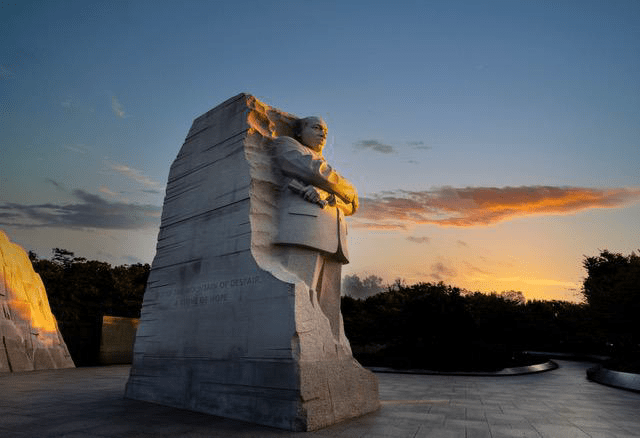
Meripol said another particularly memorable experience was his time in Washington photographing the Martin Luther King Jr. and Lincoln memorials.
Due to flight delays caused by storms, Meripol didn’t arrive in Washington until midnight. He took an Uber at 4 a.m. to the memorial to capture it before sunrise. He said he could not have asked for better lighting and was so inspired in fact, he decided to walk to the nearby Lincoln Memorial.
Martin Luther King Jr. Memorial, located in Washington, D.C. Photo courtesy of Art Meripol.
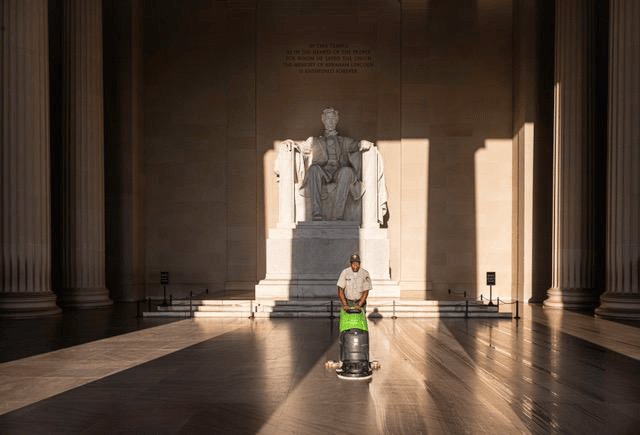
The Lincoln Memorial is typically a high-traffic tourist attraction, making it hard to photograph. But, due to the storms, Meripol said the memorial was empty, save for one employee.
“A U.S. government employee, an older Black man, was polishing the floors in front of Abraham Lincoln with the morning lights streaming through the columns and lighting him up,” Meripol said. “And I shot maybe one of my single favorite pictures of my life.”
Lincoln Memorial. Photo courtesy of Art Meripol.
Meripol said he hopes his work inspires viewers to visit the historic landmarks in his photos.
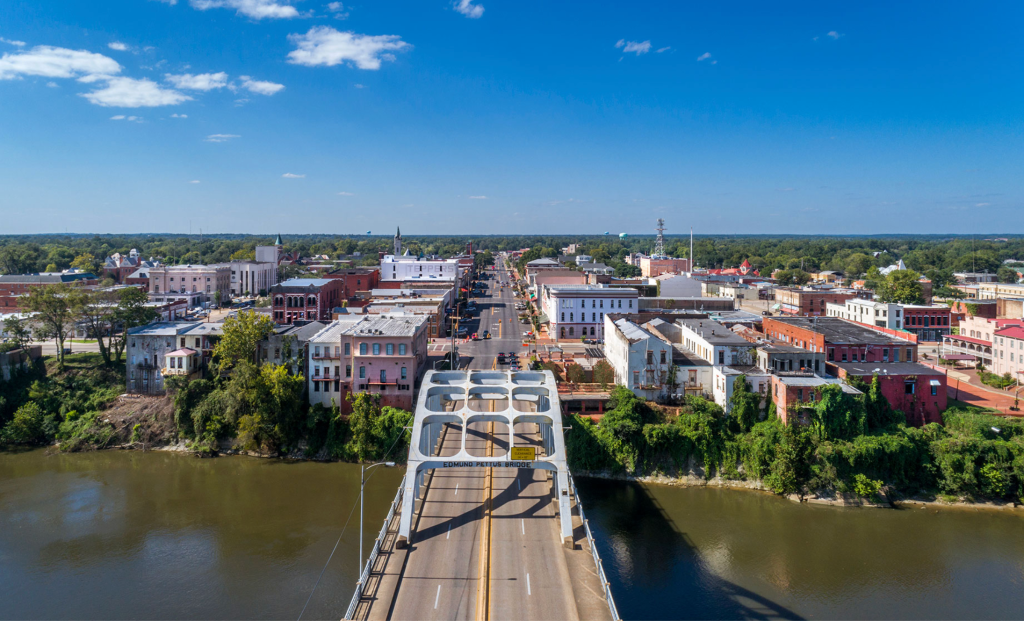
“I have a picture of the Edmund Pettus Bridge where the Bloody Sunday marches happened for voting rights,” Meripol said. “I hope they see that picture and want to go experience the bridge themselves. If they do, they’ll walk over the bridge as the marchers did back in the early sixties.”
Edmund Pettus Bridge, located in Selma, Alabama. The bridge was the site of Bloody Sunday, a conflict on March 7, 1965, when police attacked civil rights demonstrators as they were marching to the state capital. Photo courtesy of Art Meripol.
Fuhr said Meripol’s photography is important for preserving and highlighting the history of the United States.
“It’s a trite statement, but it’s true. If we don’t know our history, we’re doomed to repeat it,” Fuhr said. “I think any of us have a connection to the history that made this country. I feel it’s important to be seen in such a beautiful way. Because there was such pain, but it’s presented in such an appealing, beautiful way that people can appreciate.”
Meripol said the United States has always acknowledged its failures, but the current political climate is leading to the burial of some history.
“When we start hiding those failures, then you don’t know what needs to be paid attention to,” Meripol said.
In March, President Donald Trump signed an executive order targeting funding for programs that “degrade shared American values, divide Americans based on race, or promote programs or ideologies inconsistent with federal law and policy.” A few months later, in August, the Wall Street Journal reported that the White House ordered a review of exhibits at the Smithsonian Museum to align with Trump’s interpretation of American history.
Civil rights leaders, advocates and historians have criticized these moves as singling out content on slavery and civil rights in an effort to minimize the contributions of Black Americans.
National Museum of African American History. Photo Courtesy of Art Meripol.
“There is an effort to try to hide those things, hiding Black history, which is American history. It hurts to see it happen,” Meripol said. “I’m hoping this exhibit will keep people discussing these things and finding ways to move forward.”
Fuhr said KASU’s involvement in creating the exhibit and reception aligns with the non-commercial public radio station’s mission to be a resource for the community.
“This is the kind of thing that public radio does that others don’t really do, which is to go deeper in the world and be able to bring this to the community.”
Mark Smith, KASU station manager, said the radio station is excited to bring Meripol’s photographs to the community. He said viewers will be immersed in the rich history and the craftsmanship on display.
Fuhr said bringing the exhibit to A-State was a joint effort between many individuals, both within and outside of A-State.
The event is sponsored by the A-State Office of the Provost, A-State College of Liberal Arts and Communication, Mosaic Templars Cultural Center and Arisa Health.
Kendall Moody, interior/exterior team leader for facilities management project services at A-State, was responsible for much of the physical preparation regarding the exhibit. Fuhr said his contributions were integral in ensuring the photos were placed properly without damaging the walls and columns of the humanities building.
Fuhr said the exhibit is planned to stay up until early 2026, but is interested in presenting the photos at other venues as a traveling exhibit.
“Each time I look at a photograph, I get a different sense of it, and so I want it up long enough for people to really appreciate it and really feel it,” Fuhr said.
LITTLE ROCK — Arkansas State University System institutions reported strong 11th-day preliminary fall total enrollment growth of 7.6% with multiple record-setting performances, System President Dr. Brendan Kelly announced today.
“Six of our seven campuses had an overall enrollment increase, including record enrollment for A-State and an extraordinary upswing for Henderson,” Kelly said. “Our two-year institutions also attracted more students as workforce training programs grew. I appreciate the work of our teams across the ASU System to seek out and meet the needs of students and Arkansas employers.”
Total ASU System preliminary 11th-day enrollment was 30,339, up 2,132 students or 7.6% compared with official final enrollment of 28,207 in fall 2024. Full-time equivalent totals were up 7.2%.
Kelly noted that the traditional 11th-day enrollment measure, while positive for the ASU System, has become antiquated in today’s higher education environment because it doesn’t reflect collective enrollment throughout the year.
“Our campuses are enrolling and serving new students almost every week through online and non-credit training programs,” he said. “And ASU-Newport is piloting an initiative for eight-week general education courses that simply doesn’t align with the traditional reporting periods. The ASU System’s ultimate service numbers throughout the year are substantially higher.”
Arkansas State led the growth for the system with a record 17,926 students – a 7.4% increase of 1,239 over last fall’s record of 16,687. First-year students totaled 2,222, a 12% rise over last year, and include 1,764 Arkansans – who make up 79% of the class and represent a 30% increase from a year ago.
“This class is a clear sign that Arkansas families see A-State as their home for opportunity,” A-State Chancellor Todd Shields said. “It means they believe in what we are building here, and they trust this institution to shape their future and strengthen our home state.”
A-State on-campus enrollment grew by 7.8% while online program enrollment is up 6.7%. The A-State total also includes 1,053 students at Campus Queretaro in Mexico, which is a 10% increase over fall 2024.
Total preliminary enrollment at Henderson climbed 9.9% to 2,258, up 203 students from the fall 2024 total of 2,055. The number of first-time freshmen jumped 46% to 572 compared with 391 a year ago while transfer students were up 32% to 196 compared with 149.
“The Reddie Spirit is alive and well on campus as we welcome our returning students and the largest freshman class in six years,” Henderson Chancellor Trey Berry said. “Our faculty, staff, alumni and friends are committed to the success of our students, and it is inspiring to see the growth and tremendous energy throughout our campus community.”
Leading the way for the system’s two-year institutions in the fall reporting are ASU-Beebe with 3,588 students, which is an 9.5% increase over 3,277 last fall; ASU-Newport with 2,118 students, a 13.4% increase over 1,868; ASU-Mountain Home with 1,318, a 0.2% increase over 1,315; and ASU Mid-South with 1,180, a 15.5% increase over 1,022. ASU Three Rivers reported 1,951 students, a 1.6% decrease from 1,983.
The two-year institutions and A-State reported robust growth in high school concurrent credit enrollment with 5,650 students as the ASU System works with the state’s high schools to fulfill goals outlined in the Arkansas ACCESS Act.
Wilson Hall at Arkansas State, home of NYIT College of Osteopathic Medicine. Story and photo courtesy of Arkansas State University.
JONESBORO – Arkansas State University and the NYIT College of Osteopathic Medicine (NYITCOM) at A-State today announced the launch of the Freshman to Physician Pathway, a new opportunity for Arkansas students to secure early admission to medical school and begin preparing for careers in healthcare from the first day of college.
The initiative is designed to grow the number of physicians serving rural and underserved areas of Arkansas. Since opening its Jonesboro campus in Wilson Hall in 2016, NYITCOM has graduated 650 new doctors in six classes — and nearly 70 percent of those from Arkansas have chosen to stay and practice in the state.
“This is a game-changer for the health of Arkansas,” said A-State Chancellor Todd Shields. “By eliminating traditional barriers and offering early admission assurance, we’re making medical education more accessible for high-achieving students who want to stay and serve right here at home. This is about investing in the next generation of healthcare leaders — and in the well-being of every corner of our state.”
A Streamlined Pathway to a Medical Degree
The Freshman to Physician Pathway offers a direct route from undergraduate enrollment at A-State to NYITCOM, provided students meet clearly defined academic and professional standards. Participants pursue a Bachelor of Science in biological sciences with a pre-professional studies emphasis and apply for admission to NYITCOM during their third year.
To qualify, students must maintain a 3.5 GPA in science and overall coursework (with a one-time waiver option for a single semester), complete all required pre-med classes, receive a favorable recommendation from A-State’s pre-medical committee and pass an admissions interview with NYITCOM faculty. Students who meet these criteria will not be required to take the MCAT, significantly reducing the cost and complexity of applying to medical school.
“The path to medical school is difficult and challenging, however there are hurdles that can be overcome when we have strong academic partners at the collegiate level that are preparing the students for the rigor of medical education,” said Dr. Shane Speights, dean of NYIT College of Osteopathic Medicine at Arkansas State. “Leveraging our higher education relationships creates a stronger university, medical school, and most importantly, future physicians.”
A Proven Commitment to Arkansas
NYITCOM’s osteopathic philosophy emphasizes whole-person wellness, prevention and community health — making it particularly aligned with the needs of Arkansas. Graduates go on to pursue a wide range of specialties, with many choosing family medicine, internal medicine, emergency care and OB-GYN — fields in especially high demand throughout the state.
With access to world-class instruction, early clinical experience and the full resources of the A-State campus, students in the pathway program are well prepared for the demands of medical school and a future of serving Arkansas communities.
“At most colleges, the path to becoming a doctor feels far removed from the undergraduate experience. But at A-State, it’s a part of everyday life,” said Chancellor Shields. “Having a medical school in the heart of campus creates a culture that few universities can offer. It sets A-State apart, giving our students a front-row seat to the next chapter of healthcare, and in many cases, the inspiration to pursue their own bold career path.”
Applications for the Freshman to Physician Pathway open this fall for students entering A-State in 2025. A similar program is in development for A-State’s College of Veterinary Medicine, expected to launch in fall 2026.
Photo and story courtesy of Arkansas State University.
JONESBORO – Arkansas State University is celebrating a record-breaking student body this fall with 11th-day enrollment surging to 17,926. Fueled by the largest freshman class ever and record credit hours, A-State’s growth marks another milestone in its rising trajectory as the destination for students across Arkansas and beyond.
The Class of 2029 includes 2,222 first-year students, a 12% increase compared to last year. Among them are 1,764 Arkansans, who make up 79% of the total class and represent a 30% increase from the previous year.
“This class is a clear sign that Arkansas families see A-State as their home for opportunity,” Chancellor Todd Shields said. “It means they believe in what we are building here and they trust this institution to shape their future and strengthen our home state.”
Total enrollment at A-State has increased by 28% since Dr. Shields arrived on campus in the summer of 2022.
This year’s Red Wolves are taking more classes as well, with total credit hours reaching 161,204, an 8% increase over last year and a university record.
A higher number of returning students is also driving enrollment growth, with nearly 750 more students resuming classes this fall, representing a 7% increase over the previous year.
“Our duty goes beyond recruitment. We must ensure that students persist, succeed and graduate ready to make a difference,” said Provost and Executive Vice Chancellor Calvin White Jr. “The historic number of credentials awarded last year and the improvement in returning students show that A-State is fulfilling its mission to advance student success at every level.”
During the 2024-25 academic year, A-State awarded more than 6,000 credentials, the highest total in its history.
This fall, more students are choosing the full A-State experience. On-campus enrollment grew by 7.8%, outpacing a 6.7% growth in online programs. The shift signals a rising demand for the traditional college environment, with students seeking the energy of campus life alongside strong academics. The trend also extends to A-State’s Campus Queretaro, which has seen enrollment grow to 1,053 students, up 10% from 2024.
Student life at A-State is thriving with residence halls filled to capacity. Currently, 3,242 Red Wolves and osteopathic medical students are living on campus, which accounts for 99.8% of the available beds. Meal plan selections rose 6.7% compared to last year, an additional sign of growing student engagement on campus.
“As someone new to A-State, I have been immediately impressed by the energy and excitement on campus,” said Vice Chancellor for Enrollment Management Amanda Nickerson. “It’s clear that students are drawn not only to our academic opportunities, but also to the sense of community here. That combination makes A-State an easy choice for families.”
Looking ahead, A-State is building on this year’s success with new opportunities for future students. The university has expanded its investment in merit scholarships, raising its top award to $18,000 per year and adding a new $10,000 A-State Trailblazer Scholarship for high-achieving students.
Innovative pathways are also fueling excitement, including the Freshman to Physician program that offers early admission to the NYIT College of Osteopathic Medicine at A-State. In addition, the new A-State College of Veterinary Medicine, anticipated to open in fall 2026, will provide Arkansans with the opportunity to pursue veterinary education closer to home while helping to meet the state’s critical need for veterinarians.
Information from the Tennessee Department of Transportation
MEMPHIS, TENNESSEE—In a powerful celebration of culture and history, the Tennessee Department of Transportation (TDOT) and the Arkansas Department of Transportation (ARDOT) proudly announce that the new iconic Interstate 55 (I-55) bridge spanning the Mississippi River between Memphis, Tennessee, and West Memphis, Arkansas, will now be known as Kings’ Crossing.
This new name, officially adopted by the Tennessee General Assembly and the Arkansas Highway Commission, honors three transformative figures known as “Kings”: Dr. Martin Luther King, Jr.; B.B. King; and Elvis Presley.
“Kings’ Crossing is more than just a piece of infrastructure; it is a symbol of our collective history, heritage, and the enduring spirit of unity that defines this region,” said TDOT Commissioner Will Reid. “Naming this bridge in honor of these gentlemen pays tribute to their extraordinary legacies – individuals who transcended barriers, fostered cultural exchange, and used their talents to build bridges between people.”
“It’s only fitting to name this vital crossing after three historic figures from this region,” said ARDOT Director Jared Wiley. “We’re grateful for the partnership and collaboration with TDOT on this project. It truly is the result of a regional effort that will benefit industry across this national corridor and the thousands of individuals who depend on this connection each day.”
In July 2024, the U.S. Department of Transportation awarded a landmark federal investment in Tennessee and Arkansas of nearly $400 million toward half the cost of replacing the I-55 Bridge over the Mississippi River. In addition to the nearly $400 million from the Rebuilding American Infrastructure with Sustainability and Equity (RAISE) program, TDOT, utilizing a state general fund allocation provided through the Transportation Modernization Act, and the Arkansas Department of Transportation (ARDOT) have each committed up to $200 million, demonstrating a collaborative effort to fund this bridge replacement. This marks the single-largest transportation investment in Tennessee and Arkansas’ state history.
The I-55 Bridge, a vital link for national commerce, is set to undergo a comprehensive overhaul to add capacity, improve safety standards, ensure route resiliency, and maintain optimal operational conditions. The existing bridge, which has served travelers for 75 years since its construction, will be replaced with a larger structure designed to meet modern seismic codes, as it sits on the New Madrid fault line.
The environmental process is wrapping up on the I-55 Bridge Replacement project. Design is underway, and Right-of-Way coordination should begin later this year. Construction is estimated to start in fiscal year 2026. TDOT and ARDOT are partnering to design and construct the bridge utilizing the Construction Manager/General Contractor (CM/GC) project delivery method. CM/GC is used for complex projects, aligning technical direction, organizational structure, and budgets with the department’s strategic vision.
Players compete in a tabletop miniature game during NEA Game Fest. The four-day convention brings together gaming enthusiasts for tournaments, open play, and charity fundraising in support of the Friends of the Library. Photo courtesy of Rachel Simpson, NEA Game Fest Organizers.
JONESBORO, Ark. – The Northeast Arkansas Game Fest 2025 is set to return to Jonesboro on July 17. The game fest will bring four days of tabletop games and events to the Red Wolf Convention Center.
From July 17 to July 20, NEA Game Fest is a gaming convention run by the NEA Gamers Guild to raise money for charity. The game fest has been running since 2017 and is growing steadily as it gains popularity in the Arkansas area. This year’s charity being supported is the Friends of the Craighead County Jonesboro Public Library.
The game fest will feature many different types of board games. NEA Game Fest includes four days of open gaming, game demos, board games, role-playing games, card games, miniature games, tournaments and more.
Badges are sold online, and there are multiple types of badges you can purchase to get into the event. For ages 16 and up, an adult badge costs $50 online. These badges grant access to the play-and-win library, prizes, giveaways, a silent auction and most events at no additional cost. Adult badges will cost $60 at the door.
“The money raised will assist with funding library programming, resources and materials. NEA Game Fest 2024’s fundraising total was more than $11,000 for the Friends of the Craighead County Jonesboro Public Library, so we hope to meet or exceed this total for NEA Game Fest 2025,” said Rachel Simpson, NEA Game Fest coordinator.
Simpson said they are expecting around 250 attendees. Many people are returning to the event to enjoy the various board games and tabletop games available to play. Simpson also said that this year the event is in a new venue, the Embassy Suites by Hilton Jonesboro Red Wolf Convention Center, to fit more people.
Attendees play board and card games at NEA Game Fest. The annual event draws hundreds of gamers of all ages to support local charities through a weekend of gaming and community activities. Photo courtesy of Rachel Simpson, NEA Game Fest Organizers.
“From the humble beginnings at the Hoxie Community Center to our largest NEA Game Fest yet, it’s evident that tabletop gamers in the Mid-South and our sponsors are passionate about the hobby while supporting local charities — it’s infectious,” Simpson said.
“I’m coming back to NEA Game Fest as a yearly event, which I personally adore because it’s three whole days of games, companionship and rest. Tabletop games are a spectacular way to relax and make good friends. It’s something my fiancée and I, whom I actually met through the hobby of tabletop RPGs, love to do,” said Matthew Randle, an NEA Game Fest attendee.
Randle has attended the last two years of the game fest, with this year being his third. He said he is thrilled to see new games and role-playing games featured at this year’s event. Randle also said the festival is important for Jonesboro as a whole, giving families who are less inclined toward sports a chance to get out and have fun while supporting the public library.
“I feel like events in Jonesboro are important, but don’t foster that sense of community that something like NEA Game Fest does. That, and certain events in town really only pertain to people of certain age groups, while I feel like Game Fest caters to multiple age groups at once,” said Sebastian Stokes, an NEA Game Fest attendee.
Stokes said they have met many new people at the game fest, as well as discovered new games to play. Some of Stokes’ favorite games featured at NEA Game Fest are Blood on the Clocktower and Weird Frontiers. Stokes also said the game fest is a safe place for people of all backgrounds, and even if you can’t pay to get in, there are free board games for people to enjoy.
With four days of games, tournaments and fellowship, NEA Game Fest 2025 promises to bring players of all ages together for fun and charity. Organizers say they hope the growing event will continue to strengthen northeast Arkansas’s gaming community while supporting local causes one roll of the dice at a time.
Lake City Fire Chief Hunter Timms presents during a recent Craighead County Quorum Court meeting. Photo by DDNS Reporter Shailey Wooldridge
The Lake City Fire District has not had a fire fee increase since 1999, leading to financial strain. During a recent meeting, the fire district presented this to the Public service committee of the Craighead County Quorum Court to ask for revision to the rates to make them the same as other fire protection districts in the area.
Fire fees are $35 per year for residents within the fire district living outside city limits. The Lake City Fire District is asking for this fee to be increased to $75 per year to match other fire districts in the area and help finance a new fire truck.
Lake City Fire Chief Hunter Timms said turnout prices inflated after the COVID-19 pandemic, and the fire department felt the effect.
“We’re running off the same budget we’ve had since 1999, and we’re just struggling to get by, keep upgrading things, and keep our guys in new turnouts,” Timms said.
Turnout gear is the protective clothing firefighters wear during fire suppression to shield themselves from fire and other hazards. According to a price breakdown of the department’s expenses given during the meeting, one set of turnout gear costs $4,500. The price includes boots, pants, a jacket, a face mask, gloves, and helmets.
Timms said the department has 27 firefighters whose gear must be replaced every 10 years to stay in compliance with the National Fire Protection Association (NFPA). Insurance companies may refuse to provide coverage if the department is out of compliance with these safety standards.
Timms said that out-of-compliance firefighters are not covered under NFPA life insurance policies. “Those guys go out there trying to put a house fire out, a wreck, or a car, and none of their turnouts are up to date. The state does not have their fire insurance, so their families don’t get that coverage,” Timms said.
He said costs add up quickly.
The price breakdown also included average costs for self-contained breathing apparatus that must be replaced every 20 years. In addition, hose replacements, firetrucks, fire station maintenance, utilities for both Lake City and Dixie departments and substations, medical supplies, and utilities must be addressed yearly.
However, Timms said the price for a standard fire truck has doubled since they last purchased one for $214,00 in 2015. He said since 2009, the department has lowered the county residences Insurance Service Office (ISO) rating from a nine to a five. Residences receive an ISO rating based on the fire protection services the local fire department provides. This rating is a scale from one to 10, with one being the best and 10 being the worst. Insurance companies use this rating to help determine home insurance rates, with lower ratings generally leading to lower premiums.
“That’s a 37% savings that we’re saving these people on their homeowner’s insurance for years,” Timms said. “If we don’t keep updating and replacing these things at the next ISO inspection we have, we could go down, and then that would cost them money out of their pocket, that additional payment on their home market.”
The Lake City Fire District also provides services to Dixie, an unincorporated area. The meeting concluded with a need for further discussion and an ordinance to formalize any changes.
In other business, Brian Reed and Tyler Watkins were appointed to the Nursing Center Board.
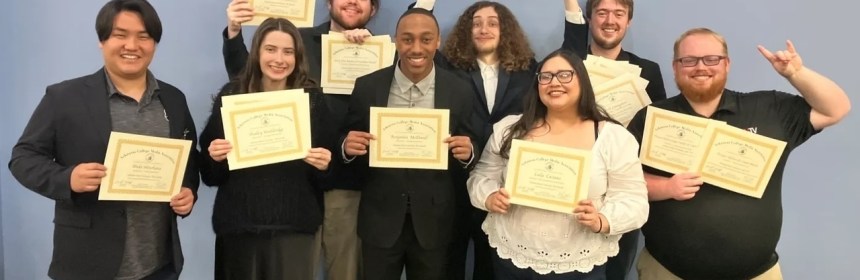
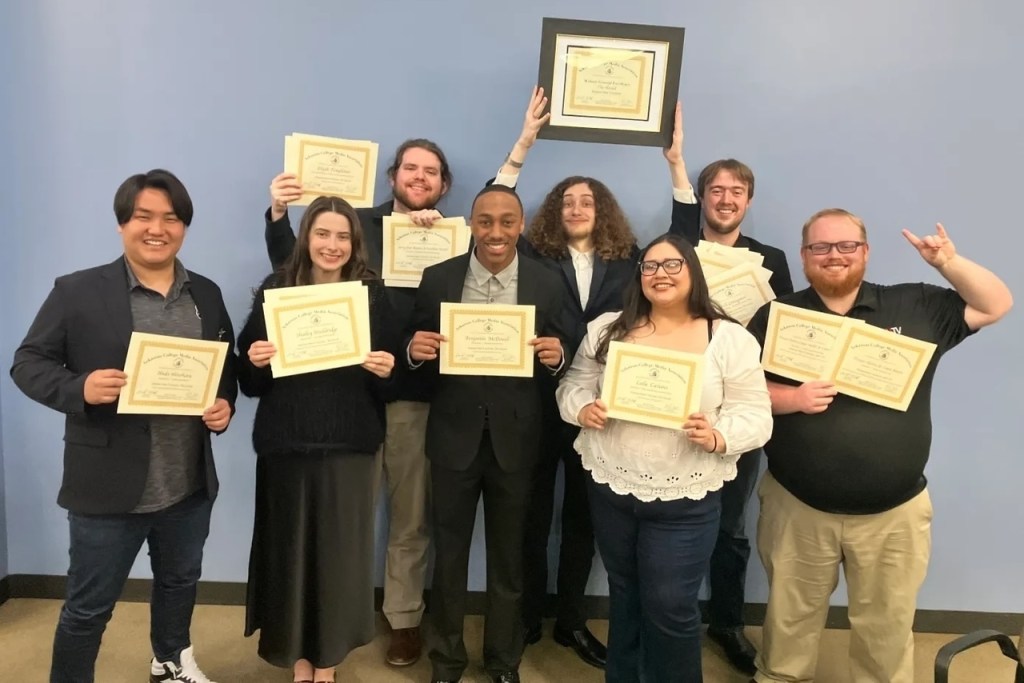
Students (from left) Ibuki Hinohara, Herald photo editor; Shailey Wooldridge, Herald news editor; Elijah Templeton, Herald life editor; Benjamin McDowell, Herald staff writer; Jerry Don Burton, Herald editor-in-chief; Laila Casiano, Herald opinion editor; Will Livingston, Herald sports editor; and Tristan Harlen, ASU-TV station manager, celebrate with their awards received at ACMA.
BENTONVILLE, Ark. — Arkansas State University’s student media outlets from the School of Media and Journalism earned 60 awards at the Arkansas College Media Association’s annual spring conference and awards banquet.
The Herald, A-State’s student newspaper, won 52 awards, including Website of the Year and honorable mention as Newspaper of the Year in the General Excellence categories.
“This is exciting!” Herald adviser Sandra Combs said. “The students worked hard and it showed. They had big smiles and great hope that they would come away with a big win.”
Retiring after 17 years of service to A-State, Combs has served as adviser to The Herald since 2015. Gretchen Hunt of NEA Premiere Magazine assisted as Herald adviser in the fall 2024 semester.
“The Herald staff members are already putting into practice real-world journalism skills as they produce a weekly newspaper and maintain a website and social media accounts, and they are doing it very well,” Hunt said. “They are already learning that having multiple skill sets is advantageous and provides them with the ability to present the news in a variety of forms. Obviously, I’m very proud of them for the work they do and the accolades they have earned.”
ASU-TV and Red Wolf Radio won four awards each. ASU-TV adviser Dustin Sullivan also praised the student work.
“We are proud and honored that students involved with ASU-TV and Red Wolf Radio were recognized for their hard work and efforts in providing professional and entertaining content for our viewers and listeners,” Sullivan said. “We thank ACMA for the opportunity to have our students recognized as award winners.”
Students attending the conference hosted by Northwest Arkansas Community College went through breakout sessions covering media job opportunities, sports reporting, audio reporting/producing, the business beat, magazine visual storytelling, entertainment, breaking TV news in digital formats, yearbook publication, and magazines in the digital age.
Award winners included:
Laila Casiano of Paragould won first place for newspaper election/political coverage, newspaper headlines, online arts and entertainment article, social media breaking news, and social media promotion; second place for audio podcast, online election/political coverage, online meeting/speech coverage, editorial page layout and online feature writing; third place for in-depth news and editorial page layout; and honorable mention for online newswriting.
Shailey Wooldridge of Caraway won second place for newspaper meeting/speech coverage, newspaper newswriting, online breaking news (within 24 hours), online election/political coverage, and online personality profile; and third place for online breaking news (within 24 hours) and online meeting/speech coverage.
Caroline Averitt of Jonesboro won first place for newspaper meeting/speech coverage and online headlines; second place for newspaper personality profile, in-depth news, and social media promotion; and honorable mention for newspaper feature page layout.
Former editor Rachel Rudd of Searcy won first place for online news photo, second place for newspaper election/political coverage, newspaper feature writing, and online feature writing, as well as third place for online personality profile.
Editor-in-Chief Jerry Don Burton of Vanndale won first place for newspaper meeting/speech coverage; second place for in-depth news; and third place for editorials/commentary/blogs and online breaking news (within 24 hours).
Anna Cox of Paragould won first place for personality profile and sports feature writing, and second place for online breaking news (within 24 hours), and newspaper meeting/speech coverage; and third place for sports page layout.
Will Livingston of Hot Springs won first place for sports feature writing; second place for sports feature writing; and honorable mention in online editorials/commentary/blogs.
Shelby Russom of Paragould won second place for newspaper news photo, online news photo, and audio podcast.
Elijah Templeton of Jonesboro won second place for newspaper review writing and honorable mention for online arts and entertainment review and online arts and entertainment article.
Abigail Leggett of Jonesboro won first place for online sports photo and third place for newspaper sports photo.
Allie Carson of Jonesboro won third place for online headlines, and Jack Douglas of Paragould won third place for online news photo.
Ibuki Hinohara of Nagano, Japan, won second place for online sports photo, and Benjamin McDowell of Wynne won second place for newspaper sports story.
Luke Morse of Jonesboro won first place for best specialty music show, while MacKenzie White of Trumann won first place for best radio documentary.
Emily Pilkington of Clinton won second place for best radio documentary. and Christian Sandoval of Jonesboro won second place for best specialty music show.
ASU-TV’s Tristan Harlen, Cooper Melder and Caton Marsh, all of Cabot, won first place in television sports reporting. Harlen and Marsh also took first place in television sports feature.
ASU-TV’s Makenzie Cutler of Harrison, Carson Campbell of Jonesboro, Pilkington and Christian Wilcox of Jackson, Tenn., won second place for television political coverage.
ASU-TV’s Colby Thompson of Conway, Jack Roach of Paragould, Markell McCoy of Clarksdale, Miss., and Mehr Aslam of Garden West Karachi, Pakistan, won third place in television feature.
JONESBORO – Six outstanding students from Arkansas State University have been selected as Distinguished Service Award (DSA) winners for 2024-2025. The DSA recipients will be recognized during the Convocation of Scholars as the institution’s most outstanding graduates based on their record of leadership, scholarship, and citizenship.
One of these students will be announced as the 2025 recipient of the university’s highest honor, the R.E. Lee Wilson Award, on Thursday, April 24, at a campus dinner for the DSA winners.
This year, the recipients are Elizabeth England of Piedmont, Mo.; Rachel Mooneyham of Jonesboro; Sabrina Pierce of Maumelle; Braden M. Ross of Nashville, Ark.; Jonathan Schaufler of Salem; and Amber Yates of Salem.
Faculty, staff, and advisers nominate top students for the prestigious annual awards.
All of the nominees have achieved excellent academic records and provided countless hours of service to the community, their classmates, campus organizations, their departments and colleges, and Arkansas State University.
A committee comprised of students, faculty, staff, and previous Wilson Award recipients makes the final selections. Here are some highlights about each of this year’s DSA winners.
Elizabeth England of Piedmont, Mo. With a double major in political science through the College of Liberal Arts and Communication and economics with the Neil Griffin College of Business, England will graduate in May. During her time at A-State, she has been on the Chancellor’s and Dean’s Lists and been awarded numerous scholarships.
England interned at the Washington Center, was a Truman Scholarship nominee, and was awarded the Public Policy and International Affairs Graduate School Scholarship. She served as director of food pantry operations with the A-State Volunteer Council, was a senator of the Student Government Association, and volunteered with the A-State Women’s Business Leadership Center.
Following graduation, England plans to pursue a master’s degree in public policy. Her advisers are Natasha Neal, instructor in political science and Dr. Chris Brown, professor of economics.
Rachel Mooneyham of Jonesboro Mooneyham will graduate from the College of Liberal Arts and Communication in May with a bachelor’s degree in strategic communication with a minor in marketing. During her time at A-State, she achieved a 4.0 GPA and was named to the Chancellor’s list for the past four years.
The awardee of many scholarships, Mooneyham received the Gena and Neil Griffin Business Scholarship, Alpha Gamma Delta Foundation Pearl Johnson Essay Scholarship, and Adrian Headley Memorial Textbook Scholarship.
She wore many hats as part of the Student Government Association serving as a senator, chief of staff, and public relations director. She is a member of Alpha Gamma Delta, where she served in leadership roles. She is currently studying in England for her final semester. Her adviser is Rachel Freeze, instructor in strategic communication.
Sabrina Pierce of Maumelle A psychology major in the College of Education and Behavioral Science, Pierce will graduate in May. With a cumulative GPA of 4.0, Pierce has been on the Chancellor’s and Honors Director’s Lists and was also named the 2024-2025 Bachelor of Science Psychology Student of the Year.
A recipient of numerous scholarships, Pierce was awarded the Global Student Leaders Scholarship, Jo Anne J. Trow Scholarship, and was a Barry Goldwater Scholarship nominee in 2024. In addition to her studies, Pierce has been involved in several extracurricular activities. She serves as president for Psi Chi: International Honor Society in Psychology, A-State Society for Neuroscience, and vice-president of Alpha Lambda Delta. On campus, she was part of the Student Activities Board, Volunteer A-State, the Honors College, and several more organizations.
She worked as a Communication Center coach on campus and said that experience gave her a sense of belonging and connection. Following graduation, she plans to attend graduate school seeking a Specialist in Education degree in clinical mental health counseling. Her adviser is Dr. Anthony Eldridge, assistant professor of psychology.
Braden M. Ross of Nashville, Ark. A pre-professional studies biological sciences major in the Beck College of Sciences and Mathematics (BCSM), Ross will graduate in May. He has been on the Chancellor’s and Dean’s Lists, as well as the Honors Director’s List.
Ross is the winner of several scholarships. He interned as a grant-funded research assistant with New York Institute of Technology’s neuroscience research lab, held numerous leadership roles within the Student Government Association, served as a tutor and ambassador for BSCM, and was involved in the pre-professional club.
Described as being a very determined student, Ross plans to continue his education at A-State to attend graduate school. He also plans to attend flight school. His adviser is Dr. Kyle Gustafson, assistant professor of biology and environmental health.
Jonathan Schaufler of Salem Graduating in May with a bachelor’s degree in nursing from the College of Nursing and Health Professions, Schaufler has been on the Chancellor’s and Dean’s Lists and was the 2024 Arkansas Nursing Student of the Year.
He serves as president of the Student Nurses Association, president pro tempore of the Student Government Association, and is a member of the College of Nursing and Health Professions Dean’s Student Advisory Board. A Chancellor’s Ambassador, Schaufler has also served in leadership roles in his fraternity, Phi Delta Theta.
In addition to his campus involvement, Schaufler has been involved with the community. He has interned at NEA Baptist Memorial Hospital where his ingenuity and drive were recognized. His adviser is Addie Fleming, associate professor of nursing.
Amber Yates of Salem Yates graduated in December with a bachelor’s degree in communication studies from the College of Liberal Arts and Communication. She has been on the Chancellor’s and Deans’s Lists and is the winner the Excellence in Student Diversity Award in 2022, and the Black Student Association (BSA) Advocate and BSA Humanitarian awards in 2024.
She served as president of the National Pan-Hellenic Council and held several leadership roles with the Omicron Tau chapter of Sigma Gamma Rho Sorority. In her time at A-State, she was pivotal in reactivating the sorority on campus after a 16-year hiatus. Yates was a volunteer with the A-State Food Pantry, a Pack Leader, a Communication Center coach, and served on the Student Government Association. Yates also served as an ambassador for the Multicultural Center.
Her adviser was Matthew Robins, instructor in communication studies and director of the Communication Center.
During the annual meeting, Jonesboro Mayor Harold Copenhaver addressed plans to grow the city’s population to 100,000 people, the city’s strong financial health, and projected 2025 projects and revenues.
The mayor spoke for around 30 minutes to a packed crowd at Embassy Suites.
“The state of the city of Jonesboro, Arkansas is strong. It’s filled with potential because of the people it’s filled with,” Copehaver said. “Jonesboro is anything but static.”
Copenhaver said the city has $33 million in reserves and projected 2025 revenues of $93 million. Its achievements in 2024 include a 106-ton neighborhood cleanup, a revived glass recycling program, and numerous park and infrastructure improvements.
He said preparing for 100,000 people will require constant effort to maintain the city’s growth and prosperity.
This month, Jonesboro will break ground on the $70 million Sportsplex, which Copenhaver said will increase revenue for Jonesboro businesses.
Additionally, he said plans for repairing and adding miscellaneous streets, sidewalks, and road overlay projects will cost another seven figures.
“Among the most critical projects that need funding is extensive work on South Caraway Road and the associated pedestrian accommodations,” Coperhaver said.
The city will fund foundational pieces of the master parks plan, provide new vehicles and equipment for the police and fire departments, and update the Jonesboro E-911 center.
He said community engagement is necessary to address crime, provide opportunities for youth, and support local nonprofits and businesses.
Copenhaver said quality of life for parents is knowing their kids can safely cross streets, call 911 in an emergency, and receive a kind and experienced dispatcher on the other end.
“We all love to think big, but we can’t overlook the basic responsibility as leaders of this community. I believe, like you, we have a moral responsibility, a moral mandate, to prioritize projects that will save lives,” Copenhaver said. “Kids can’t be it if they can’t see it.”