On Friday, November 10, the ASU mechanical engineering department hosted a robotics competition for local middle school students. The event took place at Centennial Hall in the Student Union from 9:30 AM to 1 PM.
The competition was mostly for eighth grade students that are participating in their schools’ EAST program. EAST (Environmental and Spatial Technology) is a national education model, first established in Arkansas, that fosters technology training, teamwork, problem solving, and service projects.
Nine teams from nearby schools were expected to show up, including Buffalo Island Central Junior High, Annie Camp Junior High, Jonesboro Visual and Performing Arts School, Highland Middle School, Marked Tree Elementary, and East Poinsett County High School.
The purpose of the event was to reach out to local schools, promote ASU, and foster a love of engineering, according to mechanical engineering student ambassador Morgan Diamond. It was completely arranged by mechanical engineering students and supported by the Kays Foundation.
“We want to reach out to the schools, tell them about Arkansas State University, but also foster hopefully a love for engineering and robotics, STEM careers,” Diamond said. “Getting them involved…in a design-oriented competition pretty early on is big for development…”
“So even if they don’t go here, they go somewhere else,” said Landon Perdue, another student ambassador. “We want to foster the next generation.”
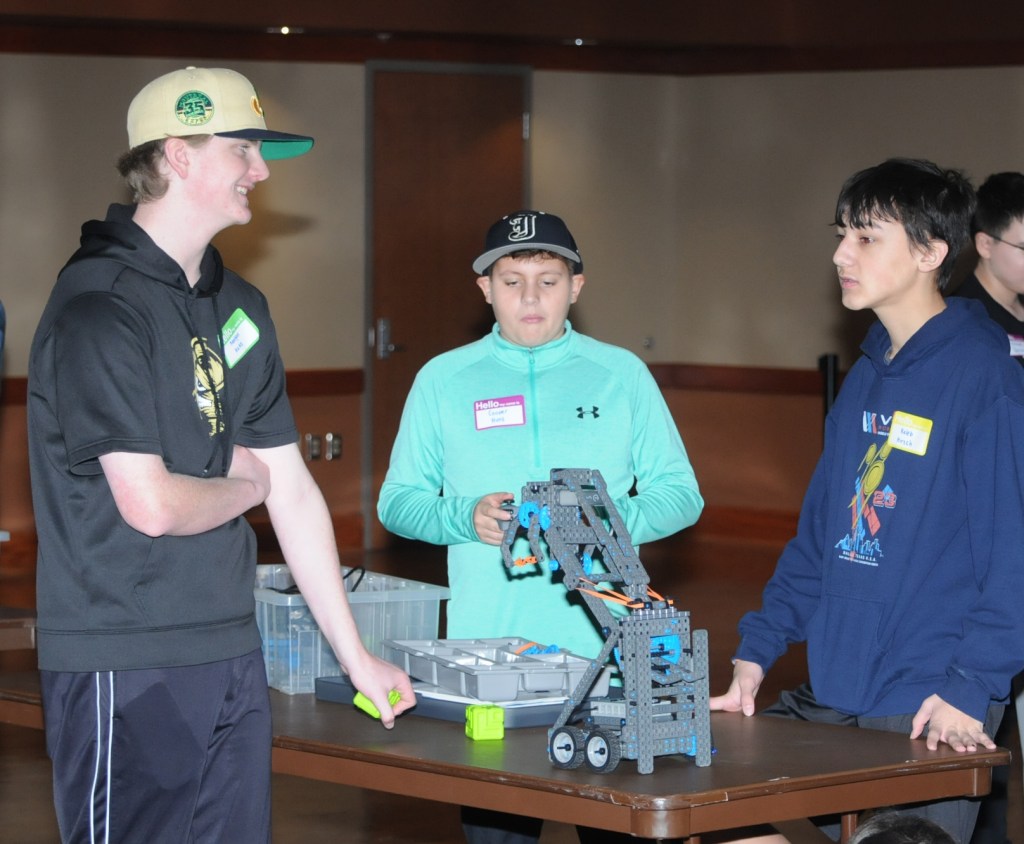
Students Keagan Hicks, Cooper Hunt, and Kaleb Hirsch work on their robot.
The competition is usually held every year during fall. It was previously hosted at other local schools for several years, but they decided to have it on campus this year. They wanted for the event to be more accessible to other schools that are further away.
Every school attending is allowed two teams consisting of four students. Some chose to only bring one team. Altogether, they expected around thirty-five to forty students to show up. Teachers, family members, and friends were also allowed to attend for support.
Each of the teams is provided with a kit a couple of weeks before the competition that they can use to build a robot. At the competition, they have to use that robot to pick up blocks and navigate an obstacle course to drop the blocks in a basket.
“There are several schools that do not have a robotics program, they’re starting fresh, so we are most happy to help,” said Dr. Shivan Haran, the director and a professor of mechanical engineering overseeing the event. “We even told them…come by, we’ll even show your kids how to put this together…”
Whichever team deposits the most blocks wins the competition. Points are deducted if the robot breaks things. The blocks are strategically placed, some in areas that are difficult to reach and some that are easier.
“The goal of that was actually to maybe help develop critical thinking skills and time management and time management, like we don’t want to go for that block, that’s in a hard spot, instead we’re going to try and take a route to get all the easy ones,” Diamond said.
Additionally, because every team designs their robot in a different way, some blocks will be hard to get for one team while they will be easy for another, and vice-versa. The top three teams that get the most blocks each win a trophy.
“We don’t want them to think robotics is something stressful and hard. We want them to think of it as easy and fun, something accessible,” Diamond said.
“The goal here is to get a basic foundation of what robotics is like,” Perdue said.
For a student there from Buffalo Island Central named Henry Sills, it was his second time competing. He’s in eighth grade and learned about robotics in his EAST class, which he has been in for a year.
“Robotics has always been something I’ve been interested in, the actual building of it and the coding,” Sills said.
A group of students from East Poinsett–Christopher, Dalton, Bella, and Jumaro–was there for the first time. They’re also all in the eighth grade, and it’s their first year learning robotics in their EAST program.
Avery Jonesis a junior in the Department of English and Philosophy at Arkansas State University in Jonesboro. She can be reached at: avery.jones@smail.astate.edu
NOTE: Feature photo by Atsuki Ohbuchi of students Annie Shepherd and Vignesh Nair. Other photo in article also by Atsuki Ohbuchi.
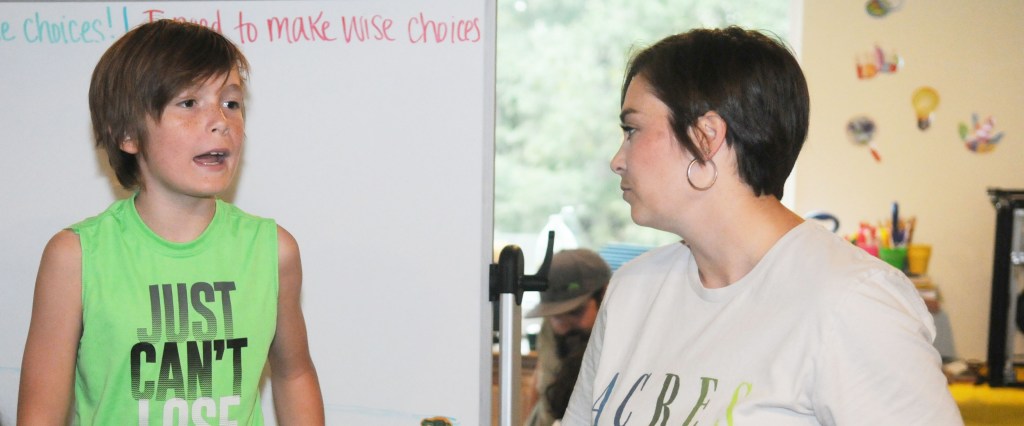
Lauren McDaniel-Carter, founder of ACRES, with a student, Jonah Sharma.
Microschooling is a growing trend in education. According to The Reform Alliance, a nonprofit in Arkansas concerned with connecting families with education options, microschooling is comparable to the one-room schoolhouse concept. In a microschool, a small group of students meets for a certain amount of days a week to learn together.
It’s separate from a public or private school and falls under the category of homeschooling. Microschooling can either be a child’s main form of learning or a supplement to their homeschooling.
Laurie Lee from The Reform Alliance said that microschooling is becoming more popular because of the past closures of schools due to the recent pandemic; parents have also become more concerned with the state of education. Families want to have a stronger role in their children’s education.
“The great thing about a microschool is that you can’t put it in a box…It’s truly family, community-led,” Lee said.
There’s no definite beginning point for when microschools became a concept. There have been communities and homeschool families who have engaged in group learning before microschooling became popular. However, Lee states that a significant turning point in the microschool movement was the establishment of Prenda, an organization that helps to start microschools.
Prenda was inadvertently started by Kelly Smith in Arizona. He thought students needed a bigger emphasis on STEM in their education. His group grew, and now the organization helps other microschools by providing curricula and advice regarding the technicalities of microschooling.
“I think the verbiage, microschool, the name, might be more new than the concept,” Lee said.
According to Lauren McDaniel-Carter, founder of ACRES, a local microschool, there’s no strict definition of a microschool because the group gets to define it for themselves. There’s a lot of gray area.
“I’ve been calling mine somewhere between a homeschool co-op and a private school,” McDaniel-Carter said.
Her school opened this August. She planned to take no more than fifteen students from the age groups of kindergarteners to fourth graders.
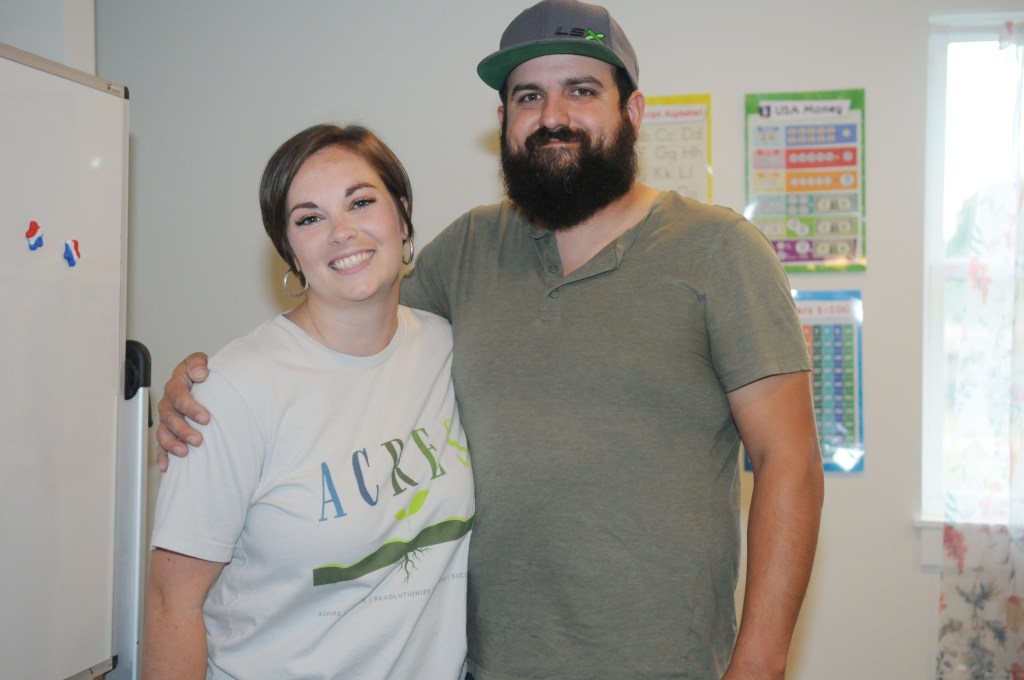
Lauren McDaniel-Carter and her husband, Nathan Carter.
According to Lee, microschools aren’t limited by age group. Some of the schools that The Reform Alliance has helped to set up only take students from kindergarten to third grade whereas others are K-12. The kids usually aren’t separated by age group or grade, either; they all learn together.
“I think the environment breeds a different day every day,” Lee said. “This model is set up to fit the needs of the people that are using it…We’ve seen extreme growth in students in these models over the last three or four years we’ve been actively working in them.”
McDaniel-Carter’s ACRES will focus on the core subjects of language arts and math. The students will use mainly online curricula and depending on the individual’s pace, it will probably take about two hours a day.
The programs used will be completely secular. McDaniel-Carter doesn’t plan to incorporate any religious teachings into the students’ work.
The students will work on computers, but they will be allowed to take breaks and go at their own pace. Additionally, the students don’t have to work on the same subject or curriculum at the same time.
“Rather than [having] these long, extended blocks where kids have to sit still in desks…they can be kind of where they want, they can take breaks…” McDaniel-Carter said. “They may be working on different programs, too. It’s not a one-size-fits-all curriculum…It’s just whatever the kids kind of need at that moment.”
For other subjects like science and social studies, she plans to use a projects-based and hands-on approach. She will also offer “enrichment” subjects like arts and language learning as well as time for unstructured socialization and play.
Her vision is to have the kids “take ownership of their learning.” She wants to have them determine what subject they want to master in a certain amount of time.
“This is the stuff that gets kids excited about school and learning, when they get to do stuff that they’re interested in, and a lot of the times in public school, you only see those opportunities being given to the kids who are excelling,” McDaniel-Carter said. “That kind of learning should not be just reserved for the ‘gifted’ kids. Anybody should have access to it. The fact that kids don’t like school is not a reflection of them, it’s a reflection of the school.”
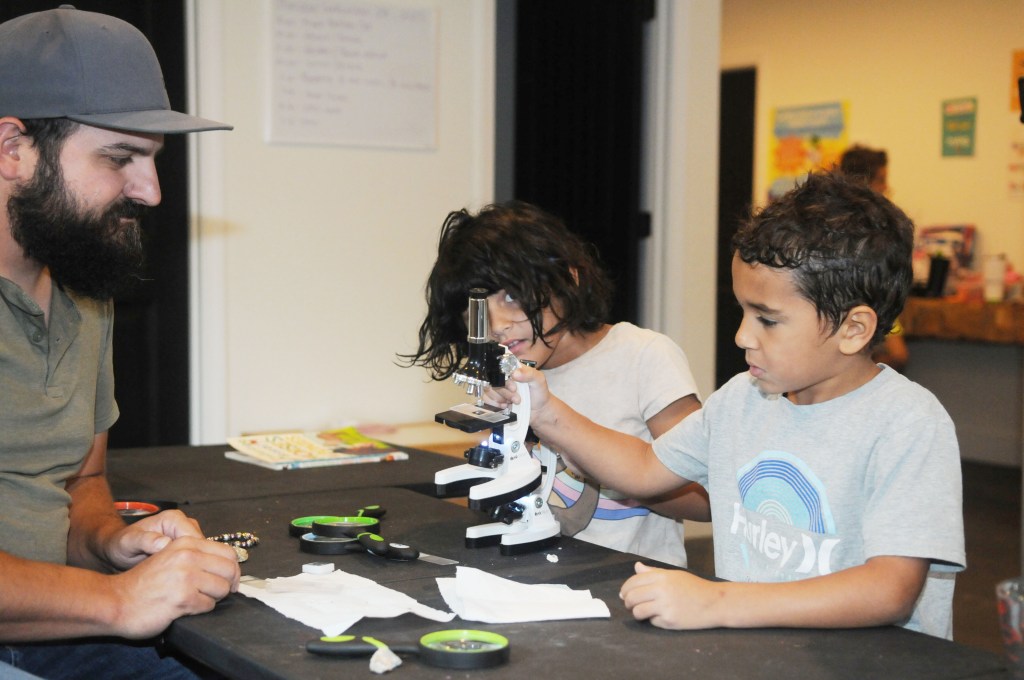
Nathan Carter with students Skyler Armitage and Hazel Sharma.
McDaniel-Carter will guide the kids in the learning process. According to The Reform Alliance, it’s normal for microschools to have “learning guides,” but they don’t have to be certified teachers. McDaniel-Carter wants to eventually be able to hire a part-time learning guide to help.
Unlike public or private school, mastery will not be determined by a score on a standardized test. Students will move on when they’re ready instead of whenever the teacher determines they can move on.
In this way, the kids will not be compared to each other. They aren’t competing with grades, and since each student will be allowed to go at their own pace, they won’t be pulled out of the class for intervention or forced to move on before they’re ready.
Lee said that “Educators are starting to understand that student-focused and student-led days are more productive for kids to learn than a very rote, lecture-style classroom.”
She further stated that children should be taught like they’re going to be adults, which they will be eventually. Adults get to structure their own day and have to prioritize.
If they don’t complete their tasks for the day, those tasks have to roll over into the next day. Children need to learn these skills in environments which will teach them real-life consequences.
At ACRES, to measure her students’ progress, McDaniel-Carter will be able to see how they’re doing on their online programs and what they’re struggling with. She can share progress reports with the students’ families to keep them involved.
Additionally, everything the students do in their project-based learning time will be compiled in a portfolio. She also hopes to implement a badge system in which students will earn badges for certain achievements. Eventually, she wants to be able to host an end-of-the-year showcase to share the students’ accomplishments.
Measuring progress is usually up to the learning guide, according to Lee, but with the new LEARNS act, any school taking EFA funds will have to test students every year with a test set up at the national level. These tests will determine the sustainability of that program.
At ACRES, families will be able to determine how many days their children will attend. Some people might want to only come two days a week as a way to supplement their education at home, while others will want to come all five days as their main source of education.
Additionally, the tuition cost depends on how many days they want to attend. This makes it more accessible for even low-income families.
McDaniel-Carter has also invested much of her personal funds into the school. The school is located at her house in a room they built specifically to be multipurpose.
Lee at The Reform Alliance stated that microschools can be hosted virtually anywhere. She’s seen schools held in someone’s kitchen, repurposed buildings, and churches.
Before McDaniel-Carter decided to start a microschool, she worked as a public school teacher for eleven years. However, it wasn’t for her, and when her husband suggested that she start a “pod school,” she liked the concept of that.
“I can’t believe I lasted that long,” McDaniel-Carter said. “Honestly, I can remember doing my student teaching and thinking, I can’t do this for thirty years.”
She posted in a Facebook group to ask if anyone would be interested in a microschool, and in a couple of hours, she had around eighty responses. The process of starting a microschool has been “surprisingly smooth” for her. She said that she felt like she was following a path instead of trying to carve one.
The most difficult part was trying to get people to commit to the school. People are often reluctant to try something new. In June, she had eleven applications, but people are often prone to drop out or apply at the last minute.
Also, there’s not much clarity on the mandates regarding homeschooling, especially with the added confusion of the new Arkansas LEARNS act. The money provided by the act would be beneficial for her school.
“It would be nice, I feel like, if there was some clarity on what a microschool is and what governs it,” McDaniel-Carter said. “I would love to have access to that money. How that’s going to happen, I don’t know because there’s so little clarity in the act…if the financial barrier is removed, that opens us up to a lot more people.”
According to Lee, The Reform Alliance has set up and assisted in setting up several microschools. On July 22, they hosted a microschool conference in Little Rock where attendees learned about microschooling from the National Microschooling Center.
Avery Jonesis a junior in the Department of English and Philosophy at Arkansas State University in Jonesboro. She can be reached at: avery.jones@smail.astate.edu
NOTE: Feature photo of Lauren McDaniel-Carter and her students at ACRES by Atsuki Ohbuchi.All other photos in article also by Atsuki Ohbuchi.
JONESBORO, Ark. – Constitution Day was on Sept. 17. The holiday celebrates the adoption of the U.S. Constitution. The day is especially important for public schools because they must recognize the day and use the opportunity to teach students about the Constitution according to a federal requirement.
Local schools in Jonesboro are no different and had some activities planned for Constitution Day. According to Jon Newman, an Advanced Placement U.S. History and Government teacher from The Academies at Jonesboro High School, his school didn’t have a school-wide event planned but each teacher covered the topic in their classrooms.
Since Constitution Day was on a Sunday, Newman chose to recognize the day on Tuesday. He and his students were discussing the development of the Constitution. He also brought in Senator Dan Sullivan to talk about his role in the government and our state legislature’s role in the system that was created by the Constitution.
According to Newman, the goal of this day in schools is to “help students to see how the document that established our current government was created out of a need that arose with Shay’s Rebellion.” He makes sure that he stresses to students the importance of how the Constitution was created to adapt to the country as it grew and changed.
In past years, the high school used to invite the Arkansas National Guard to speak to all of the classes about the importance of the National Guard. However, because the requirements for what must be taught has increased, more teachers are unwilling to give up an entire day for such a presentation. Newman doesn’t mind occasionally using a day, though, to allow an elected official to come talk to his students.
Newman says that his students usually respond pretty well to the day. Because of his classes’ subject matter, it’s easy to fit in the lesson.
However, one problem that comes up for other classes not about history and government is that they have to pause their usual lessons to teach about the Constitution for only one day. This lesson can seem arbitrary to students since it doesn’t flow well with the usual subject matter.
At Valley View Schools, the teachers are all doing different activities in their classrooms as well. Matt Mink, a social studies teacher at the junior high school, recognized Constitution Day on Monday the 18th.
He put together a “Constitution Day Escape Room” for his students. Each student works with a partner to decipher four clues which will provide a four-digit code. This code unlocks a lockbox that contains the “stolen” Constitution.
Mink’s goal of this activity is to allow the students to experience something different and to learn from it while having fun. He and his class discussed the Constitution prior to the activity. Mink has been doing this activity for four or five years.
“The students love this activity,” Mink said. “Once they figure out how to decipher each clue, it becomes real competitive. They all want to be the first ones done.”
Melissa Mayfield, a history and government teacher at Valley View High School, also planned special activities for Constitution Day. The school rolled Constitution Day into Freedom Week, which is celebrated during the last week of September.
The purpose of Freedom Week is to emphasize teachings on the development of the U.S. and its founding documents, including the Constitution. It’s an official holiday only in Arkansas, Florida, Kansas, Oklahoma, and Texas.
The social studies department at Valley View High School, which Mayfield is a part of, planned a recital of the Bill of Rights during lunch on Sept. 25. It was recited by students from the American History and Government classes on the balcony that overlooks the school cafeteria.
The students from Mayfield’s AP World History class made posters with the amendments on them to display in the hallways of the social studies department. Additionally, Mayfield taught about different constitutions from around the world and compared them to that of the U.S.
Mayfield does the constitution comparison each year, but this is the first time that the social studies department has collaborated for the Bill of Rights recital. Mayfield said that in general, some students are more engaged than others.
The sophomores have a basic understanding of government structure, but haven’t extensively learned about the amendments. As a result, the teachings of Freedom Week focus on the individual rights that come from the Bill of Rights and comparing our government structure with that of other countries’.
“I want students to understand our Constitution, but I also want them to see how it influenced the creation of other constitutions and how other documents, like the English Bill of Rights, influenced the creation of our state,” Mayfield said.
Avery Jonesis a junior in the Department of English and Philosophy at Arkansas State University in Jonesboro. She can be reached at: avery.jones@smail.astate.edu
Emergency services, such as police departments, fire departments, and ambulances, often require foreign language resources at hand if they need to help someone who speaks little to no English. Bilingual employees can be highly valuable as a result.
In Jonesboro, this is especially relevant because of the large Hispanic population. While many Hispanic people can speak English fluently, there are also many who don’t.
The Jonesboro Police Department works most directly with Spanish speakers. According to Mary Oliver, who works in the records division, many people come to request a copy of their report or file a report, including Hispanics.
The records division deals with all of the paperwork that comes through, including accident reports, arrest reports, and tickets. Belinda Rodriguez, a translator who speaks fluently in both English and Spanish, helps those who need translation to communicate when they come to request or file a report.
“With the language barrier with the rest of the clerks, sometimes it’s hard to figure out their need, what they’re requesting, and so she fills that gap for us,” Oliver said.
They rarely get witness statements in Spanish since there’s usually an English speaker there who can translate for them if needed. However, on the occasions that this does happen, Rodriguez will translate the document for them when there’s a need.
Additionally, the criminal investigation division sometimes interviews people who only speak Spanish, so in those cases, Rodriguez translates for them during the interview.
“We have a large need here. We’re here Monday through Friday, eight to five…I would say daily, she is translating for us in some form or fashion,” Oliver said.
Before Rodriguez was hired in July 2022, the records division worked for several years without a translator. According to Fodor, it was a struggle, and they had to reach out to other resources in order to get the translation they needed.
Rodriguez is Hispanic and grew up in the U.S. learning Spanish alongside English. Even before she worked as a translator, she found herself translating wherever there was a need.
For example, she has helped people to communicate at the ER, the revenue office, and in a former job as a dental assistant. The first two instances weren’t in a professional capacity; Rodriguez says it’s in her nature to help where she sees it’s necessary.
“My mother struggled a lot growing up, so I know firsthand what it’s like to be in that situation,” she said.
Additionally, many Hispanic people are scared to file reports, according to Rodriguez, because they think that nobody will be able to understand them or even fear getting deported. She hopes to help bring in more Hispanic people, especially women who need to report domestic violence.
The police department also has two bilingual police officers who speak both English and Spanish fluently. One such officer is Corey Obregon. He has worked with the department for almost five years.
He grew up in El Paso, Texas, and only spoke Spanish in his household, so he’s fluent in conversational Spanish. In the field, he mostly speaks Spanish when dealing with DUI (driving under the influence) and domestic violence cases.
“I’m pretty much one of the people they call quite often,” Obregon said.
The other bilingual officer in the department is Homero Gonzalez. He’s been working with the JPD for nearly two years.
Gonzalez believes there’s definitely a need for Spanish speakers in the department. He’s been called to many different parts of the city to help translate and has assisted detectives with translation as well.
He meets people who speak little to no English at least once or twice during his work week. It’s usually during the evening when people are going home from work and mostly cases of thefts, accidents, and domestic violence.
“I find Hispanic subjects are more willing to give me information due to me being able to communicate in their native tongue,” Gonzalez said. “I can always see the relief on people’s faces when they find out I speak Spanish. It’s just one less thing to worry about.”
Usually, the only foreign language the department works with frequently is Spanish. However, they have occasionally encountered others, such as Romanian, Nepali, and Marshallese.
The department has a variety of resources they can use when confronting a language barrier. There are translators they can contact for help communicating, and some officers like Gonzalez use Google Translate.
There’s currently an incentive program in the works for officers who speak a second language. There used to be an incentive program in place but after officers tried to fight for a pay raise, it was taken away in 2015.
However, after the recent fight for a pay raise in the department over the summer, a new incentive program is being established. According to Obregon, it will be incorporated next year.
The Jonesboro Fire Department also occasionally needs to communicate with Spanish speakers. According to Martin Hamrick, the fire chief, they sometimes have to use basic phrases and questions when doing EMS calls, wrecks, and fires, and it can be difficult to communicate.
In cases where the individual speaks little to no English, the department has been able to get assistance with translation from the police or from another person there who can speak both languages. Mostly, the only foreign language they encounter is Spanish, but they have dealt with some Asian languages on occasion.
“But it’s definitely better if we speak one-to-one, we get a faster response that way,” Hamrick said.
None of the firefighters are bilingual, but some know basic phrases. El Centro Hispano, the Hispanic center of Jonesboro, offers a basic Spanish class, and some of the firefighters have taken it.
Because the fire department has to follow the civil service guidelines set by the state, they don’t offer any incentives for bilingual firefighters nor is it considered a requirement or advantage when hiring.
Emerson, a local ambulance service, also occasionally helps people who speak little to no English. In these cases, the EMTs usually communicate with others on the scene who speak English or use Google Translate, according to Eric White, who’s an EMT at Emerson and also works in public relations there.
The EMTs can also use a chart using symbols that the patient can point to indicate how they’re feeling. As a last resort, they have a number they can contact for translations.
Once at the hospital, there’s usually translators on-site who can help both the EMTs and the patient once the ambulance arrives. Besides Spanish, other foreign languages Emerson has encountered include German and Russian.
There are a couple of EMTs at Emerson who can speak Spanish to a certain extent. Having a second language as an EMT does come in handy, according to White, and is a standout skill on a resume when they’re hiring.
Avery Jonesis a junior in the Department of English and Philosophy at Arkansas State University in Jonesboro. She can be reached at: avery.jones@smail.astate.edu
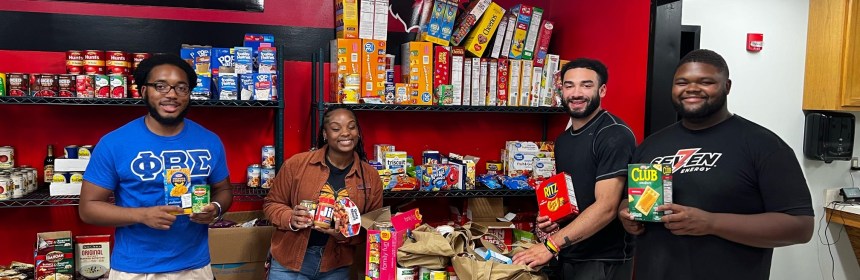
Recently, the Jonesboro Walmart on Highland has been donating to the food pantry on the Arkansas State University Jonesboro campus. The partnership was arranged by Every Child Is Ours, a nonprofit organization headquartered in Tuckerman.
Use of the food pantry is available to anyone with an ASU ID–student, faculty, or otherwise. With the large number of people in need, it can be difficult to keep up with demand, according to Jameson Archer, an ASU student and the president of the volunteer council.
Every year, the food pantry serves 3,000 to 4,000 students and employees. In July of last year, they served 700 people. Usually during summer break, that number would be around 200 since most students are off-campus at that time, so the demand has seemingly increased.
“There are a lot of times where they’re really having to strap to get people food,” said Dean MacDonald, a graduate student at ASU who also works with Every Child Is Ours.
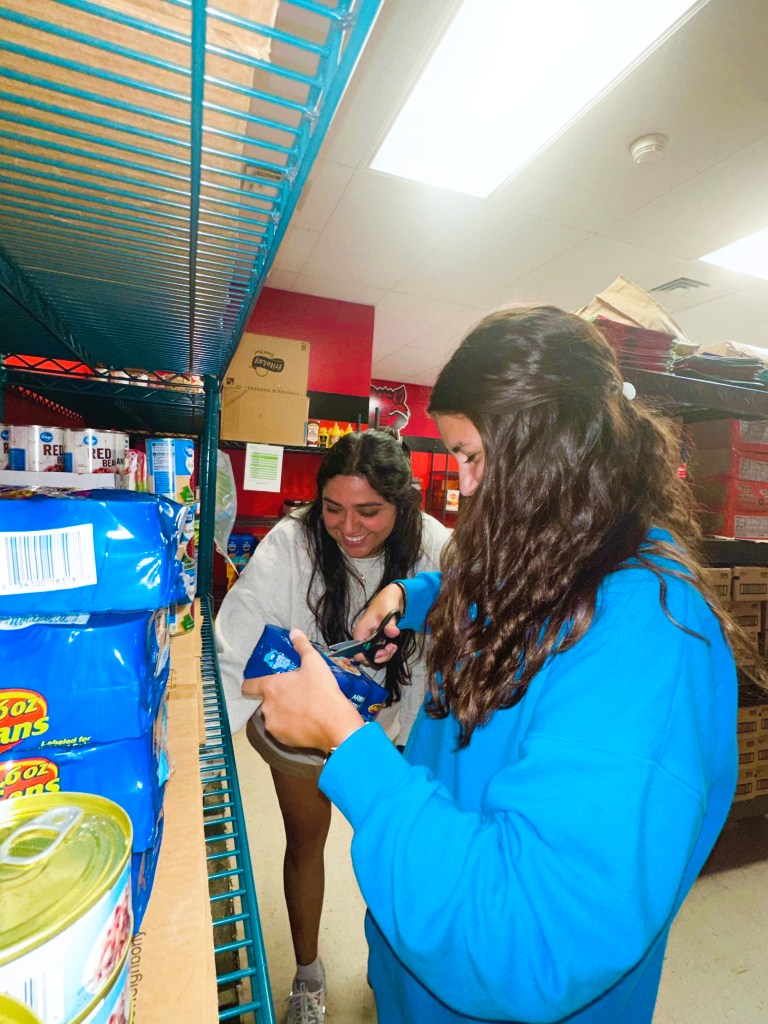
Volunteers Kennadie Hobson and Ericka Hernandez at the food pantry.
Over the summer of this year, they started developing the idea of Walmart donating to the food pantry. The pantry was in need of volunteers since most students had left for the summer. Raven Person, who works in Student Affairs, started volunteering there.
According to Person, she and Bekah Herring, the assistant director of Career Development who also manages the food pantry, started discussing the need for donations. Herring said that almost all of the pantry’s resources come from individual donations.
Both MacDonald and Person personally know Jan Paschal, the owner of Every Child Is Ours. Along with another student, a history major named Alandria Maddox, they set up a meeting with her on June 2 at the ECIO food pantry to discuss what they could do for the community.
Maddox works as an ambassador for Every Child Is Ours. She brings awareness to the cause and helps Paschal whenever she’s needed. She’s been working with them since May when she was introduced to Paschal by Person.
According to Maddox, Person came up with the idea that Walmart might donate to the food pantry on campus. Paschal had collaborated with Walmart before on other projects, and Walmart also often donates to similar causes.
“A lot of hard work was done by Dr. Hogue, Dean, Raven, and Mrs. Jan,” Maddox said.
Paschal said at the meeting that Walmart wanted to donate to ECIO, but it would be better if the donations went to ASU instead. Paschal contacted an executive at Walmart, Carolyn Hembrey, to set it up.
Hembrey said that she has worked with Paschal many times. She approved the new project and helped to coordinate times for when the volunteers come to pick up the donations.
“I just did not realize that there was a need. I guess we just assume if they’re going to college, they must have the funds to eat, and I was just like floored at the need that there was…” Hembrey said. “I’ve really been encouraged by the participation from the volunteers and just the excitement that they’ve had about the project also.”
The donations occur once weekly. They consist of canned items and other preserved food but also fresh food, such as vegetables, fruit, meat, and dairy. These donations offer a bigger variety than what the food pantry is usually able to provide.
“It’s widened our variety,” said Archer. “It’s always nice because we’re serving so many people, it just gives us something else that we don’t have to personally buy.”
Avery Jonesis a junior in the Department of English and Philosophy at Arkansas State University in Jonesboro. She can be reached at: avery.jones@smail.astate.edu
Note: Feature photo showsvolunteers at the food pantry.
Divine Intervention hosts “Together We Can Stop the Stigma” to discuss how stigma attached to addiction affects those struggling with and recovering from addiction
JONESBORO, Ark. – NEA Divine Intervention, a peer community center for those struggling with addiction, hosted a conference with various similar organizations around the state. The conference was called Together We Can Stop the Stigma, and its intention was to discuss and combat the kind of stigmas that are attached to addiction.
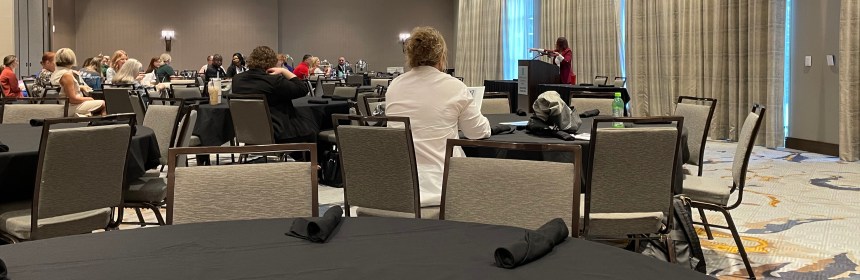
The conference was held at Embassy Suites in Jonesboro on September 11 from 9 AM to 4 PM. Several organizations that deal with addiction were in attendance. There were also several people scheduled to speak, as well as a few panels. Refreshments and lunch were provided.
The speakers included Chief Operating Officer Tony Thomas on behalf of the mayor, discussing community support; Casey Copeland, a peer recovery specialist on The Arkansas Peer Advisory Committee for the DHS Recovery Unit, discussing the beginnings of peer support in Arkansas; and Paula Cunningham, who had a son now deceased of an overdose, discussing prevention and recovery.
The discussion panels included Difficult Questions, a Q&A provided by people working in recovery programs; Surviving the Other Side, a conversation from some who have grown up around people who have struggled with addiction; and Fighting for the Right to Belong, perspectives from those who are in recovery and advocating for themselves and others like them.
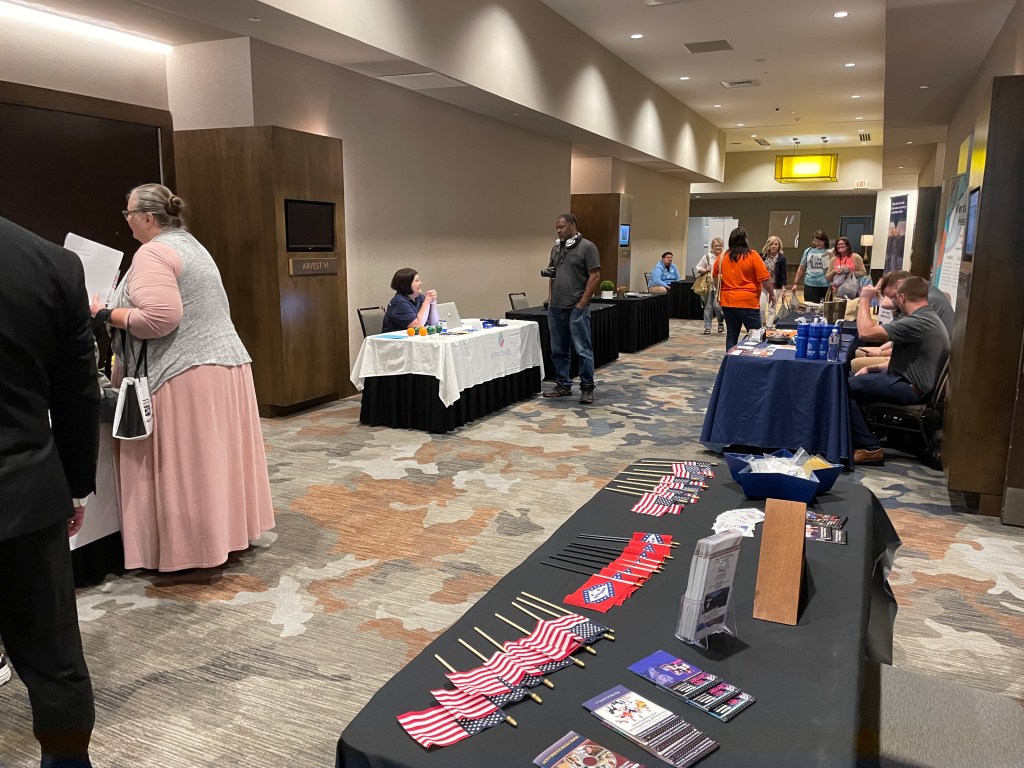
Various businesses and nonprofits displaying their services at the convention.
Some organizations in attendance were Arisa Health, NewVision Withdrawal Management, Longbranch Recovery Center, Engaging Arkansas Communities, and the Wolf Street Foundation. Many of these organizations had set up tables outside the convention room to introduce themselves and their services. All of them had worked with Divine Intervention or the director at some point.
“In my line of work, I come across a lot of different types of people from a lot of different types of backgrounds,” said Kimberly Nail of Engaging Arkansas Communities. “I just want to be able to help anyone I can and share my lived experience.”
Shalinda Woolbright, the director of NEA Divine Intervention and the host of the event, said she originally wanted to arrange an event called “Recovery in the Streets,” but because she didn’t want to wait on approval from the mayor’s office, she decided to do something different.
Her original intention was to gather different recovery resources from around the community so that others could benefit, but the result transformed into something new. This is the first time that Divine Intervention has hosted an event of this type. Woolbright hopes to learn from this event for next year.
“I have been doing this for the last six years, and I have ran into a lot of stigma. To the point where somebody made the statement, ‘Well, maybe they need to die.’ Another statement, ‘They just need to grow up,’” Woolbright said.
“I have been doing this for the last six years, and I have ran into a lot of stigma. To the point where somebody made the statement, ‘Well, maybe they need to die.’ Another statement, ‘They just need to grow up.’”
– Shalinda Woolbright, the director of NEA Divine Intervention
Woolbright believes that this kind of stigma comes from a lack of knowledge. With this event, she wanted to bring knowledge to the table, not just from recovering addicts but also from families of these addicts. She hopes that if people see the issue from the family’s side, they would have more empathy and compassion.
The inspiration for the event was an article written by Paula Cunningham in the Arkansas Democrat-Gazette on Nov. 12, 2018, titled “The last heartbeat.” The mother writes about how her son became consumed with addiction, and now she’s watching him die of an opioid overdose.
However, the main point of the article was that her son had faced so much shame and stigma, and Cunningham, one of the speakers at the event, wants to be the voice for her son that will fight this stigma. Copies of this article were printed out and laid on every table in the convention room for everyone to read.
NEA Divine Intervention in Jonesboro is a nonprofit organization that has been providing support and resources to anyone struggling with addiction, mental illness, and intellectual disabilities since 2021. They essentially help these people to get back on their feet with jobs, housing, and treatment.
Woolbright is in long-term recovery herself, so she knows what others like her struggle with and why it’s so difficult to recover and get back on your feet. The purpose of her organization is to help others face those struggles with better support and resources at their disposal.
“Honestly, I found it to be so overwhelming to have a record, look for a job, ask for help, go back to school, and I just crashed and burned so many times,” Woolbright said. “The purpose is to walk alongside somebody that’s going through the same thing that I’ve been through so that they won’t have to go through the struggles that I did and so that they will be given an option to…start recovery and not become overwhelmed and stressed out and give up.”
Divine Intervention hosts other community events as well and connects with people to make themselves known to those who need help. They meet with people from probation and parole, drug court, DHS, and other places where those struggling with drugs and mental illnesses might be.
They have hosted free haircuts, homeless drives where they give away care packages, art therapy, a “Grill ‘n Chill” with an art contest and dancing, and a back-to-school event in August where they gave away free backpacks for kids.
Mary Tolliver, a volunteer, came to Divine Intervention also because she was struggling to find a place to live. She has been working with them for about four or five months because she wants to give back.
“To see somebody be able to get jobs that they haven’t been able to or to find homes…it’s a sense of satisfaction,” Tolliver said. “You get to watch that here because [Divine Intervention] offers so many services to help people do that.”
Avery Jonesis a junior in the Department of English and Philosophy at Arkansas State University in Jonesboro. She can be reached at: avery.jones@smail.astate.edu
JONESBORO, Ark. – On June 14, the Southern Baptist Convention voted against allowing female pastors in churches associated with the convention during their annual meeting in New Orleans, Louisiana, according to a press release from the Baptist Press. They have also voted to expel three churches that have female pastors from the convention.
While female spiritual leadership is becoming more and more prevalent in churches today across several denominations and sects, it’s still relatively uncommon in Northeast Arkansas.
According to the Pew Research Center, only certain denominations allow women to be ordained, the most relevant for this area being Methodists, Church of Christ, Episcopals, Lutherans, and Presbyterians. Southern Baptists generally do not allow female preachers.
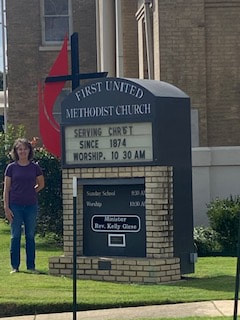
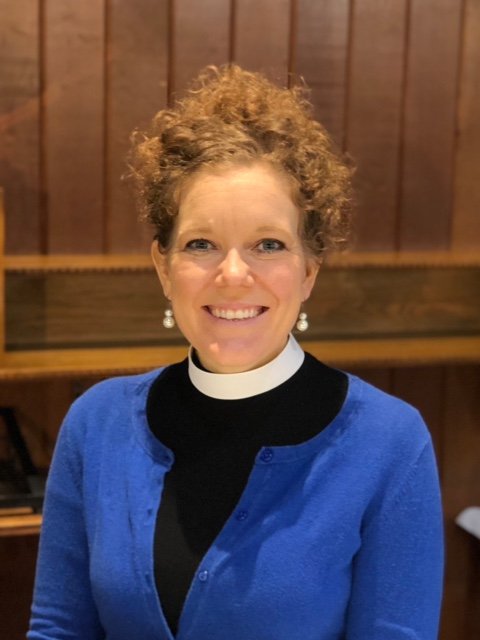
While it’s still relatively uncommon, there are a few female pastors in the area. Reverend Kelly Giese is the head pastor at the First United Methodist Church in Newport.
She’s been serving as a pastor for twenty-six years and at her current church for two years. She’s originally from Arkansas and currently living in Newport.
Reverend Kelly Giese
She was drawn to community service growing up. After she graduated from high school, she was very involved in vacation Bible school and Sunday school.
She also started working with disabled children from a group home. She worked in education for twelve years and has a master’s degree in education. A friend of the people from the group home died, and she was asked to preach at the funeral.
“I got a hold of my pastor at the time, and I said, here’s what’s going on,” Giese stated. “And that person said, you can preach this service better than I can. You know this person…From there, I just started exploring ministry.”
She described her decision to pursue ministry as a “calling.” She followed one of the usual pathways to ordination.
Her church held a conference to verify that she had been called and voted to receive her. She was assigned a mentor and decided what path she was interested in. She went through a process to become licensed which made her a local pastor.
“There’s a lot of other avenues out of there. I just happened to choose to go to seminary and then work through towards ordination after that, but there’s other pathways,” Giese said.
She attended the Duke Divinity School in North Carolina which was founded by the Methodist Church. By that point, she said, it had become fairly common for women to go to seminary and become pastors.
“I graduated from high school in 1978, and I had never met a female pastor at that point,” she said. “From that time forward…it became much more common…All of the women who went before me helped me.”
“I graduated from high school in 1978, and I had never met a female pastor at that point,” she said. “From that time forward…it became much more common…All of the women who went before me helped me.”
– Reverend Kelly Giese, Head pastor at the First United Methodist Church in Newport.
Her duties as a pastor vary from day to day. While she of course preaches and leads worship, she also has many other responsibilities.
She does a lot of community service, like visiting people in the hospital or nursing home, mentoring children, or helping with the food pantry. In the church, she helps with ordering curriculum for Sunday school, preparing for worship, and church maintenance as well as administration.
“I can’t say that that’s my job, but it’s what’s needed by the congregation…” Giese said. “I’ve caught three birds, there was a possum in the toilet, and we caught a raccoon.”
Another pastor, Reverend Annie Jones, is the rector of St. Paul’s Episcopal Church in Newport. She’s been serving there since 2021. She’s been a priest since 2020 and is originally from Iowa.
Rev. Annie Jones
Like Giese, she also experienced a “calling.” Before she was a priest, Jones was working as an elementary school teacher.
“Callings are very interesting and tricky things…I tried to ignore it, and that didn’t work out well for me,” Jones said.
She felt called to ministry since she was thirteen years old, but in college, she chose to go a different direction because, according to her, first-generation college students are generally expected to choose a “safe” path–a career that’s stable and provides a comfortable living. However, when Jones went on a trip to Eswatini, Africa (formerly Swaziland), she could no longer ignore the call.
In Eswatini, Jones was listening to several speakers, and one speaker was talking about callings. Jones felt like she couldn’t keep running from what she felt was the “internal voice of God” telling her to become a priest.
She had to do three years of seminary to become an Episcopal priest. She attended Church Divinity School of the Pacific in Berkeley, California. She also did clinical pastoral education, or CPE, which is 400 hours of hands-on chaplaincy work.
Most people do their CPE in hospital settings, but Jones had the opportunity to work with San Francisco Night Ministry where she walked the San Francisco streets from ten p.m. to two a.m. ministering to anyone who needed it.
Like Giese, Jones is expected to keep up with many duties as a priest. Jones said that because churches don’t usually have a large staff, pastors and priests are expected to be a jack of all trades.
It’s relatively common for women to be pastors in the Episcopal Church. According to Jones, they started ordaining women in the 1970s. In the diocese where she came from, the percentage of ordained women was well over fifty percent.
Here in this region, the percentage is much lower. However, Jones says that it’s changing.
Jones said that what she most loves about her job is the people.
“Being able to walk with people in the hardest and the happiest times, and being permitted to be in those spaces with them,” Jones stated. “And to help hold them and support them and pray with them and be an encouragement…we see the highest of highs and the lowest of lows in ways that many family members don’t actually even see of others, and that is a huge, huge responsibility, but also one of the amazing parts of the job.”
“Being able to walk with people in the hardest and the happiest times, and being permitted to be in those spaces with them,” …
– Rev. Annie Jones, St. Paul’s Episcopal Church in Newport
Captain Teri Smith is another local female pastor from the Salvation Army Church in Jonesboro. She’s part of a Protestant sect called the Salvationists, who have similar beliefs to Methodists.
Captain Teri Smith
She has been working with the Salvation Army since 2010 and has been an ordained minister since 2015. She was working as a youth pastor before she was ordained.
Smith and her husband, Captain Charles, decided to pursue ministry together. In the Salvation Army, both husband and wife have to become ordained together, not just one of them. Furthermore, if a single person is ordained, they can’t marry anyone unless the other person is also ordained or in the process of becoming ordained.
To become ordained, Smith attended the Salvation Army’s training center in Atlanta, Georgia, where she studied for two years. It’s similar to a seminary, but also teaches how to run a shelter and other practical aspects of working with the Salvation Army.
As a minister, Smith is also considered one of the commanding officers of the Salvation Army’s Jonesboro region. She and her husband direct eight counties. Her duties depend on how many volunteers and employees they have at the moment.
Currently, Smith’s duties include administration, like human resources and finances, and she and her husband share the duties of preaching. She also oversees Safe From Harm, which is a child protective training program that all of the volunteers and teachers in their church have to undergo.
In addition, Smith is the director of the women’s and youth ministry program. She teaches the lessons most of the time. She also is a part of the disaster services unit; whenever and wherever there’s a disaster, Smith is deployed with a team of other officers to assist.
“There are a lot of arms. As commanding officers, we are charged to ensure that things will run smoothly and sometimes, that means we are the ones that have to head it up,” Smith said. “Other times, we hope to train someone, or help encourage others to be a part of that, and then we just oversee it, but if there is no one to fill in that duty, as I’ve had to do right now with our finances…I’m having to fill that duty.”
“There are a lot of arms. As commanding officers, we are charged to ensure that things will run smoothly and sometimes, that means we are the ones that have to head it up,” Smith said.
– Capt. Teri Smith, Salvation Army Church in Jonesboro
Additionally, as officers, Captains Teri and Charles Smith can be deployed or moved at any time. They’re currently living in Jonesboro, but if they get called to move to another region, they will have to leave. Teri is originally from Ohio.
Similar to other denominations, women ministers are very common in the Salvationist Church. In their doctrine, they believe that it’s better for married couples to be ministers together. The couple is supposed to act as a unit.
“There’s no difference between male or female in that,” Smith said. “If you feel called, that is something that the Salvation Army will pursue.”
In the 1800s, when the Salvation Army was first established, Catherine Booth, the wife of the founder, felt the call to ministry. She wrote many articles, pamphlets, and books advocating for female ministers.
However, Smith still faces much prejudice as a female minister. According to her, it’s still not widely accepted in many circles for women to be ministers. For example, it’s difficult for her to be part of ministerial alliances where there are many ministers that don’t believe women should be ministers.
“My job isn’t to make anyone feel uncomfortable,” Smith said. “If that’s where I feel God has called me, then no matter if people agree or disagree, I don’t need that affirmation…”
Smith said many people believe that women shouldn’t be pastors because theological beliefs and certain interpretations of the Bible. However, Smith believes that because there were some women in the Bible who were in positions of authority, women are permitted to be ministers.
Additionally, some people even refuse to acknowledge her authority as a commanding officer of the Salvation Army. In her experience, sometimes people will ask for the captain, and when she says that she’s a captain, they’ll ask for “the man.”
However, at the end of the day, Smith said that “our heart is to be able to help people.” Because of the nature of her work, sometimes when people come to them, it’s because they’re having the worst day of their lives. What she truly wants is to help people, and the hardest things are the occasions when she’s unable to help.
-30-
Avery Jonesis a junior in the Department of English and Philosophy at Arkansas State University in Jonesboro. She can be reached at: avery.jones@smail.astate.edu
JONESBORO, Ark. — This Thanksgiving, some local small businesses and nonprofit organizations offered free community Thanksgiving meals open to all in Jonesboro. These events are hosted for the homeless, those without family, those without the money for a Thanksgiving meal, or simply those who want to engage with the community.
The Hope House, a nonprofit organization that provides for the homeless and low-income population, hosted a Thanksgiving dinner on Thursday, November 16, from 11 AM to 1 PM and then 2 PM to 4 PM. The event was held at their location.
“Our goal is…to be able to be a blessing to those in the community who may be struggling at this time to just have a simple Thanksgiving meal, especially for those who are less fortunate,” said Terri James, the director of Hope House. “Sometimes those of us who are blessed, we kind of get [blind], and we just don’t realize how fortunate we are. To be able to give back to the community is also a way we can say thank you for supporting the Hope House.”
However, the event wasn’t intended just for those less fortunate, but for anyone who wanted to come and partake. They hoped to feed at least 200 to 250 people. They had at least twenty-five volunteers helping out, five of which were staff members at Hope House, but more were welcome to help.
This was the first time the Hope House was able to host a community Thanksgiving. The meal was entirely arranged by them and provided for by donations from the local community.
They planned to serve chicken, ham, dressing, green beans, corn, potato salad, macaroni salad, and desserts. Carry-out was offered for anyone who was unable to stay.
The city of Jonesboro arranged a community Thanksgiving at the St. Bernards Auditorium on Thanksgiving day starting at 10:30 “for the hungry, the homeless, and the lonely,” according to the event’s Facebook page. Home delivery within the city limits was offered for anyone who couldn’t come.
The food was provided by members of the community. Donations for non-refrigerated desserts were taken from 1 to 5:30 PM on the Wednesday before. Volunteers arrived at 9:30 the next morning, and anyone was welcome to help without former notice.
The Jonesboro community Thanksgiving has been hosted almost every year since at least 2014. They usually serve around 1,800 or more meals, with around 1,200 of those being home delivery. The amount of volunteers varies between 500 to 750.
The VFW (Veterans of Foreign Wars) in Jonesboro hosted a Thanksgiving at their location on Thanksgiving day from 12 to 2 PM. They have hosted community Thanksgivings for many years.
According to Kay Baker, who works at the VFW, the purpose of the meal was to offer to everyone who doesn’t have a place to go for Thanksgiving an opportunity for friendship and fellowship. The meal was not just for veterans, but for everyone who wanted to participate.
The food was provided for by donations from the community of food and funds, as well as from fundraisers. Most of the food was donated directly, and the food was prepared by volunteers at the location that day.
“There is a big turnout. There’s a lot of veterans that have no place to go and a lot of other people that don’t have a place to go, so they come here,” Baker said.
They served turkey, dressing, gravy, mashed potatoes, green bean casserole, sweet potatoes, corn, cranberry sauce, rolls, and desserts. To-go plates were offered for anyone who was unable to stay.
Marie Turner, owner of Billie Marie’s Auction, hosted a community Thanksgiving at her store on Thanksgiving day from 3 to 5 PM. This was her first time hosting a meal, but she has given out Thanksgiving boxes before.
“I always wanted to serve hot meals to people on Thanksgiving, [but] was never able to until this year, and I am so excited,” Turner said.
According to Turner, the event was for anyone who needed a hot meal or was alone on Thanksgiving, and also for any police officers or EMTs that were on duty during Thanksgiving and in need of a meal. She arranged the event herself, using donations from family, friends, and customers.
They had at least fourteen volunteers helping with the meal, including some of her family members. Delivery in the Jonesboro area was offered for anyone who needed it; they already had fifty deliveries scheduled by November 15. They served turkey, dressing, green beans, mashed potatoes, sweet potatoes, corn, pumpkin pie, rolls, and tea.
Avery Jonesis a junior in the Department of English and Philosophy at Arkansas State University in Jonesboro. She can be reached at: avery.jones@smail.astate.edu