Monthly Archives: November 2024

Arkansas State Hosts Annual Thanksgiving Dinner

Story and photos by DDNS Reporter Jerry Burton
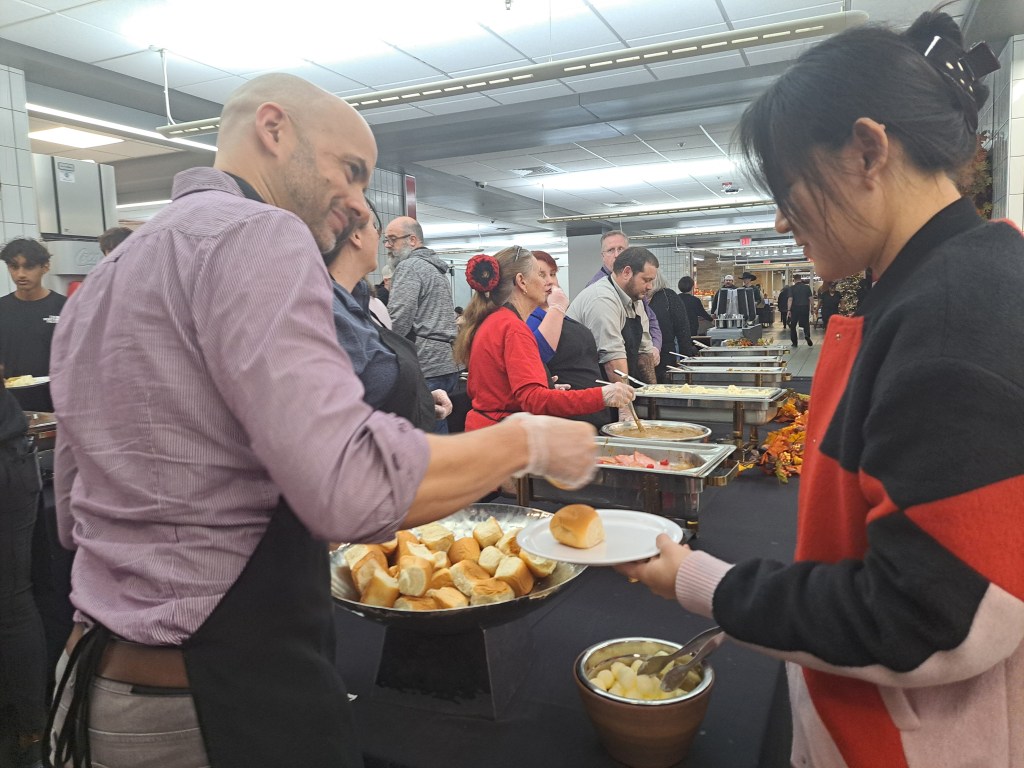
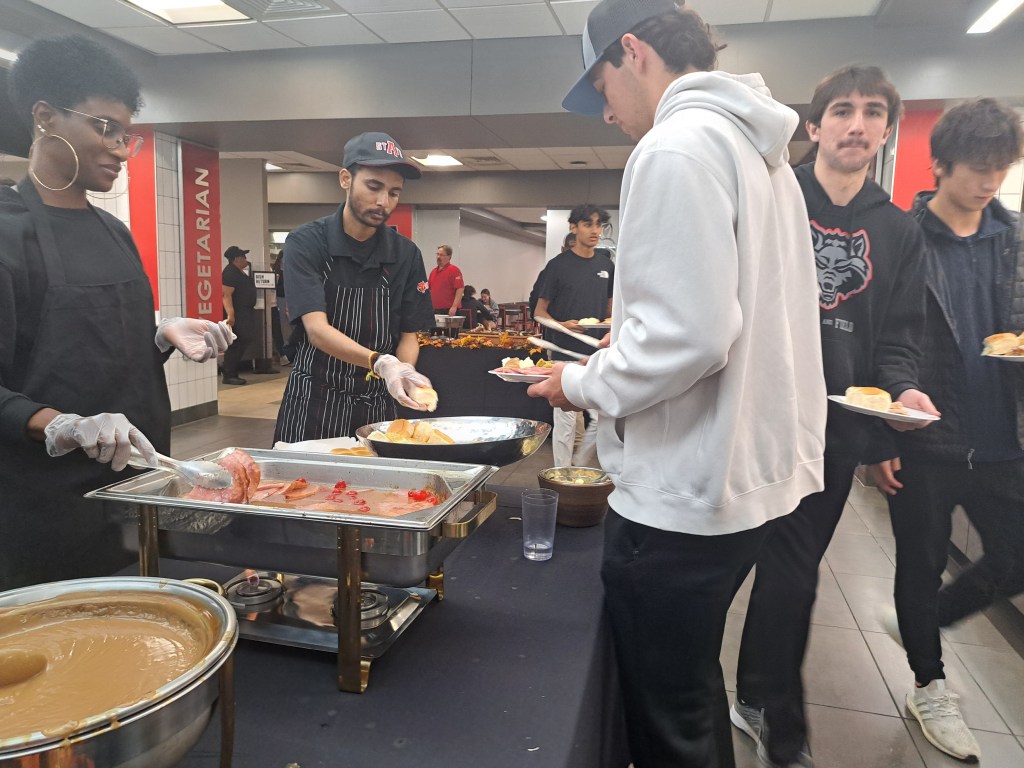
Arkansas State University held the annual Thanksgiving dinner in the Acansa Dining Hall Wednesday.

Craig Johnson, assistant vice chancellor for auxiliary services and volunteer coordinator for the Thanksgiving dinner, said the event provides for faculty, staff and students alike.
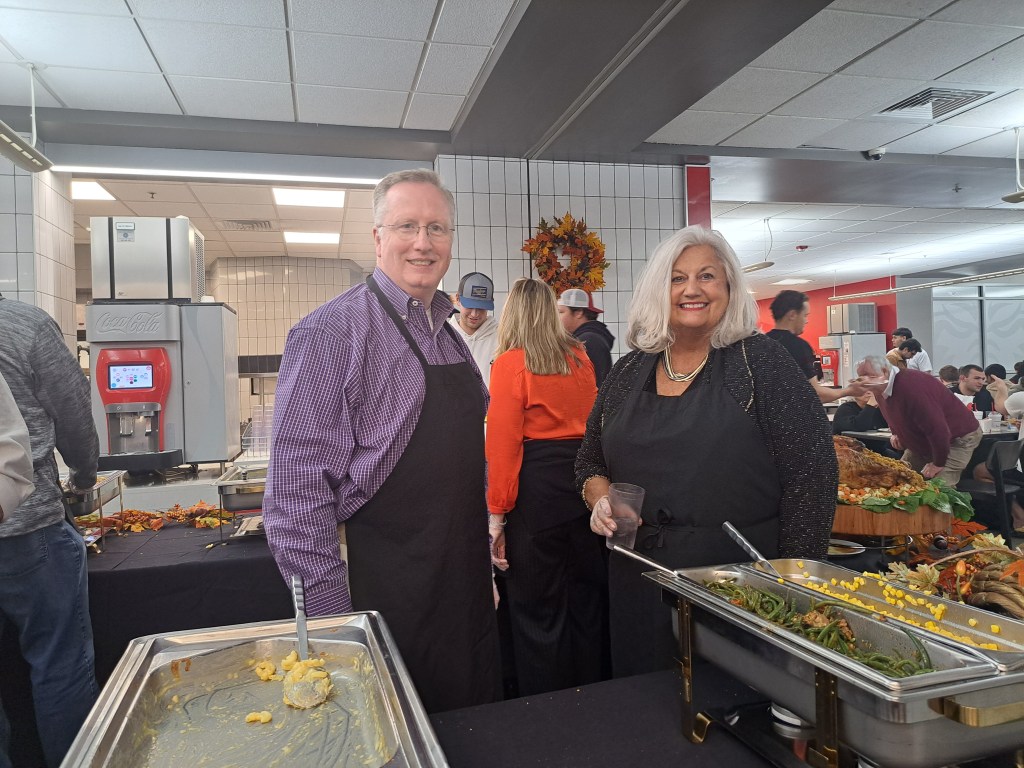
“For faculty, this gives them interactions outside of the classroom or outside of the offices,” Johnson said. “For our students, it gives them an opportunity to meet with faculty and staff in a different environment. It provides for those folks who can’t be able to go home for Thanksgiving.”

Emily Martin, a first-year nursing major from Viola, Arkansas, attended the Thanksgiving dinner. She said her favorite food served at the event was the macaroni and cheese, while her least favorite was the stuffing. Martin said the food lines never felt slow and the servers were very hospitable.

“We probably got here at a good time, we got in right after the initial people,” Martin said. “I had to go back and get mac and cheese because they were out, though.”
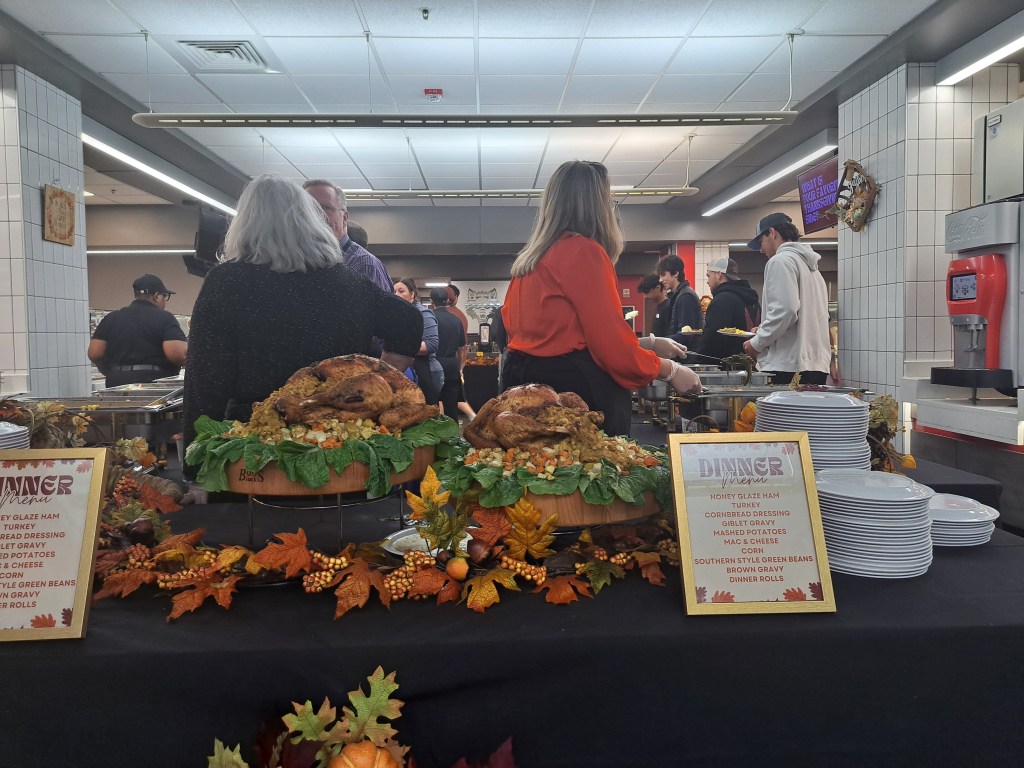
Yurizzia Macias, a first-year nursing major from Little Rock, said the food was great overall. She also said the stuffing was her least favorite food served at the event. She said while the food for the Thanksgiving dinner was being served in the middle of the Acansa Dining Hall, the space never felt claustrophobic and the food lines were never congested.

Johnson said he has helped plan the annual Thanksgiving dinner for 27 years. He said it was harder to find volunteers in the early 2000s. This year, Johnson said he had to turn people away because so many wanted to help.

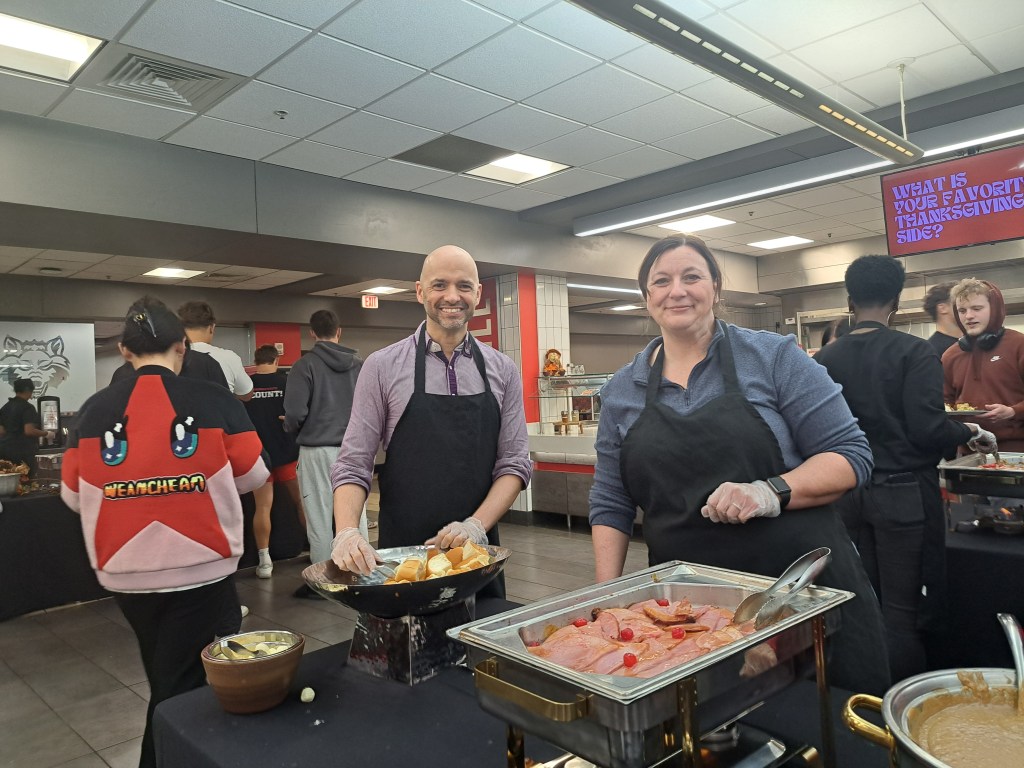
The volunteer coordinator said he sent an email at 9 a.m. asking faculty and staff to help with the event and by 9:19, the first shift of volunteers was already full.

43 volunteers comprising faculty and staff members helped serve food at the event. Johnson said volunteers receive no formal training other than guidance on giving equal food portion sizes to students.

“We really just put an apron on, put gloves on and say ‘serve’”, Johnson said.

The volunteer coordinator said 100 students were already through the line in only the first half hour of the event. He said he thinks the volunteers served about 600 to 650 students during the event.

Johnson said it was fun to see a full cafeteria again. He said A-State is still rebounding from COVID-19, which caused a drop in the on-campus student population

“I consider a place like this to be the heartbeat, where folks have the ability to engage and interact,” Johnson said.

Macias said she thinks the Thanksgiving dinner will have a positive impact on students, especially those who won’t be able to go home or see their family during Thanksgiving or Christmas break.

“If they see how it is all family-friendly, they will be more motivated to stay here,” Macias said.
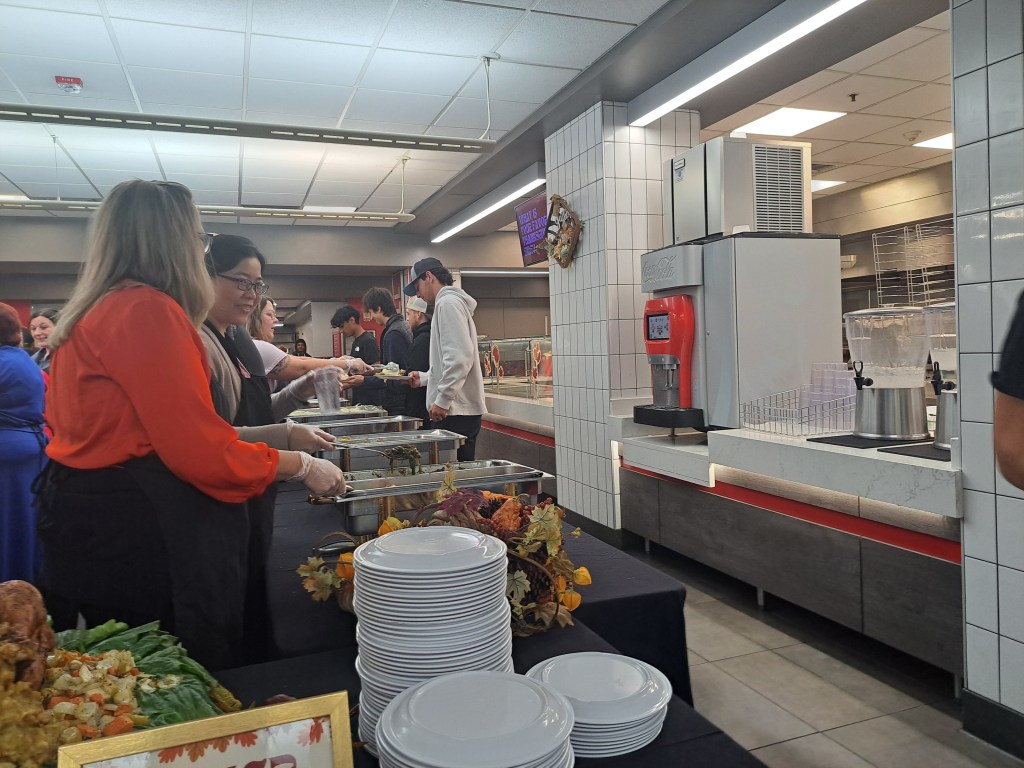
Johnson said he hopes the Thanksgiving dinner provided a warm holiday experience for students who cannot travel home while on break.

“I don’t think you can ever replace what it means to go home, we just can’t match that,” Johnson said. “But it does give that holiday feeling that you have during Thanksgiving.”

Johnson said since Thanksgiving is a holiday based on American history, some international students may not celebrate it. He said this event still serves to give these students another taste of American culture and what the holiday is all about.

Martin said while she enjoyed the event, she did notice areas that could be improved. Martin and Macias said having another table for serving food would have helped students get more food. Five volunteers couldn’t attend the event to help because they had the flu. Johnson said their absence didn’t affect the event very much because he probably had more volunteers than he needed anyway.
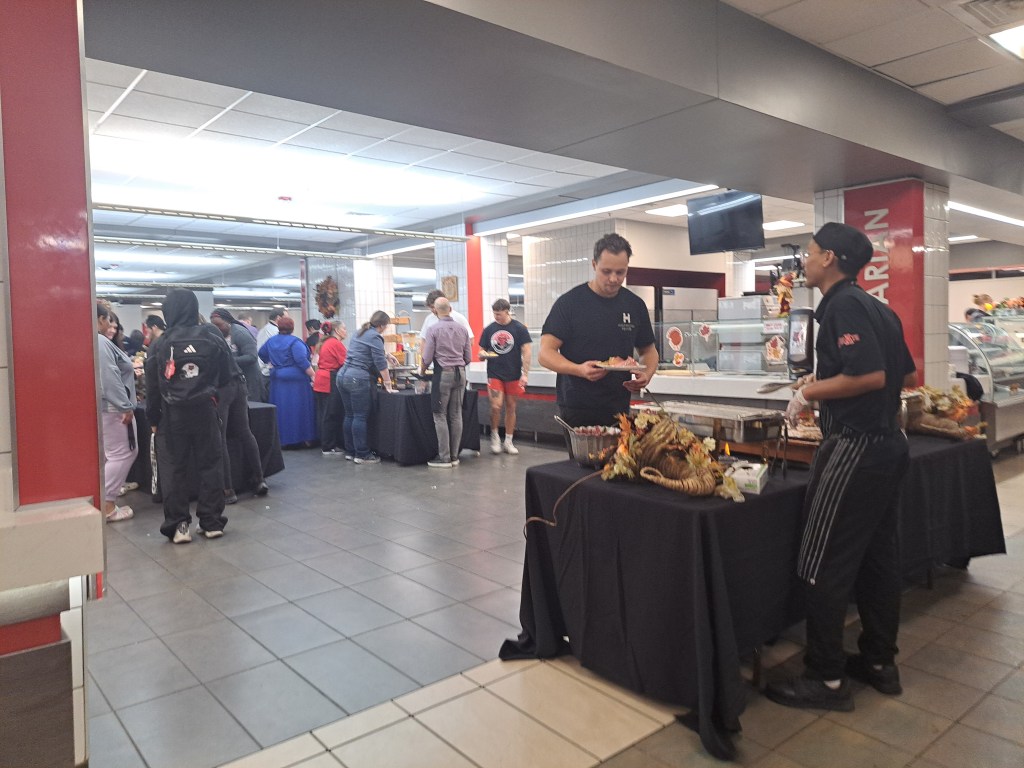
Johnson said he would like to see more food options served next year when the event is held again. He said he told the head of operations for the event he would particularly like to have candied yams available for students next year.

Macias said she would be interested in coming to the same event next year and similar events in the future.

Arkansas State ROTC to Induct Three into Hall of Heroes

JONESBORO – The Department of Military Science at Arkansas State University will induct three new members into the ROTC Hall of Heroes at the 28th annual ceremony, announced Lt. Col. Morgan Weatherly, professor of military science.

The induction will start at 9 a.m. Saturday, Nov. 23, in Cooper Alumni Center, 2600 Alumni Blvd.

The three to be honored with the prestigious recognition are Albert (Al) G. Martin, former Captain (Promotable), U.S. Army; Robert A. Barker, retired Colonel, U.S. Army; and Jerry W. Cheatom, retired Lieutenant Colonel, U.S. Army.

Following the ceremony, placards will be hung in the Hall of Heroes by the inductees. The honorees also will be recognized during halftime of the 2 p.m. Red Wolves football game against UL-Monroe at Centennial Bank Stadium.

All three are alumni of the ROTC program in the A-State Department of Military Science. Here are the profiles of this year’s inductees:

Albert (Al) G. Martin, Captain (Promotable), U.S. Army
Special Mission Force, Strategic Technical Directorate Assistance Team-158

Former Captain (Promotable) Al Martin is a native of Helena. In 1969, upon graduation from A-State with a degree in political science and as a member of Tau Kappa Epsilon fraternity, he was commissioned as a Distinguished Military Graduate into the Active Duty force as a Military Intelligence officer.

2nd Lt. Martin attended his MI Officer Basic Course and volunteered for Airborne and Special Forces training. As a lieutenant, he served with the 6th and 5th Special Forces Group (Airborne) at Fort Bragg, N.C. While there, he earned his Green Beret and completed U.S. Army Ranger School and Vietnamese language school prior to his deployment to Vietnam.

In Vietnam, 1st Lt. Martin served with Special Mission Force, Strategic Technical Directorate Assistance Team-158. SMF had a classified mission of POW, MIA, and Downed-Pilot Recovery. They also ran other non-classified company and platoon-size operations. SMF was composed of 124 indigenous mercenary Montagnards, 41 of which were in 1st Lt. Martin’s platoon.

Upon redeploying to the states, 1st Lt. Martin attended his MI Officer Advance Course and was promoted to captain. He then attended flight school to receive a rotary and fixed-wing pilot rating at Fort Rucker, AL. His follow-on assignment was with the First Army Security Agency Aviation Company (CEFIRM Leader) as the operations officer at Ft. Bliss, Texas. The unit flew modified U-21 aircraft with direction-finding, signal intelligence, and radio signal jamming capabilities.

Capt. Martin was reassigned to the 25th Infantry Division, 3/4 Cavalry at Schofield Barracks, Hawaii, as a rotary-wing pilot. Following his tour in Hawaii, Capt. Martin resigned his commission and began a 42-year career as a commercial real estate agent, in Honolulu, and Austin, Texas, retiring in 2019.

His awards and decorations include the Special Forces tab with Green Beret, Ranger tab, Combat Infantryman Badge, Aviator Wings, Senior Jump Wings and Jumpmaster Qualification, Bronze Star Medal, Air Medal (numeral “2”), Army Commendation Medal (1 OLC), Vietnam Service and Campaign Medals, Vietnam Cross of Gallantry w/Palm (Unit), and National Defense Service Medal.

Martin is a 100% Disabled American Veteran living with his wife, Joyce, in Austin. They have three children, and they now engage in Christian ministry and travel.

Robert A. Barker, Colonel, U.S. Army
Chief of Staff to the CG, Fort Gordon And Cyber Center of Excellence

Retired Col. Barker is a native of Jonesboro. In 1985, he was commissioned through the A-State ROTC program with a reserve commission as an Army Signal Corps officer. He graduated Arkansas State in 1986 with a degree in mechanical engineering.

Col. Barker was the Distinguished Honor Graduate of his Signal Officer Advance Course. He also completed Command and General Staff College (2000)—receiving an M.S. in computer resources and information technology (Webster University); the U.S. Army War College (2009)—earning an M.A. in strategic studies, and the U.S. Army War College Senior Leader Seminar (2014).

Col. Barker’s notable assignments include Operations Officer, Theater Communications Control Cell (TCCC) (Fwd), Dhahran, Saudi Arabia. As part of an eight-person Army cell operating at Khobar Towers in Dhahran the night of the Khobar Towers bombing, he was instrumental during recovery operations and the reactivation of the operations center after the terrorist attack. In 2004, he commanded the 63rd Signal Battalion during combat operations in Iraq. In 2008, Col. Barker was tasked to deploy to Moscow, Russia, in support of a Joint Operation’s exercise with the Russian General Staff to develop a working relationship with Russia for future joint operations. He served as the director, Concepts, Requirements, and Doctrine Division (CRDD) and the director, Capabilities Development Integration Division (CDID) of the Signal Center of Excellence, and was the garrison commander at Ft. Gordon, Ga. Col. Barker retired in 2016 as the chief of staff to the Commanding General Cyber Center of Excellence (CCoE) and Ft. Gordon, where he was directly involved in the activation of the CCoE, Cyber School, and the new command and control, and training facilities for Ft. Gordon to support the transition to Cyberspace Operations and the move of Army Cyber Command to Ft. Gordon. He wore the uniform for over 30 years.

His noteworthy awards and decorations include the Legion of Merit (1 OLC), Bronze Star (1 OLC), Defense Meritorious Service Medal, Meritorious Service Medal (1 Silver OLC), Air Force Achievement Medal with “V” Device, Joint Staff Officer’s Badge, and Basic Parachutist Badge.

Col. Barker now resides in Harrisburg with his wife Barbara and two granddaughters, Kya and Aunna. He manages the family business, Brasco Service Inc.

Jerry W. Cheatom, Lieutenant Colonel, U.S. Army
Director of Army Instruction, San Antonio Independent School District

Retired Lt. Col. Jerry Cheatom is a native of El Dorado. In 1976, upon graduation from Arkansas State University with a degree in printing technology, he was commissioned as a Distinguished Military Graduate into the Active Duty force as an Infantry officer. A recipient of the Distinguished Service Award, he was also the president of the Black Students Association and a member of Omega Psi Phi fraternity and Scabbard and Blade Military Society.

Lt. Col. Cheatom’s education includes a master’s degree in adult education (Kansas State University) and a master’s in school administration (Trinity University), as well as a doctorate in educational leadership (UT-San Antonio).

His senior level assignments included Space Surveillance Commander, Space Defense Commander, and Chief, Training Evaluations, Standardization, and Exercises, U.S. Space Command, Cheyenne Mountain Space Force Base, Colo.; and professor of military science, Florida Agriculture and Mechanical University, Tallahassee.

Lt. Col. Cheatom has served an additional 22 years in uniform with JROTC as Senior Army Instructor (SAI) at Theodore Roosevelt and Sam Houston High Schools in San Antonio, and as director of Army Instruction for San Antonio Independent School District, where he continues service today. He also served as assistant principal for five years at Roosevelt High. He concurrently serves as a senior counselor for Texas American Legion Boys State and is a member of the Alamo Area, Texas, and National Alliances of Black School Educators. In essence, Lt. Col. Cheatom transformed 21 years of military experience into 27 years and counting of youth mentorship.

His awards include the Ranger Tab, Expert Infantry Badge, Basic Parachutist Badge, Air Assault Badge, and U.S. Army Space Operations Badge.

His civilian awards and recognitions include the North East Independent School District Superintendent’s Award, induction into Phi Delta Kappa Educators Hall of Fame, the Lifetime Achievement Award, Psi Alpha Chapter of Omega Psi Phi Fraternity, National Board of Rocks Incorporated Chairman’s Award for Exceptional Service, and Rocks Incorporated Robert B. Burke Award.

Lt. Col. Cheatom and his wife Judith are the parents of four daughters—Keyna, Amber, Mila and Asante, and five grandchildren—Quinten, Camryn Lane, Grayson, Julius and Cassian.

New Arkansas State University website coming in 2025

Arkansas State University is in the process of creating the next Astate.edu website which is set to launch summer 2025.

Todd Clark, chief marketing and communications officer and member of the website redesign committee, said the website is the front door of A-State.

“Oftentimes it’s our students’ first experience with A-State, so we want to make sure we’re showcasing the university in the best light,” Clark said.

Clark said a university website lasts five to six years, and Astate.edu was last redesigned in 2012.

The committee is building the website from the ground up with external partner iFactory, a digital marketing agency specializing in higher education. They are also in collaboration with Modern Campus, a company that provides software and web content management services for higher education institutions.

“We’ve just so radically changed in the last twelve years that we had to go back and just kind of, for lack of a better word, blow it up and start over,” Melanie Wicinski, associate vice chancellor for accreditation and assessment and member of the website redesign committee, said.

Justin Coats, a junior computer science major from Cherry Valley, Arkansas, said the current website is good at overall presentation, but does a lackluster job at purveying information.

“I find that I often get lost on it. So when I heard that they were recreating the website I was certainly happy about it, because it definitely needs updating,” Coats said.

Coats said he often goes on the website to look for his class bulletins but can’t find them because they’re hidden so deep within sub pages. He said it’s difficult to find databases on the website unless his professors link directly them.

“The databases and the bulletins are both so important and they’re just kind of sandwiched in the middle of nowhere in the website,” Coats said. “I think that definitely is a symptom of having so many pages that are just thrown about and added post making a main framework of the website, as opposed to considering all of that at one time and then designing the website.”

Priorities for the new website include having program pages with more dynamic information, the ability for faculty to update these pages with ease, an accessible mobile-first design and removing the a-z index.

Wicinski said the a-z index is a crutch for faculty and staff and a well-designed website shouldn’t need one.

“I would die on the hill that we should not have to have an A to Z index,” Wicinski said.

Clark said the biggest issue with the current website is its age and how bloated it is. He said the Astate.edu domain has about 40,000 pages of information.

Clark and Wicinski hosted an open forum to provide an update on the project and share prototype designs.

Jim Washam, Neil Griffin College of Business dean, attended the open forum. He said he wanted to see what the new website was going to look like so he could start planning a layout for the new College of Business page.

Washam said the current website has too much clutter.

“I think building the new website will help us clean out a whole lot of that clutter and streamline things,” Washam said. “So I’m excited about that.”

Clark said iFactory audited every page of content on the A-State website.

“We went through and inventoried our content and audited as a committee to figure out how we can try to really reduce the amount of pages,” Clark said. “There’s no need for A-State to have 40,000 pages. If we can cut that down to 10,000 it’d be great, 5000 would be even better.”

Washam said the website redesign committee should prioritize a combination of design and content to catch people’s eye and lead them to the information they need.

Wicinski said the redesign in 2012 cost over $200,000 and the committee will keep the new website continually updated to avoid having to redesign the website in five years.

To increase governance among faculty, the committee will implement transparent rules, expectations and guidelines for updating the website.

“Modern campus has tools that will remind faculty and staff when content is dated. The new system we’re migrating to will really help us make sure that we can keep this website current,” Clark said.  “If we see a section of the website hasn’t been maintained properly or is way out of date, we’ll know who on campus is responsible for updating that information and we can work with them, work with those people to get updated.”

Clark said faculty and staff can prepare for the website launch by taking a look at the pages they have now, taking inventory of outdated information or broken links, auditing employees, getting involved in building directories and putting together a small team who have ownership accountability for their pages.

The chief marketing and communications officer said hosting the open forums is important for transparency and so the committee can receive feedback.

“The university website has so many different layers and audiences, everything from the department of biological science to the library to the A-State museum, all these users use the website differently and have different types of content,” Clark said. “It’s good to get that kind of open opinion from everyone so, as we move forward with the project, we’re best informed.”

Clark said the feedback so far has been overwhelmingly positive.

“I think people are excited about the new website, the new look and I know our campus users are excited about the ease and functionality,” Clark said.

Construction underway on new Wynne High School

Story by DDNS Reporter Jerry Burton

Construction has begun on a new high school in the Wynne School District, more than a year
after an EF-3 tornado destroyed most of the campus. Faculty and staff are expected to transition to the new building in early 2027, assuming no delays.

Currently, site prep and dirt work for the area where the building will be constructed is complete.
Dusty Meek, Wynne senior high school principal, said contractors will bid for the concrete and
foundational construction soon. He said the rest of the bidding process will happen in January.
Aaron Russell, Wynne school district communications officer, said he thinks the reopening of the
high school will be a day of healing for the community.

“The high school is the heart and soul of a community, and losing one creates a huge missing
piece,” Russell said. “We hope that by re-opening our high school campus, we can heal that
scar and the new Wynne High School will serve as a new beginning and a lasting memorial to
the old campus.”

Meek said the new building will feature several upgrades, including a modern cafeteria, media
center, auditorium and internal courtyard. He said the building will also contain multiple stories,
which will help most facilities stay clustered, instead of being spread out. Russell said the
design will give students a more collegiate feel, with multiple indoor and outdoor learning
spaces and bright, open interiors.

The high school principal said the reconstruction is based on current enrollment to meet
eligibility requirements for insurance and state funds. Nevertheless, he said the new building
was designed in mind for future additions, if needed.

Russell also said the school will have storm shelters and safe rooms to ensure the staff and
students are protected from any future hazardous weather events.

The communications director said the school and architects met with faculty, staff and
community members in multiple interest meetings to learn what they would like to see
incorporated into the new building. He said there is a lot of excitement among the community
associated with the construction.

“The modern look and the spaces included are something unique to our area and we feel we will
be a huge draw for faculty, staff and future students,” Russell said.
However, Meek said not every suggestion will be incorporated in the reconstruction. He said
decisions will be made after the bids are finalized to see what will fit within the budget.

“Ultimately, like everything else, it comes down to affordability,” Meek said. “There are probably some things that people would love to see in it that we either didn’t have in the old buildings, so therefore it’s not going to be replaced, or it’s things that are not cost-effective.”

When designing the look of the new school, Russell said the district tried creating a campus that
integrated the Wynne brand and identity. Renderings of the new building showcase a campus
with highlights of the school’s blue and gold colors. The new building also incorporates Wynne’s
mascot, the yellowjacket, in its design. Meek said they also wanted easily identifiable front entrances and the ability to section off parts of the school for different events.

The high school principal said insurance will help with part of the funding for reconstruction and
the district is looking for further support from state partnerships and FEMA.
Kenneth Moore, Wynne school district superintendent, said cost estimates cannot be released
because insurance negotiations are still ongoing.
Russell said weather is the biggest challenge the school has faced in the reconstruction process.

“The things we cannot control provide the most significant challenges,” Russell said. “We are in
constant contact with our architect and contractor to limit delays.”

Meek said another challenge is monitoring the reconstruction project while also actively running
the temporary campus, where the Wynne High School is operating following the tornado.
Meek said the new high school building will be very exciting for the community and he hopes it
raises morale. He said moving from the temporary campus to a 21st-century building with
modern amenities will be very exciting.

“Just having indoor restrooms will be exciting for most of us, because everything we have now
you have to travel outside to it,” Meek said. “It’ll be really exciting at the time but, just like
anything else that you find, once you get into it, it just becomes your norm.”

Despite the excitement, Meek said the students who experienced the tornado and will graduate
before the construction is complete must not be forgotten. He said these students will likely never set foot in the new building and bringing it up reminds them of bad memories, so they
don’t discuss it often.

“One of the things that we’ve tried to do is provide as close to a real experience as we can on
this campus and make this campus a home in itself and understand that this is their high
school,” Meek said. “This is what they’re going to graduate from, let’s make memories here.”
Moore said he wants students to enter the new building and see a fresh start that will lead to
new memories.

Russell and Meek said they want to give their students the best opportunities possible, provide
a positive culture on campus and want them excited about coming to school.

“The biggest hope is that we will return to normalcy and continue to grow as a school and
community,” Russell said. “A disaster is a challenging time. You learn a lot about resilience and
strength. Seeing how our faculty, staff, and students carried that burden and overcame it has
been nothing short of inspirational.”

ASU Trustees Approve $30.6 Million Bond Issue to Finance New A-State Veterinary School Facility

LITTLE ROCK — The Arkansas State University System Board of Trustees today in a special meeting approved a $30.6 million bond issue to finance construction for the new College of Veterinary Medicine at the A-State campus in Jonesboro.

Design and construction of the College of Veterinary Medicine facility is estimated at $33.2 million. The university plans to finance the building through the issuance of taxable Student Fee Revenue Bonds and use of institutional reserve funds. Tuition and fees from CVM students will ultimately fund debt service for the construction.

The move follows a recent consultative site visit by the American Veterinary Medical Association’s Council on Education, which reviewed A-State’s progress on facilities, policies and personnel for the college. The university plans to admit its first cohort of students in 2026 in what would become the state’s only public vet school.

The bond funding plan also allows for the refunding and reissuance of $11.6 million in existing student fee revenue bonds that were used for capital improvements on the A-State campus. The total 30-year bond issue must have an interest cost of no more than 7%, and the refunding must produce a savings of at least 4%.

Stephens Inc. and Crews & Associates Inc. will serve as bond underwriters. PFM Financial Advisors LLC is the financial advisor, and Friday, Eldredge & Clark is the bond counsel. 

In other action, the board authorized Henderson State University to explore the disposition of three university-owned houses as part of its efforts to pursue cost savings and future growth.

The properties in Arkadelphia include the Ramsauer House at 327 North 11th Street, the Smith Garner House at 324 North 12th Street and the Evans Street House/Lot at 1228/1226 Evans Street.

Disposition may include the sale of each property, which would require surveys and appraisals.

Arkansas State Red Wolves Bowl-Eligible after Georgia State Win

Photos and story courtesy of Cooper Melder and Tristan Harlen/ASU-TV Red Wolf Roundtable

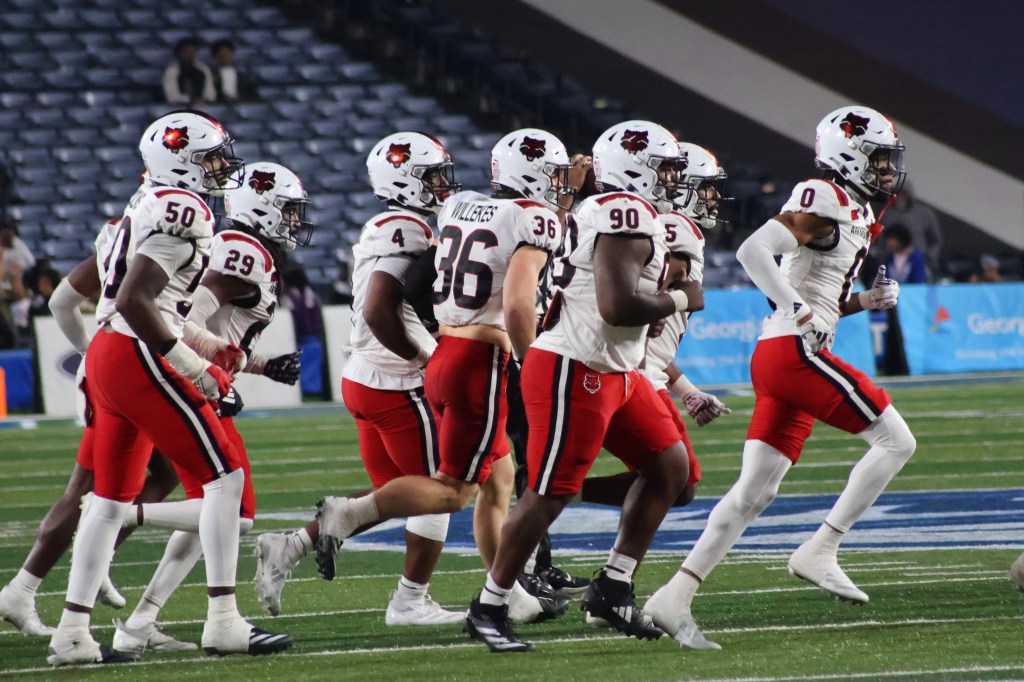
The Arkansas State Red Wolves secured bowl eligibility for the second-consecutive season by defeating the Georgia State Panthers this past Saturday, 27-20, behind a dominate performance by the Red Wolves’ run game. The Red Wolves’ running game would account for 261 total yards of offense and three touchdowns against the Panthers at Center Parc Stadium in Atlanta, Georgia.

With the win, Arkansas State moves to 6-4 on the season with their final two games of the season at home against Louisiana-Monroe and Old Dominion.

A-State quarterback Jaylon Raynor lead the Red Wolves with 97 passing yards and 114 rushing yards on the night.  Red Wolves’ running back Zak Wallace lead the team with two touchdowns, while running the ball for 62 yards.

The first half did not start well for A-State as the Red Wolves could not capitalize on a 10-play, 40-yard opening drive as they were stopped on a forth and short distance down to come up empty-handed on their first possession of the game. Georgia State would then take the ball on the ensuing possession and score the game’s first touchdown on a 24-yard pass from Zach Gibson to Ted Hurst, giving the Panthers a 7-0 lead. A-State quarterback Jaylen Raynor would lead the Red Wolves with the ground game late in the first quarter, putting up 58 yards on the ground in leading Arkansas State to tie the game at 7-7 when running back Zak Wallace would also use his running abilities on a 13-yard touchdown with 3:34 left in the first quarter.

 A Red Wolves’ interception by Justin Parks would halt an 11-play, 45-yard drive by Georgia State in the second quarter. Parks’ second interception of the season would keep the score at 7-7.

At halftime with the score 7-7, Arkansas State’s offense would only account for 176 yards of total offense and 29 passing yards. Before halftime, Georgia State starting quarterback Gibson would suffer a leg injury and would be replaced by backup quarterback Christian Veilleux.

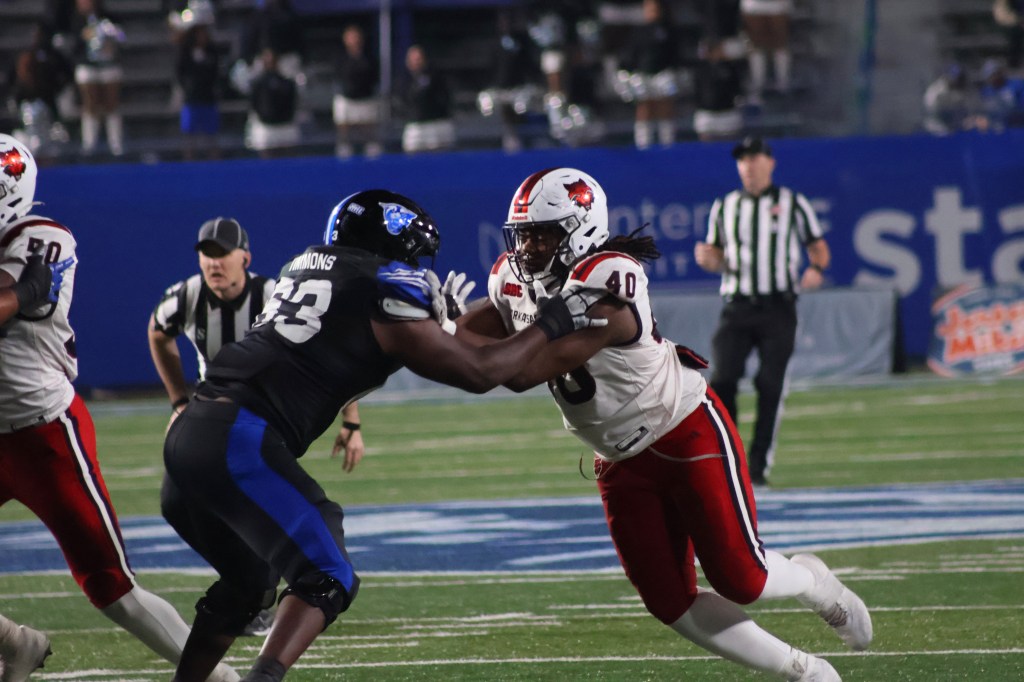
Arkansas State’s defense made key stops to secure the win.

The second half started with Arkansas State’s defense keeping Georgia State from scoring on the opening drive, highlighted by a key stop by Charles Willekes on a fourth and short to halt the Panthers. The Red Wolves would capitalize on the turnover on downs with a Zak Wallace one-yard touchdown to give A-State a 14-7 left with 9:32 left in the third.

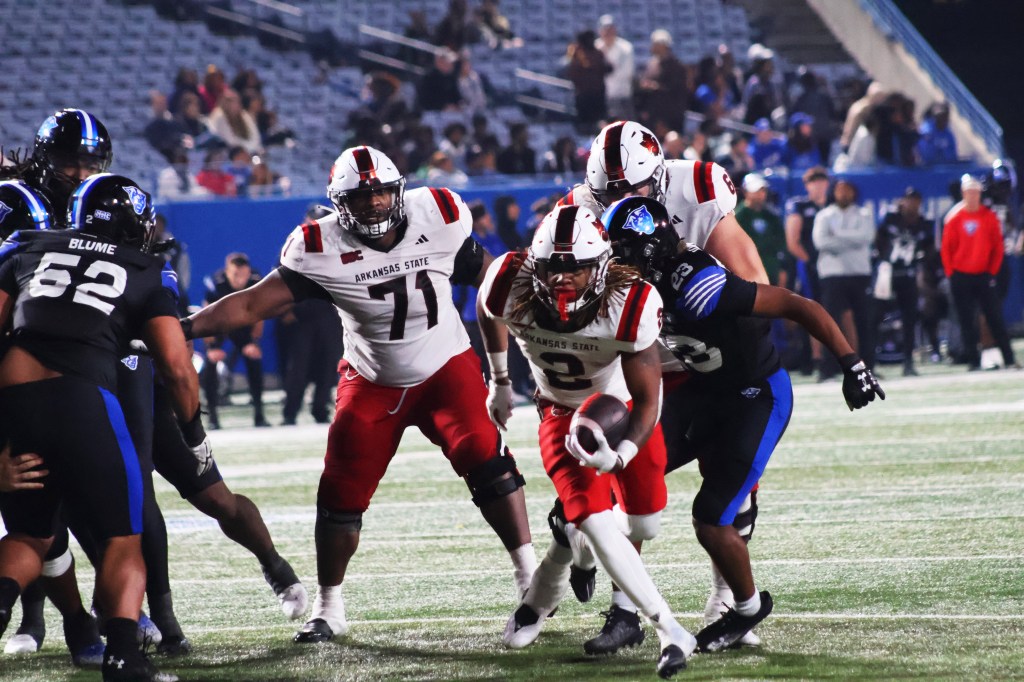
The Red Wolves’ offense would be in sync all throughout the second half, outscoring Georgia State, 20-13 in the third and fourth quarters, to secure the win. Touchdowns by running backs Wallace and Ja’Quez Cross would end up putting the Red Wolves in the win column in Atlanta.

Arkansas State running back Ja’Quez cross on the move.
Ja’Quez Cross celebrates after a key touchdown for the Red Wolves.

While Georgia State outgained the Red Wolves in total offensive yards, 419-336, the Red Wolves would out rush the Panthers, 261-73. The A-State defense would sack Georgia State quarterbacks twice and force two interceptions in the win.

The Red Wolves will be back in action on Saturday, November 23, as they take on the Louisiana-Monroe Warhawks at 2 PM at Centennial Bank Stadium.

Ridgefield Christian Academy’s Evan Ellenburg featured for DDNS

By Garrett Finnicum for Delta Digital News Service

Garrett: Hello everyone, my name is Garrett Finnicum. Today, we take you behind the scenes with Evan Ellenburg, a senior standout from Ridgefield Christian and a true “Warrior” on the basketball court. With his sights set on playing at the college level, Evan’s journey is about more than just stats. It’s a story of passion, resilience, and leadership.

Garrett: Evan’s commitment to the game goes beyond high school. He is driven by a dream to play college basketball, a goal he has worked towards since he first stepped on the court. This is the next chapter in his story, one he is ready to face with unshakeable dedication.

Garrett: On the court, Evan’s strengths shine through. His ability to sink tough shots and tenacity on defense make him a formidable opponent, but he is also a player who acknowledges where he can grow, always striving to sharpen his skills and refine his game.

Garrett’s question: So, what are some short-term goals that you would like to accomplish before the season begins, or going back to what you were working on during the offseason?

Evan’s answer: Getting stronger is something a lot of teams have pushed us to do, and it’s something I need to be as well.

Garrett’s question: Are there any specific skills you didn’t have last year that you want to improve this year, going into your senior season?

Evan’s answer: I think getting to the rim a lot more, just going in, creating contact, and finishing.

Garrett’s question: So those are kind of talking about your weaknesses. What strengths would you say you have on the court?

Evan’s answer: Shooting. I think I’m a pretty good shooter, and I can see the floor and make the right pass, which I think helps us out a lot.

Garrett: As a senior, Evan has taken on the role of a mentor, guiding younger teammates with a steady hand and a positive example.

Evan: Just telling them what’s expected and showing them, since they don’t have the most experience, and just showing them what to do.

Garrett: At the core of Evan’s drive is a deep sense of purpose. His motivation comes not just from his dreams of college basketball, but from the support of his family, teammates, and coaches. Every practice, every game, is a step towards proving to himself what he is capable of achieving.

Garrett: With his senior year in full swing, Evan Ellenburg is ready to leave his mark for Ridgefield Christian and improve on his individual stats from his junior season, as shown on the screen: averaging 15.3 PPG, 2.8 APG, and 5.3 RPG.

Garrett: He is more than just a player, he’s a leader, a motivator, and a Warrior. The future looks bright for Evan and any team lucky enough to have him will gain not only a talent player, but a true team leader.

Team: Be humble, be hungry.


Applications Open for Hemingway-Pfeiffer Writer-In-Residence Program

PIGGOTT – The Hemingway-Pfeiffer Museum and Educational Center in Piggott is announcing its 2025 writer-in-residence position.

The residency will be for June 1-30, 2025, and includes lodging at a loft apartment over the City Market coffee shop on the downtown square in Piggott.

The writer-in-residence will be able to work in the studio where Ernest Hemingway worked on “A Farewell to Arms” during an extended stay with his wife’s family in 1928. The residency includes a $1,000 stipend to help cover food and transportation.

“The writer-in-residence will be expected to serve as a mentor for a week-long retreat for writers at the educational center,” stated Dr. Adam Long, executive director of the A-State heritage sites.

This retreat will be open to eight to 10 writers from the region. The recipient may be asked to hold one or two readings of his/her work. The remainder of the month will be free to the writer-in-residence to work on his/her work.

Candidates with a Master of Arts or Master of Fine Arts in a relevant field are preferred.

Applicants should send a cover letter, curriculum vitae (CV), and writing sample of roughly 20 pages, in any genre, to Long at adamlong@AState.edu by Feb. 28, 2025.

Questions about the program can be directed to Long. For more information about the museum or lodging (the Inn at Piggott), one may visit Hemingway.AState.edu.

Incomplete applications cannot be accepted. Due to the expected high volume of applications, confirmation of receipt of applications cannot be guaranteed.

The writer-in-residence program is made possible through underwriting sponsorship by Piggott State Bank.

The Hemingway-Pfeiffer Museum and Educational Center, an Arkansas State University Heritage Site, contributes to the understanding of the regional, national and global history of the 1920s and 1930s eras by focusing on the internationally connected Pfeiffer family of Piggott and their son-in-law and regular guest Ernest Hemingway.

This includes drawing on Hemingway’s influence as a noted American author to foster interest in literature and the arts and promote excellence in both.

Women’s Business Leadership Center Adds Director of Student Engagement and Leadership

JONESBORO – The Women’s Business Leadership Center (WBLC) at Arkansas State University strives to positively impact the lives and futures of young women on campus. The center, founded in 2016, provides many opportunities for ladies attending the university including mentoring, scholarships, internships and other educational opportunities.  

“This year has been one of rapid growth and change,” said Dr. Patricia Quinn Robertson Johnston, executive director of the Women’s Business Leadership Center. 
 
Johnston said they have added Gwennette Confer in a new position as director of student engagement and outreach.  
 
“I want to focus on building strong, meaningful connections between students, mentors and the broader community,” said Confer. 
 
Confer said she will work to create and facilitate a wide range of opportunities for student engagement, including leadership academies, mentoring events, conferences, workshops and retreats. 
 
“A significant part of my work will be leading initiatives that connect university students, high school and junior high girls to participate in leadership development at an early stage. Additionally, I will oversee WBLC service projects, ensuring leadership interns gain valuable, hands-on learning experiences,” she continued.  
 

The number of students who participate in the variety of programs offered by WBLC has quadrupled. Students across campus from different majors have been part of programs such as step up, reach back; career readiness; service project “Leadership Interns” and scholarships.  

This year, 23 students traveled to New York and 11 students traveled to Atlanta for a conference this month.  
 
“Since 2016 we have provided thousands of hours of mentoring and career preparation for WBLC Leadership Interns who are A-State students,” Johnston added. 
 
The annual Women’s Leadership Conference, which is free for all attendees, usually hosts about 500 people including high school students, college students and professionals. 

“I want students to know that the WBLC is a welcoming and inclusive space where they can grow both personally and professionally, regardless of their major. While the center focuses on leadership development, it is open to all students, not just those in business-related fields,” Confer added.   

She added that they typically award more than 20 scholarships each year and expect the funding for those scholarships to continue to grow.  
 
More information on the WBLC may be found at AState.edu/wblc.