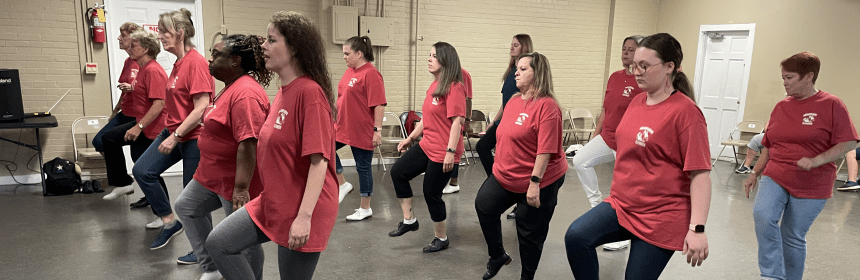
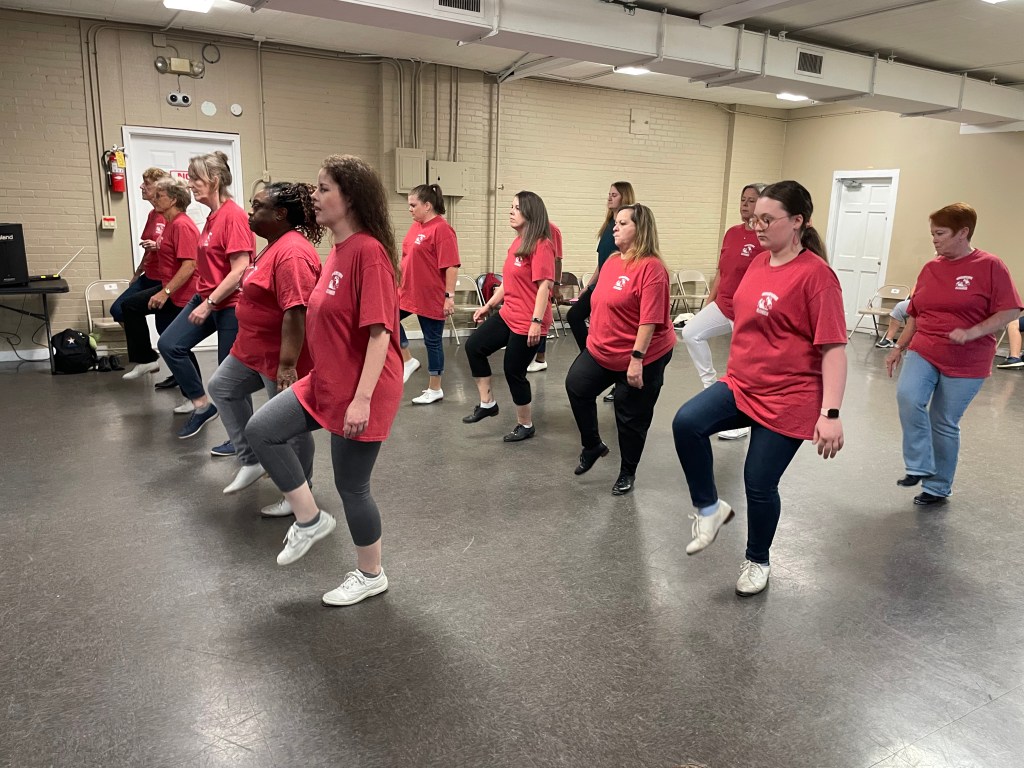
JONESBORO, Ark. – The Crowley Ridge Cloggers have began an 8-week cycle of beginner classes for people interested in the dance stye. The first held last month is just the first in an 8-week session of lessons that will prepare dancers for upcoming events.
First established in 1980, the dance group competes at both the regional and national level. events and competitions. The group transitioned to clogging from square dancing.
Leona Miller and Kathey Wilson are the instructors of the group. They are both certified clogging instructors by the National Clogging Organization. Both have been with the group since its inception.
Every Tuesday, the group meets to practice at the Earl Bell Community Center in Jonesboro. Practice begins at 6 p.m. and usually last a couple of hours.
“We’re trying to teach these young ones…” Wilson said. “It is an American folk dance, a tradition that we love.”
“It’s a good family activity that typically anybody can do,” Miller said. “You can do it on any level. Start out as a beginner, and some people never get past that and they don’t want to.”
Before the COVID-19 pandemic, the group had a seniors only group . Most participants within the group were 70 years old and up.
Although seniors continue to perform, clogging is not age-specific. Miller said they have had hundreds of people cycling through the group. They don’t have many kids right now but have had them in the past.
In the beginner classes, students learn the basic steps that are the foundation of clogging. Upon completion, participants earn a graduation certificate and the opportunity to join the team for events, workshops, and competitions.
Currently, the group consists of 14 active dancers that put on community performances and workshops, alongside competitions.
They do several events per year. They most recently attended The Arkansas Traveler Workshop in Mountain View and did a performance at The Bungalows, a senior living community in Jonesboro.
Th is fall, the group is set to perform at the Arkansas Rice Festival in Weiner, the Arkansas State Fair in Little Rock, The Harvest Festival in Bono, and the Foothills Festival in Black Rock.
Veteran member Shaina Morgan is pursuing her certification as a clogging instructor. She’s been clogging for 32 years and has been with the team since she was a kid.
Morgan developed a love for the dance while clogging as a child alongside her mother. The duo will often pair together in competitions.
As an instructor, Morgan hopes to not only teach, but share the love of clogging. “I think the main thing is…being able to share my love for clogging and just how fun it can be,” she said. ” I don’t think anyone realizes just how good it is to dance…clogging has always kind of been like a therapy for me.”
“I think the main thing is…being able to share my love for clogging and just how fun it can be. I don’t think anyone realizes just how good it is to dance…clogging has always kind of been like a therapy for me.”
– Shaina Morgan, NEA Clogger
After certification, Morgan plans to stay with the Crowley Ridge Cloggers and become involved with teaching workshops at bluegrass festivals.
“[I just want to] keep it relevant, keep it where people actually know what clogging is and be able to partake…in that whole experience, even if it doesn’t mean that they get to go dance with the team,” Morgan said. “…Maybe it will get them motivated to go find a team in their town to just bring some attention to it.”
-30-
Avery Jones is a junior in the Department of English and Philosophy at Arkansas State University in Jonesboro. She can be reached at: averysjones@protonmail.com
JONESBORO, Ark. – At 6-months-old, Juanita Acosta moved with her family from Colombia to Arkansas. Growing up, people often mistook her for being Mexican. Since then, she embraced diversity and an understanding of different cultures and feels proud of her Hispanic heritage.
Currently Acosta serves as the project manager and community navigator supervisor at El Centro Hispano, a nonprofit organization serving the Hispanic community of Northeast Arkansas.
Acosta has been working with El Centro Hispano to organize events for recognition and celebration of Hispanic Heritage Month.
From Zumba classes and festivals, to parties and vaccination drives, residents of Jonesboro can celebrate Hispanic Heritage Month in a variety of different ways. These events not only honor Hispanic heritage, but will also provide a space for anyone to learn about Hispanic cultures.
“Hispanic Heritage Month is Sept. 15 to Oct. 15 and it’s interesting because it’s also around the time of independence for different Latin American countries,” Acosta said.
“Hispanic Heritage Month is Sept. 15 to Oct. 15 and it’s interesting because it’s also around the time of independence for different Latin American countries,”
Juanita Acosta
Costa Rica, El Salvador, Guatemala and Nicaragua celebrate independence Sept. 15. Mexico celebrates independence Sept. 16 and Chile celebrates independence Sept. 18.
El Centro Hispano will begin offering Zumba classes Sept. 16 from 9:30-10:30 a.m. at Union Park Pavilion, next to United Way at 407 Union St. The classes will be open to the public.
Acosta said El Centro Hispano saw a need for community and connection, as well as health issues, which sparked the idea for the classes.
Salsa for Scholarships, an event under the NEA Professional Network Committee, will also be held Sept. 16 from 9 p.m. to 2 a.m. at Brickhouse. This event will be $20 per person and feature a live DJ and Latin dancing.
“It’s a good opportunity to go meet other Hispanics in the area,” Acosta said, “and raise funds for scholarships for students in Northeast Arkansas.”
The Craighead County Jonesboro Library invited El Centro Hispano to do readings and participate in a festival honoring Hispanic Heritage Month.
Claudia Fuentes, the programs coordinator at El Centro Hispano, said each week they will choose a Spanish children’s book to read.
Chrissy Holbrook, the public relations and marketing manager at the Craighead County Jonesboro Public Library, said this will be the first time the library will be hosting a Hispanic Heritage Month Festival.
Previously, the library held the Arts & Crafts fair twice a year, but they decided to focus on certain themes.
“In May, we did it for the Asian Pacific (American Heritage Month). So, for September, we wanted to do the Hispanic Heritage Month,” Holbrook said.
“In May, we did it for the Asian Pacific (American Heritage Month). So, for September, we wanted to do the Hispanic Heritage Month,”
Chrissy Holbrook, PR and Marketing director for the Craighead County Jonesboro Public Library
The festival will be Sept. 23 from 10 a.m. to 2 p.m. Local food and craft vendors will set up booths and there will be Hispanic storytime in English and Spanish.
El Centro Hispano is partnering with Southern Pharmacy to provide COVID-19 vaccines at the festival.
“We’ve seen that sometimes with minority communities, they can be kind of scared to go to a pharmacy and be unsure– like not knowing if they have health insurance or not sure if they’re going to be treated right– stuff like that. So, we always try to find ways to create accessibility,” Acosta said.
El Centro Hispano will be posting more information and updates on their Facebook and Instagram pages.
In addition to celebrations through El Centro Hispano, organizations on the campus of Arkansas State University also plan to host events to honor Hispanic Heritage Month.
The Multicultural Center, Hermana y Hermano and Hermandad de Sigma Iota Alpha, Incorporada will be partnering together to host El Grito. The event will include food, games and dancing.
Heidy Bulbarela-Hernandez, a junior graphic design major from Stuttgart, Arkansas, serves as the co-social and community service chair for SIA, the Latin-based sorority on A-State campus.
“(El Grito) will be a sort of party in Centennial (Hall) and we’re going to do sort of like everything– some games, we plan to have some dancers and dance instructors and music,” Bulbarela-Hernandez said.
The event will be Sept. 15 from 6-8 p.m. at Centennial Hall in the Reng Student Union.
The sorority will also host SIA Week Sept. 25-29.
“We’ll be having a bonfire Sept. 26 for Meeting the SIAs and then (Sept. 27) is Roses with Teacher Supplies, which is our community service. Then (Sept. 28) is Cantaritos which is an educational event where we will be painting plant pots. So, it’s just a part of a bonding activity,” Bulbarela-Hernandez said.
SIA will host Spanish Around the World Oct. 12 to educate about the language and Spanish-speaking cultures.
“We should be learning Spanish and about the Spanish language in different countries– Spain, Portugal, in Latin America– and how that’s changed over time and how each one is unique in its own,” Bulbarela-Hernandez said.
SIA will be posting more information and updates on their Instagram page.
The Multicultural Center will host a Hispanic Heritage Month party Oct. 12 on the first floor of the Reng Student Union from 11 a.m. to 1 p.m. There will be a DJ, food and crafts.
Natan Gomez, a senior biotechnology major from Irapuato, Mexico, serves as president of Hermana y Hermano on A-State campus. The organization provides mentorship for students from all backgrounds.
Hermana y Hermano plans to organize more events for Hispanic Heritage Month. For updates, check out their Instagram page.
Trinity Haynes, the education program coordinator at the Multicultural Center, said she tried to make an effort to ensure the Hispanic population at A-State felt appreciated and celebrated during Hispanic Heritage Month.
“ I know being on a campus where a lot of people don’t look like you. It may not always feel like you’re being appreciated or you’re not being celebrated correctly,” Haynes said. “I really hope from this month, they get out of it that we do appreciate them. We love having them here on campus.”
Carolina Elmore, assistant director of El Centro Hispano, said Hispanic Heritage Month recognizes what the Hispanic community contributes to the culture in the United States.
“That’s what the month is, you know, the Hispanic families living here and how much they have contributed to culture,” Elmore said.
Elmore mentioned sports, history and music as areas of influence from the Hispanic community. Fuentes added food as a major contribution.
“So, I think what makes me proud being a Hispanic is that there are so many things we can bring. You know, we tend to be very happy people. We all were hard workers. We like to do our best,” Acosta said.
Elmore said many people in Northeast Arkansas assume all Hispanics come from Mexico or immigrated illegally, but she wants people to know Hispanics come from diverse backgrounds and many work as professionals in the community.
According to the 2020 US Census, Hispanics account for 8.5% of the population of Arkansas, a 38.1% increase since 2010.
“We’re having more and more people arrive to rural areas like Jonesboro, or like maybe Wynne, areas where you wouldn’t even think of there being Hispanics. So, you have to find a way to incorporate those communities and see how we can all come together to be better people to be better as a whole,” Acosta said.
Caroline Cherry Averittis a junior at Arkansas State University from Jonesboro, Arkansas. Her major is multimedia journalism with a minor in writing studies concentrating in creative writing. She can be reached at: caroline.averitt@smail.astate.edu
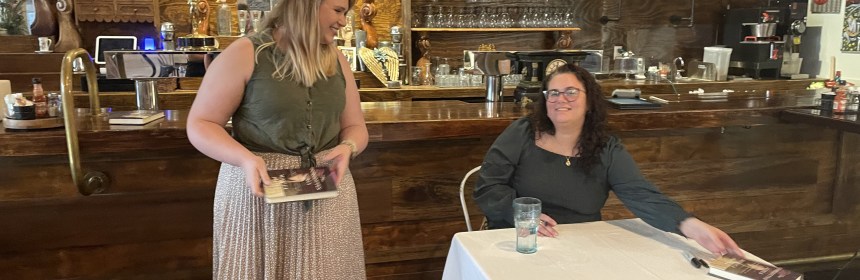
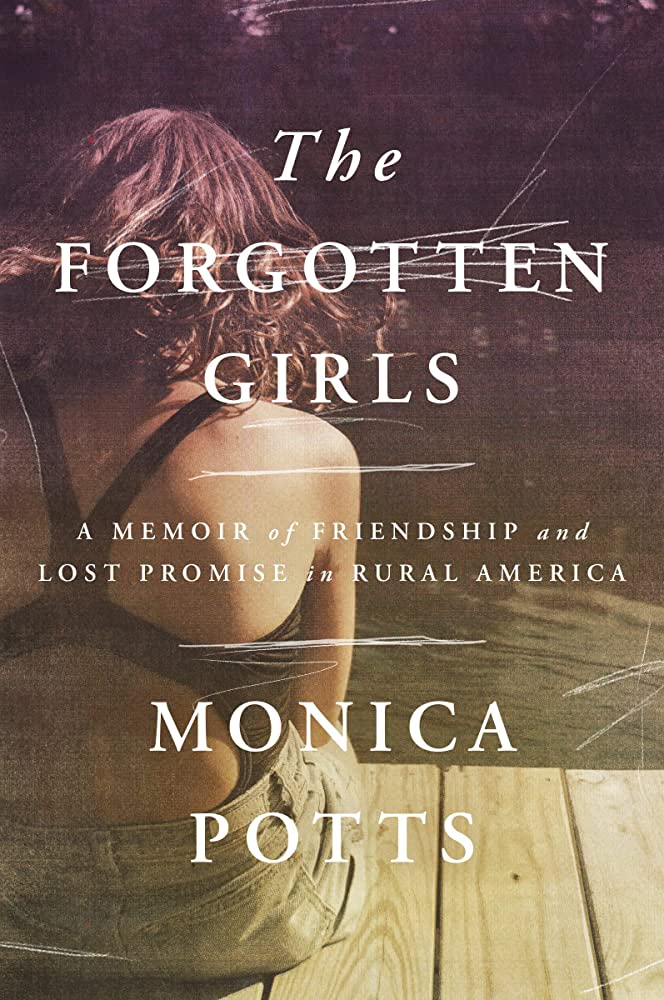
JONESBORO, Ark. – Monica Potts was recently hosted at The Parsonage restaurant in downtown Jonesboro for a discussion and signing of her new book, “The Forgotten Girls”. The event was put together by Verb Bookstore on Saturday, July 1 at 6:30-8 p.m.
Potts is a senior political reporter for the website FiveThirtyEight and has also been published in The New York Times and The Atlantic among others. The book was published in April of this year and is Potts’s first novel.
It’s a memoir about her childhood in Clinton, Arkansas that discusses the obstacles that women in rural communities face. Potts addresses poverty, religion, drug addiction, early motherhood, abuse, mental health, and lack of education.
Potts’s interest in the subject started when she heard of these studies that showed middle-aged white women in rural communities were starting to die earlier due to “deaths of despair”–deaths caused by drug addiction and suicide.
Potts explores how these deaths are linked to the obstacles these women face in their communities, including the fact that many of these women only had high school degrees or less. It was shown in these studies that highly educated women generally live longer.
She saw these obstacles in her own community. Potts mainly writes about the life of her former best friend Darci, who unlike Potts, chose to stay in Clinton for all of her life and ended up struggling with drug addiction, early motherhood, poverty, and abuse.
When Sari Harlow, the owner of Verb and host of the event, asked the room who had cried while reading the book and how much of the issues in the book they had seen in their own lives and community, several hands went up.
“Those first couple chapters were painful,” Harlow said. “I told Monica before I had to put it down and just process for a while and then come back to it because it really hits close to home.”
Potts herself had a similar experience writing the book. She said that she would often take a break to drive around in the mountains for a while to gather her thoughts. However, she also felt like it was a necessary process to endure.
She moved back to Clinton in 2018. She was working on her book by that point, and she stated that this was part of her reason for moving back, but she also had a lot of unresolved feelings about her hometown.
Despite the issues that are explored in her book, Clinton will always be home for Potts. However, it also sometimes feels like living in a fishbowl to her because everyone knows everyone. She misses city life sometimes.
“I actually felt in some ways more isolated than in the city,” Potts said.
When she moved away from Clinton to go to college, however, she sometimes felt guilty that she didn’t stay in touch with people from home, including Darci. She also felt like she had opportunities that many others couldn’t take advantage of.
Potts attended Bryn Mawr College in Pennsylvania and chose anthropology as her major even though she knew she didn’t want to be an anthropologist. However, she wanted the flexibility that comes with a liberal arts degree.
Additionally, as a first-generation college student, she believes that a liberal arts style education is more supportive than that of a state school, where it’s easier to get lost and feel adrift when one is trying to figure out the unfamiliar system.
Going into college, Potts didn’t realize the vast amount of career options that existed. For her, the importance of college was discovering what she was able to do and learning skills that would translate to several careers.
“I just can’t imagine a life without having had that,” Potts said. “It was just about having a different kind of life experience for myself…”
It’s difficult to name an ultimate solution for the kind of systemic and cyclical issues that people in rural communities face, but Potts believes that more opportunities for young people is vital to their growth.
“Figuring out who you are and who you’re going to be is a really hard job. It’s just an incredibly time-consuming endeavor, and I think teenagers have a really hard time…” Potts said. “…I think that the more grace and the more opportunities we can give young people to figure that out with as much support and kindness as we can, the better off they’re going to be.”
Potts said that the benefit of writing her book as a memoir was to connect Darci back to herself and encapsulate the whole life of someone. As for solutions to the issues that Darci and people like her face, Potts thinks that any solution couldn’t be finite or discrete; it’s a never-ending problem that can’t just be “fixed,” but instead must be addressed at a systemic level.
When asked about advice for adults that want to “escape” their small towns, Potts said that one probably has a bigger network than one believes. That person should reach out to anyone they’ve connected to in the past that might have resources or know about resources to help.
After the discussion, Potts signed books for those who had brought their own or those who were buying. Verb Bookstore had set up a table displaying copies of Potts’s book available for purchase, as well as books by other Arkansas authors and some currently popular picks.
“When we heard about her book and that she was an Arkansas author, we felt like we really needed to bring her viewpoint here to Jonesboro,” Harlow said. “It was definitely one that resonated with me personally…so I felt it was important to make those connections.”
Avery Jones is a sophomore in the Department of English and Philosophy at Arkansas State University in Jonesboro. She can be reached at: avery.jones@smail.astate.edu
JONESBORO, Ark. – On the weekend of May 19 through 20, the Craighead County Jonesboro Public Library celebrated Asian American Pacific Islander Heritage Month. The Friends of the Library sponsored children’s author Thanhhà Lai for a talk, Q&A, and book signing from 5:30-7 PM. She also did a presentation earlier in the day for students.
Lai discussed her books and how they connect to her life as a child when she fled the Vietnamese War with her family. She signed copies of her newest book, When Clouds Touch Us, published this month. It’s the sequel to her highly successful first book, Inside Out & Back Again, published in 2011.
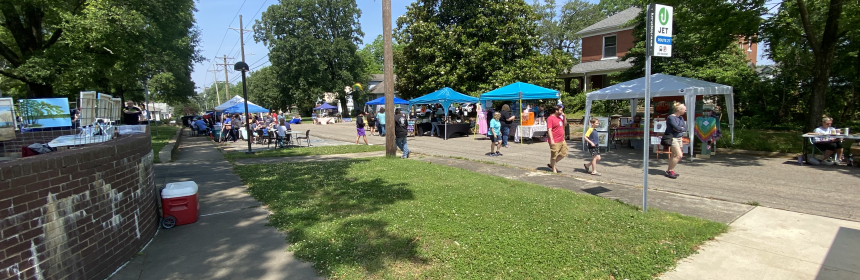
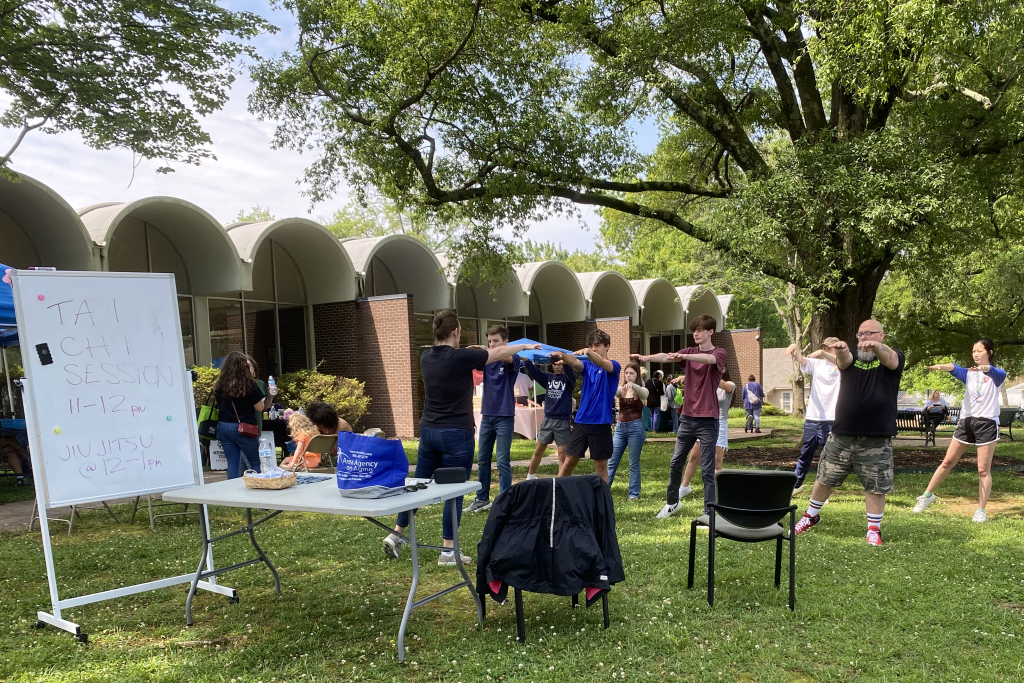
The library hosted the Asian American Pacific Islander Heritage Festival from 10 AM – 2 PM on the front lawn. Many crafts and food vendors came to celebrate, and the library gave away free copies of When Clouds Touch Us. International students from ASU-Jonesboro kicked off the festival with a drum performance, and later, there was karate lessons, a cosplay contest, and a tai chi demonstration.
A variety of arts and crafts vendors attended, including art, jewelry, cosmetics, and clothes designers. Almost all of the vendors were small businesses local to Arkansas.
Marissa Clark from True North Designs featured her artistic engravings. She does her work with laser engravers and has been doing engravings for three years. She has enjoyed drawing and working with wood since she was young, however.
She has her own shop and can engrave any design and customize anything of any material. A few of the items featured at her stand included home decor, wall hangings, and earrings.
A tai chi demonstration by the East Arkansas Area Agency on Aging during the AAPI Festival at the library. Photo by Avery Jones
Chenoa Summers of Anthropocenic Art was there to display her paintings. The name is in reference to how her artwork reflects the current period of the Earth whereas her earlier work mostly focused on prehistoric animal life.
Summers is a biologist who likes to paint the nature that she studies. She has three degrees in science and is currently working on a biology degree. She mostly does watercolor paintings but also crochets. She primarily sells her work online.
Britni from Rosemore Creative displayed her homemade cosmetic and hygienic products. She sells facial care, bath salts and bombs, wax melts, candles, hand and body soap, among other things.
She’s been coming to the library’s festivals for many years, but previously sold bags and other crochet crafts. She wanted to expand the kind of products she made, so she started teaching herself to make hygienic and cosmetic products last year. She primarily sells online.
Glitter Critter Studios was selling handmade clothes, earrings, stickers, and more. Their designs were very colorful and bright, almost cartoon-like.
Heather, one of the artists, said that her work is inspired by things from her childhood and also the exotic animals she rescues in her spare time. She has been a professional freelance artist for the past five years.
Glitter Critter Studios is an artist collective studio made up of three friends, including Heather, located in Memphis. This was their first time in Arkansas and first time at one of the library’s festivals.
Another designer, Alexandra of Xandra Page Co., displayed her handmade jewelry. She started making and selling her jewelry in 2020, looking for a creative outlet during the COVID-19 pandemic, but she’s been crafty from a young age and is self-taught.
Right now, Xandra Page Co. has turned into a full-time job for her. She also has a graduate degree in English but is enjoying where she’s at for the moment. She primarily sells online and also at some festivals.
There were also some organizations there to represent themselves. The International Students Association from ASU-Jonesboro were there to talk about the kind of opportunities they offer for international students. This is the first time the association has been to the library’s festival, but they’ve been to lots of other events to represent and promote themselves.
They help to bring together international students on campus through various activities so that they can connect with others they have something in common with, get to know each other’s cultures, and become more comfortable in a culture that’s new to them.
The three international students from the association at the festival—Nihal, Mahita, and Pauline–showcased the diverse interests of the association, one being a computer science major, one a wildlife conservation major, and one having just graduated with a master’s in psychology, respectively.
A nonprofit organization called The Reform Alliance was also in attendance. Their focus is education equity for K-12 students in Arkansas.
They raise awareness for all types of education options, including public, private, homeschool, and microschool. They also offer scholarships.
There were also a few food vendors there, such as Spice Girls Thai Street Food which soft-opened just this May. The food truck is an offshoot of the Sai Thai restaurant which closed in April. Spice Girls’ official grand opening will be June 1.
According to Valerie Carroll from Friends of the Library, the Craighead County Library hosts two festivals per year, and they choose a different theme each time. This is the first time AAPI Month has been the theme.
“I think that some of the folks from the Multicultural Committee are probably here at the event, but they do have a new committee where they’ve been trying to do some different things to widen out the cultural net, bring in some more people, and teach people who are here about different cultures,” Carroll said.
Avery Jonesis a sophomore in the Department of English and Philosophy at Arkansas State University in Jonesboro. She can be reached at: avery.jones@smail.astate.edu
Writer and poet Scott McDaniel reads his poetry during open mic.
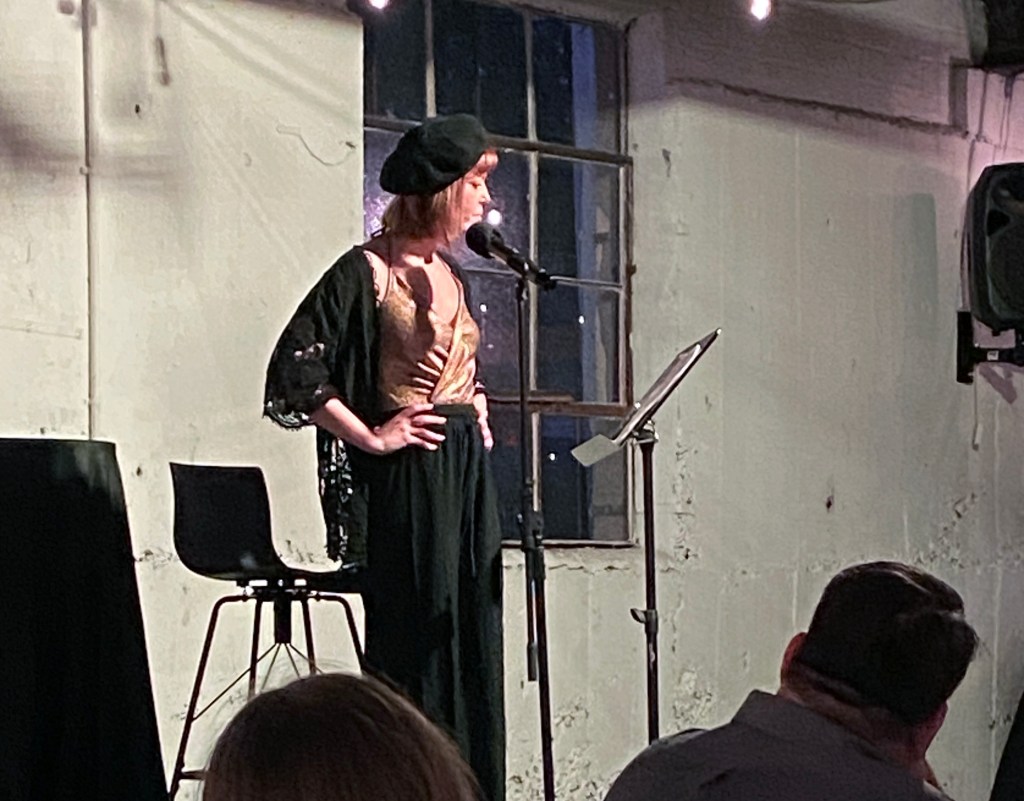
JONESBORO, Ark. – Delta Writers, formerly known as Delta Poets, is a nonprofit organization that supports writers and poets in the Northeast Arkansas community. It was established in 2021 by Scott McDaniel and Nicole Sylvia after the COVID-19 restrictions started to lift.
Poets McDaniel and Sylvia are originally from Jonesboro. They have been widely published in various literary magazines and have presented their work at formal readings and open mics.
Both attended college. McDaniel went to University of Arkansas-Fayetteville and received a bachelor’s in psychology and sociology.Sylvia attended both Black River Technical College and Arkansas State University-Jonesboro.
Aside from writing, McDaniel works as a contractor while Sylvia is a supply chain coordinator for a farm. They met at a poetry reading and wanted to collaborate creatively.
While collaborating, the duo decided to start Delta Writers because they felt that an outlet for creative writing was necessary for the Northeast Arkansas area since none had been established yet. They wanted there to be consistent events for writers to be able to expose their work.
“I was going to New York a lot for workshops and things like that, and I just kind of thought there was no reason for there not to be quality spoken word events here,” McDaniel said. “If you look at Arkansas, believe it or not, Arkansas is a hub for literature.”
“I was going to New York a lot for workshops and things like that, and I just kind of thought there was no reason for there not to be quality spoken word events here,” McDaniel said.
– Scott McDaniel, writer-poet
Nicole Sylvia reads during a poetry reading.
Detailing the states literary relationship, McDaniel noted that the longest-running spoken word event in the country, Wednesday Night Poetry, is in Hot Springs; one of the most respected presses, Sibling Rivalry, is in Little Rock; one of the most respected literary magazines, Oxford American, is in Conway.
The group’s focus right now is to build a writing community by hosting events. They organize spoken word events that are open to the public at various local businesses. In the future, they hope to host workshops.
Currently, two kinds of spoken word events are held by the group, open mics and features. The group recently started an open mic event called Final Friday which is held on the last Friday of every month at Story Coffeehouse. They’ve also had open mics at Cregeens, an Irish Pub in downtown Jonesboro. The events are open for anyone to come speak.
During feature events, which can boasts anywhere from 50 to 80 attendees, well-known poets are brought in for more formal and organized readings. Former Virginia Poet Laureate Tim Seibles was recently invited to speak at the Recovery Room Coffeehouse & Bistro. Tickets are sold for these events so that the poet gets paid.
“It’s about the audience, and we really want to make sure that they’re comfortable and that they are enjoying their time,” Sylvia said. “It may not seem like it has any rhyme or reason to it, but us putting…Tim at the Recovery Room, there’s a reason for those environments…we’re not just sending them blindly to somewhere that doesn’t suit what they’re trying to do.”
“It’s about the audience, and we really want to make sure that they’re comfortable and that they are enjoying their time.”
Nicole Sylvia
Ideally, they want to have four quarterly features a year. Once they’re able to hit four features per year consistently, they plan to add workshops in which a group regularly meets to read and critique each other’s work, and a feature writer will be there to instruct.
Alexandra Oliver reads during a poetry reading.
Their latest feature was held on Saturday, April 15, at the Glass Factory with Alexandra Oliver. Oliver is a well-known poet from Canada. She has published three collections and has presented her poetry at Lollapalooza, Paris Fashion Week, among many other events.
McDaniel and Oliver met at a Writers’ Hotel conference in New York City, where she was an instructor for the conference, and they hit it off. McDaniel invited her to be in one of the Delta Writers’ features.
Oliver is originally from Vancouver, and now lives in Burlington, Ontario. She’s been writing poetry professionally for 30 years. She also teaches poetry at universities.
Oliver attended college and has a bachelor’s and master’s in drama from the University of Toronto, an MFA in creative writing from the University of Southern Maine, and a PhD in English from McMaster University in Canada.
Rayna Kingston reads during a poetry reading.
The poetry reading at the Glass Factory was from 6 to 10 p.m. and was catered by Urban Organics. Opening music was supplied by classical guitarist Adrian Little during the mingling.
Poet Rayna Kingston was the opener. Kingston is also involved with the Delta Writers. She works for KASU and has a master’s degree in English from Arkansas State University Jonesboro. She’s done reading for Delta Writers before and is published in literary magazines.
Kingston was followed by Sylvia, and McDaniel was the last to speak before Oliver, who ended the night. She gave out signed copies of her published collections.
According to McDaniel and Sylvia, the best way for a writer to get involved with the group is to come read at one of their open mics. The Final Fridays would be the most convenient since they happen regularly. Both McDaniel and Sylvia can also be contacted through email: scott@mcdanielpoetry.com and anicolesylvia@gmail.com respectively.
Avery Jones is a sophomore in the Department of English and Philosophy at Arkansas State University in Jonesboro. She can be reached at avery.jones@smail.astate.edu
JONESBORO – March was Women’s History Month. It’s a recognition of women’s contributions to culture, history, and society. The annual celebration began in 1987. It first started as Women’s Day on Feb. 28, 1909.
In northeast Arkansas, many women serve in leadership positions and have started their own business. In Jonesboro, several small, independent businesses are owned and operated by women. They range from medical practices to art schools.
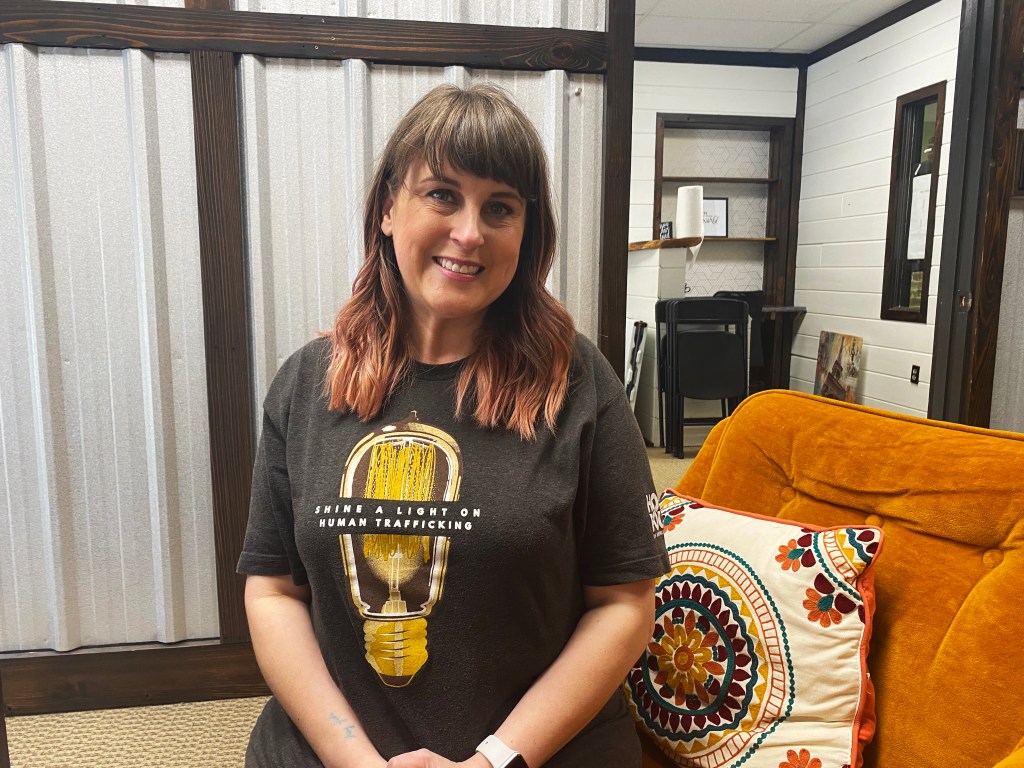
One such business is Hope Found of Northeast Arkansas, a nonprofit organization focused on raising awareness to fight against sex trafficking. It officially became a nonprofit in 2019. Megan Brown co-founded it with Audra King, Mary Sellers, and Miranda Ballard.
Megan Brown of Hope Found NEA.
Brown has been involved with anti-trafficking since 2009. She was living in Nashville and saw a documentary about trafficking, then felt called to help. She first worked with local organizations as an intern or volunteer.
Brown is originally from Jonesboro and decided to move back in 2011. Back then, there was only one anti-trafficking organization in the state, PATH (Partners Against Trafficking Humans) in Little Rock. She volunteered with them until 2015 and became a stay-at-home mom until 2018.
In 2018, Brown and the other co-founders first came together to discuss opening their organization. Brown and King had worked together before at PATH. Brown was always interested in starting her own nonprofit, but after three big trafficking cases around northeast Arkansas came to light, she became inspired to pursue it for the first time.
“We just really recognized there’s a need for an organization to serve these victims and also educate the community,” Brown said.
“We just really recognized there’s a need for an organization to serve these victims and also educate the community,” Brown said.
– Megan Brown
They struggled to find time to dedicate to the project because Brown was a stay-at-home mom, and the other co-founders had their own jobs and projects to deal with. However, because it was her dream, Brown continued pursuing it.
“When you’re walking in God’s calling, you’re going to constantly have the devil try to knock you down or try to create challenges or barriers,” Brown said. “Just kind of navigating that through it all is difficult as well.”
Brown graduated from Arkansas State University Jonesboro with a bachelor’s degree and was a licensed social worker. When she was living in Nashville, she worked at a restaurant and became a bartender as well as a corporate trainer and opened restaurants in New England.
Her best friend at the time ran a nonprofit in northwest Arkansas, and Brown asked her if she would’ve worked with a nonprofit consultant if she could do everything over again. The friend confirmed this, and Brown decided to pursue this path.
When she was starting to think about opening a nonprofit, Brown worked with a local company called KHARIS Group Consulting. She learned from a consultant named Shunquetta Cunningham about how to manage a nonprofit.
Today, Hope Found NEA has two employees, one of them being Brown. They give sex trafficking awareness presentations for professionals, and they have a curriculum for youth. The curriculum teaches the red flags to look for in someone who might have been trafficked, how to avoid being trafficked, and how to identify positive influences in one’s life. They also set up booths at various events.
Tanya Eddy, 53, owns and runs Jonesboro Art School, a small, independent school for children. She opened the school in 2009. Before the COVID-19 pandemic, she used to teach in-person classes for children, but now she teaches exclusively online.
She has been teaching for 20 years. She used to teach private lessons with the Foundation of Arts and decided at 40 years old that she wanted to open her own school.
She’s originally from Pocahontas and went to school at Arkansas State University. She started out pre-med, but decided later that she wanted to be a teacher. She got her teaching degree with a major in biology and a minor in art.
While in college, she worked at a bank for 10 years and had become a supervisor by the time she graduated. She left banking 25 years ago.
Within the first year of her art school opening, her class grew from 6 students to 50 students. About 3 years ago, they went completely online.
Eddy enjoys teaching online because she gets to teach students who live in other states and who have moved away. She also works with her daughter, Maya Eddy, 24, who teaches elementary art and creative writing at their school.
Eddy also does digital art and has a YouTube channel where she records demonstrations. Online lessons and digital art work much better for her than traditional art due to her arthritis.
“I love working with the kids,” Eddy said. “I love those moments when they’re learning to do something, and they get it. You can tell that they realize they understand how to do it.”
“I love working with the kids…I love those moments when they’re learning to do something, and they get it. You can tell that they realize they understand how to do it.”
– Tanya Eddy
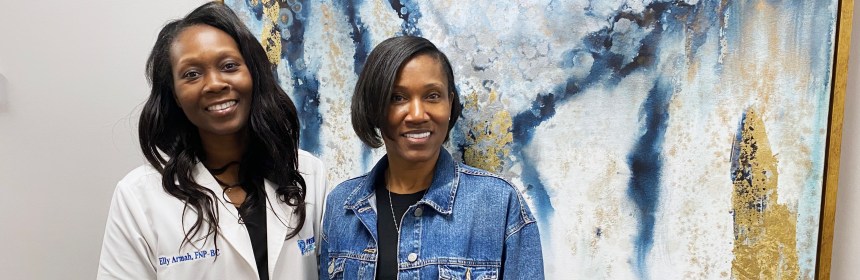
Premiere Family Practice is a small clinic run by Carolyn Coleman, 49, and Elly Armah, 41, nurse practitioners. Armah has been practicing for over 10 years, and Coleman has been practicing for over 20 years.
Elly Armah (left), Carolyn Coleman (right) of Premiere Family Practice.
Coleman is originally from Marked Tree while Armah is originally from Ghana. Armah lived there until she was 2, then moved with her family to Britain, then to the U.S. where she graduated high school. She’s been in Jonesboro since 1996.
Both attended Arkansas State University Jonesboro. Coleman earned her bachelor’s degree in nursing from ASU, then her master’s in nursing from University of Memphis. Armah earned both her bachelor’s and master’s degrees in nursing from ASU.
They both currently work as trauma hospitalist nurse practitioners as well as running their clinic. They first opened their clinic in April 2021. They wanted to have more autonomy and give back to the Jonesboro community.
“I enjoy building up those relationships with my patients,” Armah said. “We pride ourselves on allowing our patients to have access to us. Most physicians don’t give their patients access, and our patients can call the clinic and speak to us, they can call our cellphones and speak to us, so we pride ourselves on giving that personal touch when it comes to their care.”
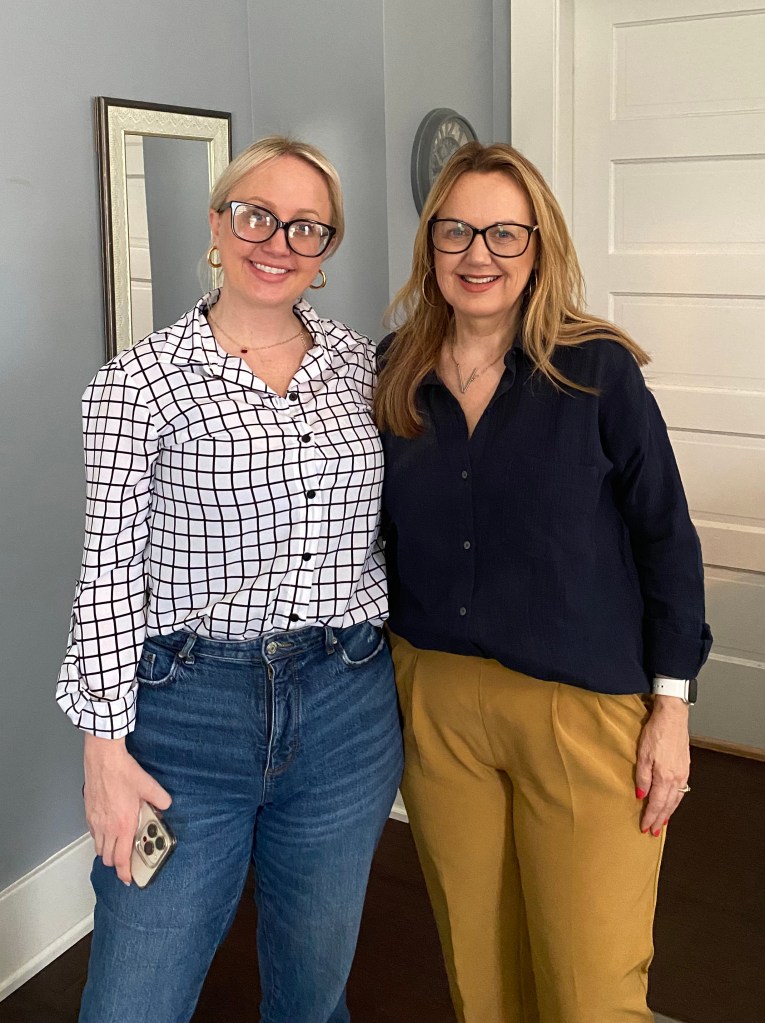
Foundation – A Wellness Practice is a therapy center owned by Vicki White, 60, and Lauren Hannah, 37. They’re a mother and daughter duo who have been running their business for 5 years. They both worked previously as therapists in nonprofit community mental health centers.
Lauren Hannah (left), Vicki White (right) of Foundation therapy center.
White is originally from Missouri, and Hannah is from Massachusetts. They’re both married, and Hannah currently has four children. When not at school, they stay upstairs in the Foundation building. Hannah’s husband also works for Foundation.
White is a licensed social worker with a bachelor’s degree from University of Tennessee and a master’s in social work from University of Missouri. Hannah is also a licensed social worker with a bachelor’s from Arkansas State University Jonesboro and a doctorate in social work from University of Tennessee.
They decided to open their business because they wanted to offer more specialized care to patients. Their focus is on holistic treatments that prioritize therapy and other natural methods over medication, although they do still offer medication.
They also recently bought the building across the street from theirs in order to open another business, associated with their therapy center, that will offer several wellness treatments: a wellness spa, cryotherapy, halotherapy, IV therapy, a sensory deprivation tank, proactive health treatments, a wellness boutique, and more.
Foundation currently has five full-time therapists and three part-time therapists, as well as a psychiatric nurse practitioner that handles medication. Each therapist has their own specialty. White specializes in couples therapy, while Hannah specializes in anxiety and women.
When asked what she likes about owning their own business, White said, “One thing I really like about it is we have the flexibility to meet people’s needs. If someone we’ve been working with for a while loses their insurance, we can say, Hey, we’ll still see you, we’ll figure it out together. Whereas if you’re working in a bigger business, sometimes you can’t make those types of decisions for yourself.”
Women in northeast Arkansas continue to own, open and operate many businesses which contribute significantly to their communities. The presence of female business ownership and leadership continues to grow, revealing the importance of their existence to society.
Avery Jones is a sophomore in the Department of English and Philosophy at Arkansas State University in Jonesboro. She can be reached at avery.jones@smail.astate.edu
JONESBORO, Ark – February is Black History Month. A celebration of black history was first established by African-American historian Carter G. Woodson, who started a black history week in February 1920 to celebrate African-American achievements, culture, and history.
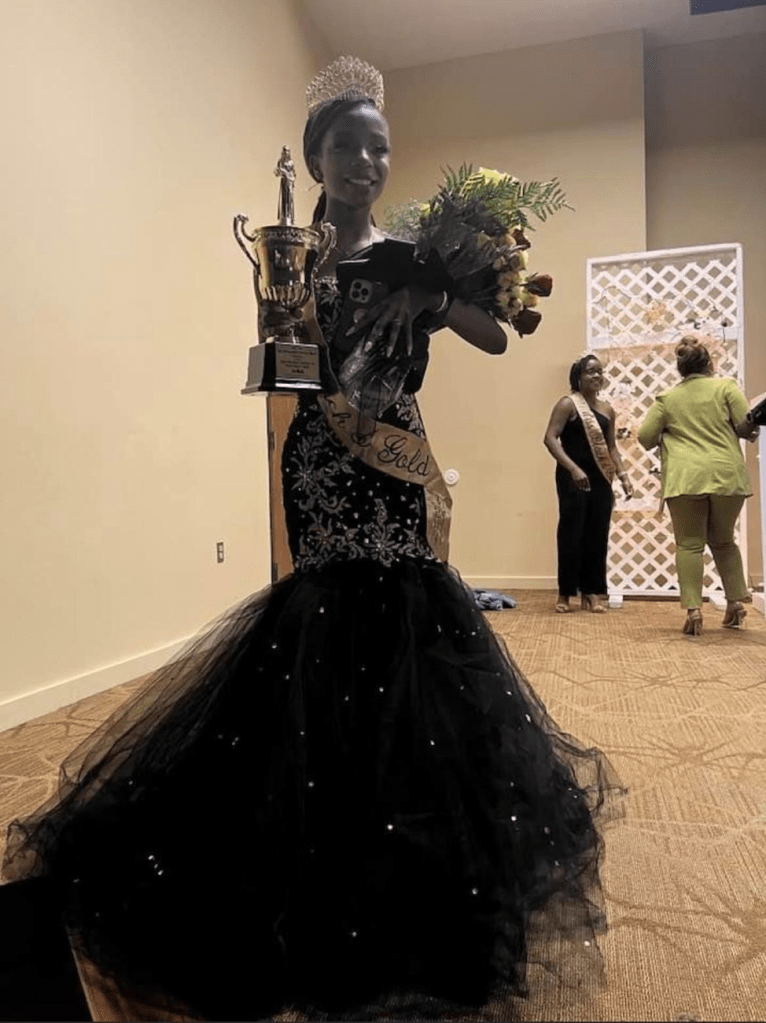
February became the official Black History Month in 1986, when Congress passed the law designating it. However, African-American culture is celebrated in many ways throughout the year, and the Miss Black and Gold Pageant is one such way.
The Miss Black and Gold Scholarship Pageant is an event meant to celebrate the achievements and beauty of college-age black women. It is sponsored by the national Alpha Phi Alpha fraternity, the first intercollegiate fraternity established by African-American men.
The competition tests the young women’s beauty, poise, confidence, communication skills, and intelligence. The winners receive varying amounts in scholarship prizes, up to $1,000.
The Miss Black and Gold orientation guide dictates that each participant must pass an interview, a swimwear presentation, a creative talent presentation, and a public speaking presentation, as well as provide evidence of academic and professional achievements and goals.
According to the Alpha Phi Alpha Nu Beta chapter website, the first Miss Black and Gold Pageant was hosted in New York City in 1976 by the National Alpha Phi Alpha Convention. The pageant then became a national program in 1982.
It has been 41 years since then, and the tradition still lives on. Several Arkansan universities and colleges have Alpha Phi Alpha chapters that host the Miss Black and Gold Pageant once a year.
The Nu Alpha chapter at Arkansas Technological University in Russellville, Ar., was unfortunately unable to have a physical pageant, but they still selected a winner from their applications.
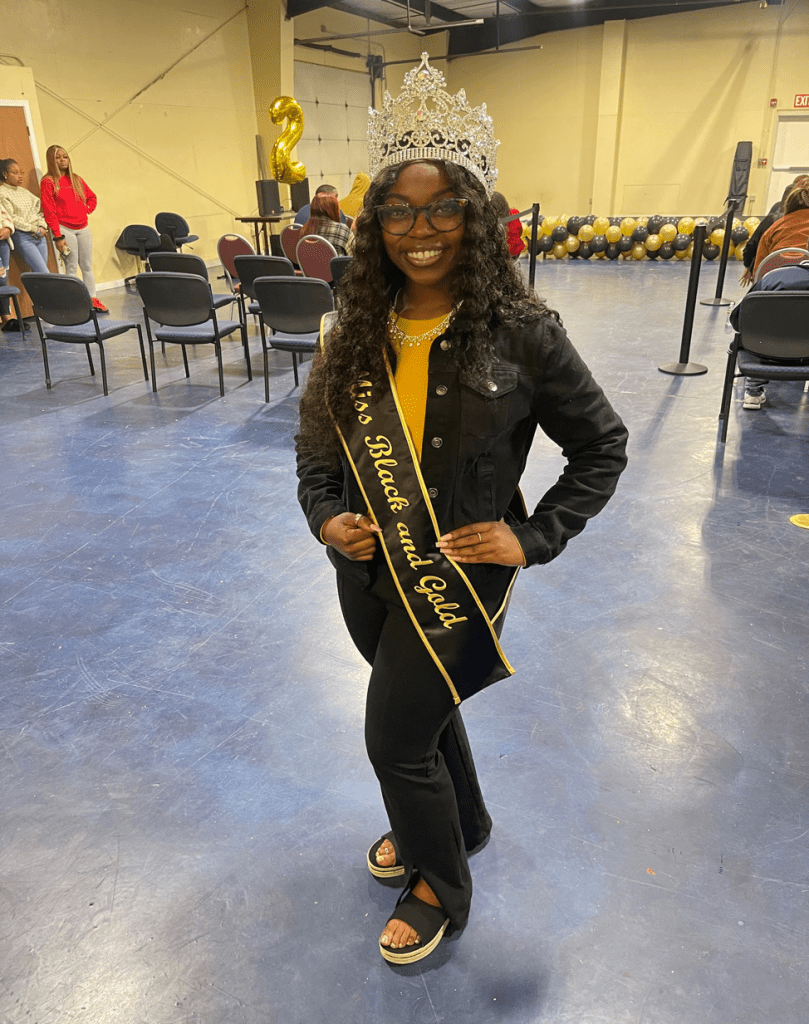
Zion Brassfield is the 2022-2023 Miss Black and Gold at ATU. She’s an 18-year-old sophomore majoring in nursing with a minor in leadership.
Zion Brassfield is the 2022-2023 Miss Black and Gold at ATU. She’s an 18-year-old sophomore majoring in nursing with a minor in leadership. She’s originally from Dumas, Ar. For her, winning means being given the opportunity to grow and learn.
Kiya Luster is the 2022-2023 Miss Black and Gold at SAU. She’s a 20-year-old sophomore majoring in business management.
The Kappa Iota chapter at Southern Arkansas University in Magnolia, Ar., hosted their pageant on Nov. 12, 2022.
Kiya Luster is the 2022-2023 Miss Black and Gold at SAU. She’s a 20-year-old sophomore majoring in business management. She’s originally from Stuttgart, Ar.
According to Luster, this was her first pageant. It meant the “absolute world” to her because it showed her that others see her beauty even when she doesn’t. She said, “On that stage I introduced myself to a new side of me that I always used to shy away from. Winning this pageant has taught me to embrace every part of myself, to never stop working towards what you want, and a few tears, silent prayers, and a smile can get you a long way.”
“On that stage I introduced myself to a new side of me that I always used to shy away from. Winning this pageant has taught me to embrace every part of myself, to never stop working towards what you want, and a few tears, silent prayers, and a smile can get you a long way.”
— Kiya Luster, Miss Black and Gold Southern Arkansas University
The Theta Upsilon chapter at Arkansas State University in Jonesboro, Ar., hosted their pageant on Dec. 3, 2022.
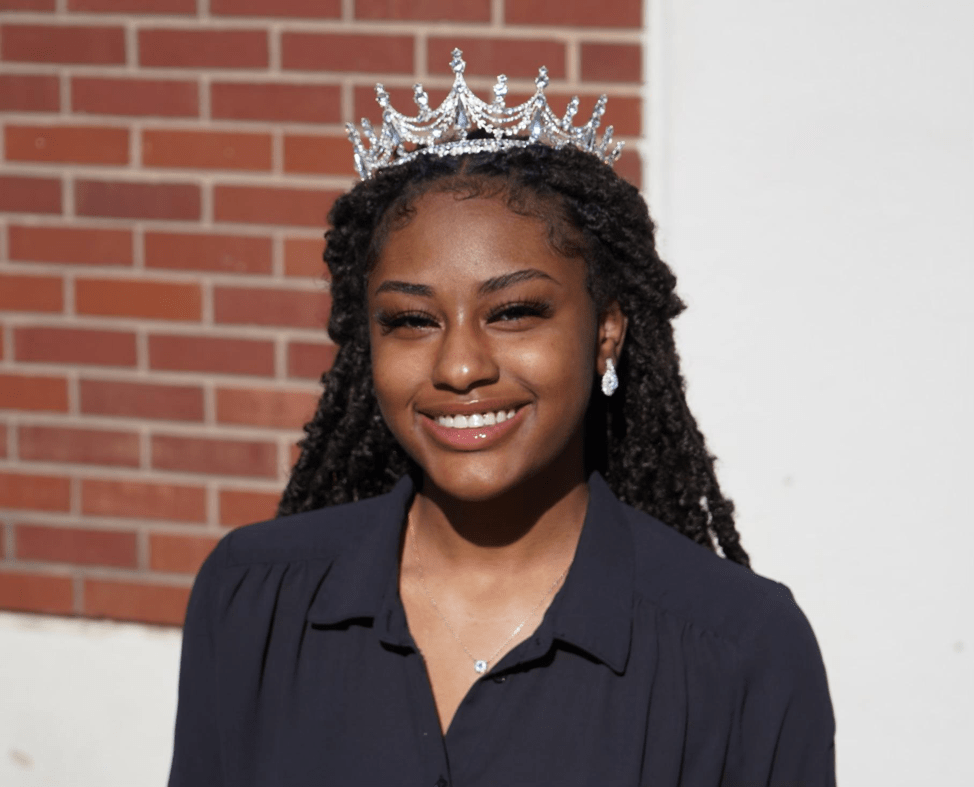
Deanna Jones is the 2022-2023 Miss Black and Gold at ASU Jonesboro.
Deanna Jones is the 2022-2023 Miss Black and Gold at ASU Jonesboro. She’s a 20-year-old sophomore majoring in communication disorders. Her hometown is Jonesboro. According to her, winning was a way to break out of her shell. She’s passionate about community projects and inspiring young girls to follow their dreams. She recently started a program called Empower in which she mentors young girls.
The Theta Kappa chapter at Henderson State University in Arkadelphia, Ar., hosted their pageant on Nov. 17, 2022.
McKenzie Sanders is the 2022-2023 Miss Black and Gold at HSU.
McKenzie Sanders is the 2022-2023 Miss Black and Gold at HSU. She’s a 19-year-old freshman majoring in biology. Her hometown is Little Rock, Ar. She said that she had always wanted to participate in pageants as a child, but was bullied into believing that she wasn’t pretty enough.
“Winning my first pageant…was a very emotional moment for me and my family…but to be crowned after all of those negative denotations and misfortune that felt like baggage just ceased to exist anymore,” Sanders said.
“Winning my first pageant…was a very emotional moment for me and my family…but to be crowned after all of those negative denotations and misfortune that felt like baggage just ceased to exist anymore.”
— McKenzie Sanders, Miss Black and Gold Henderson State University
The Kappa Kappa chapter at University of Arkansas Fayetteville held their pageant on Dec. 3, 2022.
India Young is the 2022-2023 Miss Black and Gold at UA Fayetteville.
India Young is the 2022-2023 Miss Black and Gold at UA Fayetteville. She’s a 20-year-old sophomore majoring in political science and journalism with a minor in African-American Studies. She’s originally from Warren, Ar. She said it’s an honor to represent the Arkansas District.
“Since winning I feel even more connected on campus and look forward to hosting events that bring us all even closer,” Young said. “Winning the pageant has also brought me a new level of self-confidence and poise.”
“Since winning I feel even more connected on campus and look forward to hosting events that bring us all even closer,” Young said. “Winning the pageant has also brought me a new level of self-confidence and poise.”
— India Young, Miss Black and Gold University of Arkansas at Fayetteville
The Beta Chi chapter at Philander Smith College in Little Rock, Ar., hosted their pageant on Jan. 22, 2023.
Ciara Jenkins is the 2022-2023 Miss Black and Gold at Philander Smith College. She’s a 20-year-old graduating senior majoring in biology and psychology. She’s originally from North Little Rock, Ar.
“To me, winning the pageant means I have the opportunity to display leadership on my campus and promote important values on our campus and reinforce the family culture on Philander Smith’s campus,” Jenkins said.
“To me, winning the pageant means I have the opportunity to display leadership on my campus and promote important values on our campus and reinforce the family culture on Philander Smith’s campus,”
— Ciara Jenkins, Miss Black and Gold Philander Smith College
The Pi Psi chapter at University of Arkansas Monticello hosted their pageant on Nov. 30, 2022, but the winner was unable to be reached for comment.
The Theta Psi chapter at University of Central Arkansas in Conway, Ar., hosted their pageant on Dec. 3, 2022. The winner was Jaidyn Simington, a junior radiography major, but she was unable to be reached for comment.
Avery Jones is a sophomore in The Department of English and Philosophy at Arkansas State University in Jonesboro, Arkansas. She can be reached at avery.jones@smail.astate.edu
Jonesboro, Ark. — Hidden in the midst of the Delta lies an unexpectedly thriving arts scene with a goal to enrich the community in which it resides.
Even with the addition of masks, extra disinfecting and social distancing required by the new normal of the pandemic, arts organizations around Jonesboro remain open as a haven for local artists and lovers of the arts alike.
As the pandemic drags on, so does the anxiety surrounding the still-unknowns of the coronavirus. The arts are proven to alleviate stress and calm the brain. While it is impossible to see a Broadway show right now, local organizations continue to be an outlet for the community.
Learn
A quick temperature check, a mask, a squirt of hand sanitizer and an open mind is all it takes to learn a new craft in the age of COVID.
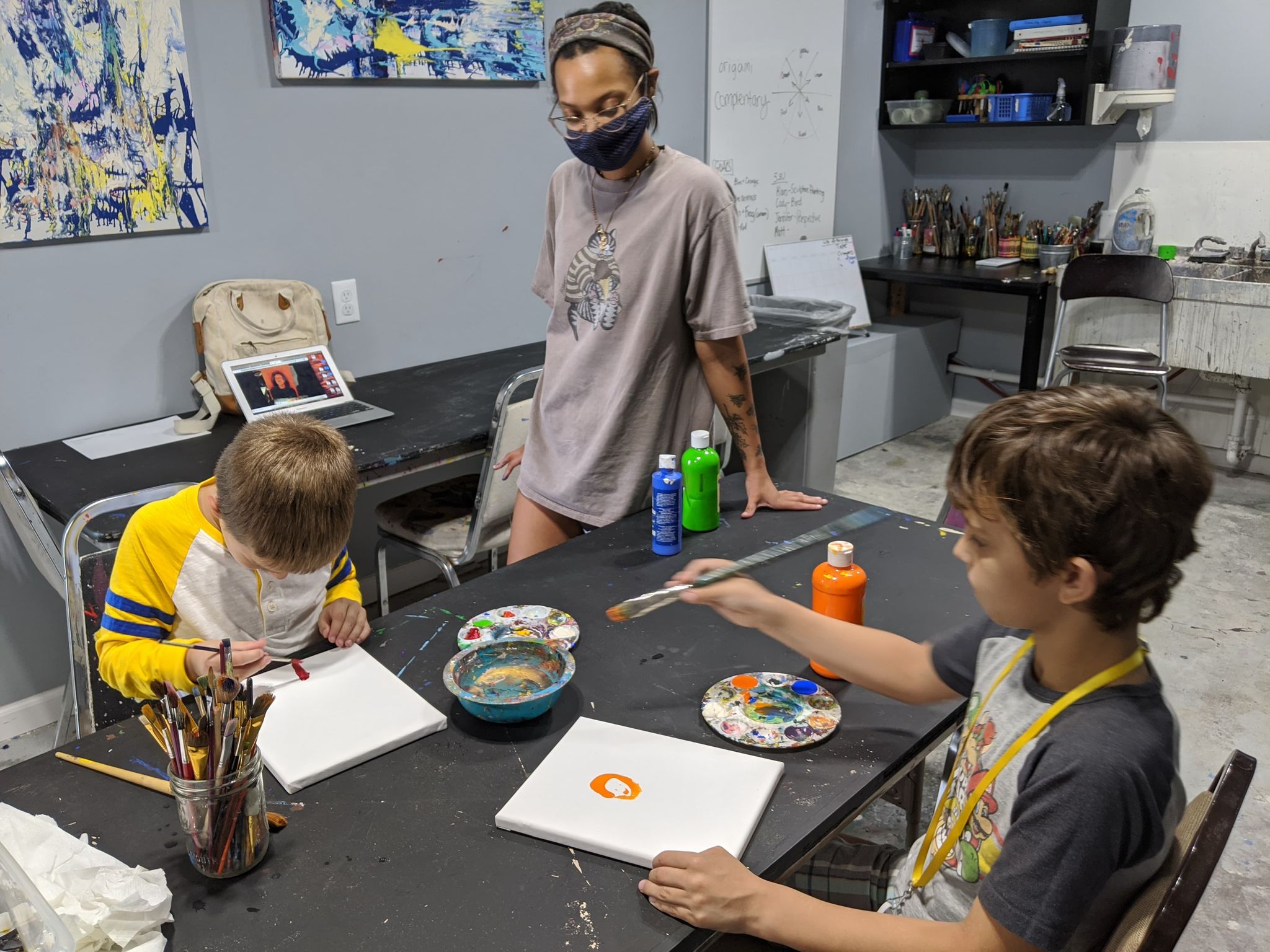
The Foundation of Arts operates in Jonesboro as a communal space for new and experienced artists to learn and perfect their craft. Kristi Pulliam, FOA executive director, said the arts are a vital part of life.
Kids participate in an FOA art class. Photo by Tristan Bennett
“The arts can improve your life in so many ways, Pulliam said. “The participation in the arts makes you better at almost every other thing you do. You’re a better communicator, you’re more self-confident, you’re more able to experiment and grow in all kinds of areas of life.”
The FOA offers classes in a wide range of arts disciplines. While learning an art may look different than in a pre-COVID world, Pulliam said the FOA staff strive for a safe environment for all their students. Enrollment numbers took a dive due to the pandemic, but classes are growing each week, and endorsement of the safety measures enacted by the Foundation.
As a space to learn, the FOA strives to improve the quality of life for everyone in Northeast Arkansas.
“The programming at the Foundation of Arts is really about people,” Pulliam said. “It starts with people, it ends with people, and it has arts all in between.”
Students of dance can learn to arabesque in ballet class, shuffle in tap or pirouette in jazz. After learning their new skills, they have the opportunity to showcase them in competitions across the region.
“It allows them to strut their stuff, and they’ll be judged against other dancers,” Pulliam said.
In addition to dance, students can train to be the next Broadway star in the FOA theatre arts classes or learn to paint like Picasso in their visual arts classes.
The FOA continues to provide opportunities for the general public to engage in the performing arts as well. Coming up, the FOA is hosting a House of Villains at their Forum theatre for Halloween, and their production of “Dreamgirls” hits the stage in November.
Immerse
There is a certain calmness that can only be achieved by visiting an art museum. Jonesboro is fortunate to have one right at its heart on the Arkansas State University campus.
The artworks that grace the walls of the Bradbury Art Museum silently serve as a cultural steward to enhance the lives of Northeast Arkansas citizens.
Even in a pandemic, people of the community can immerse themselves within the quiet elegance of the museum. Garry Holstein, BAM director, said the art museum adjusted to the new protocols with relative ease.
“We’re a fortunate space in that we’re set up for people to come and enjoy artwork by themselves or with close friends, and not to touch,” Holstein said. “We’re kind of built for a going out safe experience.”
After a temporary closure, BAM reopened with a small, socially-distant reception and a brand new exhibit.
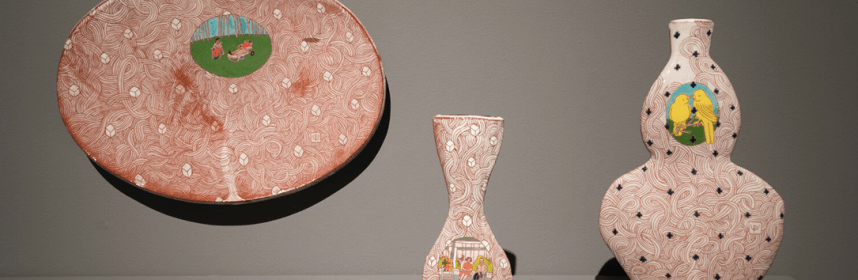
Currently, the museum houses an exhibition entitled “Radius 1.” It showcases artwork created by artists who live and work within a 180-mile radius of BAM. The show not only gives local artists a chance to showcase their work regionally, it gives the community the opportunity to see the talent growing in their own backyard.
Holstein said, “The amazing thing about this is you have so many talented artists here. A lot of people think you have to go to New York or somewhere far away to see amazing work, but we have people that have shown in Venice in this exhibition.”
The Delta is crawling with artistic talent, and through places like BAM, the residents of the community have the opportunity to dive into prestigious art right from home.
“Creative exploration of our shared cultural dialogue is what we do,” Holstein said. “It just reinforces our role in the community and our dedication to serve as a cultural steward and collaborate to create a shared sense of place.”
The coronavirus forced BAM to limit its hours to noon to 5 p.m. on Tuesdays through Saturdays, but the artwork still waits in its regal silence for someone to come brood over the artist’s true intention.
Experience
As devastating as the pandemic could have been on the arts, it only brought more creativity into the delivery of artistic experiences. Before, no one could have ever imagined listening to a live symphony from the comfort of their couch, but current circumstances made it possible for fine music to be available outside of the auditorium.
The Delta Symphony Orchestra is rooted in heritage and strives to meet an underserved need in the community. Neale Bartee, music director and conductor, said the orchestra formed in 1975 to give professional musicians in the area a chance to perform.
“There were really strong band programs and choirs, but there were no orchestra programs, and that’s an entirely different thing with the string section,” Bartee said. “We were providing a need that had not been fulfilled at that time.”
45 years later, the music scene in Jonesboro has expanded greatly. However, orchestra music still lags behind. The Arkansas State music department focuses mainly on instruments commonly played in marching bands, but Bartee, during his time on faculty with the department, helped to create the university orchestra program. As far as professional orchestra music in the region, the Delta Symphony Orchestra still operates alone.
“There’s a whole heritage of orchestra music that goes back 300 years with Bach through Beethoven, and there is no other group that performs that,” Bartee said.
COVID-19 forced live orchestra performances to a grinding halt, but in a way, it is now easier than ever for everyone to experience symphony music. The Delta Symphony Orchestra began livestreaming their performances on Facebook, making it possible to listen to a live professional orchestra on a couch, at the dinner table or in a car.
Bartee and the orchestra even began digging through past, recorded performances in order to provide the community with music during this time.
Now, anyone in Jonesboro can experience the sounds of the orchestra on cable channel 24. Previously recorded performances are broadcast regularly on the City of Jonesboro’s channel as a service to the community.
The Delta Symphony Orchestra not only provides a historically rich music to the community, it invests in the next generation of artists.
“We’ve brought Broadway stars to Jonesboro,” Bartee said. “We brought those guest artists that did some great work coaching the kids on how to do musicals.”
Hearing the orchestra through a screen may not be the ideal experience, but it expands the opportunity to more of the community and provides a chance to the general public to broaden their horizons.
Grow
As Pulliam said, involvement in the arts is a pillar of any quality society. Whether it be learning a new craft, immersing in a visual art or experiencing an orchestra, all work to enhance the quality of life of all those who enjoy it. In the extra stressful era of COVID-19, art can serve as an escape. Many think great art lives in far off places, but Jonesboro is home to a thriving art scene just waiting for the community to join.
Organizers called off the annual Brockett Cemetery Fall Cleanup Day after a morning downpour interfered with the cleaning.
Volunteers showed up at the cemetery to mow, arrange displaced tombstones, pick up leaves and cut off dry tree branches, but began to leave when rain arrived. The rain, which started as a drizzle before they arrived, continued for the better part of the morning hours.
Lyda Davidson, secretary of the Brockett Cemetery committee, said,
“We couldn’t stay with this rain and you know, coronavirus, we don’t want anyone catching the virus in this weather, we had to call it off.”
Trent Ingram, a member of the committee, said the cleaning event takes place annually.
“Most people who show up volunteer their services,” he said.
The majority of the volunteers buried their families at the Brockett Cemetery.
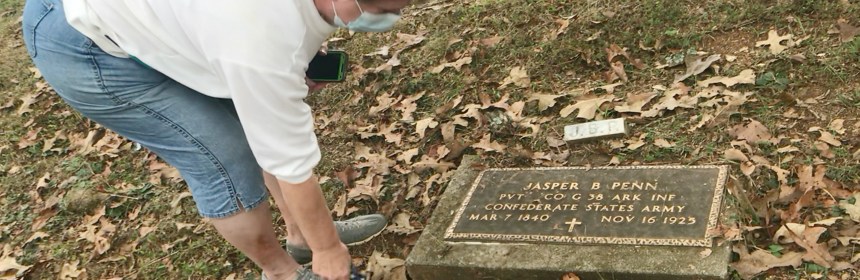
Five generations of Davidson’s family lay buried there, starting with her great-great-grandfather Jasper B. Penn, born in 1841, having died in 1925. Penn served during the Civil War in the Confederacy as a postmaster. She said the late Penn delivered mail on horseback and wagons.
Not too far from her great-great-grandfather, lay the tombstone of her great-grandfather Solomon Steven Mack and his wife, Barbara Mack.
Next to their grave, her grandfather and grandmother Aaron O. Mack and Ollie F. Mack, behind them, her grandfather’s brother John Adams Mack and his sister Carrie E. Milam.
Then her grandfather, Robert H. Milam and wife, Sara E. Milam, her father Alvin Andrew Milam and mother Eula Mack- Milam’s tombstone lay beside each other on one long black and grey marble stone a little distance away.
Her uncle and aunt lay behind her parents. Her late brother- in- law’s tombstone lay next to her sister’s, who is still alive. And many other family members.
“This cemetery is like home for me. When I’m here, I feel peace,” she said.
In 2015 after her brother-in-law died, Davidson bought a tombstone for herself. A mixture of pink and black marble the size of three soccer balls combined. The marble rock, neatly cut on the engraved side and rough on the other side, bore her birthdate and engraved motto on the stone which read,
“Death is swallowed up in victory,1 Corinthians 15:54.”
At 75 years old, Davidson said she does not fear death.
“Death is not a lasting thing. We live on. For Christians, it’s a happy feeling,” she said.
Each generation of her family took care of the Brockett Cemetery. They would carry their lunch to work, take breaks to eat and go back to work until they completed the job.
“Sometimes people move the tombstones away to the road nearby, and these rocks are markers. We pick them up during cleaning and return them to their proper positions. We keep this place up to preserve our genealogy, for anyone interested in genealogy, this is a good way to preserve it,” she said, as she pushed out of the way into a stockpile cut weeds from a gravesite.
The weed is called “pork salad”, she pointed. It grows a lot here, and I like it; it’s edible. In the olden days, people used their black seeds as a dye for clothes and ink for writing.
The original name of the Brockett Cemetery was Knotts Cemetery, named after the late Joseph L. Knotts.
Knotts donated the piece of land for burial. Many of his family’s tombstones lie on the cemetery along a line, each bearing the name Knotts, young and old.
The name later changed to Brockett, the name of the community at the location of the cemetery.
Every year, they organize for clean-up in March and in October weather permitting. Volunteers show up from various states.
She said they also get donations from people and use the funds to hire for help in cutting grass and dry tree branches at the cemetery when they cannot find volunteers.
Davidson said they also sponsor community members not able to afford burial sites or tombstones.
“Anyone can be buried at the Brockett Cemetery,” she said.
Davidson says she believes at least three more fresh graves came in 2020. So far, 400 people call Brocket Cemetery their permanent home, even in death.
Davidson said the committee meets twice a year, and they have not come up with a new day to reschedule the clean-up after the rain sabotaged their plans.
She said people could find their contacts at the local funeral homes in Randolph County and neighboring towns.
JONESBORO – With the 2020 census on the horizon, the Hispanic community faces an ever present and mounting number of challenges while trying to get as many people to complete the census as possible.
Challenges like technological issues, misconceptions, the political climate and the coronavirus all represent a hurdle for the Hispanic community, said Gina Gomez, executive director of the Hispanic Center in Jonesboro.
Most of these challenges were expected, but the coronavirus situation presented new challenges and dampened plans that Gomez and others had been working on for a while.
“Even though we have been planning this work with the census for months now, we didn’t expect this was going to happen,” Gomez. “Every activity that we had planned, like door-to-door canvassing and going out to events where we were going to promote the census have been canceled. That’s a big challenge. Right now we are looking into ways we can continue promoting the census using online resources and social media.”
Gomez emphasized in the current political climate there are many misconceptions on what will be done with the information given by families in the census. The community is working on educating families that information given will not be used against them or given to law enforcement agencies and informants.
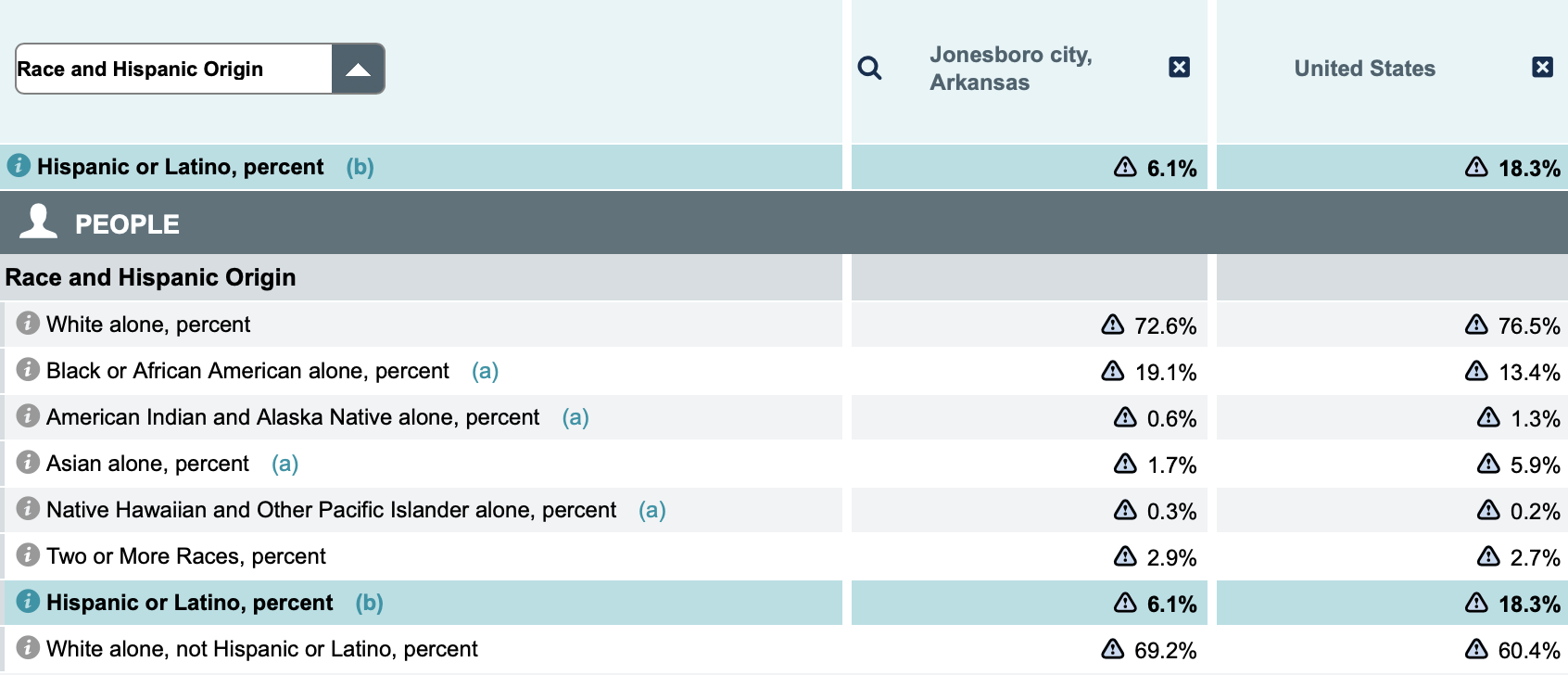
This graphic from Census.gov shows the percentages of various ethnic groups in Jonesboro and the United States.
“Our people are afraid to provide information to the census,” Gomez said. “There’s been an educational phase where we have been trying to inform people about what the census is, how the census impacts them and also that there is not any risk by providing the information.”
According to the census, counting children is a tough challenge for all families, no matter what ethnicity or race.
“Children under 5 years old are among population groups historically undercounted in the census,” a Census Bureau press release said.
Gomez said counting children in Hispanic families is a problem too. Gomez highlighted that many families completed a census in their home country, but once these families move to the United States they question whether they need to do the census or not.
“Many families don’t understand what the impact the census has on your family or kids,” Gomez said. “If they don’t see the importance of bringing those funds to our city in order to have better schools, access to healthcare providers, improving our roads, it’s difficult to have people participating. A lot of this is education related. We need to educate our community.”
This is the first year families can complete the census online. This makes it easier on some, but can also be a problem for others.
“For some of our families, they don’t have computer access, online access, they don’t have internet or they just don’t have the knowledge of how to do it,” Gomez said. “They can do it on a computer, an iPad or cellphone. It’s a little complicated for some of our people, especially for ones living in more rural areas. That’s one of the areas that we as the Hispanic Center were trying to work really hard on.”
With the coronavirus dampening many ways to advertise the census, Gomez and the community have put a lot of emphasis on social media. Gomez noted just how important it is for Hispanic families to do the census as those families will see benefits moving forward.
“We hope by demonstrating the number of Hispanics we have in the area and in general the state, because we are part of the state coalition, we’ll be able to assure based on the percentage of Hispanics there are specific needs to target this minority in Arkansas by providing language services when it comes to healthcare or schools,” Gomez said. “But, if we are not able to demonstrate by how many people we have, the need will not be as evident even though we have the people here.”
The coronavirus was not the only thing that affected the push towards the census. On March 28, an EF-3 tornado tore through Jonesboro. Homes and businesses were destroyed throughout the city.
“Now, more than ever, we need to bring funds to our city to help rebuild it,” a post on the Hispanic Center’s Facebook said. “You can help us with this, completing Census 2020.”
Gomez worked with the Hispanic community in 2010 to complete the census but she said then the effort was not as widespread and did not have as many people involved.
“In 2010 Arkansas was really undercounted,” Gomez said. “We want to assure we are counting as many people as we can around the state this time so we are not letting those funds go.”
According to the census, the Hispanic population makes up an estimated 6.1% of the total population in Jonesboro. The estimated total population in Jonesboro reads 76,990.
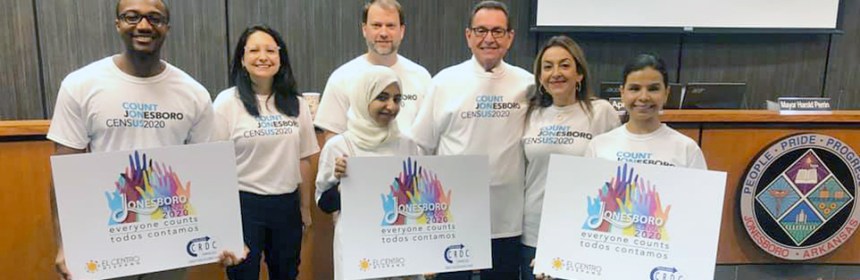
This time around the Hispanic Center created its own campaign with the city of Jonesboro and also created its own logo. There is also a state coalition called Arkansas Counts to spread the word about the census and efforts surrounding the census are more structured now.
“When I moved here to this country, I didn’t understand why it was that important for me to fill out the census,” Gomez said. “But now that I have been educated on the topic I can educate others.”
Editor’s Note: Feature photo courtesy of the Jonesboro Hispanic Center: Members of the Hispanic Center and Jonesboro community work together to spread the message about the 2020 census.
JONESBORO – An exhibit of the civil rights struggle and African American culture at the Arkansas State University Museum attracted locals as far as Batesville. The “For all the world to see” exhibits until March 16.
The tour coordinator at the ASU museum, Michelle Friend, said The National Endowment for Humanity together with the Office of Diversity and Community Engagement at ASU organized the traveling exhibit to commemorate the black history month.
Several visuals, including videos, photos, newspaper cut-outs, books, booklets, newsletters, and relics on display, brought the civil rights struggle back in time.
Walking through the museum, the exhibit reveals how television and advertising visuals of the period reflected constant racist visage of blacks in America.
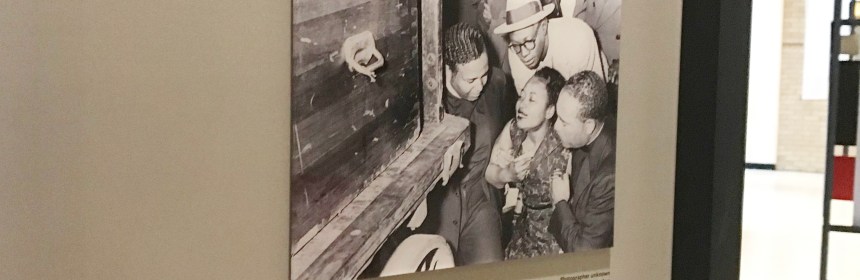
“I remember when this happened, I was a little girl then and there were talks about it in the newspaper. It was a sad moment,” said Marti Allen, the director of the museum, as she stares at a portrait of Mamie Till Bradley, weeping over the casket of her slain son Emmett Till.
The writings on the portrait said white supremacists murdered Till, a 14-year-old boy, while he visited family members in Mississippi on August 28, 1955. Carolyn Bryant Donham, a white girl, accused Till of touching her hand and waist and using vulgar language. Accusations that Donham later recanted in 2017.
Isaiah Koffi Poku is a junior work-study undergraduate student at the ASU nursing school. He checks-in guests at the museum. While exploring the exhibits on display, he said he realized during the civil struggle positive advertisement only focused on white families. Almost none contained images of black families and if they did, the it was stereotypical. He said he’s glad he can see a lot of changes.
Other items also fill the museum.
“On display, we also have a wildlife exhibit, a war exhibit, a space exhibit and more. The exhibits are always changing. You can come to the museum and learn a different thing every time,” Poku said.
JONESBORO — The Arkansas State University Museum is hosting a black history exhibit, “For All the World to See” until March 15. The museum held a meeting for the local NAACP chapter to accompany the exhibit.
The National Endowment for the Humanities’ traveling exhibit “For All the World to See” is an in-depth display of the media depiction of African Americans throughout the civil rights movement, though it doesn’t start in the 1950s. According to Craighead County NAACP President Emma Agnew, the civil rights movement is a living history, dating back decades before it truly came to light.
“During a lot of the earlier periods, there was no media to cover the stories. Martin Luther King Jr. and others knew how to use the media. Before that, a lot of people only knew about black people based on what they saw on television,” Agnew said. “During the civil rights movement, they saw intelligent, motivated black people fighting for a cause. The media can be your friend or your enemy.”
The exhibit showcased both positive — relatively, for the time — and negative representations of African Americans in mass media, from historic television performances to the horrific tragedy of Emmitt Till, a 14-year-old black child that was brutally murdered in Mississippi on Aug. 28, 1955.
“I Am a Man” sign from a Memphis sanitation protest in 1968 on display. The protest caught the attention of Martin Luther King Jr., ultimately leading to his assassination. Photo by Chase Gage.
Though the newspapers did not want to publish the grotesque photos of Till’s body, his mother Mamie Bradley wanted her son’s story shown, not just told. Bradley responded by sending the photos of her son’s open casket funeral to “Jet” Magazine, an African American publication, and soon, the nation took notice.
Sandra Combs, associate professor at Arkansas State, spoke at the NAACP event — whose audience was nearly split evenly between black and white listeners — and recalled the putrid incident. She spoke of the courage it took to have an open casket for a child that was desecrated and castrated; a child whose eyes were gouged out and penis cut off and shoved in his mouth.
“We saw that and grieved with (Bradley). When we saw that, we got a little hopeful, a little courageous. If that little woman can go through that, we can make it,” Combs said.
The exhibit does not solely focus on tragedy, though, as it also offers triumphant breakthroughs for the black community during the Civil Rights era. It boasts black athletes such as Jackie Robinson and Muhammad Ali who completely shifted the landscape of their respective sports while also documenting the early days of black entertainers like the Jackson 5 and Richard Pryor.
“A lot of people only knew about black people based on what they saw on television.” – Emma Agnew
However, many people already know the stories on the extreme ends of the spectrum. The lowest trenches and highest peaks of the civil rights movement have been well-documented. What often falls between the cracks are the “smaller” struggles that still persist today.
One such instance is displayed between Till’s story and those of sports heroes. African Americans have historically been portrayed through negative stereotypes that have been either missed or dismissed by non-black viewers.
Even as times progressed, these negative images bled through into mainstream culture. Whether it be the image of a child eating a watermelon for an advertisement— as opposed to an overly racist caricature — or Aunt Jemima feeding white families her famous pancakes, these often subtle jabs at the image of African Americans did serious damage to black history and has yet to be completely eradicated in the United States.
Exhibits like “For All the World to See” exist to bring these issues to light for audiences that may have been uninformed. The fact is, black history and the fight for civil rights has more of a history than can be learned in a lifetime.
Top: A Shell Gasoline advertisement. Bottom: a postcard depicting southern African Americans. Photo of display by Chase Gage.
Virtually everyone knows the stories of King, Rosa Parks, Malcolm X, and others, but the vast majority of stories fall through the cracks. Cherisse Jones-Branch, professor of history at A-State, spent her time at the meeting shining a light on these little-known stories.
“There are all kinds of stories that we don’t see. We miss the texture and the complexity of the stories we know,” Jones-Branch said. “Think beyond what the civil rights movement is. Black people have been fighting for their rights, this is nothing new.”
Jones-Branch opened her speech with a joke that African Americans didn’t “suddenly wake up in 1950” to realize things weren’t right for their communities, demonstrating the fight for civil rights dates back throughout black history in the United States.
The story of the Montgomery Bus Boycott is rather famous in terms of black history teachings, but transportation boycotts actually outdate busses. In 1903, the state of Arkansas issued Act 104, mandating segregation of streetcars. Just a year later, there was a streetcar boycott in the state. It would be half a century before Parks was arrested for not giving up her seat.
Viola Desmond, a Canadian civil rights warrior, was arrested for sitting in the “white” section of a movie theater in 1946. In the same year, Laverne Cook, a black girl, was enrolled in a white school in Huntsville, Arkansas. Claudette Colvin was arrested in Montgomery, Alabama for refusing to give up her bus seat nine months prior to Parks. Colvin was only 15 years old at the time.
In reality, so much of black history during the civil rights movement was built on precedent. The famous stories are often not the first of their kind, but the first to break into the mainstream.
Black history is a living, breathing document of the lives of African Americans throughout history. Only through education can these issues be brought to life. Without knowing our history, we are doomed to repeat it. Perhaps King said it best in a letter to Harold Courlander in 1961.
“The world seldom believes the horror stories of history until they are documented via the mass media.”
One of the oldest forms of expression, art comes in many different forms and can be found in just about any corner of the world.
Many artists in the United States work independently, with one-third being self-employed according to a study done by National Endowment for the Arts; half work with private companies and studios.
Jonesboro-based artist Jacquelyn Nicole Young said art can be vital in the development of a community.
“It brings people together,” Young said. “People who would never speak to each other or give more than a moment’s glance suddenly have something big in common.”
Companies like Hobby Lobby sell ready-made art available in large quantities, so people who want to enjoy art at a low cost are able to do so. David Green, store manager of Hobby Lobby in Jonesboro, as well as the corporate office, had no comment on this.
The industrialization of art, beginning in the 1800s, led to wider, easier access to art for anyone to have in their homes. Because prints can be duplicated quickly at little cost, more people are able to obtain art in the 21st century than any other time in history, according to a paper done by J.N. Nielsen, an author that studies the politics of art.
On the flip side, though, the mass production and growing industry mean a decline in employment and commission opportunities for local and independent artists.
Jonesboro brought art back to the roots of the city, though, with businesses making efforts to present and display the works, sounds and creations of local artists.
The Edge Coffee House, located near the Arkansas State University campus in Jonesboro, rotates art done by local artists regularly. Sculptures, paintings, prints and much more can be found within the coffee shop.
The Edge buys art from the community of artists to display in the coffee shop as well as to display for sale. They plan to expand their art scene and allow artists to post their work for commissions once renovations are complete.
“Local art gives culture, plain and simple,” Brian Nobles, co-owner and operator for The Edge, said.
Artists who choose to sell their work through galleries and displays create the piece first. Then, if a person wants to purchase that piece, both the artist and the business may get a cut of the profit. Commission-based jobs allow artists to work with clients to create something new and original.
“Local art stimulates the economy and defines a community more than corporate,” Nobles said.
Many businesses in Jonesboro support the local art scene by showcasing undiscovered artists – not just for fine arts, but also for musicians, singers and bands.
Creegan’s Irish Pub, a bar in downtown Jonesboro, hosts live, local bands.
“Almost every night of the week we have live music here, that’s what we shoot for,” Danny Nanney, a bartender for Creegan’s, said. “It was $2 bottles and tacos when I started here — now people come in every night expecting good music, and we deliver.”
Arkansas-based bands and artists can perform live for the community and get their name out, Nanney said.
“A lot of folks here consider us the music capital of Northeast Arkansas,” he said. “But there’s a difference between supporting local music and shitty music, so you have to be good to play here.”
The bar has hosted a number of locally-famous bands, including Shugar Pills and Bera Bera, as well as individual singers, guitarists and performers. Nanney also said the crowd turnout goes up when local bands play live at the bar, especially on the weekends.
Nathan Smith, a vocalist and bassist, performs with Conway-based band Bera Bera. He began playing music at 6 years old, and he said local music pulls communities together.
“When a local band is touring the area, there’s a really big turnout for those businesses,” Smith said. “People come out to see their friends, support local art and have a good time.”
Bera Bera has performed at Creegan’s as well as White Water Tavern in Little Rock, Backspace in Fayetteville and Bearden in Conway, as well as other venues around Arkansas.
“It feels like we’re all together in this,” Smith said.
Another local musician, Jo Fore of Harrisburg, said local art flourishing shows signs of a community doing “something right.” Fore has performed covers of many genres, from rock to jazz, all around the state, including at Arkansas State University in Jonesboro.
“Local artists showcase their unique talents cultivated by their hometown and bring a sense of elevated culture as well as revenue to the table,” she said. “As long as art has been around, it has been used to inspire and bring people together.”
Because art comes in many sounds, shapes, colors and feelings, strangers can find a common ground on which to stand and communicate. According to Young, no two artists see the world in the same light, which offers more perspectives in a community.
“Art brings people to a bigger picture – seeing something as a whole instead of just one perspective,” Young said. “I think that can really help sculpt a community.”