Category Archives: Culture

Sultana Disaster Museum Gets Upgraded

By Crystal Carter Harrell
Delta Digital News Service

MARION – New arrangements have been made for the Sultana Disaster Museum in Marion, Arkansas.

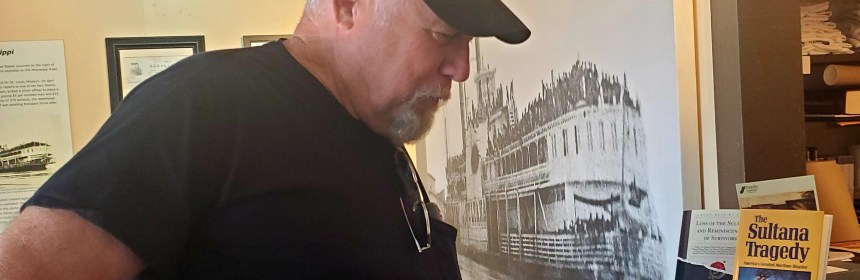
The museum tells the story of an explosion of the steamboat, the Sultana, that occurred April 27, 1865.  During the Civil War era, the boat was designed to carry only 376 passengers plus crew. Investigations revealed a great deal of corrupt practices, including bribes paid to high-ranking Union officers causing overcrowding on the vessel. Three of the boat’s four boilers killed nearly 1,200 of the more than 2,100 passengers and crew.

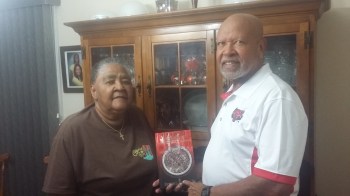
A 14-foot replica of the Sultana is available for viewing at the current museum site at 104 Washington St. in Marion. Photo by Crystal Carter Harrell

Project director Louis Intres said the new museum will be located on Old Military Road in the old Marion gymnasium, two blocks from the current site at 104 Washington St.

“It will be remodeled and repurposed into a 14,500 sq. foot state-of-the-art museum and archive and replace the existing 1,000 sq. foot museum,” Intres said.

The Sultana Historic Preservation Society Inc. purchased the 1938 Marion School Auditorium-Gymnasium as a future home for the Sultana Disaster Museum. The building provides higher ceilings, LED lighting, space for additional artifacts and precise temperature and humidity control.

“Architects working on the design will make the museum interactive and modern, which will entertain as well as educate people of all ages,” Intres said.

Three years ago, the museum confirmed the location of the Sultana.  It sits 37 feet below a soybean field in Crittenden County. They are currently working with state agencies to develop a monument.

“Want to hear something interesting? I work for a farmer in Marion in the fall. The Sultana sunk on his great grandfather’s land,” museum visitor Tony Sasser of Marion said.

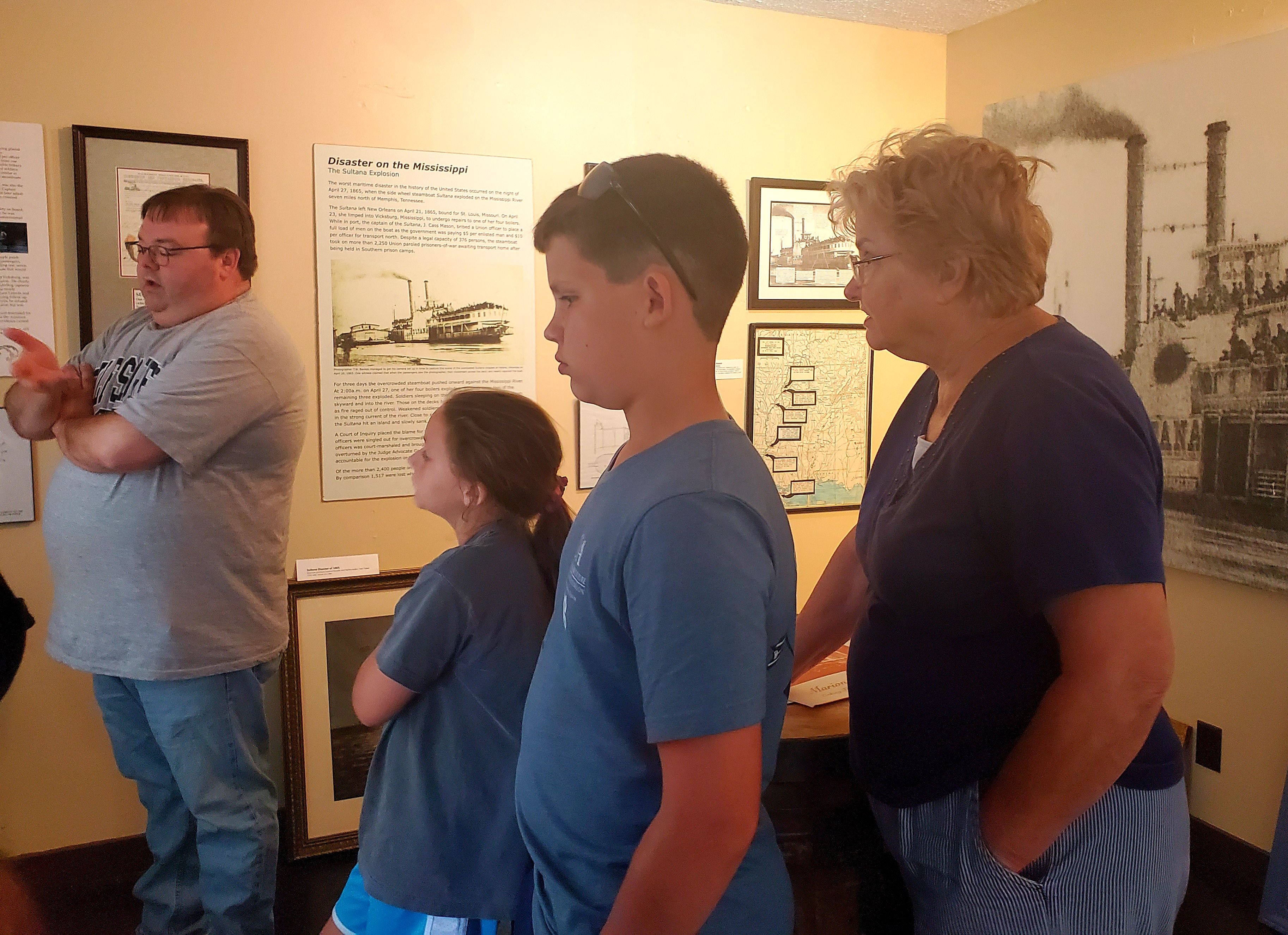
Jere Norville, far left, museum guide, explains the casualties of the Sultana disaster to Gracie Ford, left, Eli Ford , center, and May Sasser, right. Photo by Crystal Carter Harrell

Jere Norville, doctorate candidate at the University of Memphis, gives tours of the current Sultana Disaster Museum on Fridays.

“Now, we’re just fundraising to build the new museum. Hopefully within two years, there will be a permanent home in the new location,” Norville said.

Stories will be told of the men who were freed from Andersonville and Cahaba prisoner of war camps and how they were overcrowded onto one boat. The Congressional Resolution acknowledges the incident as the greatest maritime disaster in U.S. History.

The new museum will demonstrate the conditions which caused the boiler explosions, show the workings of the steamboat propulsion and allow the display of fragile materials. 

“We are really thankful and appreciative of Marion Public Schools for allowing us to take over the old building,” Intres said.

Editor’s Note: Feature photo shows Tony Sasser of Marion viewing artifacts and clippings of the Sultana maritime tragedy. Photo by Crystal Carter Harrell.

State fish hatchery prepares for upcoming fishing derby

By Tristan Bennett
DELTA DIGITAL NEWS SERVICE

CORNING, Ark. — A local fish hatchery prepares to celebrate as National Hunting and Fishing Day approaches.

For the first time, Donham State Fish Hatchery, along with the other five state hatcheries, will host a fishing derby to celebrate National Hunting and Fishing Day.

The holiday began as a day of thanks for sportsmen who contributed to conservation and sustainable use of fish and game, according to the National Fishing and Hunting Day website. President Richard Nixon first proclaimed the holiday in 1972 as a day to enjoy the outdoors and encourage proper management of natural resources.

This year, National Hunting and Fishing Day falls on Sept. 28.

The employees at Donham hatchery work year-round to ensure derbies such as this one go off without a hitch. They must plan ahead each year to ensure each derby site gets the proper amount of fish.

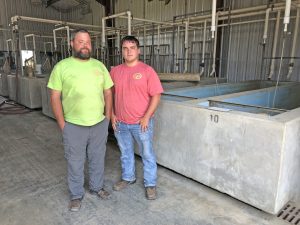
Robert Zimmer, left, and Erik Jordan pose by fish vats. Photo by Tristan Bennett

Mark Harness, hatchery manager, said, “In January or February, I’ll know how many fish I’ve got to produce for the whole year.”

Preparing these fish is no small task. The technicians keep themselves busy taking care of the fish and helping maintain the hatchery itself.

Robert Zimmer, senior technician, said, “We do everything from mowing to cleaning the bathrooms and everything in between.”

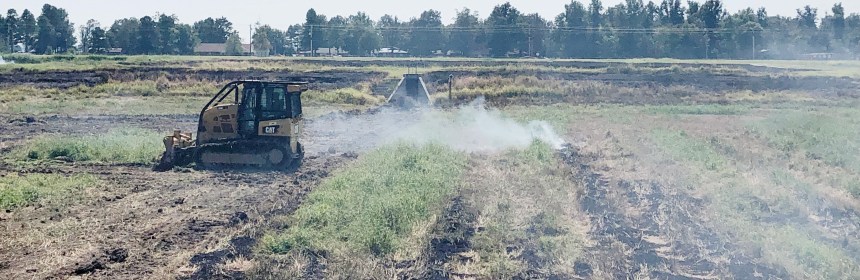
In the fall, the employees rework the ponds by draining them and mowing the grass in them down as well as work on their second round of fish harvesting for the year. In the spring, they put fish in spawning nests and usually begin harvesting by June or July.

“Checking all the oxygen levels is the first thing we have to do every morning,” said Erik Jordan, a technician at the hatchery.

The technicians keep a close eye on oxygen levels to ensure the fish are in a healthy environment. Fish must also be fed and checked on regularly to confirm proper growth.

When the time comes to send those fish out into the community, the hatchery employees harvest the ponds using a method called dragging.

“We have a seine that reaches across one of our 1 1/2-acre ponds, and we’ll drag the whole pond to a corner and slowly pull it in,” Harness said.

From there, they take a sample to get an approximate weight of the fish.

“Let’s say these fish are one pound,” Harness said, “that means one fish weighs one pound, so if we’ve got to have 500 fish, we know we’ve got to have 500 pounds.”

Then, technicians load the fish onto trucks and take them to their new homes for communities to enjoy.

Harness’s hatchery stocks catchable catfish, one pound or over, in many of the Family and Community Fishing Ponds in Northeast Arkansas. Several of these ponds will hold derbies throughout the summer and fall.

Family and Community Fishing Ponds get stocked with catfish in April, May, June, September and October. Trout come to the ponds in November through February. Lakes and ponds get stocked according to what the biologist wants, so it varies from year to year.

Zimmer said, “We may stock Lake Charles this year, but we may not stock it next year.”

The biologist is in charge of deciding how many fish and of what species a lake needs.

The hatchery’s job does not always stop there. Donham holds its own derby at the hatchery every year as well as the National Hunting and Fishing Day derby, which will take place on the Arkansas State University campus.

“We are not doing it here (at the hatchery) because we reach the local people with our derby in June. So, we are going to move to Jonesboro with this one to see about getting a different group of people,” Harness said.

Hatchery employees will be there working educational booths and a casting contest to teach people how to cast correctly. The A-State American Fisheries Society will also be there with information on endangered species. In the past, Donham hatchery has also done a BB gun range, a knot-tying station and kayaking at their derbies, Jordan said.

Admission to the derby is free, and anyone is welcome to fish from 8 a.m. to noon at the Pavilion Pond on the A-State campus. Family and Community Fishing Program rules apply, so someone could even go by themselves to the derby. There is a three fish limit per person.

“It’s designed to get families back to fishing or even get the young kids interested in fishing,” said Harness.

National Hunt and Fishing Day is all about enjoying the outdoors, and Harness hopes this derby will provide Northeast Arkansas with a chance to do so as well as learn about conservation and wildlife.

Editor’s Note: Featured photo shows hatchery staff reworking ponds in preparation of spawning season. Photo by Tristan Bennett

Living as ‘Trans’ in Northeast Arkansas

by Destini Lattimore
Delta Digital News Service

As the transgender population in the United States continues to increase in number, individuals on the state and local level are calling for their communities to as well.

The transgender population nationwide has increasingly become an important sector of the population. In fact, a 2016 study found 0.6 percent of adults in the United States identify as transgender. A separate study conducted in 2018 by the University of Minnesota concluded that about 3 percent of teens identified as transgender.

Luke Smith and Mason Graves* are no different. The two teenagers both said they feel as though they have always been different from other kids, and growing up in their respective hometowns was no easy feat.

“It’s a very small town, everyone there has the Confederate flag hanging from their house,” Smith said of his hometown, Booneville. “There was like a 1-to-1,000 ratio of ‘I’m very different from everyone here.'”

Graves said he had a similar experience growing up in Missouri.

“I’m actually from Southeast Missouri,” Graves said. “I went to school in Donovan and it’s one of those towns where everybody knows each other. If you’re different, it’s a 50/50 chance, either everyone loves you and thinks you’re interesting or you’re bullied.'”

While both of the teens had similar experiences as they grew older, their child lives were very different. Smith described himself as a quiet, reserved child who preferred “playing adventures” and “rough-housing” than playing with dolls and dresses.

Graves, however, considered himself to be a loud and outgoing child. Although he was born female, he always saw himself as his “dad’s kid,” but he still enjoyed both traditional girl and boy activities.

Smith and Graves both found solitude in “coming out” to their friends before telling their family members.

“I actually told my friends first. I just remember it kind of hit me, we were in the middle of choir pictures, and I went up to my friends and was like ‘I’m a dude.'” Graves said. “I transitioned to telling my friends, at first. The first time I told my mom, I just told her I feel like a boy and she said ‘No.'”

Graves said his mom eventually started to come around and she is slowly trying to become more understanding. However, Graves’ father is still unaware and the teen is afraid to tell his father out of fear of his reaction.

“I also told my friends first,” Smith said. “I kind of had hints of it in the back of my head for a couple years but I didn’t realize it until about a year ago. Over Christmas break last year, I told my dad.”

Smith said he felt like his father knew he had to tell him something important and that his father thought Smith was going to tell him he was pregnant.

“He was very nervous. He thought that I was pregnant, he thought that I had done something,” Smith said. “So whenever I said it, he was kind of relieved but he also didn’t really understand.”

Smith and Graves both use he/him as their preferred pronouns and said this has caused issues with them, specifically in the classroom. Both teenagers have experienced being misgendered and both said they were afraid to speak up to correct the mistake.

Graves specifically endures this because, although he identifies as male, he often dresses in clothes that are deemed to be for women.

“I’ve had a pretty good experience here with telling people I’m trans,” Graves said. “But there are still people who don’t get it and they use she pronouns and I have to correct them.”

Overall, the two said they feel as though they’ve had an overall good experience in Northeast Arkansas and the community they have found with each other and their respective friends helps them maneuver through daily life.

However, there are still a number of strides individuals need to take within the region, throughout the state and nationwide. Primarily, the pair wants people around them to make an effort to ask people for their preferred pronouns and make a conscious effort to use them.

Graves said. “When you assume a trans person’s pronouns and misgender them, it’s really hard for them and can put them in a really bad mental state.”

Smith said he encourages people to ask questions if they don’t understand and have a genuine interest in learning about the trans experience.

“Asking questions is always a good idea if you have a transgender friend and you don’t understand something very well and you want to,” Smith said. “Generally, I’m always ready to answer a question to help people understand because I want people to understand.”

***

Editor’s Notes: *The names of individuals in this story have been changed to protect privacy. Featured photo by Ted Eytan [CC BY-SA 2.0]

Soul Food Comes to Jonesboro

***

by Miranda Reynolds
Delta Digital News Service

JONESBORO – The opening of a small restaurant in the downtown area uses family recipes to bring new customers in.

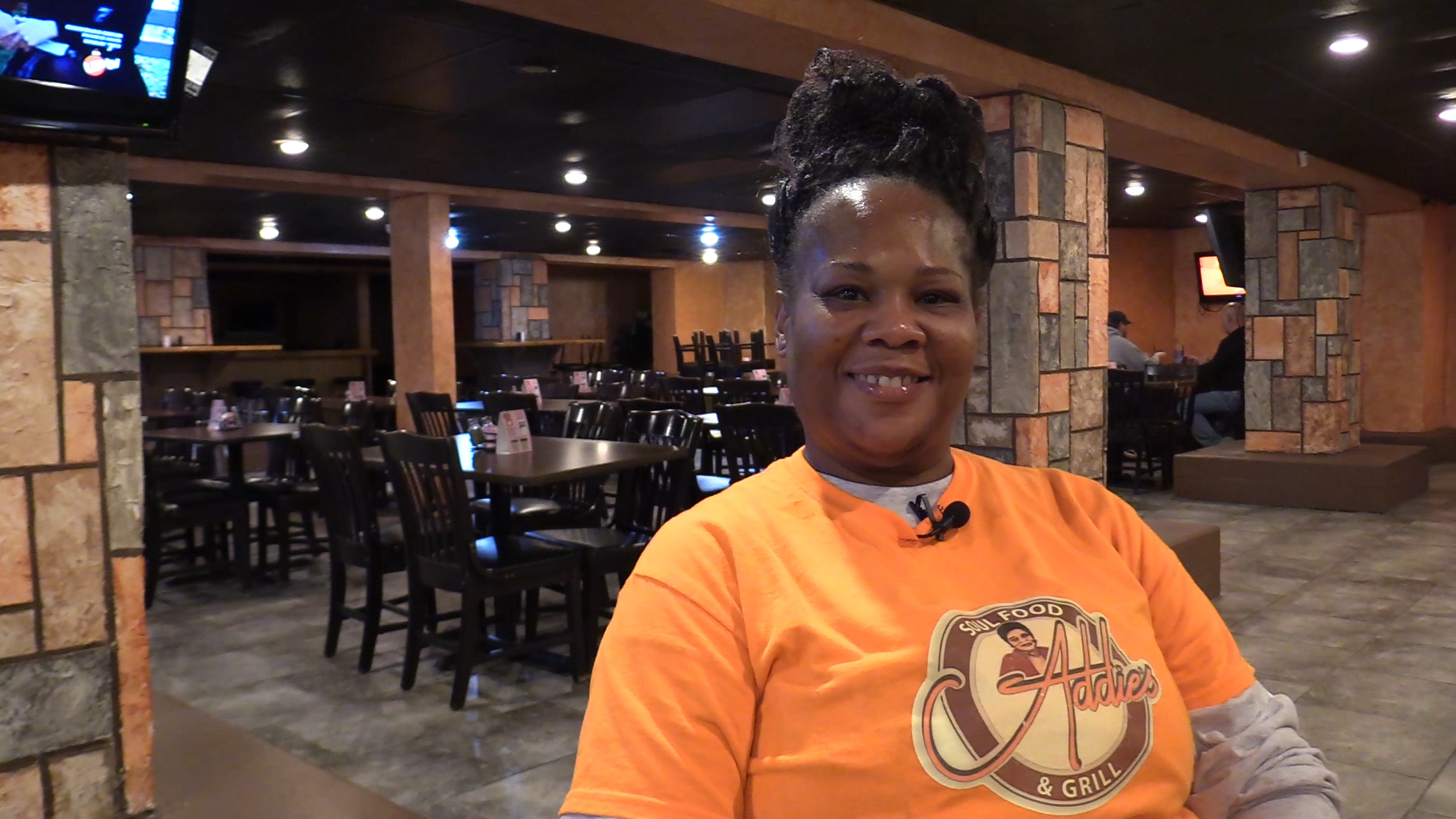
Cynthia Jones, owner of Addie’s Soul Food and Grill, named her restaurant after her mother Willie Addie, who died about 10 years ago. She learned everything she knows from her mother and wants to share her recipes with others.

“I always cooked for my family. I come from a family of 10, but I never knew people enjoyed my cooking until I actually started cooking for the church and that’s when I thought ‘Maybe I should venture out and do it,'” Jones said.

Many family members work with Jones in the restaurant. A sister, nephew, cousins and friends help out when needed. Lacretia Ray, assistant director of Addie’s Soul Food and Grill and sister to Jones, said family remains important to her.

“Cynthia is a very family-oriented person. They push her to keep going. They know she likes to cook and her kids do, too. Her family steps in and helps when they can, so her family, they do a lot. They encourage her a lot,” Ray said.

Not only did Jones learn a few recipes from her mother, but so did Ray.

“When my siblings eat my food, they say, ‘This reminds me of Mom.’ She left a big impact, so every time they eat they always think of her because they say it tastes just like hers,” Ray said.

Among some favorite recipes, Jones remembers her mother’s favorites.

“Her favorite recipe, maybe her turnip and mustard greens, and her dressing was probably her favorite,” Jones said.

One of the restaurant’s employees working under Jones, Amber Hunter, says the atmosphere reminds her of family.

“The sense of family, like it feels like family even though I’m not a part of her family, I feel like I am in a way,” Hunter said.

Jones hopes many people come out and try the new restaurant in the community.

“My goal is for everyone to come out, enjoy and just try it to see if they enjoy it. Just share some of the recipes and stuff, and if they really enjoy it or not, and tell me what I can do to make it better. It’s just for the community. I enjoy to give to people,” Jones said.

Hunter said she plans on working at the restaurant for Jones in the future.

“Working for someone like Cynthia is amazing. You’ll see me here for a while,” Hunter said.

While the restaurant’s soul food cooks, it can be smelled from blocks around in the downtown area.

‘Souper Sunday’ benefits Habitat for Humanity

by Ana Maria Baquero
Delta Digital News Service

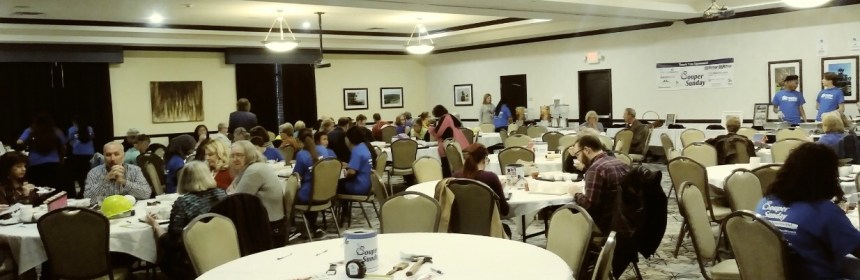
Jonesboro — Habitat for Humanity raised more than $20,000 at the ninth annual “Souper Sunday” event Nov. 4.

During the event, more than 350 people tried 21 different soups from 20 area restaurants and participated in a silent auction hosted by The Hilton Garden Inn. Honey Baked Ham took bragging rights with its Ham and Bean soup.

Micheal Sullivan, executive director for Habitat for Humanity of Greater Jonesboro, said he believes the event was a success.

“Events like Souper Sunday make it possible for us to build up our local community while helping those who need it most,” Sullivan said.

Mari Shelton, chair for Habitat for Humanity’s developmental committee, encourages people to come to future events like this so the community can benefit from it in the future.

“All the money raised from this event remains in Northeast Arkansas and it allows Habitat to build more homes in the area,” Shelton said.

Kandi Baker, director of sales at the Hilton Garden Inn, said the Inn also benefits from the event’s exposure.

DeltaYou: A Public Radio Leader Retires

by Kimberely Blackburn
Delta Digital News Service

JONESBORO – A changing of the guard will soon occur at KASU, Jonesboro’s public radio station as its current station manager retires after 32 years of service and a decade of leadership.

KASU staff members reflected on their time with Station Manager Michael Doyle positivity. Mark Smith, development director, said Doyle served as his mentor for many years. He said he hopes the community joins him in celebrating Doyle and his work throughout the region.

“He has been a good leader for KASU and his natural charm has endeared him to so many in his public appearances for the station throughout the region,” Smith said.

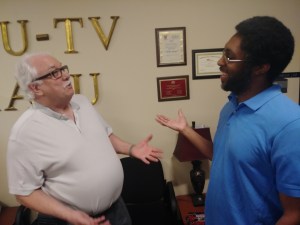
Doyle and Brandon Tabor

Michael Doyle (left) shares a laugh with KASU Morning Edition host Brandon Tabor. Doyle recently announced his retirement as KASU station manager. Photo by Kimberely Blackburn

Reflecting back on Doyle’s leadership in community involvement, June Taylor, KASU’s broadcast production specialist, said he understood the importance of connecting with the community. Doyle served the community in taking up the banner of both entertaining and educating the Jonesboro community. Concerts showcasing local acts include “Bluegrass Monday” in Paragould, “Bluesday Tuesday” in Newport and the Johnny Cash Heritage Festival in Dyess.

Helping local acts perform at the Johnny Cash Heritage Festival proved to be a source of pride for the station. Doyle said these acts performed on the concrete slab where the old commissary stood in Dyess. Cash’s childhood home — recently restored by Arkansas State University’s Heritage Sites — served as the backdrop during the concert.

Although local acts did not perform with headliners Rosanne Cash and Kris Kristofferson, Doyle said performing on that stage served as a source of inspiration and pride for these artists. Helping Arkansans find a sense of pride in the state proved to be important to Doyle. When Arkansas native Glen Campbell died, a social media post composed by Doyle noted while others portray Arkansans as ignorant hillbillies, the state’s rich musical heritage should be a source of pride.

Hear Doyle’s entire social media post and his thoughts on Arkansas music

Arkansas Roots

Doyle first considered a classical music program to fill the noon hour. But after brainstorming with KASU staff members, “Arkansas Roots” debuted. Program director Marty Scarbrough said Doyle shares his own personal knowledge of Arkansas musicians, resulting in the program greatly benefitting its listeners. He said those who tune into the program learn of pioneers who inspired not only Arkansans but many others.

“Without people like them, we wouldn’t have people like Bonnie Raitt or Sheryl Crow,” Scarbrough said. “There wouldn’t be a James Brown or a Ray Charles without people like Rosetta Tharpe or Louis Jordan.”

Not only does the show broadcast the state’s extensive musical history, it also plays current acts who make music for the love of making music. Taylor said the program quickly resonated with KASU’s listeners. Because the program focuses on the roots of Arkansas, people discover upcoming musical events and learn about their community. That, she said, fulfills the purpose of public radio.

Legacy

Doyle said he hopes he leaves KASU better because of his influence. He said 10 years ago, the station gave him an opportunity to do something other than teach four classes a day. This opportunity gave him a chance to make a difference.

KASU staff members said that change will be felt. Since Doyle established such a clear vision for KASU leadership, Scarbrough said he doesn’t foresee any large changes. Taylor agreed and said his leadership kept staff on the right track, continuing on to the goal. Smith said he plans to hold Doyle to his promise of continuing on working at the station as a volunteer.

Doyle told a story of a man he met while doing doctorate work at the University of Tennessee in Knoxville. After deciding to do something different for lunch one day, Doyle said he stopped in at the Wesleyan Center, a Methodist center for UTK students on campus. He said he found himself drawn to a man wearing a white shirt and tie and engaged him in conversation. After some time, Doyle learned the man served as the director of the center. Before the man’s tenure, very few students attended and the center appeared desolate and run-down.

The man worked to build the center up, performing repairs and engaging students in hopes they would visit. In doing so, the man’s doctorate work — the reason he first came to campus — fell by the wayside. Looking around, the man proclaimed the center became his doctorate. Doyle said he feels similarly about his work at KASU.

“I feel like I’ve left it better than I’ve found it,” he said. “So, this is my doctorate. I’ve never finished it, but I’m glad to have done something worthwhile. And I think this is it and I’m very appreciative of that.”

Kimberely Blackburn interviews Michael Doyle on NEA Expose’

6th Annual Ride Benefits Memorial Gardens

by Madison Gomez
Delta Digital News Service

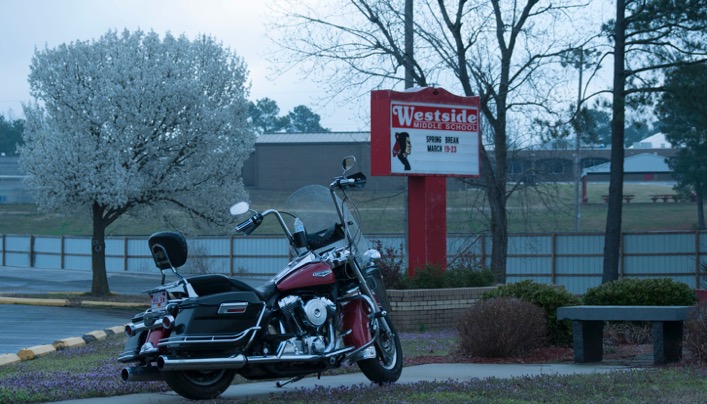
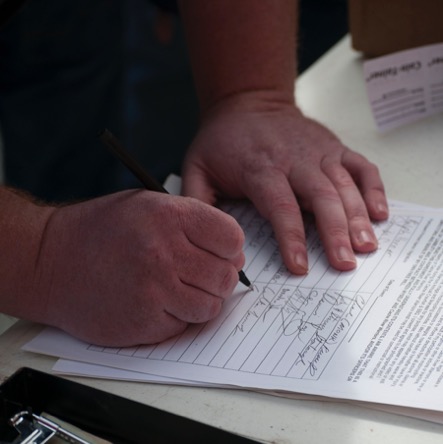
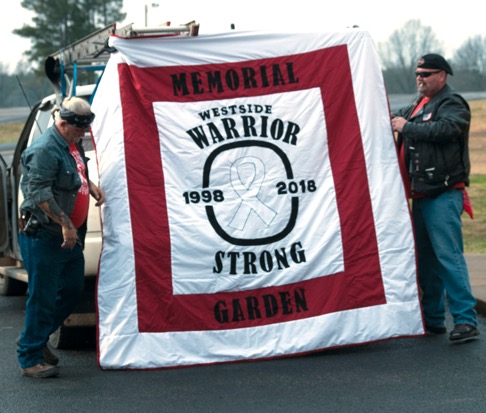
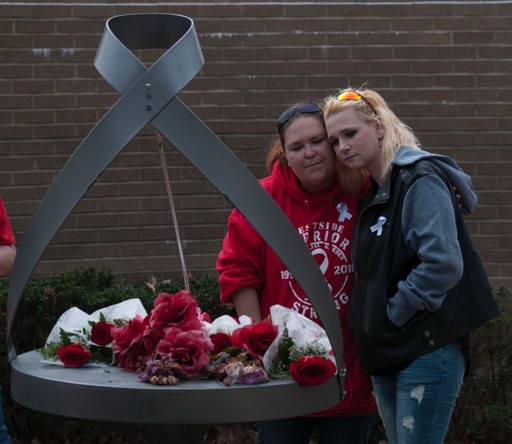
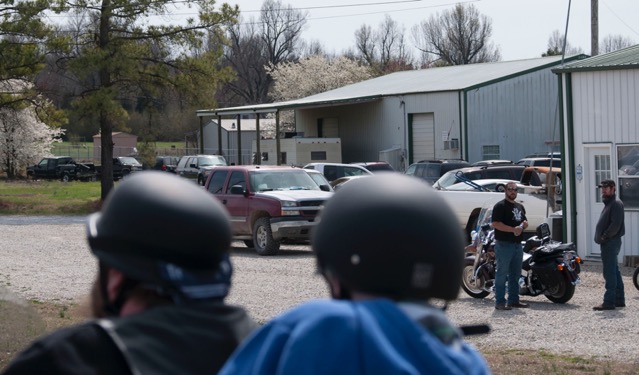
The sixth annual Westside Memorial Garden Ride and Benefit was held Saturday, March 17 at Westside Middle School in Jonesboro. The benefit raises money for the maintenance and upkeep of the memorial garden built in rememberance of the shooting that took place on the grounds in 1998.

motorcycle

A motorcycle rests on a sidewalk at Westside Middle School before the benefit.

Robert Webster

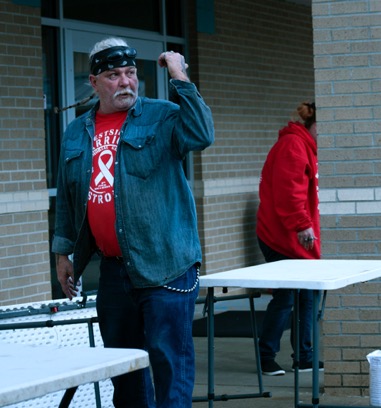
Robert ‘Teardrop’ Webster, directs crew setting up for the Westside Memorial Garden Benefit and Ride in Jonesboro.

driver sign-up

A rider signs his name to drive in the Westside Memorial Garden Ride and Benefit.

quilt

Robert ‘Teardrop’ Webster and Dean McGlothin hang the quilt to be raffled off. Linda Auspaugh makes quilts each year for the benefit.

embrace

Two participants in the ride prepare to embrace before the ride at the Westside Memorial Garden Ride and Benefit.

white pin ribbons

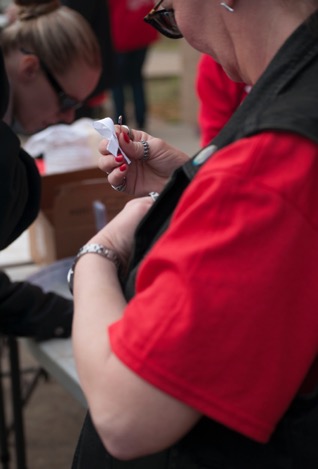
Participants wore white pin ribbons at the Westside Memorial Garden Ride and Benefit in remembrance of the 1998 shooting.

Krystal Scott and Amanda Nelson

Krystal Scott and Amanda Nelson embrace while looking at the sundial in the memorial garden. Scott, present at the school on the day of the shooting, remembered the day: “The fire alarms went off. We proceeded out the doors and it sounded like firecrackers going off until we started seeing people go down and then it was run for your life,” Scott said.

white bows

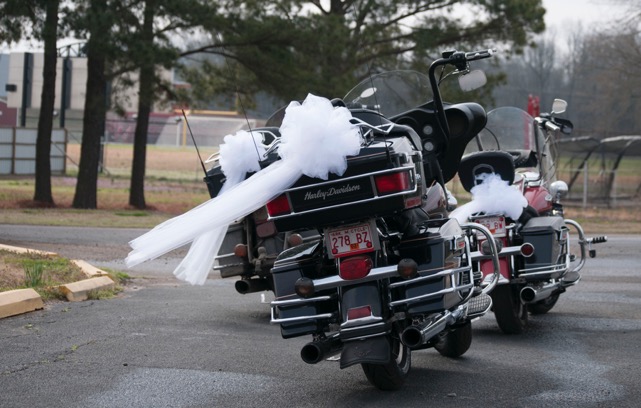
White bows hang from the back of motorcycles at the Westside Memorial Garden Ride and Benefit. Five bows hang for the five victims who lost their lives and one bow hangs for the 10 people injured.

motorcycle repair

Several riders look at a motorcycle as another makes a repair at the Westside Memorial Garden Ride and Benefit.

group prayer

A group huddles for a prayer at the Westside Memorial Garden Ride and Benefit.

waving to the crowd

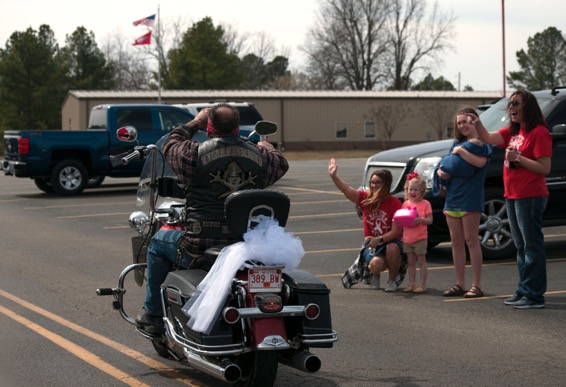
A rider waves to a crowd as the benefit ride begins. The raises money for maintenance of the Memorial Garden at Westside Middle School.

bystanders

Bystanders watch the Westside Memorial Garden Ride and Benefit ride.

riders

Riders for the the Westside Memorial Garden Ride and Benefit.

DeltaYou: Couple’s Impact Still Resonates

By Kimberely Blackburn
Delta Digital News Service

JONESBORO – Many Northeast Arkansans feel the influence of two educators long after they retired.

The Stricklands

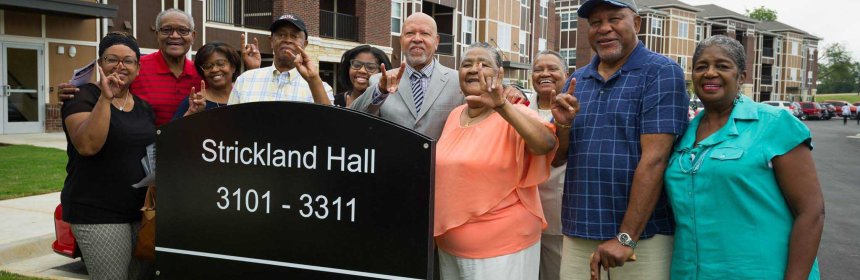
Herman and Maxine Strickland display “The Circle.” A-State dedicated apartment buildings to its first four black facility members, known as “The Circle.” Photo by Kimberely Blackburn

Herman Strickland Sr. taught elementary school in Blytheville and moved up to principal. He considered teaching at Arkansas State University to allow his wife to return to school.

The university made the decision easier with a simple addition to the offer: a house. Until then, the Stricklands lived in an apartment. The house and the low tuition for his wife helped prompt the move.

As A-State’s second black faculty member, Strickland said his family did not face many racial issues. History professor C. Calvin Smith faced difficulties when he came the year before. But Strickland said he believed the university worked out all the issues before he arrived. Showing his love of sports, he compared his and Smith’s journeys to those of baseball players.

“Jackie Robinson had all the problems, but they worked them out before (Roy) Campanella and Don Newcombe came,” Strickland said. “It was sort of that way before me, I think.”

Maxcine Strickland planned to study social work, but said the university did not offer that discipline at the time. She said she believed divine intervention caused her to choose elementary education. The decision, she said, remains one of the best she made in her life.

Herman served A-State as associate professor of teacher education and dean of University College. He said he never thought he would stay in higher education. After Maxcine earned her degree, they planned to return to Blytheville. He said he thought he would return to primary education.

But his students made him change his mind. Herman fell in love with higher education and decided to stay. He worked to mentor students, both in the department and in his fraternity, Alpha Phi Alpha.

Their Impact

Rickey Greer, principal of Jonesboro’s Math & Science Magnet School, said Herman and Maxcine greatly impacted his life. He still strives to pattern his life after them.

Greer learned professionalism from Herman. Greer said Herman always looks at everyone as if they had potential. Greer said Herman’s positivity struck him as well. Although Greer knew the Stricklands faced obstacles due to their race, Herman did not dwell on them.

Greer said he does not know many men like Herman.

Maxcine taught first grade in Jonesboro. Retiring after 26 years, she said her “children” still visit, bringing “grandchildren” along.

In her first year of teaching, Maxcine said she thought every child would pass — she would make sure if it. Maxcine said a wise mentor told her she could not make them learn. Instead, she could provide the information to the children and encourage them.

Although most turned out fine, the students who struggled broke her heart. She said she still wonders what she could have done differently.

Greer worked as a student teacher under Maxcine. He said her dedication to her job and her children greatly affected him.

“She felt like or treated every kid as if they were queens and kings, or they were the best, or they were (gifted and talented) kids,” Greer said. “No matter what level they were on, she treated them that way.”

Maxcine tried to treat every child the same. She set a high bar and encouraged each child to reach it. She told them to never underestimate their abilities. She said if she expected it, they did it.

The Circle

Although the Stricklands moved four houses down from the Smiths in the neighborhood now known as “The Circle,” both families left Jonesboro every weekend. They started going to each other’s homes with the university’s hire of Wilbert Gaines, emeritus associate professor of physical education. The Circle became a family following the arrival of Mossie Richmond, who became A-State interim president, vice president for student affairs and dean of University College.

Maxcine said she never expected what came from The Circle. She said they came to Jonesboro to do a job, but instead, gained nephews, nieces and friends they will love until the day they die.

Herman said he never thought A-State would dedicate buildings to them. The thought overwhelms him. He said he hopes it inspires black students to know if they work hard and find mentors, they can do anything.

Greer said he wished his students could understand how the Stricklands affected their lives. He said he hopes his students spread the positive impact forward.

Herman said he still looks ahead.

“I hope in the future it won’t make any difference about race. I’ll see you as a sister and you’ll tell me about your parent. I’ll feel your parent did a really great job with you and I’ll know you want to leave a legacy for your parent,” he said. “My parent did a great job with me, didn’t have many means, and I want to be a legacy for them.”

(Featured photo courtesy of A-State Media Relations)

Women’s Hall of Fame Inducts 2017 Class

Hawkins award

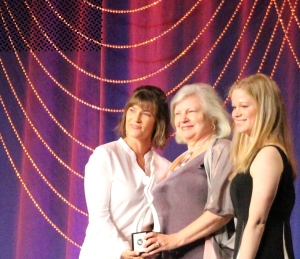
Holly Fish, chair of the Arkansas Women’s Hall of Fame board (left), presents Ruth Hawkins, executive director of A-State Heritage Sites (center), with the 2017 induction award. Also pictured is Shelby Worsham, a girl of distinction. Photo by Kimberely Blackburn

By Kimberely Blackburn
Delta Digital News Service

LITTLE ROCK – The Arkansas Women’s Hall of Fame inducted nine women and one convent into its 2017 class Thursday evening in the third-annual award ceremony held at the State Convention Hall.

Immediately preceding the event, the board of directors unveiled a permanent installation celebrating all the women inducted into the hall of fame. Located downstairs in the Convention Hall, the interactive installation shares the stories of these inspirational women and their accomplishments.

John Owens, president of the North Little Rock Chamber of Commerce, said although his organization involves itself in several community events, this is his favorite due to the impact these women have on Arkansas.

“These women have a positive impact on social change and make it easier for the next generation (to invoke change),” Owens said.

This year’s inductees include:

  • Olivetan Benedictine Sisters, for ministry and medicine
  • Maya Angelou, writer and activist
  • June B. Freeman, advocate for the arts
  • Ruth Hawkins, for honoring history and heritage
  • Brinda J. Jackson, groundbreaking architect
  • Bernice Jones, philanthropic leader
  • Pat Lile, community champion
  • Judge Elsijane Trimble Roy, legal trailblazer
  • Dr. Joanna Seibert, healthcare pioneer
  • Dorothy Stuck, force for equality

Still Making a Difference From the Past

Accepting the award on behalf Maya Angelou, Patricia McCraw said she finds honor in accepting any award for her friend.

Perhaps best known for her writing, Angelou found inspiration in Malcolm X and Martin Luther King Jr. and moved to Egypt to join the anti-apartheid activists. After returning the United States, Angelou joined the civil rights effort.

McGraw said when Angelou saw evil upon any person, she would try to help and Angelou strived to inspire others to love and respect all.

In 1993, Angelou achieved history by becoming the first woman and the first African-American to read a presidential inaugural poem.

McGraw said she composed a poem calling Angelou a “shero of the ages,” due to her desire for peace within the human race. Angelou herself composed a poem where she says, “We are more alike, my friends, than we are unalike.”

Bernice Jones and her husband Harvey committed themselves to contributing a large amount of their fortune to the betterment of Arkansas families. Founded in 1933 by Harvey, The Jones Truck Lines eventually turned into an $80 million-per-year business. After being unable to start a family, Jones and her husband began a philanthropic endeavor to better the state for other families.

Jones paid the salaries of Springdale’s teachers during The Great Depression and helped fix the public school facilities in order to better the education of the children. Although they created a charitable foundation in the 1950s, they chose to make most of their contributions anonymously. In 1995 the Jones Center for Families opened, offering educational opportunities as well as recreation for the community.

Ed Clifford, CEO of the Jones Center of Springdale, accepted the award in Jones’ honor and said her spirit lived on through her contributions, but also through the Jones Center.

Jones’ nephew, Jeff Curtis, also accepted the award in her honor. Curtis said Jones believed the three ways to be successful in were to “follow God, treat everyone the way you would like to be treated, and to follow your passion.”

Judge Elsijane Trimble Roy’s long list of accomplishments includes being the first female judge on the Arkansas Supreme Court.

Roy grew up saying she wanted to follow in her father’s footsteps by becoming a lawyer, but that plan changed when she learned of Amelia Earhart. However, after Roy’s uncle took her on a ride on his crop duster, her mother quickly ended her daughter’s aviation dreams.

After being appointed as a federal judge in 1977, Roy served in the same courtroom as her father for many years. Roy’s son, Jimmy, said his mother often looked at her father’s photo, displayed in the courtroom, for inspiration and guidance when making difficult decisions.

Accepting the award in her honor, Jimmy Roy said his mother loved what she did and she wanted to serve the people.

Serving the Community Together

Inducted into the group category, the Olivetan Benedictine Sisters of the Holy Angels Convent serve the citizens of Jonesboro through various ministries. Established in Pocahontas, the convent moved to Jonesboro in 1889. The original six sisters from Switzerland opened St. Bernard’s Medical Center in 1900. Currently, the sisters try to visit every patient admitted to the Medical Center daily.

Sister Mary Claire of the convent said the sisters believe tending to a patient’s spiritual needs greatly impact their physical condition. Sister Claire said she felt as if her predecessors in the convent felt compelled by God to achieve their mission against all odds. Although not trained in medicine, the sisters rely on their faith and sense of community to fulfill their mission.

“Praying together, eating together is an important part of our lives. We’re kind of scattered with our ministries, but we still want that community feeling, that family feeling and those real bonds you get from living together,” said Prioress Johanna Marie Melnyk in a prepared statement provided by Arkansas Business Publishing Group.

In addition to their ministry at St. Bernard’s Medical Center, the sisters also visit prisoners and work at the Hispanic Center of Jonesboro. Accepting the award for the convent, Sister Teresa Marie said they only want to love their neighbors, as Jesus commanded.

Making a Difference in the State Today

jackson

A senior picture of Brinda Jackson was featured at the 2017 Arkansas Women’s Hall of Fame Induction ceremony. Jackson served as the first black valedictorian of Lake Village High School. Photo by Kimberely Blackburn

As the final group of women inducted, the contemporary category held six women currently striving to serve.

Brinda Jackson, the first black women registered in Arkansas to practice architecture said she received inspiration in a surprising way.

The tube of drawings Mike Brady of “The Brady Bunch” brought home appealed to her, inspiring her to speak with her high school counselor about architecture. Even after having to explain the craft to her counselor, Jackson said she did not let it deter her.

As the first black valedictorian of Lake Village High School, Jackson said she expected to receive the same college scholarship awarded to past students in the past situation. However, after the school decided to make a change, they awarded the scholarship to the salutatorian instead.

After crying for some time, her father comforted her by saying he would still ensure she went to college. Jackson became only the second black woman to complete the architecture program at the University of Arkansas.

Many tried and failed to deter her from the profession, leading Jackson to begin work with the Army Corps of Engineers in 1990. After being sent to Iraq at the beginning of Operation Iraqi Freedom, she faced her fears when her truck broke down while traveling from Kuwait to Iraq.

Refusing to accept the same fate as Jessica Lynch, a soldier captured a few weeks earlier, Jackson said she flagged down a passing convoy and asked if they could head north. By finding a way out of the situation, she earned the 555 Combat Engineer Group Commander’s Award and the honor of being named battlefield hero of the day.

The award surprised Jackson as she said she did not know how many she inspired, but she accepted the award in honor of her parents. She said her parents deserve the credit for her success. Her father would come home from working on the farm and do his children’s chores so they could concentrate on their homework.

Jackson said to never give up because there will always be someone who does not value you as you should be valued.

“Don’t let anyone deter you. Other people cannot determine your success,” Jackson said.

Dorothy Stuck said she came to Arkansas to teach history. She said the thought of being part of Arkansas history makes her very proud. Stuck began her philanthropy career after helping to further the cause of desegregation inspired her. She said she believed segregation to be inconsistent with the nation’s ideals, and one should be judged by their abilities, not the color of their skin.

Owning three newspapers with her husband, Howard, Stuck wrote the news, sports and lifestyle sections, as well as writing editorials and selling advertisements. The Arkansas Gazette published her editorials against segregation, and in 1964 and 1969, she was named Press Woman of the Year. Stuck worked with the 1969-1970 Constitution Committee to repeal the poll tax.

In 1970, the U.S. Office for Civil Rights named Stuck regional director for the Department of Health, Education and Welfare. Over the five-state region of Arkansas, Texas, Oklahoma, Louisiana and New Mexico, Stuck continued her desegregation efforts. While regional director, she worked to integrate public schools, schools of higher education and public-health facilities.

According to a prepared statement provided by ABPG, Stuck chaired Southern Bancorp’s nonprofit, called Southern Bancorp Community Partners. Their mission remains to address poverty in the Delta by providing low-interest mortgages and education with loans to small businesses in the area.

Stuck said she never dreamed she would be considered for such an award. She advises others to never give up, to never give in, and above all, to be stubborn.
stuck

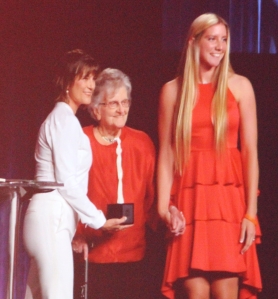
A photo of Dorothy Stuck accepting her award is projected onto the big screen. Also pictured are Fish and Savana Melton, a girl of distinction. Photo by Kimberely Blackburn

“Courage is just being stubborn when you’re scared,” she said.

Dr. Joanna Seibert began to consider medicine as a career late in college. Becoming the first trained pediatric radiologist in the state, she decided to work with children because she always loved them.

She moved to Arkansas with her family in 1976 as the nation celebrated its bicentennial, saying that Arkansas welcomed them with fireworks.

She and her husband, Dr. Robert Seibert, worked to develop Arkansas Children’s Hospital. Siebert said she would often play the harp for the parents, with her favorite area being the neonatal intensive care unit.

Siebert remembers playing the harp as a child suffered a cardiac arrest. She thought she should stop playing, but the doctor working with the baby told her to keep playing. The music seemed to help the medical team as they worked with the patient.

Siebert often kept contact with her patients. She still speaks to a now elementary-aged child who, when born, weighed only 500 grams.

Seibert began training to be a deacon in her church over 20 years ago and is now ordained in her Episcopal faith. Serving at St. Mark’s Episcopal Church, she said she never feels a conflict between her faith and medicine. She said medicine taught her to be curious, but not to fear illness or death.

Siebert said she hopes to live up to the honor of this award.

Committed to making Arkansas better through the arts, June Freeman’s father told her at a young age she would not make a living being an artist. Moving to Arkansas after earning her bachelor’s degree at the University of Chicago, Freeman missed the museum. She began the Little Firehouse Community Arts Center in Pine Bluff, which housed not only an art gallery, but community art classes as well.

After the art center became the Southeast Arkansas Arts and Science Center, Freeman kept the exhibits circulating through the state so Arkansans could enjoy them in their hometowns. She served the state as a cultural entrepreneur.

Freeman also helped to establish Pine Bluff Sister Cities, which encourages trade and friendship with cities in foreign lands. Through Freeman’s efforts, Pine Bluff became the first Arkansas city with a sister city in Iwai City, Japan.

Freeman said one’s life can take many roads, but the key is to never ask permission.

Pat Lile became a full-time community volunteer after being privileged to have full-time help in her home.

After attending a national conference in child advocacy, Lile said the problems the children face in Arkansas overwhelmed her. She then realized something could be done about it, and as long as she could bring something to the table, she would.

In her career, Lile served on several nonprofit boards. In 1999, President Bill Clinton appointed her as the lone Arkansan to attend the White House Conference on Philanthropy.

Serving from 1996-2007 as the president and CEO of the Arkansas Community Foundation, Lile said a sign on Little Rock’s Broadway Bridge inspired her to move forward.

The sign said, “Who will build Arkansas if our own people do not?”

Lile said although she did not know everyone in attendance, she viewed them as a beautiful crowd of Arkansas builders.

Being the second oldest of 12 children, Ruth Hawkins said her parents never questioned that they would all go to college. After beginning her professional career as a journalist, she developed a love of the stories of the state’s Delta region.

As director of Arkansas State University Heritage Sites, Hawkins worked to restore historical sites, such as the childhood home of Johnny Cash and the barn studio in Piggott where Ernest Hemingway wrote “A Farewell to Arms.”

In 2012, she authored a book titled, “Unbelievable Happiness and Final Sorrow: The Hemingway-Pfeiffer Marriage” after 12 years of research. She said the book sets the record straight about Hemingway’s marriage to his second wife, Pauline Pfeiffer.

Hawkins said her interest lies not in the buildings themselves, but in the stories that could be told through them.

“We have a very rich heritage here. There are so many stories out there beginning to disappear because the material things associated with them are beginning to disappear,” Hawkins said.

Hawkins is currently working on the 2017 Johnny Cash Heritage Festival being held in Dyess on Oct. 19-21. Performers include Roseanne Cash and Kris Kristofferson. Hawkins said Cash’s family wanted the restoration of his childhood home for many years.

Attendees of the event will be able to view the house behind the performers.

Arkansas Women’s Hall of Fame

Past inductees include Hillary Rodham Clinton, civil rights crusader Daisy Gatson Bates, Alice Walton and the first woman ever elected to the Senate, Hattie Caraway.

Alex Howland with ABPG said the North Little Rock Chamber of Commerce began the event and a partnership with ABPG to help elevate the status and impact of women.

Arkansas’ First Lady Susan Hutchinson serves on the board of directors. She said the hall of fame serves to bring together and honor those women who make a difference in the state.

A selection committee decides who will be honored based on established criteria. Such criteria include the nominee’s positive impact on women and girls, and her impact on the state.

The board uses three separate categories for inductees. Hutchinson said the board decided on a posthumous category to help preserve the past from the “shadows of time.” The contemporary category highlights women still making a difference for today’s society. The group category showcases groups of women making a difference together.

Girls of Distinction

Howland said they chose five area high school girls to escort the honorees to the stage. Those chosen for this honor serve in student government positions, maintain high academic standards and strive to make their communities a better place.

This year, they chose Jennifer Bond, Zharia Harris, Savana Melton, Stephanie Verdaris and Shelby Worsham to serve as “Girls of Distinction.”

Verdaris serves as student body president at Mount St. Mary’s Academy in Little Rock, as well as a student ambassador for the school and member of both the National Honor Society and Beta Club.

Verdaris said her inclusion in the ceremony humbles and honors her, and being around such women makes her nervous but excited. She escorted Pat Like and the Olivetti Benedictine Sisters.

Harris, a Little Rock native, started “Socks for the Rock,” a nonprofit that provides socks for Little Rock’s homeless population. Other than their basic uses, Harris said that socks can block the passage of certain bacteria to help ward off infection.

Harris said being included in this ceremony makes her want to do more to improve society.

For more information on nominations, visit The Arkansas Women’s Hall of Fame website.
Delta Residents Join March for Women, Equality

by Caitlin Janczys
Delta Digital News Service

Participants march towards the capitol's steps in Little Rock. (Photo by Trisitin Janczys)

Participants march towards the capitol’s steps in Little Rock. (Photo by Trisitin Janczys)

LITTLE ROCK – People filled the intersection at Pulaski and Capitol streets, waiting behind a long purple marker. Police blockaded the surrounding streets, preparing for participants to walk. Thousands of citizens joined at the Capitol Saturday, Jan. 21, as part of the Women’s March.

Formally known as the Million Woman March, the Women’s March originated in Washington, D.C. What started as a simple rally turned into a historic movement as people in every state’s capital — and even countries around the world — marched in solidarity with the D.C. participants.

The Women’s March For Arkansas, designated due to its focus on women’s health and civic rights, was also an inclusive march. Its Facebook page stated, “This event is inclusive, and everyone who supports the rights of all is welcome. Our mission is to further the ideal of justice for all people who consider the United States home. Our vision is to educate and empower individuals to connect with like-minded allies to be the change they wish to see in the world.”

The mixture of genders, races, nationalities, religions and sexuality was hard to miss. Educators, lawyers, families and many more attended the event. Rebecca Spencer marched with her son, Jacob, a sophomore in college.

“We’re here just to march for social justice,” Spencer said. “It was an opportunity to share this with my son, to raise him to be a different white male in America.”

Jacob Spencer and his mother Rebecca Spencer hold signs for the march. Spencer runs the Allen House in Monticello. (Photo by Caitlin Janczys)

Jacob Spencer and his mother Rebecca Spencer hold signs for the march. Spencer runs the Allen House in Monticello. (Photo by Caitlin Janczys)

Quite a few educators marched in support as well, though some were reluctant to provide their full name in hopes of protecting their jobs. A self-identified professor from Arkadelphia said he marched for education as well as LGBTQIA rights.

“I believe education is very important,” Karr said. “I have a daughter, my friends are non-binary gender, and I also have gay/lesbian friends. It’s very important to represent for those people who are too afraid to come out and speak, and also to promote a positive attitude and emphasize how important education really is.”

Another educator named Shannon echoed similar feelings when it came to educational rights and being at the march for her child.

“I’m here because I have a 7-year-old daughter. I want her future to be bright and amazing, and I don’t want her to worry about any glass ceilings,” she said. “If I don’t stand up and make a difference, who’s gonna?”

As an inclusive march, many supported LGBTQIA rights.

“I’m here in representation of trans youth and women’s rights that are intersectional,” said Eliot, who supports equal representation for women from all walks of life. “We have to remember those in the margins who don’t get as much ‘air time’ as a privileged white woman might.”

Robert Polk moved to Little Rock a year ago from Dallas, Texas.

“The purpose of us being here is for promoting a better world,” Polk said. “The rights of equal opportunities, the respect of other women, LGBT, black, Afro-American, Latinos, you know all of us . . . just to make sure that the love is still there.”

(from left) Jaimee Jensen McDaniel and husband Ron of North Little Rock, stand with Gavin Stewart and his mother, Sherri, of Mountain View prior to the Women's March.

(from left) Jaimee Jensen McDaniel and husband Ron of North Little Rock, stand with Gavin Stewart and his mother, Sherri, of Mountain View prior to the Women’s March.

Cheers soon broke over the crowd in waves, signaling the 11 a.m. march to the directly facing Capitol building had begun. Marchers lifted decorative, bold signs high in the air and stepped over the purple marker.

“We Shall Over Comb!”

“Women’s Rights are Human Rights!”

“I’m with Her”

Many more signs would catch a person’s eye. Fists raised into the sky were also on prominent display. Chants could be heard over the roar of stomping feet:

“This is what Democracy looks like!”

“Love trumps hate!”

“We can change!”

Although the recent inauguration of the least popular president in modern times featured violent protests, the Women’s March in Little Rock was as peaceful as promised. The energy was high, and participants were kind and welcoming to each other.

The same feeling could be sensed across the country, including the main event in Washington, D.C. Breanna Francis from Marked Tree described the energy at the D.C. march.

“It was positive, and it was a true heartwarming experience for all,” she said. “The march on Washington gave me hope for the future of this country, and hope that things will get better.”

Rebecca Moore and Breanna Francis

Rebecca Moore and Breanna Francis marched in Washington, D.C. (photo courtesy of Breanna Francis)

Back in Little Rock, marchers surrounded the Capitol as the organizers and speakers greeted them. At noon, participants observed a moment of silence for solidarity with every person participating around the country. Then the speakers took the podium to address the crowd, calling for everyone to become politically savvy and contact their congressional leaders to demand fair rights for all.

Overall, hope provided the driving feeling of the whole event from start to end. One of the speakers, Vivian Flowers, told the crowd, “This march is not about one man, one election; it’s about unity and harnessing our power in the face of ignorance.”

For more information, photos and videos about the Women’s March, visit womensmarch.com or bethechange.org; search social media through the hashtags #taketheoath, #btc, #bethechange; or view the official Little Rock Women’s March Instagram.

Skate Through the New Year

by Austin Hayslip
Courtesy of A-State Department of Media

JONESBORO — “Downtown is a very happening place to be in during the holidays,” Downtown Jonesboro Association Executive Director Hailey Knight said.

The holidays in downtown Jonesboro have always been full of activities. This year, Knight said they’re adding more to the holiday experience in downtown.

“This year in addition to our Winter Wonderland, we also have this wonderful new ice skating rink that was donated by First Community Bank,” she said.

Winter Wonderland is a building full of Christmas spirit. There are booths that are set up full of Christmas décor that the community can walk through and experience. Knight said the location is what makes it so great.

Residents skate

Residents skate at the Wonderland Rink sponsored by First Community Bank. The Downtown Jonesboro Association hopes the rink will become an annual tradition.

“There’s been a lot of people down here. It’s really neat because they can visit Winter Wonderland, which is right across the street, and see the different holiday-themed booths inside Winter Wonderland, and then come right across the street after that with their friends or family and ice skate.”

All you need is $5; that will buy you 45 minutes of skate time. Knight said the community response has been overwhelming.

“It’s really cool to see all the people coming downtown. Normally about 5 p.m. when we come out of the office, we’ll see all kinds of kids over here because they’re out of school and they’re ready to ice skate,” she said.

The ice skating rink is something that Knight hopes will be a staple in the holiday traditions downtown. It will be open through Jan. 1 Monday-Friday from 4 p.m.-10 p.m.; Saturdays from 1 p.m. – 10 p.m.; and Sundays from 1 p.m.-6 p.m. To schedule a group event, call 870-933-4604.

More information can be found online or on the Downtown Jonesboro Association Facebook page.

Park Celebrates ‘Ghosts, Legends, and the Unexplained’

by Marie Mitchell
Delta Digital News Service

GREENE COUNTY – While on a hunting trip, a man only identified as Mr. Hamilton and an acquaintance observed a drove of cattle in a state of alarm. As the cattle fled past, they also became alarmed at the sight of an animal that unmistakably resembled a giant human presence. Hamilton claimed the hairy creature resembled a “wildman,” which ran with great speed leaping 12-to-14 feet at a time. His foot prints measured around 13 inches each.

Farmers and ranchers in the Crowley’s Ridge area witnessed this creature from time-to-time, but did not come forth with any information until Hamilton’s story appeared in a Memphis newspaper on May 9, 1851. That “wildman” sighting marked the first actual “Bigfoot” sighting reported and documented east of the Rockies, according to Elizabeth Kimble, park interpreter for Crowley’s Ridge State Park.

Those hoping to catch a glimpse of the “wildman” can attend a haunted hayride on Friday, Oct. 28. This hayride has become a popular event over the past two years, Kimble said.

“What started out as a hundred or so visitors in the past few years, turned into around 1,000 guests last year,” she said. “This year we have extended the hayride even farther into the woods to possibly get a sight of a zombie or two and other ghostly visitors from the past.”

The park’s Halloween event — “Ghosts, Legends, and the Unexplained” — also features carnival-style games, a zombie photo booth, coloring contest, and a stroller and handicapped-accessible path on Lake Ponder Trail filled with free candy donated by local businesses. Kimble encouraged attendees to bring a flashlight and a bag for candy to share. The night will also feature costume contests.

Ages 2-4: Contest begins at 6:30 p.m. with registration opening at 6:15 p.m.
Ages 5-8: Contest begins at 7 p.m. with registration opening at 6:30 p.m.
Ages 9-12: Contest begins at 7:30 p.m. with registration opening at 7 p.m.
Ages 13-17: Contest begins at 8 p.m. with registration opening at 7:30 p.m.
Ages 18 and up: Contest begins at 8:30 p.m. with registration opening at 8 p.m.

Addie, pet of Erica Olney, was among winners of 2015's pet photo contests.

Addie, pet of Erica Olney, was among winners of 2015’s pet photo contests. (Photo courtesy of Crowley’s Ridge State Park)

All costumes must be age-appropriate; trophies and prizes will be awarded to first-, second- and third-place winners in each category. Winners will also be announced from a pet contest in which contestants submit photos of their pets dressed in costumes.

Nashville recording artist and Northeast Arkansas native Lauren Richmond will provide live entertainment to add to the excitement, Kimble said. Richmond will take the stage around 7 p.m. and perform until 9.

The haunted hayride costs $4 for ages 13 and up, and $2 for ages 4-12 at this cash-only event; those 3 and under ride for free. Although checks and credit cards will not be accepted, concessions and souvenirs will be available for purchase at the CCC Pavilion. Ticket sales for the zombie booth and haunted hayride will end at 8:30 p.m.

For more information, to donate or to volunteer for the event, please call the visitor center at (870) 573-6751. Located on Highway 168 N in Walcott, reach Crowley’s Ridge State Park by traveling west on Highway 412 from Paragould, or traveling north on Highway 141 from Jonesboro.

Using the Arts to Change Lives

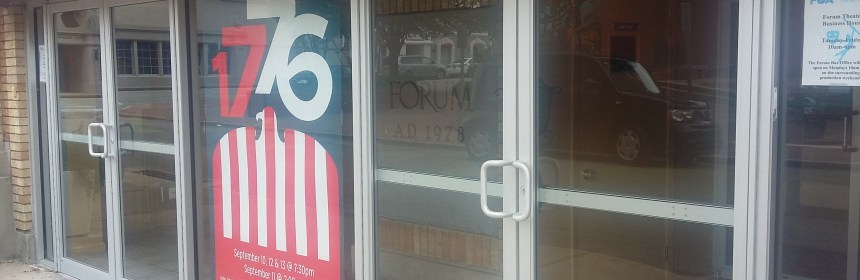
JONESBORO, Ark. – Premiering on Broadway in 1969, the musical “1776” showcases important events in American history. But even after the success of its latest show, members of the Foundation of Arts for Northeast Arkansas still consider bringing the community together to be its greatest endeavor.

FOA creative and artistic director Kristi Pulliam said “1776” draws the audience due to its humanization of heroes from American history. Set in the weeks leading up to the signing of the Declaration of Independence, “1776” shows the struggle in Congress as they prepare to declare independence.

While the musical features John Adams, Benjamin Franklin and Thomas Jefferson, there are actually 22 male characters total.

“I don’t know if we’ve ever had a show with that many men,” Pulliam said. “We only have three ladies in the cast.”

Pulliam said two cast members from two competing radio station performed together in this production. She said she found that interesting because it shows what the FOA does best: they bring people from all walks of life together.

LeeAnn King was 8 years old when she first came to the Foundation of Arts for Northeast Arkansas. Although dance was one of King’s passions, her family could not afford lessons. FOA’s scholarship assistance program allowed her to take a class. Later, as she rose through the classes, she became an assistant teacher.

“I was 14 and I assisted in my first class,” King said. “I was helping the 3-year-olds and all we did was run to the potty, but I was hooked.”

She became a dance teacher, and after three years became FOA’s education program manager. She said she would never be able to accomplish any of her dreams without the FOA. Now she dedicates her life to helping her “kiddos” accomplish their dreams.

The Foundation of Arts for Northeast Arkansas formed when three of Jonesboro’s artistic organizations united in 1983. Today, the root goal of the FOA remains the same: to educate and to change the lives of their students.

Pulliam said the central belief of the FOA encourages everyone to come, take part and give of themselves. One’s financial status, religion and race do not matter.

“We do art, but from my standpoint, it’s a conduit for making better people,” Pulliam said.

A love of people drew Pulliam to the FOA, not her love of theater. Pulliam said many are drawn to theater first, and then to people who can help them in the craft. She finds the opposite to be true for her. 

Pulliam uses the theater for its storytelling capabilities. She said a theater production shows the audience, not only the story of the play but the stories of all those brought together by the production.

That provides the root of culture, Pulliam said. Lives are changed through each other’s stories. She said she feels everyone’s stories are intermingling and intersecting. That is how people change and grow, she said.

Pulliam said by putting everyone from completely different walks of life together, everyone walks away, no only with a renewed sense of what they can do, but also with new thoughts of what they can accomplish with their lives.

“That’s the beauty of having so many people from so many different walks of life,” Pulliam said. “We try to help everyone find a place.”

The FOA strives to provide educational opportunities for everyone, regardless of their ability to pay for classes. King said she estimates about 45 of the 250 students enrolled receive their classes for free. Even more receive some type of assistance.

Pulliam said all of the students work together to create, regardless of their ability to pay. The FOA turns no one away, and no one is singled out. She said only the staff knows who is on assistance.

The FOA benefits many in the Jonesboro community. It offers programs such as Learning Expressions through Art Programming. L.E.A.P. is available to those also enrolled in the Abilities Unlimited program that assists adults with disabilities.

Fine Arts and Me also greatly impacts the Jonesboro community. F.A.M.E., with the assistance of The United Way, reaches out to children with special needs.

According to FOA’s website, F.A.M.E. helps special-needs children become more confident through their exposure to art classes.

The FOA community also experiences great impact. As the mother of three daughters enrolled in classes, Jenny Box sees many effects on her daughters. She says she sees the biggest change in her eldest daughter.

Enrolled in dance classes since the age of 4, Box’s now 12-year-old daughter currently assists dance teachers in classes. FOA helps increase her daughter’s confidence, Box said.

“She is getting to see that she has the knowledge base and the capability to do what seems so huge for her,” Box said. “Now she is getting to be the leader and mentor.”

Describing her younger daughter as “full of confidence,” Box said the FOA provides her younger daughter a creative outlet. She can grow and learn in a safe place.

The FOA strives to provide a safe place for students to learn. They provide a place without competition.

“All (art) is about the expression of truth and beauty, and how we best can express that,” Pulliam said.

Pulliam said she believes something is lost in the competition.  Many forget the submissions of others are also valid.

The sense of community draws Box in. She said she remembers a time where a child missed her cue. The FOA community rallied around her, calmed her down and got her back on stage. Box said she doesn’t feel as if the child would have come back for another show if the “FOA family” had not been there for her.

“It is kind of like a second family. There are people that know my children. I know other people’s children,” Box said. “It’s nice to just have that feeling of belonging.”

Multiple studies have shown test scores will improve and students are more likely to take more difficult courses. For more information on the benefits of an art education, you can visit National Endowment for the Arts

FOA students also learn the discipline of following through on their commitments. This opens many more doors of opportunity to them, Pulliam said. Pulliam’s greatest joy comes when a student learns they are capable of anything.

“(A student) Choosing to go into medicine because they met someone here that showed them that they could,” she said.

King said she loves all the little things about FOA. Children stand up and say their name just a little bit louder. They learn a sense of belonging.

“That’s why I come back. I get to see the faces of the kiddos that I get to see every week,” King said. “Even when they’re wearing me out, even when we have to keep going over a step that that just can’t seem to get, I love spending time with them.

For more information on future productions in the upcoming season or to buy tickets, check out the FOA’s website.


***
Editor’s Note: A previous version of this article incorrectly labeled the arts organization as the Jonesboro Foundation of Arts. 

« Older Entries Recent Entries »