Monthly Archives: September 2017

A-State Board Considers Weapons Policy
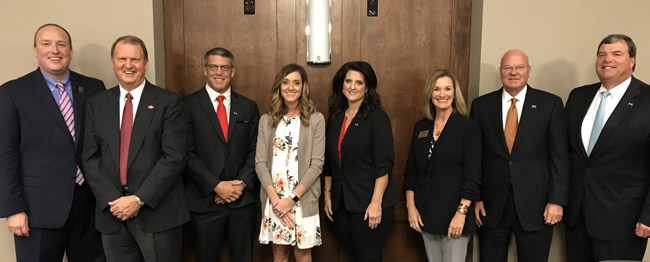
by Keith Turner
Delta Digital News Service

JONESBORO — The Arkansas State University System board of trustees considered an updated weapons policy, helping transfer students and disaster preparation during its first fall meeting.

ASU System President Chuck Welch described the new weapons policy as a “reaction” to a bill passed by Arkansas legislature. The bill allows, to a degree, concealed carry on college campuses.

Welch said the Arkansas State Police have not yet completed its enhanced training program, meaning no one can legally carry a handgun on campus yet.

“We anticipate that it will be sometime in 2018 – January, February, March – sometime in that time frame before an individual will be able to legally carry a weapon on our campuses,” Welch said.

Helping Transfers

Welch and A-State Chancellor Kelly Damphousse announced a study of transfer students beginning in October or November. The goal of the study is to analyze the relationship between ASU campuses and students who transfer or wish to transfer from two-year schools.

“We have a large number of students in community colleges in the state of Arkansas. Unfortunately, we don’t have a large percentage transferring to a university,” Welch said.

Damphousse said he is passionate about transfer students.

“The next step is to make sure we get more transfer students from our sister schools to come here,” Damphousse said.

Disaster Preparedness

The board approved long-term lease agreements for ASU disaster preparedness training facilities in Walnut Ridge and Imboden. The school will seek grants and private funding for the project, which will train participants to respond to a variety of natural disasters. Fewer than 10 similar facilities exist nationwide.

Representatives of ASU and the cities of Walnut Ridge and Imboden signed 50-year leases for the facilities the following week.

In Walnut Ridge, ASU will pay $12,500 a year to rent 100 acres of land, with a 3 percent increase every five years. Walnut Ridge will pay the rent on behalf of ASU for the first two years. The Walnut Ridge site will have training zones specific to certain disasters, such as tornadoes and floods.

ASU will pay $10,000 a year to rent 183 acres in Imboden. The Imboden site will allow for “wilderness scenarios.”

Susan Hanrahan, dean of ASU-Jonesboro’s College of Nursing and Health Professions, assisted in the push for the training facilities.

“With the opportunity to have land in two different spaces, we can start working on getting funding to help build those things and bring people to our region for that type of education,” Hanrahan said.

Walnut Ridge Mayor Charles Snapp told the Jonesboro Sun this “might be the biggest economic boom” in the history of his city and Lawrence County.

System Review

Welch announced plans to hire a firm for reviewing the ASU System and campuses. The review will analyze staffing, programming and resources to determine the overall efficiency of the office.

The review should take around 12 weeks, but it could be up to six months before the results are known.

Other items considered included:

  • Celebrating the anniversaries of two ASU System campuses: ASU Beebe, now in its 90th year, and ASU Mid-South, now in its 25th year.
  • Accepting a resolution to rename the ASU-Newport criminal justice department in honor of the late Lt. Patrick Weatherford, who was killed in the line of duty in June. Weatherford worked for the Newport Police Department, and was a graduate of ASU-Newport and ASU-Jonesboro. His wife, Kristen, attended the meeting.
  • Approving restructuring amendments to the faculty handbook.
  • Approving new policies on internal controls and investments.
  • Approving a resolution to change the name of the lounge area on the third floor of the Reng Student Union to the Vaughn Student Lounge.
  • Approving a request by ASU-Newport to offer additional automotive-mechanical certificates (automotive mechanical systems, automotive transmissions and axles, engine performance, and heating and air conditioning).
  • The efficiency of the employee health care plan.

(Board of Trustees photo courtesy of A-State Media Relations)

Delta Writing Project Impacts Thousands

by Tucker Crain
Delta Digital News Service

JONESBORO – A local branch of the National Writing Project, the Arkansas Delta Writing Project focuses on the overall goals of teacher leadership and writing instruction, shaping the styles of teaching in the region.

Opportunities for the NWP to shape instruction occur throughout the year, but the biggest draw in the region occurs during the ADWP summer program at Arkansas State University. The two- to three-week program emphasizes placing teachers in the same role as their students, allowing for an understanding of how each activity and training session is carried out in the classroom.

A federally-funded program, the ADWP is one of approximately 150 sites across the country that utilize this training. Though the program resides in Jonesboro, it draws in teachers from schools across the Delta region.

“It’s authentic,” ADWP director Dixie Keyes said. “The teachers-teaching-teachers method – rather than people who aren’t teachers trying to tell teachers what to do – is really the heart of it. That’s the gold mine.”

The NWP does not place strict guidelines on these regional sites. Instead, these sites are considered grassroots programs. This allows for greater specialization of instruction based on the region.

Teachers from the Delta have their work published in an anthology at the end of the program. This anthology acts as a model for teachers, showing how to apply all they have learned in the program.

IMG_9949

Heather Neeley, English teacher at East Poinsett County High School. Neeley participated in the summer 2017 program. Photo by Tucker Crain

Heather Neeley, an English teacher at East Poinsett County High School in Lepanto, attended the program this past summer.

“I hate to use the cliché word ‘revolutionized,’ but it revolutionized the way I think about even assigning non-writing units. I’m connecting things I would not have put together before and having it be meaningful for the kids,” Neeley said.

During the program, every teacher leads a daily activity, such as a demonstration lesson on a specific part of writing. The teachers collaborate on projects, write daily journals about the activities and discuss what problems their students encounter.

The ADWP is open to all teachers in the Delta region from kindergarten through college. Though few college professors have attended, teachers from all subjects and all grade levels regularly attend. Neeley said this cross-subject discussion lets teachers learn what general styles of teaching are successful and that the program is beneficial to teachers regardless of subject.

IMG_9954

Kelly Webb, English teacher at East Poinsett County High School. Webb participated in the summer 2017 program. Photo by Tucker Crain

Kelly Webb, an English teacher at East Poinsett County High School, attended the program this past summer.

“I knew I wasn’t doing everything I needed to be doing, and this just gave me an arsenal. I still have my notebook, and I can flip through it and go ‘Oh, I can use this and this and this!’ Really, it was life-changing,” Webb said.

Part of this arsenal includes a “2 cents” activity. Webb said this activity involves reading an article, a short story or another piece and requires students to throw two pennies in a bucket. But, students cannot throw in their 2 cents until they give their insight into the reading. This hands-on approach runs throughout the activities taught at the ADWP summer program.

Even basic writing activities changed the classroom and the student response. Neeley said writing-based assignments like a daily journal give the students something they are confident in and want to talk about during class.

Debbie West, a technology coach at Nettleton Public Schools, went through the ADWP program in 2009 before helping facilitate the program from 2010-2012. Though not a teacher now, West taught during her time with ADWP.

IMG_9965

Debbie West, technology coach at Nettleton Public Schools. West participated in the summer 2009 program. Photo by Tucker Crain

West said the program helped her gain leadership skills and an ability to convey to other teachers what she was doing in the classroom, enforcing first and foremost that writing has worth. The program, in turn, shaped her teaching style.

“(My students had) an excitement for writing. It was important for me to write at the same time that my kids were writing. I also saw the kids beg me, ‘Please take me to the computer lab, we want to blog today!’ They really built an online community with each grade level. They loved reading each other’s stories,” West said.

The blog process incorporated into West’s class involved publishing online stories that the other students read and commented on. West said the students motivated each other regularly, with one student calling another student “as good a writer as J. K. Rowling.”

ADWP has taught around 75 teachers in total, with the summer program’s attendance staying around 10 teachers. One teacher can instruct hundreds or even thousands of students during their time as a teacher. Keyes said she believes this acts as the most beneficial impact of ADWP.

“As the years go by, you’re talking about thousands of students who are enriched just by one teacher,” Keyes said. “So when you think 75 teachers and all the students they’re impacting, that’s what gives me reason to sustain this and keep going.”

Damphousse Seeks Community Ties

By Kimberely Blackburn
Delta Digital News Service

Damphousse Window Art

Window art featuring Kelly, Beth and Maple Leif Damphousse decorated the window of the Chancellor’s office. Damphousse became A-State’s chancellor on July 1. Photo by Kimberely Blackburn

JONESBORO – A native Canadian and Montréal Canadians fan, Arkansas State University’s new chancellor aspired to become either a goaltender for the NHL or a Mountie before coming to Northeast Arkansas by way of Oklahoma.

Chancellor Kelly Damphousse said he planned to stay at his last position as dean of the College of Arts and Sciences at the University of Oklahoma until retirement, but an email sent by A-State President Chuck Welch prompted him to apply. When he first visited the campus, Damphousse saw the challenges but viewed A-State as a diamond in the rough. He said he can impact a community as a chancellor in a much different way than he could as a dean.

“It’s important for us to have a relationship with the people on our campus. Sometimes it’s easy for someone who in administration to get removed from the reality of the world that they’re serving,” Damphousse said.

Damphousse explained why he creates relationships:

Campus and Community

Damphousse said his main concern will always be the students, faculty and staff. He said he understands he can only see a few students per day due to his position. Yet faculty and staff members interact with hundreds.

Damphousse said he wants to use his position to help bridge the gap between campus and community. He said there seems to be a strain between the two due to past events. He said he believes strains occur due to a lack of communication, meaning people do not truly know each other.

To remedy this, Damphousse said he speaks to any community club that extends an invitation, as well as local merchants and companies to see how A-State can help their business. Jonesboro Mayor Harold Perrin said he and Damphousse agreed to work together on several projects.

Perrin said he hopes to help get the word out of what A-State offers the community. He said A-State remains a driving force in the Craighead County community.

Perrin said A-State can help employers by providing both new employees and education for existing workers. Perrin said he believes A-State and the Jonesboro community can achieve this by fine-tuning programs already on campus.

“I’ve always learned in business, you build and become strong on what you have. If you’ll continue to build and to redefine what you’ve got, you’ll be highly successful,” Perrin said.

Damphousse explained his plans to keep A-State movng forward:

United Way

Damphousse recently announced on his Facebook account that The United Way of Northeast Arkansas named him and his wife, Beth, as co-chairs of Arkansas State University’s United Way Campaign.

Nanette Heard, executive director of United Way of Northeast Arkansas, said the Damphousses will encourage the A-State community to designate part of their salary to help fund projects throughout the eight-county region.

UWNEA covers residents of Clay, Craighead, Cross, Greene, Jackson, Lawrence, Poinsett and Randolph counties. Heard said the projects include shelters, after-school programs and programs that help feed the hungry.

Damphousse said the community matters to him and to A-State. Because the campus and community will always be tied together, he said if one rises, they both rise. Damphousse said he and Beth plan to be around for the long run.

He mentioned an analogy about planting trees you never get to sit under. But Damphousse said he wants to sit under the trees he plants. He said he wants to see the efforts that come from the changes he implements.

This is why, Damphousse said, the motto “Every Red Wolf Counts” truly encompasses everyone.

“Every Red Wolf Counts. That means every student, every faculty member, every staff member, every alumnus, every member of the Jonesboro community,” Damphousse said. “I see them all as Red Wolves because we’re all tied together.”

He even let students name the family dog:

Listen to the entire interview: