Category Archives: Education: HigherEd

A-State Board Considers Weapons Policy
by Keith Turner
Delta Digital News Service

JONESBORO — The Arkansas State University System board of trustees considered an updated weapons policy, helping transfer students and disaster preparation during its first fall meeting.

ASU System President Chuck Welch described the new weapons policy as a “reaction” to a bill passed by Arkansas legislature. The bill allows, to a degree, concealed carry on college campuses.

Welch said the Arkansas State Police have not yet completed its enhanced training program, meaning no one can legally carry a handgun on campus yet.

“We anticipate that it will be sometime in 2018 – January, February, March – sometime in that time frame before an individual will be able to legally carry a weapon on our campuses,” Welch said.

Helping Transfers

Welch and A-State Chancellor Kelly Damphousse announced a study of transfer students beginning in October or November. The goal of the study is to analyze the relationship between ASU campuses and students who transfer or wish to transfer from two-year schools.

“We have a large number of students in community colleges in the state of Arkansas. Unfortunately, we don’t have a large percentage transferring to a university,” Welch said.

Damphousse said he is passionate about transfer students.

“The next step is to make sure we get more transfer students from our sister schools to come here,” Damphousse said.

Disaster Preparedness

The board approved long-term lease agreements for ASU disaster preparedness training facilities in Walnut Ridge and Imboden. The school will seek grants and private funding for the project, which will train participants to respond to a variety of natural disasters. Fewer than 10 similar facilities exist nationwide.

Representatives of ASU and the cities of Walnut Ridge and Imboden signed 50-year leases for the facilities the following week.

In Walnut Ridge, ASU will pay $12,500 a year to rent 100 acres of land, with a 3 percent increase every five years. Walnut Ridge will pay the rent on behalf of ASU for the first two years. The Walnut Ridge site will have training zones specific to certain disasters, such as tornadoes and floods.

ASU will pay $10,000 a year to rent 183 acres in Imboden. The Imboden site will allow for “wilderness scenarios.”

Susan Hanrahan, dean of ASU-Jonesboro’s College of Nursing and Health Professions, assisted in the push for the training facilities.

“With the opportunity to have land in two different spaces, we can start working on getting funding to help build those things and bring people to our region for that type of education,” Hanrahan said.

Walnut Ridge Mayor Charles Snapp told the Jonesboro Sun this “might be the biggest economic boom” in the history of his city and Lawrence County.

System Review

Welch announced plans to hire a firm for reviewing the ASU System and campuses. The review will analyze staffing, programming and resources to determine the overall efficiency of the office.

The review should take around 12 weeks, but it could be up to six months before the results are known.

Other items considered included:

  • Celebrating the anniversaries of two ASU System campuses: ASU Beebe, now in its 90th year, and ASU Mid-South, now in its 25th year.
  • Accepting a resolution to rename the ASU-Newport criminal justice department in honor of the late Lt. Patrick Weatherford, who was killed in the line of duty in June. Weatherford worked for the Newport Police Department, and was a graduate of ASU-Newport and ASU-Jonesboro. His wife, Kristen, attended the meeting.
  • Approving restructuring amendments to the faculty handbook.
  • Approving new policies on internal controls and investments.
  • Approving a resolution to change the name of the lounge area on the third floor of the Reng Student Union to the Vaughn Student Lounge.
  • Approving a request by ASU-Newport to offer additional automotive-mechanical certificates (automotive mechanical systems, automotive transmissions and axles, engine performance, and heating and air conditioning).
  • The efficiency of the employee health care plan.

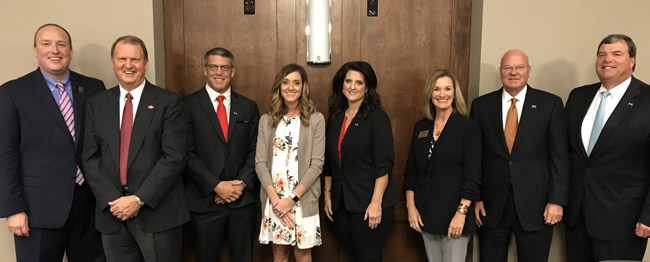
(Board of Trustees photo courtesy of A-State Media Relations)

Delta Writing Project Impacts Thousands

by Tucker Crain
Delta Digital News Service

JONESBORO – A local branch of the National Writing Project, the Arkansas Delta Writing Project focuses on the overall goals of teacher leadership and writing instruction, shaping the styles of teaching in the region.

Opportunities for the NWP to shape instruction occur throughout the year, but the biggest draw in the region occurs during the ADWP summer program at Arkansas State University. The two- to three-week program emphasizes placing teachers in the same role as their students, allowing for an understanding of how each activity and training session is carried out in the classroom.

A federally-funded program, the ADWP is one of approximately 150 sites across the country that utilize this training. Though the program resides in Jonesboro, it draws in teachers from schools across the Delta region.

“It’s authentic,” ADWP director Dixie Keyes said. “The teachers-teaching-teachers method – rather than people who aren’t teachers trying to tell teachers what to do – is really the heart of it. That’s the gold mine.”

The NWP does not place strict guidelines on these regional sites. Instead, these sites are considered grassroots programs. This allows for greater specialization of instruction based on the region.

Teachers from the Delta have their work published in an anthology at the end of the program. This anthology acts as a model for teachers, showing how to apply all they have learned in the program.

IMG_9949

Heather Neeley, English teacher at East Poinsett County High School. Neeley participated in the summer 2017 program. Photo by Tucker Crain

Heather Neeley, an English teacher at East Poinsett County High School in Lepanto, attended the program this past summer.

“I hate to use the cliché word ‘revolutionized,’ but it revolutionized the way I think about even assigning non-writing units. I’m connecting things I would not have put together before and having it be meaningful for the kids,” Neeley said.

During the program, every teacher leads a daily activity, such as a demonstration lesson on a specific part of writing. The teachers collaborate on projects, write daily journals about the activities and discuss what problems their students encounter.

The ADWP is open to all teachers in the Delta region from kindergarten through college. Though few college professors have attended, teachers from all subjects and all grade levels regularly attend. Neeley said this cross-subject discussion lets teachers learn what general styles of teaching are successful and that the program is beneficial to teachers regardless of subject.

IMG_9954

Kelly Webb, English teacher at East Poinsett County High School. Webb participated in the summer 2017 program. Photo by Tucker Crain

Kelly Webb, an English teacher at East Poinsett County High School, attended the program this past summer.

“I knew I wasn’t doing everything I needed to be doing, and this just gave me an arsenal. I still have my notebook, and I can flip through it and go ‘Oh, I can use this and this and this!’ Really, it was life-changing,” Webb said.

Part of this arsenal includes a “2 cents” activity. Webb said this activity involves reading an article, a short story or another piece and requires students to throw two pennies in a bucket. But, students cannot throw in their 2 cents until they give their insight into the reading. This hands-on approach runs throughout the activities taught at the ADWP summer program.

Even basic writing activities changed the classroom and the student response. Neeley said writing-based assignments like a daily journal give the students something they are confident in and want to talk about during class.

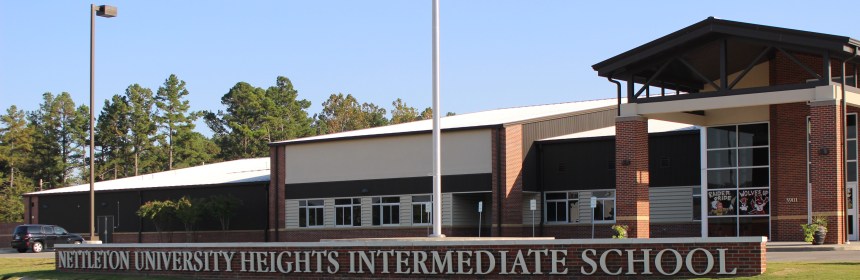
Debbie West, a technology coach at Nettleton Public Schools, went through the ADWP program in 2009 before helping facilitate the program from 2010-2012. Though not a teacher now, West taught during her time with ADWP.

IMG_9965

Debbie West, technology coach at Nettleton Public Schools. West participated in the summer 2009 program. Photo by Tucker Crain

West said the program helped her gain leadership skills and an ability to convey to other teachers what she was doing in the classroom, enforcing first and foremost that writing has worth. The program, in turn, shaped her teaching style.

“(My students had) an excitement for writing. It was important for me to write at the same time that my kids were writing. I also saw the kids beg me, ‘Please take me to the computer lab, we want to blog today!’ They really built an online community with each grade level. They loved reading each other’s stories,” West said.

The blog process incorporated into West’s class involved publishing online stories that the other students read and commented on. West said the students motivated each other regularly, with one student calling another student “as good a writer as J. K. Rowling.”

ADWP has taught around 75 teachers in total, with the summer program’s attendance staying around 10 teachers. One teacher can instruct hundreds or even thousands of students during their time as a teacher. Keyes said she believes this acts as the most beneficial impact of ADWP.

“As the years go by, you’re talking about thousands of students who are enriched just by one teacher,” Keyes said. “So when you think 75 teachers and all the students they’re impacting, that’s what gives me reason to sustain this and keep going.”

Damphousse Seeks Community Ties

By Kimberely Blackburn
Delta Digital News Service

Damphousse Window Art

Window art featuring Kelly, Beth and Maple Leif Damphousse decorated the window of the Chancellor’s office. Damphousse became A-State’s chancellor on July 1. Photo by Kimberely Blackburn

JONESBORO – A native Canadian and Montréal Canadians fan, Arkansas State University’s new chancellor aspired to become either a goaltender for the NHL or a Mountie before coming to Northeast Arkansas by way of Oklahoma.

Chancellor Kelly Damphousse said he planned to stay at his last position as dean of the College of Arts and Sciences at the University of Oklahoma until retirement, but an email sent by A-State President Chuck Welch prompted him to apply. When he first visited the campus, Damphousse saw the challenges but viewed A-State as a diamond in the rough. He said he can impact a community as a chancellor in a much different way than he could as a dean.

“It’s important for us to have a relationship with the people on our campus. Sometimes it’s easy for someone who in administration to get removed from the reality of the world that they’re serving,” Damphousse said.

Damphousse explained why he creates relationships:

Campus and Community

Damphousse said his main concern will always be the students, faculty and staff. He said he understands he can only see a few students per day due to his position. Yet faculty and staff members interact with hundreds.

Damphousse said he wants to use his position to help bridge the gap between campus and community. He said there seems to be a strain between the two due to past events. He said he believes strains occur due to a lack of communication, meaning people do not truly know each other.

To remedy this, Damphousse said he speaks to any community club that extends an invitation, as well as local merchants and companies to see how A-State can help their business. Jonesboro Mayor Harold Perrin said he and Damphousse agreed to work together on several projects.

Perrin said he hopes to help get the word out of what A-State offers the community. He said A-State remains a driving force in the Craighead County community.

Perrin said A-State can help employers by providing both new employees and education for existing workers. Perrin said he believes A-State and the Jonesboro community can achieve this by fine-tuning programs already on campus.

“I’ve always learned in business, you build and become strong on what you have. If you’ll continue to build and to redefine what you’ve got, you’ll be highly successful,” Perrin said.

Damphousse explained his plans to keep A-State movng forward:

United Way

Damphousse recently announced on his Facebook account that The United Way of Northeast Arkansas named him and his wife, Beth, as co-chairs of Arkansas State University’s United Way Campaign.

Nanette Heard, executive director of United Way of Northeast Arkansas, said the Damphousses will encourage the A-State community to designate part of their salary to help fund projects throughout the eight-county region.

UWNEA covers residents of Clay, Craighead, Cross, Greene, Jackson, Lawrence, Poinsett and Randolph counties. Heard said the projects include shelters, after-school programs and programs that help feed the hungry.

Damphousse said the community matters to him and to A-State. Because the campus and community will always be tied together, he said if one rises, they both rise. Damphousse said he and Beth plan to be around for the long run.

He mentioned an analogy about planting trees you never get to sit under. But Damphousse said he wants to sit under the trees he plants. He said he wants to see the efforts that come from the changes he implements.

This is why, Damphousse said, the motto “Every Red Wolf Counts” truly encompasses everyone.

“Every Red Wolf Counts. That means every student, every faculty member, every staff member, every alumnus, every member of the Jonesboro community,” Damphousse said. “I see them all as Red Wolves because we’re all tied together.”

He even let students name the family dog:

Listen to the entire interview:

Trump Puts DACA in Doubt

Canizales at protest

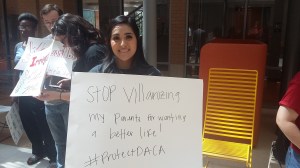
Daniela Canizales, a dreamer, attends a pro-DACA protest on the A-State campus. She remembers nothing of her birth country after coming to the United States as an infant. Photo by Kimberely Blackburn

By Kimberely Blackburn
Delta Digital News Service

JONESBORO – President Donald Trump announced his decision to discontinue the Deferred Action for Childhood Arrivals program, a decision placing those brought to the United States as children by undocumented immigrant parents, often known as “dreamers,” at risk for deportation.

Trump’s decision comes after lawmakers from 10 states demanded he take action against the program, which they called “unlawful and unconstitutional.” Texas Attorney General Ken Paxton sent a letter penned by himself and other officials, including Arkansas Attorney General Leslie Rutledge, giving the Trump administration until Sept. 5 to make a decision on DACA. After this date, the group would proceed to federal court.

In a prepared statement, Rutledge said, “While we are a compassionate country, the United States is a country of laws, and President Trump recognized that President Obama’s DACA program went far beyond the executive branch’s legal authority. Congress has always been the proper place for this debate, and I am pleased that the President is granting Congress an additional six months to legislatively address this issue.”

The Impact

One dreamer, Bryan Hernandez, said his parents decided to leave Mexico City after someone robbed his father at gunpoint. After coming to the United States at the age of 6, Hernandez said he does not remember much of his birth country.

Hernandez said his parents brought him and his sister to the United States for a better education and more work opportunities. He said his parents work as a roofer and a maid, having previously worked for low wages as migrant workers.

Edica Tamez, a friend of Hernandez, said she remembers when Hernandez’s 4-year-old brother worked as a migrant worker alongside his family. Tamez said the child knew his family needed money and wanted to help.

Tamez said she often saw a similar work ethic in the Hernandez family, remembering Hernandez’s now 16-year-old sister reacting to being approved for DACA, after being denied twice.

“She was so relieved she could finally work. She could finally help her family and go to school,” Tamez said.

Brought from Monterrey, Mexico, 18 years ago, now 19-year-old Daniela Canizales said she remembers nothing of her birth country. Canizales said she fears how the end of DACA affects her educational opportunities. While currently not in school, she said she wants to study social work.

Canizales said her parents brought her and her older brother to the United States for a better education. She says DACA also provided opportunities for her brother and sister-in-law to provide for their 6-year-old daughter.

Hernandez and Tamez at protest

Edica Tamez and dreamer Bryan Hernandez protest the end of DACA. The A-State Young Democrats protested in the Humanities and Social Sciences Building. Photo by Kimberely Blackburn

The Aftermath

The Young Democrats of Arkansas State University staged a protest on the A-State campus. Those in attendance included Kayleigh Schalk of Poplar Bluff, Missouri. Schalk said she attended the protest because of her belief that it is unfair for children to be sent away from their home.

Schalk said she attended class with dreamers in a small Missouri university, finding them to be kind and hardworking. One, Schalk said, worked odd jobs and swept up the trash after all the events and ball games.

Special Sanders, outreach director of Arkansas Coalition for DREAM, said Arkansas requires dreamers to pay out-of-state tuition. This is often close to double what Arkansas residents pay. Sanders said when DACA ends, dreamers will most likely not be able to keep their identification or their jobs.

Sanders said she does not think Congress will pass legislation to help dreamers. She said if something does not change, she will return to the streets in protest.

Dylan Herekamp, also in attendance for the protest, said he did not know any dreamers personally. However, he said, that did not matter to him. Herekamp said his goal will always be to stand up and support dreamers, and he encourages everyone to write or fax their lawmakers and make their voices heard.

A Deal in Progress

Late Wednesday night, Senate Minority Leader Chuck Schumer and House Minority Leader Nancy Pelosi issued a joint statement after meeting with Trump which said “We agreed to enshrine the protections of DACA into law quickly, and to work out a package of border security, excluding the wall, that’s acceptable to both sides.”

Sarah Sanders, press secretary for the Trump Administration issued a Tweet which said, “While DACA and border security were both discussed, excluding the wall was certainly not agreed to.”

Uncertain Future

In response to DACA critics, Canizales said she wishes everyone would become fully informed on the issue. Canizales said everyone should do research and learn of the issue before making snap judgments.

Hernandez said the future of his family remains uncertain and his education remains a concern.

“(This decision) takes away the opportunity, the change for an education that we always wished for,” Hernandez said.

NEARK Schools Prepare for Solar Eclipse

by Tucker Crain
Delta Digital News Service

JONESBORO – Northeast Arkansas high schools are taking the necessary precautions in preparation for viewing the solar eclipse on Monday, Aug. 21.

The eclipse, which is predicted to take place around 1 p.m., will be visible in the United States from coast-to-coast for the first time since 1918. This brings a new challenge to the school districts, which have not faced the prospect of viewing a potentially hazardous eclipse in recent memory.

The Valley View School District opted out of allowing the students to view the eclipse altogether. Select schools in the Jonesboro, Nettleton, Westside and Ridgefield Christian districts are allowing students to view the eclipse.

“No one will be outside watching the eclipse. Our district made the decision to stay inside and watch a livestream instead,” said David Goodin, Valley View High School principal. “We were worried about the glasses. They’re supposed to be one-size-fits-all, but maybe they don’t fit some students. Younger students may not use the glasses properly, or someone might take their glasses off and get hurt.”

Valley View decided to stream the eclipse instead of going outside to watch even after consent forms were sent home with students. Glasses purchased for the event will go unused.

“Our older students may be checked out by their parents to watch the eclipse with their own approved glasses, and that’s fine. This decision is really just for the general welfare of our student body,” Goodin said.

At Jonesboro Public Schools, all students will be supplied with glasses and allowed to watch the eclipse with an approved consent form.

“We purchased approved solar eclipse glasses for all the students and faculty in the Jonesboro Public Schools district, except for our kindergarten and pre-K students,” Carol Neves, Jonesboro Public School District’s Science, Technology, Engineering and Math specialist. “Every student has a permission slip to get signed by a parent or guardian to be able to watch it. If they don’t get it signed, we’ll still be streaming the event inside our buildings.”

Jonesboro Public Schools is the only district allowing all of its students to watch the solar eclipse. Nettleton, Westside and Ridgefield Christian are only allowing older students to watch, though “older” is different at every district.

“Our eighth-grade through 12th-grade students can view the eclipse. We have contacted local eye doctors and developed a safety plan for what type of glasses to use,” said Michael Graham, Westside High School principal. “We’re conducting a safety briefing before the event. We’ve had some concerns, but our consultations with the local specialists made us feel like students will be safe to watch.”

Ridgefield Christian will also allow seventh-grade students to watch.

“Our secondary students will be invited to view the event. Our glasses will be provided free of charge, but the students must have their consent form approved by a parent or guardian. All our younger students will watch a stream online,” said academic adviser Veronica Reeves.

While other schools secured enough glasses for all students to view the eclipse, the Nettleton School District only secured enough for certain classes.

“All of our science classes will be viewing the eclipse, and we’re trying to find enough glasses to get the entire school out there,” said Brian Carter, Nettleton High School principal. “The ninth through 12th-grade students who are in a science class during the eclipse will be able to go outside and watch it if they have their consent form signed by a parent or guardian.”

The path of the solar eclipse will show between 75-90 percent totality in Jonesboro and the surrounding areas. The totality in each area lasts around 2 minutes and should not be looked at without using approved glasses.

A-State Dedicates ‘The Circle’

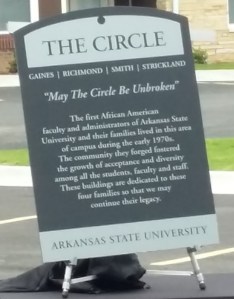
University officials unveiled a placard explaining “The Circle” during the dedication. The university named the apartment buildings for its first four black faculty. Photo by Kimberely Blackburn

by Kimberely Blackburn
Delta Digital News Service

JONESBORO — Arkansas State University honored its pioneering black faculty Aug. 7 at the dedication of “The Circle,” a group of apartment buildings.

Chancellor Kelly Damphousse said such an honor sends a statement and begins many projects intended to make the campus a more welcoming place.

“We’ve come a long way in recognizing the important role that African-Americans play in our community, but we have a lot further to go,” he said.

A-State named the buildings — which will house A-State faculty, graduate students and New York Institute of Technology College of Osteopathic Medicine students — for the four men who taught at a time when many did not accept integration:

  • C. Calvin Smith, emeritus professor of history and A-State’s first black faculty member
  • Mossie Richmond, A-State interim president, vice president for student affairs and dean of University College
  • Herman Strickland Sr., emeritus associate professor of teacher education and dean of University College, and
  • Wilbert Gaines, emeritus associate professor of physical education.

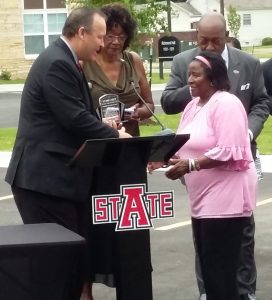
Chancellor Kelly Damphousse presents Earline Smith with a crystal award in honor of her late husband C. Calvin Smith. Each family received an award. Photo by Kimberely Blackburn

Smith lived in campus housing after being unable to find someone in Jonesboro willing to rent to his family. As the other families arrived, they became neighbors and formed “The Circle.”

Rick Stripling, vice chancellor for student affairs, said the dedication sends the statement that Arkansas State embraces diversity. He emphasized the importance of honoring the contributions of these men in the public eye.

Smith’s widow, Earline, said the families’ shared experience formed an extended family who truly loved each other. She said never in her wildest dreams did she expect so many people would attend the dedication. Richmond’s widow, Velmar, said the dedication honored and dumbfounded her.

Strickland said he came to A-State and found friends immediately. He said he gained acceptance as a teacher because of his friendship with Smith, who had done it first. He said he became a dean because Moss mentored him.

Gaines claimed the dedication shows A-State as, “a beacon of light to which other institutions can come for divine wisdom and insight.”

Richard Hartness Sr. authored a book illustrating the families’ lives called “The Circle: Coping With Integrated Life at AState, 1970-1978.” A former student of Smith’s, Hartness said he learned of the story at the celebration of Smith’s life after his death. Hartness said Smith brought important aspects of American and black history to his students that sometimes corrected the history books. Hartness said he now teaches these ideas to his students at East Arkansas Community College.

Richmond’s family member, Sandra Smith, works as principal of the BCH2 Academy at Wynne public schools. She said the dedication provided an opportunity for her to bring ideas to her students and teachers. Smith said she often quotes Frederick Douglass — who said, “Education can be an equalizer” — to show the importance of education to her students.

“In 2017 when we find there is still racial tension at times, this (dedication) establishes the fact hard work does pay off, and there is a facet of America that recognizes hard work,” she said. “As (Arkansas State) honored these founders and pioneers, they have honored themselves. As we lift others up, we lift ourselves up and if we understand that, we will be a greater America.”

Immigration Ban Sparks Concern

By Kimberely Blackburn and Caitlin Janczys
Delta Digital News Service

JONESBORO – Although the 9th U.S. Circuit Court of Appeals ruling put a freeze on President Trump’s executive order limiting the entry of citizens from seven Muslim-majority countries, it still impacts thousands of people, including those currently in Arkansas.

Residing in the United States for four years, Aya* and her family will return to Libya in a few months. She said although it does not affect her now, she fears the executive order might alter her family’s future. Although Aya planned to return to the United States to work on her doctorate after visiting home, now she fears she will not be allowed.

The executive order not only affects Aya’s education, but also her children’s education. After learning of her 3-year-old son’s autism diagnosis, she feared for his future. In Libya, he would not be taught how to better express his emotions, which he now finds difficult. While in America, he learns to communicate by learning his alphabet, numbers and colors. If they cannot return, he will lose the benefits of a better educational program.

Jaden,* a graduate student from Yemen, came to the United States a year ago. He planned to return to Yemen in August for his wife and their 18-month-old child. But now he may have to stay here without them.

“There is now a need to stay here without them, without my soul,” he said.

img_1683

Protesters hold signs at the “NEA: We All Belong” rally in front of the Craighead County Courthouse. The rally started with a Facebook page. (Photo by Caitlin Janczys)

Voices like these got a group of people thinking. Cord Rapert and others decided to help make those voices heard by creating the “NEA: We all belong” rally on Friday, Feb. 3 in front of the Craighead County Courthouse. Word spread quickly.

“It’s all been word-of-mouth and Facebook,” Rapert said.

By noon Saturday, more than 60 participants showed up to hold signs and stand close to the edge of the sidewalk that faced Main Street for passing cars to see. The message they spread: “No bans. No walls. No mass deportations. We all belong.”

“We decided to show not only the community here that there are people here who support (immigrants) and have their back no matter what,” Rapert said, “we wanted to do something that showed our support and showed how we are against this issue. We’re going to fight it any way we can.”

Honking horns from passing cars signaled support for the rally and its participants. The encouragement lifted the crowd’s spirits, making them hold their signs higher and chant louder.

Yet with such a high tension-filled issue, the rally wasn’t just met with optimism. A few cars passed with their windows open so that they could yell negative comments in the faces of the participants. One male even stood up through his window, turned his phone on the rally so he could video them, the other free hand raised in a fist, screaming, “Build that wall.”

Aya said the prophet Muhammad teaches followers to treat others the way they would like to be treated. She understands how some equate Islam with terrorism, but said Islamic militants do no represent Muslims accurately.

“I hate them!” she said.

Aya said the majority wishes to work with the United States to rid Libya of the terrorists. When the Obama administration worked to kill known terrorists in the area, many Libyans assisted in the United States’ efforts. She said terrorists attack her country as well as others.

Jaden said he agrees that the group, which calls itself the Islamic State, affects those practicing Islam the wrong way. He said those truly practicing the Islamic faith hate the terrorists more than others. Islam will always be a personal faith, he said, noting it means something different to every Muslim.

Yet not everyone understands the divide between terrorists and Muslims. Jaden said he fears the executive order will increase the level of hate between U.S. citizens and Muslims.

img_1684

Many rally participants attended not only to raise concerns about the “ban,” but to promote hope, too. David Nunez, an organizer for Arkansas United Community Coalition, evoked the hopeful feeling at the rally.

“I thought it was a good idea … advocating for civil rights and social justice and civic integration,” he said. “Everybody has been so friendly and we’d like to keep it that way. It is a great rally. I’m very excited, I’m very, very proud to be here in solidarity.”

The outpouring of community support overwhelmed Aya, but it did not surprise her.

“I was sure the American people would not accept (the executive order),” she said. Many have tried to send her a message of support.

Aya said she has received many messages of support. After the president announced his executive order, Jaden said an American organization left flowers and prayer cards on the steps of the mosque expressing support. He said acts of kindness like this help him focus on peace and try to remain optimistic. Jaden said he believes this order goes against the human spirit and something will change. That could be the way his country and the United States views each other.

Jaden said he came to America with a negative view of the country due to the media attention it received in Yemen. But seeing the motivation of American citizens changed his view. Jaden said he hopes when he returns to Yemen, others will notice a difference in him and obtain a better view on Americans. He said he believes America remains a land of diversity and dreams, and that we can all learn from each other if we will just try.


*Editor’s Note: Names changed for privacy.

Students’ Sweat Equity Benefits City, Habitat

by Austin Hayslip
Courtesy of A-State Department of Media

After a year working with Habitat for Humanity, Jonesboro High School students are getting their hands dirty. ASU TV’s Austin Hayslip reports.

“I loved it, I love the whole idea of working with your classmates to work for a common goal, and that being building a house for a Jonesboro citizen,” said high school student Mark Havdala.

High school students are building houses, not completely on their own, but with the help of Habitat for Humanity.

Habitat has been working with the Jonesboro School District for over a year now. It is a cause Jonesboro High School student Mark Havdala said is worth donating time to.

“You are working, it is a visible and legitimate donation of your time and you actually see what you doing be put to work and the best part is an actual Jonesboro citizen will actually get that house,” he said.

Jonesboro Habitat for Humanity Executive Director Michael Sullivan said it doesn’t begin or end with a house. The students play a vital role in the organization.

“They volunteer, they educate, they fundraise and they advocate on behalf of Habitat for Humanity,” he said.

Students who spent months putting together floor plans will begin putting up walls in the coming weeks.

The house being built now is the first that the Jonesboro School District has helped with.

Assistant Superintendent Sue Castleberry said the school district is including almost every campus, giving each student an opportunity to help.

“Our news crews from math and science will come do some video work, so almost every campus will take some of the things,” she said. “The woodwork things, we’ll take that back to the art teachers at the elementary to paint.”

Castleberry said the students are actually teaching her things as well.

“Last year the students taught me how to know how to measure and actually cut siding,” she said.

Habitat for Humanity and JPS have created a relationship that’s benefiting the entire community.

Stop When the School Bus Stops

A school bus stops, via Wikimedia Commons

A school bus stops and warns drivers not to pass. But some drivers fail to pay attention. Photo by Infrogmation [CC BY 2.5], via Wikimedia Commons

JONESBORO, Ark. – Every day thousands of area school children board school buses. However, many drivers do not stop when the school bus stops.

Jonesboro Police Department’s public information officer Paul Holmes said the city issued 23 citations in the past 12 months to drivers caught passing stopped school buses. He said the penalties often shock drivers.

According to Arkansas state law, the fines range from $250 to $1,000. The penalty also affects your motor vehicle report similarly as reckless driving and driving under the influence. A driver’s motor vehicle report also directly affects insurance rates.

Jonesboro Police Department Sgt. Doug Formon said those who will pass a stopped school bus often amazes him.

“I’ve stopped several school teachers, not only locally from here, but from other school districts,” Formon said. “I’ve stopped a school bus driver one day who was off work from Missouri.”

Formon said when he follows a school bus, drivers attempting to pass the stopped bus will often pass him first. He said many drivers claim to not have seen the bus while others simply did not pay attention. Formon said after the passing of no-texting laws, many drivers now look down at their phones as an attempt to keep them hidden, which he believes also contributes to a rise of violations.

A lack of education causes many drivers to pass stopped school buses. Formon said many drivers he stops thought they didn’t have to stop due to them traveling in the opposite direction, i.e. many said they believed they don’t have to stop because of the two lanes and an additional passing lane divide them and the stopped school bus.

Arkansas state law 27-51-2004 states, “When a school bus stops and displays its alternating red warning lights for the purpose of loading or unloading passengers, every operator of a motor vehicle or motorcycle meeting or overtaking the school bus from any direction shall bring the motor vehicle or motorcycle to a complete stop before reaching the school bus. The operator of the motor vehicle or motorcycle shall not start up or attempt to pass in any direction until the school bus vehicle has finished receiving or discharging its passengers and is in motion again.” You can read the state laws regarding school buses in their entirety here.

Formon said all drivers on all of Jonesboro’s roads must always stop for school buses with no exception. He said he can only catch one per bus, but more than 20 vehicles often pass.

Forman said he remembers a time they took more officers out to follow school buses, and they stopped over 30 vehicles because enough officers patrolled that day.

Jonesboro School District transportation director Mickey Long said be believes the problem also lies with the parents of the bus riders. He said while dropping their children off at the bus stop, many parents will stop long enough to watch their children board the bus, and then pass the bus illegally.

Long said this remains a chronic problem. He said he turns in at least three reports from bus drivers a week. He said he believes simply holding people accountable will help bring awareness. His department works closely with Jonesboro police to combat this ongoing issue.

Long said it’s not uncommon to see several officers come to the bus yard and follow the drivers on their routes. Holmes said they remain in constant communication with the transportation department to find problem areas.

Long said he hears reports of drivers passing stopped buses from his drivers every day. He said many times the drivers said they believe if the children did not pay attention, they would have been hit.

Long said the wind blowing a dropped piece of paper into traffic could potentially cause a tragedy, i.e. some children will give chase without stopping to consider if everyone will stop.

“The risk and reward are not there because the risk is you’re going to run over a kid,” Long said.

Holmes said they try to educate the public through the media and also social media. He said they try to do everything they can to better educate the public. Formon said they placed an electronic billboard at the beginning of every school year.

The Arkansas State Board of Education annually holds a Flashing Red. Kids Ahead. campaign, designed to educate Arkansas drivers on school bus safety. 

“ADE encourages students and schools to get involved in the campaign by sharing videos and pictures of why school bus safety is important,” ADE’s Kimberly Friedman said. “Videos and pictures can be posted to social media using #2016Flashing Red”

Long said he doesn’t want to get anyone in trouble. He said he simply believes prosecution of drivers who do not stop brings awareness to the problem.

Holmes said the best thing would be for drivers simply to comply. He said he hopes the public will become better educated because eventually they will be caught.

“They’ll get educated when you say, ‘Sign here,'” he said.

Long said one driver can make a difference in protecting the children.

“It just takes that one person to stop,” Long said. “You stop for the bus and everyone behind you is going to stop.”

PLWC Helps Paragould Students Start Year

Kristie Ford, counselor of Paragoulds Baldwin Elementary School, reacts to the donated supplies. PLWC's Volunteerism Committee makes an annual donation of backpacks and food for local children in need. (Photo by Kimberely Blackburn)

Kristie Ford, counselor of Paragoulds Baldwin Elementary School, reacts to the donated supplies. PLWC’s Volunteerism Committee makes an annual donation of backpacks and food for local children in need. (Photo by Kimberely Blackburn)

by Todd Kelley
Community Journalist

   The Paragould Light Water and Cable (PLWC) Company’s Volunteerism committee provided food and school supplies donated by employees to help area students start the 2016 school year.

   PLWC’s Environmental Services manager Lisa Ellington along with committee members Michael Sims and Greg Adams delivered 108 backpacks and various food items to both Greene County Tech and Paragould School Districts. The items will be dispersed among all students in the district; from kindergarten through 12th grade.

   Greene County Tech Junior High social worker Leslie Stallcup said the teacher-referral process allows targeted help on an as-needed basis. The process allows students and parents to receive the food and school supplies they need, in a way that minimizes the possible discomfort that parents and students may feel.

   “We feed a family and it helps eliminate some of the child’s stress. Kids have enough stress as it is, and you learn better when you are focused on learning,” Stallcup said.

   Ellington said the PLWC Volunteerism Committee has many projects that help feed the hungry. Projects include feeding children in local schools, helping people with meals during the holidays, and helping others in general.

   “It is important that everyone know that the committee is made up of company employees. We receive our funding directly from them, and they set the pace for our charity work. Although more community involvement would be welcome,” Ellington said.

   Anyone interested in volunteering or donating should contact Ellington at(870) 239-7700.

AState President Hosts Town Hall on Jonesboro Campus

AState President Chuck Welch

AState President Chuck Welch listens to concerns at a Town Hall meeting on the Jonesboro campus. He said he expects to have an interim chancellor in place within a few weeks. (Photo by Tucker Crain)

by Tucker Crain
Delta Digital News Service

JONESBORO, Ark. — Arkansas State University System President Chuck Welch addressed the Jonesboro campus in an open town hall following the resignation of chancellor, Tim Hudson.

“There is not going to be any formal presentation taking place, instead, I want us to have a conversation. This is going to be very laid back,” Welch said.

Over 50 people attended the Aug. 24 meeting, and questions ranged from the minutia of running the campus to transparency.

“ASU-Jonesboro lacks transparency. From the top to the bottom; this is nothing new. The recent audits have just exacerbated that. How do we let our shared governance come in and keep this from being the case?” asked Michael McDaniel, professor of communication disorders. “We, the faculty and staff – and even the students – have achieved a seat at the table. But having that seat does not seem to be the same as having a voice. We want to be heard. These shared governance committees do not work like this.”

Welch insisted things will improve.

“I have sat in on many of the shared governance meetings, and there are certainly very vocal people on every single one. If we need to go through extra steps to make sure everyone feels like their voice is being heard, then we will,” Welch said.

Welch then explained how such a shared governance committees could actually work out.

“We have an issue with clearly defining shared governance, its committees and how they are executed. When it seems like something is being done that not everyone at ASU-Jonesboro likes, you must remember that we make decisions that affect more than just the ASU-Jonesboro campus and its community,” Welch said.

While the crowd seemed satisfied by the answers on transparency, students in attendance brought concerns of their own.
Brett Dush, a junior at ASU-Jonesboro, went on a recent study-abroad trip to Spain.

“We were all given documents specifying the exact cost of everything and where all our money was going. But we looked into it. A lot of our money went to a travel agency and we had to pay for some of our meals out of pocket, which was not the original plan. I will email them to you,” Dush said.

“Please do,” Welch replied, “because I will provide transparency. I’ll show everyone the receipts I have that are under question. We are hiring a full-time study-abroad director. We will not carry out any trip that will not let students get the most possible from it. That is why we had to recently cancel the upcoming trip to France. And for that, I am truly sorry. But if we do these, we are going to do them right.”

History professor John Beineke, a distinguished professor of educational leadership and curriculum, questioned if Welch knew of the improprieties of the Hudson administration. Welch denied prior knowledge.

“I hear a lot of things. I hear a lot of things that just are not true. Was I aware the Dr. Hudson’s leadership style was different than mine? Yes. However, the word ‘bully’ never came up until after everything else came to light,” Welch said.

Paul Mixon, the interim dean of the College of Engineering, questioned when the Jonesboro campus would have new leadership. Welch suggested an interim chancellor would be selected in weeks rather than months.

“What we really need right now is a chancellor who can act as a healer,” Welch said. He continued by addressing concerns brought by audience members who thought the search committee might not have done the best job picking the last chancellor.

“I cannot predict the future, and hindsight is always 20/20. But the search committee will come up with numerous capable candidates,” Welch said.

Mary Jackson-Pitts, professor of communications, questioned if the search committees actually had input.

“On the last search committee I was on, we were not allowed to vote for who we really liked,” she said.

Welch noted that would not have been his instructions.

“I have never been on a committee where I said we could not vote. Instead, I say this: I want to protect both members of the committee and the candidates. But we do a heavy background check on all the candidates. I call people on and off the reference sheet. I talk to former students and coworkers. I bring all this information to the committee and we discuss,” he said.

Welch assured everyone the flagship campus still has the most consideration of any in the system.

“People question a lot of things we do by saying, ‘But won’t that hurt ASU-Jonesboro?’ The decisions we make at the central office always help the flagship campus the most. You can look and see that at the University of Arkansas, the University of North Texas, and other schools we compare our systems to,” he said.

Welch emphasized the openness he demonstrated in the town hall was something he was looking for in the next interim chancellor and, eventually, the long-term chancellor.

“I underestimated how little this sort of thing was taking place – this openness. I want the next chancellor to be a listener, have a calming influence, an external perspective and to help me stay honest with you all. Last time, I wanted someone who was aggressive, progressive and inventive. Well, we sure got that,” he said.

During the conversations, Welch did not forget to mention how much he loves his job and Jonesboro.

“This is my hometown. I was a first generation college student, and my dad did not even graduate from high school. This job is not just a paycheck for me – it is a chance for me to give opportunities to others that my parents did not have. It is my passion. We cannot undo some things that happened but we can heal. I may not be the brightest, but I can learn a few things,” he said.

Welch will also meet with the following campus governance committees next month:

  • Student Government Association—Sept. 13
  • Faculty Senate—Sept. 16
  • Staff Senate—Sept. 21

Habitat For Humanity Reaches Jonesboro

By Jobari Williams
Delta Digital News Service

JONESBORO, Ark- Jonesboro community collaborates, as Habitat For Humanity reaches Jonesboro. Jonesboro High School, Arkansas State University and the communit…

Source: Habitat For Humanity Reaches Jonesboro

Phi Beta Lambda Helps The Helping Neighbors

Christopher Lee
Delta Digital News Service

JONESBORO, Ark.-  Every year, Arkansas State University’s Phi Beta Lambda chapter takes part in their annual Community Service Project, and for the last two years PB…

Source: Phi Beta Lambda Helps The Helping Neighbors

Recent Entries »