Category Archives: Health

Nonprofit Fights Teenage Substance Abuse


by Kayce Wilson
Delta Digital News Service

JONESBORO – Active in this community since 2008, the Craighead Out of The Dark Coalition plans to jump-start the organization.

CODC’s executive board attended the Arkansas Prescription Drug Abuse Prevention Summit in Hot Springs. CODC received a $175,000 Drug-Free Communities grant to apply to its goals. Efforts to receive the grant started five years ago.

“I started out as a community volunteer and was contacted by the board because they had heard that I was running another youth state program,” President Noelle Richardson said. “Last spring we wrote for the DFC grant through Substance Abuse and Mental Health Services Administration and we found out in the last week of September that we were awarded the grant.”

The DFC grant will provide CODC with full-time and part-time staff. The grant assists communities in connecting with 12 different sectors, from government to education.

Meeting the Community

Noelle’s husband and CODC chair Kevin Richardson thanked attendees of the November meeting at the NEA Food Bank for their support.

“Even though you haven’t heard a lot from us, a lot has been going on,” he said.

CODC challenged Craighead County fourth-graders to create drug-free posters. The top contestants attended the meeting and displayed their posters; Cason Kifer of Buffalo Island Central West Elementary won the competition. His poster can be seen on billboards throughout the city.

The Prevention Squad held its Christmas party at Lost Pizza Co. (back row, l. to r.) Melissa Ayers, Noelle Richardson, Zavier Roberts, Mia Goodrich, Lauren Lewis; (front row, l. to r.) Jackie Sosa, Rylie Fanning, Abigail Pausch. Photo by Kevin Richardson.

The Prevention Squad, made up of six high school students from the area, gave a rundown of the events held within the last year. The Prevention Squad hosted a Back 2 School Bash and the “Leave Your Mark” rally in October. It also participated in the Mud Ball Tournament, which benefits the St. Bernards’ NICU.

The CODC’s chapters curently include the Bay, Brookland, Buffalo Island Central, Nettleton, Riverside, Valley View and Westside school districts. Seventeen school chapters exist across Craighead County alone, as well as more than 250 students who attended a five-hour leadership training course put on by CODC. Noelle Richardson said she believes they will have a chapter in every school within the next year.

“People should be on the lookout for Out of The Dark,” Noelle Richardson said.

Benton police department Cpt. Kevin Russell from the Coalition for Safer Arkansas Communities showed a video created by a Colorado-based group, Smart Colorado that provided information on the negative effects of marijuana in Colorado since they legalized recreational marijuana use.

Russell said youths need to be taught the importance of the word “yes.”

“They not only need to say ‘no’ to drugs but ‘yes’ to life, which is a life free of drugs,” Russell said.

CODC also participated in the Arkansas Rx Drug Take Back, which collected over 60 pounds of old prescriptions during the four-hour period.


Harvest Affects Asthmatics

by Miranda Reynolds
Delta Digital News Service

Eli Norton (photo courtesy of the Norton family)

MCCRORY, Arkansas – Harvest season in the Delta creates turmoil for residents who annually suffer from asthma and allergies.

Eli Norton, age 7 of McCrory, has severe allergies requiring shots every other week. Aside from the shot, he uses nose spray and allergy medication in the mornings and at night. Lesley Norton, Eli’s mother, said she notices a change in Eli’s condition during harvest season.

“He gets more headaches and he has a more stuffy, runny nose,” she said. “Sneezing, coughing, just the typical symptoms you would have with allergies. When it’s not harvest season, we can do the shot once a month. With harvest season, we sometimes have to do it once a week depending on how severe his symptoms are.”

The farmers of rural communities in Arkansas cultivate their yields and feed its country’s residents during the fall season.

Billy Holmes, a farmer in Woodruff County, harvests about 1,600 acres of rice and soybeans. Holmes said soil types, residue, weather and the location of the fields determine whether to burn the rice stubble.

Safety is a concern for Holmes’s employees. Holmes said the employees keep themselves out of smoke as much as possible while doing the same for the neighboring farms. Laborers work mostly in tractors with cabs equipped with filtered air conditioning to protect them from dust.

Melissa Alumbaugh, advanced practiced registered nurse with ARcare, sees most of her patients suffering from allergies in the spring and fall. Alumbaugh said harvest season absolutely affects those with asthma.

Alumbaugh said preventative measures that asthma suffers can take include:

  • Avoid irritants. Use prescribed allergy medications, including antihistamines and nasal steroids.
  • Use dust mite covers on beds.
  • Use humidifiers at night.

The dust and smoke that harvest season produced may affect children, adults and the elderly.

Knowing personal conditions regarding dust and smoke can help with better preparation for this time of year. A health care provider can assist with a plan of action when harvest season occurs in Arkansas.

Flu Shots Provide Protection

by Miranda Reynolds
Delta Digital News Service

MCCRORY, Arkansas – Doctors strongly encourage Arkansans get the flu shot to ensure their health and the health of their families.

The time for flu shots in Arkansas approaches rapidly as winter draws near. Getting an annual flu shot better protects one’s health and deters the possibility of spreading the illness to others.

Melissa Alumbaugh, advanced practice registered nurse with ARcare, said getting the flu shot decreases the risk of getting the flu. If you do get the flu, it is likely the symptoms would not be as severe. She said some older generations believe the myth that getting the flu shot gave them the flu, as patients were once vaccinated with a live strand of the influenza virus. This caused older generations to believe the myth.

The Youth

The McCrory region expects to receive flu shots at the end of October. For McCrory High School and McCrory Elementary School, this will be a busy time.

Amanda Brewer, nurse at McCrory public schools, said the Arkansas Department of Health will administer the flu shots to the students.

Brewer decides school procedure for dealing with sick students. She evaluates the student’s illness and checks for a high fever. If the student is suspected of the flu, the parents are contacted and advised to get the child a flu test by a local doctor. If parents cannot pay for testing, there are other methods of payment services available. Brewer said she recommends those who cannot afford a flu test to ask for payment assistance.

Alumbaugh said the flu shot affects everyone differently. Size, weight and how staff distribute the shot play a role. The way people absorb the shot along with exposures in their surrounding environment also play a role.

“The healthy should avoid the sick, practice good handwashing and quarantine those sick family members to help stop spreading the flu virus,” Alumbaugh said.

Alumbaugh said she advises getting flu shots in October since it takes 14 days for the vaccine to be active.

Public’s Impact

Experts anticipate the projected strain of the flu virus by the previous year’s flu virus. Alumbaugh said multiple strains of the flu exist and experts find it difficult to predict exactly what strain will be the most effective.

The flu shots Arkansans receive cover three to four different types of strains predicted to hit the region. The ARcare clinic’s flu shot in McCrory will cover these basic flu shot types.

Alumbaugh said that if projections miss the exact strain, the clinic would not administer a second dosage of flu shots to the public. If a clinic runs out of flu shots, it cannot easily receive more. However, the clinic may receive more, depending on availability.

The Elderly

Latricia Milton, director of nursing at the Woodruff County Health Center, said, “Patients at the Woodruff County Health Center will receive a mandatory flu shot.”

The Woodruff County Health Center houses 96 residents who need help with everyday life. Facility directors mandate nurses and staff receive a flu shot as well. Milton said valid reasons for denial of the flu shot include being sick, having a fever or being allergic to eggs.

In cases where patients are not of sound mind, families determine if staff members administer the vaccine. Staff separates patients who contract the influenza virus from other roommates and the doctor is notified. Milton said the doctor of the patient then decides if they should start Tamiflu or other medications.

Treatments of outbreaks of influenza in the Woodruff County Health Center begin with testing of the original patient suspected of the flu, testing surrounding neighbors and keeping identified patients separated.

Alumbaugh said flu shots in Arkansas are very much a necessity for those wishing to avoid the flu.

“A lot of people are hospitalized every year for the flu. They’re very ill, and some of them end in death,” Alumbaugh said.

Alumbaugh said she encourages doing something that can prevent a hospital stay or death. Prepare for the flu season by getting your flu shot.

Editor’s Note: Featured photo by Patrica H [CC BY-SA 2.0]

New DHS Program Cuts Hours for Disabled Citizens

by Kimberely Blackburn
Delta Digital News Service

JONESBORO – A new program implemented by Arkansas Department of Human Services resulted in cuts of home health care hours for many in the disabled community of the state.

Legal Aid of Arkansas won a temporary restraining order on behalf of many who suffered a cut in hours in February. DHS appealed and won a postponement of the original court date of July 2017. The suit is expected to go to court in 2018.

The suit states Arkansas DHS did not notify those enrolled in the ARChoices waiver program of upcoming changes. This lawsuit came after winning a suit filed in federal court against DHS.

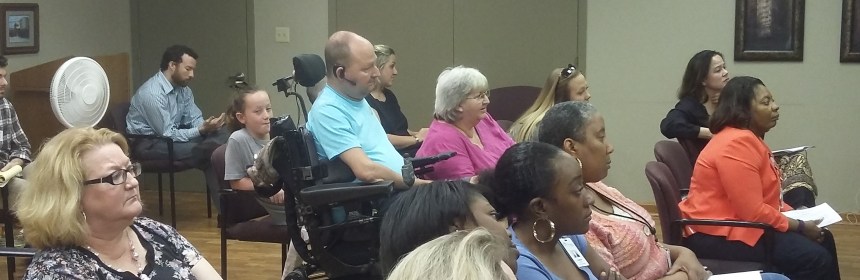
James Dukes speaks about a video he directed that highlights the impact of the 4,000 cuts. Legal Aid of Arkansas is traveling the state meeting citizens to help explain the cut in hours imposed by Arkansas DHS. (Photo by Kimberely Blackburn)

Kevin De Liban, attorney with Legal Aid of Arkansas, said the lawsuit came after several clients contacted him after DHS drastically cut their hours. These cuts resulted from a new program called ARPath. The program uses an algorithm developed at the University of Michigan to determine a category each patient would fall into. DHS assigned each category a pre-determined number of hours assigned that cannot be changed by a health care professional.

Brandi Hinkle, deputy director of communication for Arkansas DHS, said, “ARPath was implemented to provide a more objective review of client needs to ensure that all beneficiaries receive a consistent, medically appropriate level of care.”

She said DHS developed the categories after studying a large number of individuals with similar diagnoses. DHS used this study to best determine home health care hours. Hinkle said DHS commits itself with helping individuals maintain a high quality of life.

De Liban said the lawsuit was filed due to the violation of the Administration Procedures Act, which governs state agencies. According to the Act, state agencies must publish any proposed changes and allow for public comment. After the period for public comment closes, they must consider comments and re-evaluate the proposed change.

Hinkle said DHS follows an extensive procedure for changes to all programs and clients have the right to appeal after their assessment. De Liban said DHS did not adequately inform the public of the change. He said DHS published a notice of rulemaking online and in newspapers of record, but included no mention of the algorithm. The notice did include a link to the entire 242-page document, but De Liban said the notice mentioned the algorithm only six times and did not include it on the page that listed the major changes.

The Effects

Dan Watson acts as the primary caregiver of his 32-year-old son Andrew. He said they learned of the new program with they asked for a re-assessment. Watson said his son’s condition worsened, but the new program resulted in a reduction of hours. He said the nurse ran the program with all the worst answers and it still resulted in the same number of hours. He said his concern lies in what will happen to Andrew in the future.

Dorothy Vaughn suffered a spinal stroke, which involved a blood vessel bleeding out into her spinal cord. She said paralyzation occurred within a matter of hours. DHS cut Vaughn’s hours by 21 hours per week. She said her family works and her son cannot turn her due to his back surgery. She said she suffered a stage-four pressure sore due to her lying on her back each night, a result of the reduction of hours.

Vaughan said she remained in a nursing home for three weeks after having part of her tailbone removed in treatment for the pressure sore. She said she needs the additional home health care hours to help her get on top of the pressure sore and become productive again. As it stands, Vaughan said her end result will be a nursing home.

Shannon Brumley suffered a spinal-cord injury 16 years ago as a result of a motorcycle accident. His mother remains his primary caregiver.

Brumley said emotional health plays a big part in one’s physical health. He said being in a nursing home would affect his emotional state greatly directly. He said he wishes DHS could live his life for a week. If possible, he said it would change its mind.


Tammy Dobbs of Cherokee Village explain how the cuts in her home health care affects her life in a video directed by James Dukes. Legal Aid of Arkansas produced this video to show the impact of the cuts caused by the new program implemented by Arkansas DHS. (Video courtesy of Legal Aid of Arkansas)

The Future

Arkansas DHS appealed the state lawsuit and De Liban said it could take until 2018 for the case to go to court. In the meantime, those enrolled in this program can protect themselves. Hinkle said all enrollees have 30 days to appeal their assessment. She added anyone who appeals within 10 days has the right to keep all their hours until the hearing.

De Liban said anyone who loses at the hearing will be required to pay the state for the cost of the extra hours. However, he said DHS cannot garnish any Social Security or Medicaid benefits. He said he also suggests each one logs all hours in which care received, what they do, and what they cannot do for themself.

De Liban said his main concern involves the lack of thought DHS made on how its actions would affect many enrolled in their program. He said anytime you make a decision that will greatly affect those vulnerable, great thought must be made.

“You definitely should get the opinions of the people who are going to be affected by the program,” he said.

Vaughn said although her concern remains her future, others’ futures concern her more. Before her recent health decline, she volunteered at schools with special-needs children.

“My heart breaks for the possibility of this affecting children,” Vaughan said.

Confronting Arkansas’ Opioid Crisis

Opioid Crisis

The Multimedia Reporting course (Spring 2017) investigated the Opioid Crisis in the Delta:

  • Destini Lattimore examines how regional rehabilitation centers help those with dependency.
  • Meagen Matuszyk details the Jonesboro Police Department’s response to the issue.
  • Madison Gomez examines three high schools’ efforts to confront the issue.
  • Seth Cleveland examines how pharmacists are approaching the issue.
  • Jama Domerese discusses the politics behind the issue.

Banner made by adapting frankieleon’s “pop life” [CC BY-SA 2.0]

CDC Questions Health Effects of Vaping

By Destiny Quinn
Delta Digital News Service

Jonesboro, Ark,  – The phenomenon some people refer to as vaping leaves a lot of questions to be answered.

Vaping is terminology that has resulted from the use of an electronic cigarette, which vaporizes a liquid that can be flavored. These e-cigarettes typically consist of nicotine, propylene, glycol and glycerine in the form of a liquid.

Some tobacco users say “dual use” to illustrate how they feel about the e-cigarettes. They say they believe vaping provides the key to weaning themselves off the nicotine and the addiction. Questions remain if it’s the safest way to end the addiction. Decades of research indicates just how harmful tobacco usage is on the lungs.

“Just cutting back on cigarettes may not protect you from an early death. Heavy smokers who reduce their cigarette use by half still have a very high risk for early death,” notes the Centers for Disease Control.

NEA Baptist Clinic Dr. Doug Maglothlin explained his viewpoints on the fad.

“I don’t think anyone really knows just yet what the long-term effects are going to be of vaping,” Maglothlin said. He explained he didn’t have a lot of prior knowledge on the subject matter because vaping is still so new to doctors.

The Food and Drug Administration has not regulated the ingredients in e-cigarettes or e-cigarettes in general.

“So there’s no way to know for sure what is in them, or how much nicotine they contain,” states the CDC.

Maglothlin said there could be similarities between this new smoking alternative and what was known as popcorn lung.

“It’s interesting; if you read about vaping, you always come back to a thing called ‘popcorn lung,'” he said.

Maglothlin referenced an incident involving chemicals and microwave popcorn that left people with damaged airways and a COPD side effect.

“Years ago, in the factories that were making microwave popcorn, they had this chemical in there that had a buttery creamy kind of smell and taste, and they used a lot of that,” he said. Maglothlin noted the smell employees were inhaling actually was the chemical diacetyl. Diacetyl can be found in some e-cigarettes and vape shops.

With the growing number of e-cigarette users, especially used by young adults ages 18-25, it is important for potential risks to be known.

“Reasons reported by young people for using e-cigarettes include curiosity, taste and the belief that e-cigarettes are less harmful than other tobacco products,” states the CDC.

Maglothlin said he believes the best way to combat the usage is to not discourage users.

“I don’t discourage them, if they think that’s a way they can get off (smoking), then I don’t discourage them — but certainly, I would not encourage anyone to start vaping,” he said.

E-cigarette companies reported over $2.5 billion in business in the United States in 2014. Since 2004, e-cigarette use has grown exponentially. Even children are getting in on the act. And that usage gives further credence to the argument that more needs to be known about e-cigarettes and their potentially harmful effects.

(Editor’s Note: Vaping picture by Lindsay Fox [CC BY 2.0 (http://creativecommons.org/licenses/by/2.0)%5D, via Wikimedia Commons)

Affordable Care Act Still Raises Questions, Concerns

By Destiny Quinn
Delta Digital News Service

BLYTHEVILLE — Throughout a very divisive election, one of President Donald J. Trump’s key campaign promises was to repeal and replace the Affordable Care Act. The day after his Electoral College victory, over 100,000 Americans registered for health coverage through the Affordable Care Act.

Former President Barack Obama designed the Affordable Care Act as a way to make health insurance more affordable and accessible. The act reduces the cost of health care and lowers the uninsured rate. It requires all U.S. citizens and residents to obtain basic health insurance. If they refuse, they must pay a fine. However, certain circumstances can lead to an exemption.

Abby Houseworth Whitener, Holiday Inn’s manager in Blytheville, finds fault with ACA in its current form.

“It covers just the basic. You still have to pay out the wazoo just to see the doctor,” Whitener said. “It doesn’t cover (Holiday Inn employees) for prescriptions.”

Whitener said she believes the coverage could be improved.

“Ultimately, it’s like a big façade. Everyone has health insurance, but they don’t get anything for it and they are having money taken out of their check to cover it,” she said. “It’s a letdown for them.”

Whitener said she would like to see President Trump replace it with something that would be more beneficial for her employees. But others note the benefits.

“I have seen good outcomes from it and I have seen frustrations with it. I’ve seen outcomes where pregnant women are able to gain insurance under it and are more readily accepted by providers,” said Amanda Deel, assistant dean of the New York Institute of Technology College of Osteopathic Medicine at Arkansas State University’s Jonesboro campus.

The ACA made the process for women to see the OB-GYN easier. Women no longer need a referral from another doctor to seek medical attention from an OB-GYN.

Through the ACA, women also have the benefit of prenatal care visits, iron deficiency anemia screening, gestational diabetes screening, Rh incompatibility screening, tobacco counseling and cessation intervention, and alcohol misuse screening and counseling.

“I’ve seen people that have the insurance, but aren’t really sure of what they have,” Deel said. “They don’t understand; they have this card in their hand that says I have insurance, but they don’t really understand what that actually covers and what it doesn’t.”

Deel said some patients feel frustration due to the miscommunication. She said she believes the general public is less informed than it should be about the various plans and the total coverage.

Whitener spoke about some aspects of the ACA she did like.

“One thing I do like is the vision care. They (Holiday Inn employees) love it,” Whitener said. “They get to go and get their eyes checked and they get to get discounts on glasses. The dental is really good. You get to go and get your teeth cleaned quarterly.”

Both Deel and Whitener emphasized the importance of having a replacement for ACA that will be as good, if not better than what is already in place if ACA is repealed. So far, the Trump administration and Congress have not released a plan of action for its repeal.

(NOTE: Featured photo courtesy of Ted Eytan from Washington, DC, USA [CC BY-SA 2.0], via Wikimedia Commons)

Mumps Outbreak Affects Public Schools

By Destiny Quinn
Delta Digital News Service

KENNETT, Mo. — An infectious viral disease continues to spread at a rapid rate in Arkansas and nearby Missouri. With 2,595 cases of mumps confirmed, the Arkansas Department of Health has a lot of work to do in the upcoming months.

Northeast Arkansas school districts impacted by the mumps include Tuckerman, Paragould, Jonesboro and Randolph County. The ADH also released information indicating two college/vocational schools impacted by the mumps as well as 31 workplaces.

Missouri has also dealt with the mumps outbreak over the past few months. At the University of Missouri’s main campus in Columbia, more than 300 mumps cases have been identified, according to the Associated Press.


School districts everywhere are taking special precautions in an effort to keep children healthy. Kennett School District’s Director of Nursing Deborah “Deb” Cook said nurses in Kennett were given materials to review regarding the signs and symptoms of mumps.

“We have not done any additional education with teachers,” she said.

Cook said the Kennett School District has not had any confirmed cases of the mumps. She also spoke of a law regarding exclusion that could affect students in Kennett.

“Parents of students with medical exemptions were notified of the mumps outbreak and the state law requiring inadequately immunized students to be excluded from school,” Cook said.  “The exclusion is a minimum of 21 days from the date of the last identified case.”

Amanda Deel, assistant dean of the New York Institute of Technology’s Osteopathic School of Medicine on the Arkansas State University campus, noted mumps vaccination comes with the measles, mumps, rubella and varicella vaccination.

“So the way that works is even with two shots, two injections, two doses of that vaccination, the efficacy of protecting against mumps is about 88 percent,” she said.

Deel said there aren’t really any vaccines that are 100 percent effective. However, she said it is important to be vaccinated in order to protect against the mumps.

Jada Hess, a registered nurse for NEA Baptist, said education provides the key to preventing the mumps.

“Educating parents on vaccinations for themselves and their children, signs and symptoms, and prevention of spreading viruses is very important,” she said.

(NOTE: Featured photo courtesy of Frankie Leon[CC BY 2.5], via Creative Commons)


Paragould Plans New Greenway

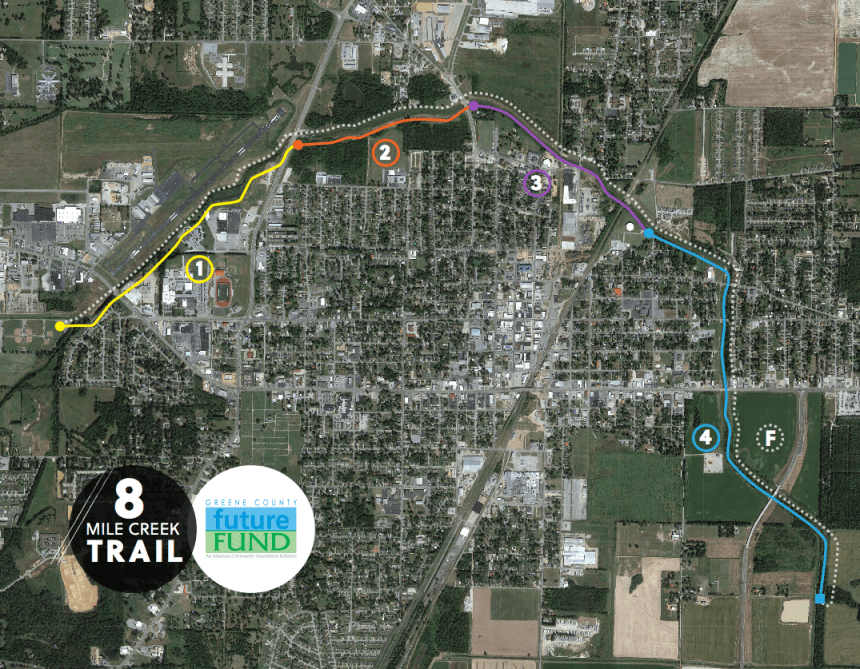
The proposed greenway that would run through Paragould. (Photo courtesy of the Green County Future Fund)

The proposed greenway that would run through Paragould. (Photo courtesy of the Green County Future Fund)

by Kimberely Blackburn
Delta Digital News Service

PARAGOULD – The Arkansas Highway Transportation Department recently approved a grant to partially fund the first leg of an urban greenway for the city of Paragould.

AHTD’s grant provides 80 percent of the approximately $580,000 project. Mayor Mike Gaskill and the City Council’s approval provides the remainder from the city’s reserve funds.

Greene County Future Fund‘s Kimberly Dale said the trail will begin at Rotary Softball Park, near the Sundale subdivision, and follow 8-mile Creek to Highway 49. Noting how the trail will connect the community, she said the project excites her.

“People my age and younger will move to a place for the quality-of-life amenities,” Dale said.

Conservation Tools‘ guide lists many of the economic benefits hiking trails bring to a city. Benefits not only include attracting homebuyers, but also attracting businesses looking for top-quality employees.

After AHTD and the Army Corps of Engineers approve the design of the hiking trail, Gaskill said the city will bid the job out. He expects the construction to provide a boost to the local economy.

Plans from the Past

Gaskill first wanted a trail 19 years ago, when he became mayor of Paragould. When the city widened 8-mile Creek for drainage issues, leaders considered a walking path, but thought it impossible due to the bridges it must cross. Later they discovered a path could be built under the bridges to alleviate any safety concerns.

Members of the Future Fund originally targeted private donors to raise the remaining funds, but Gaskill said he wanted every citizen to be involved. He said providing the money from the city’s reserve fund will not alter the city’s budget, and no other department or project will lose funds due to this project.

Gaskill said officials annually strive to improve community safety for citizens to exercise. For example, officials began sidewalk improvements in downtown Paragould in 2015.

Future Green Spaces

Greene County Judge Rusty McMillon said he first thought of a green space behind the courthouse when houses still stood on the proposed site. Although an annex to the courthouse was suggested after the county tore those houses down, McMillon said he believes Greene County needed more green spaces.

Working through “Healthy, Active Arkansas,” an initiative started by Gov. Asa Hutchinson in October 2015, McMillon said he hopes to not only educate county employees about living a healthy lifestyle, but provide a space for them to stay active. McMillon said he believes such a green space will help lower insurance premiums as well.

McMillon said he hopes to build green spaces throughout Greene County. He said he encourages all those throughout the county with ideas to contact him.

Dale said the Future Fund remains open to any ideas about future green spaces in Paragould. She said they would love the opportunity to purchase the land for a space downtown. Yet, Bolen said right now there isn’t a space in downtown Paragould where the community can gather outside during events.

Dale said with Paragould being such a pretty city, she hopes this trail will attract many to the community. Future Fund member Ashley Bolen said Paragould’s founding fathers planned for the growth when planning the city. She said Paragould’s citizens enjoy a great quality of life.

“Paragould is a well-kept secret,” Bolen said.

You can find more information on becoming a member of the Greene County Future Fund here.

DeltaYou: Bradley Ledgerwood’s Fight

by Jiayue Liao
Delta Digital News Service

CASH, ARKANSAS — Though confined to a wheelchair for 34 years, Bradley “Brad” Ledgerwood continues fighting for his personal rights.

Ledgerwood was born with cerebral palsy, which keeps him from independently standing, walking, taking care of his personal hygiene and feeding himself. The only parts of his body he can move by himself are his hands, but they have a limited range of movement.

“I can’t do anything by myself,” Ledgerwood said.

Ledgerwood lives in Cash, a very small town with fewer than 400 residents and no hospitals.

When Ledgerwood joined the ARChoices program in 2002, he was approved for 56 hours per week of in-home personal care Medicaid services, which was the maximum allowed. In January 2016, the Arkansas Department of Human Services introduced a new system for setting the maximum number of hours for ARChoices’ participants. The new system relies on computer algorithms rather than caregiver discretion.

LISTEN: Bradley Ledgerwood explains the difference in his care hours.

The Arkansas Department of Human Services twice cut Ledgerwood’s in-home personal care services from 56 hours per week down to 32 hours per week since he’s not on a respirator, according to the Ledgerwood family. Although two appeals have kept services at 56 hours a week, Ledgerwood must undergo another evaluation in January 2017.

He said the slash of personal care services would take his life away.

“I can’t drive, so if I want to go anywhere, I have to ask my mom to take me there,” Ledgerwood said.

The Ledgerwood family at Paragould's Lincoln Day Dinner.

David and Ann Ledgerwood kneel for a picture with Bradley at Paragould’s Lincoln Day Dinner. Bradley Ledgerwood will start his third term as alderman for Cash in January. (photo by Alice Mellow, courtesy of the Ledgerwood family)

When DHS first cut Ledgerwood’s hours, his mother had to quit her job to take care of him. If a life-threatening emergency happened, she might not be able to make it back in time from Jonesboro — an approximate 30-minute one-way commute.

Ann Ledgerwood said the system changed the service hours without reasoning other than a computer system that only allots so much time.

“We just know the last two years, his hours have been cut from 56 to 32 with no improvement,” she said.

Critics note a recent ruling only makes DHS explain to ARChoices’ participants why their allocated hours will be cut, and claim hours are being cut even more drastically. But testimony from the professor who invented the algorithm suggests the state’s software may be faulty and DHS does not understand the tool it uses.

“If you going to do a program, you are knowing how it works,” Ledgerwood said. “Nobody in state government knows how the computer program works.”

His father, David, notes technology may not always be the answer.

“I have a love/hate relationship with technology,” he said. “Algorithms do work, but there’s a human element that has to be there.”

Since DHS started using the new system in January 2016, 47 percent of participants in ARChoices have seen a reduction in service hours, according to a Nov. 6 Jonesboro Sun article.

“I feel like the people in government are just wanting to make a name for themselves … the ones who are supporting the cuts are just wanting to make a name for themselves and I don’t think they care about people,” Ledgerwood said.

LISTEN: Ledgerwood voices his frustration with those in government.

Digital Screens Cause Visual Consequences

by Austin Hayslip
Courtesy of A-State Department of Media

JONESBORO — “I think that we do use it in every single class, except for P.E.,” Samuel Creekmore said.

Instead of flipping the pages of a book, kids are scrolling to the next page on iPads. And that could be affecting their eyesight.

“More and more I’m seeing earlier and earlier detection of visual problems in children,” Dr. Megan Moll of Hilltop Eyecare & Optical said.

Moll said the increase in “screen time” for kids is causing some serious vision problems.

“A lot of times, it’s the increased near-point activities with the devices and increased screen time, holding things a little bit too close has shown to increase the amount of nearsightedness over time,” she said.

Mother of two Shaila Creekmore said her children had vision problems at an early age.

“Both of my boys do wear glasses. Samuel started wearing glasses in third grade; he’s now in seventh. Tyler started wearing glasses right at the beginning of third grade,” she said.

Creekmore’s children aren’t just using devices too often. Findings from VSP Vision Care suggest by the time the average American child reaches the age of 17, they’ve spent nearly six years looking at digital devices.

“Computers and devices aren’t going away; technology is excellent. It’s definitely helped a lot with schools, but some things they can do is make sure the child takes breaks — every 20 minutes do something else,” Moll said.

She also suggests using a blue-light filter for children already wearing glasses or using night mode, a setting available on the iPhone. Another excellent option: spending time outdoors.

Program Combats Dyslexia

by Kirsten May
Courtesy of A-State Department of Media

JONESBORO — City Youth Ministries is a non-profit organization that helps children in the community improve their academic achievement through a number of programs and events. And they’ve recently added to those programs. Kirsten May explains how they plan to improve student literacy.

City Youth Ministries Executive Director Denise Snider said studies show one in five people struggle with hearing sounds because of dyslexia.

Snider, a former teacher, is introducing the Orton Gillingham program called “Connections” to students at City Youth who fail a dyslexia screener.

The connections curriculum moves away from paper and pencil, and helps children learn the phonetic rules using tactile or 3-D objects. Being able to finally comprehend those rules and learn to read can help children with self-esteem issues related to school.

That confidence boost has been big for 6-year-old twins Sophia and Isabella Topalian.

Kimberly Topalian said her girls thrived while in a pilot classroom where Snider taught connections to first grade students.

She said she thinks the style of teaching used in connections would be beneficial to any child.
And thanks to a grant from Nucor-Yomata Steel, City Youth Ministries will now be able to offer it, free of charge, to more kids in need.

Snider said they are still doing the screeners right now, but hope to start teaching the curriculum by the end of the year.

Topalian said Brookland Elementary does not use connections in the classroom anymore, which is something her family is fighting to bring back. Right now, her girls continue going to private therapy to improve their reading.

Maintaining a Hospital: Behind the Scenes at NEA Baptist

by Austin Hyslip

Courtesy of A-State Department of Media

550,000 square feet, over 150 beds — all taken care of by 14 guys.

“Those folks who keep the building up and running are as important as the doctors and the nurses and the other staff who are there,” patient Richard Carvell said.

He said without the people who keep NEA Baptist up and running, there would be no hospital.

“Well, the most important people in an institution like a hospital, a school are the janitors and the maintenance people,” he said.

NEA Baptist

NEA Baptist

NEA Baptist and its six stories feature a crew of 14 who work around the clock to make sure every patient is comfortable. Mark Ward, director of plant operations, said there’s a lot of things going on.

“We’re the guys who have to watch heating, cooling, water, sewer … everything that has to do with that basic function,” he said. “But then we also we also have those intricate functions of medical gases, electrical systems, pretty much any electrical system that has to do with medical equipment as well as just your normal outlets in the rooms and things like that.”

Ward said the job is never the same.

“We do everything from hanging a picture for someone in an office, to going up and checking what’s called isolation power monitors in an (operating room) suite to make sure that it’s safe providing power to that room,” he said.

NEA Baptist is prepared to handle multiple different healthcare situations. One thing most wouldn’t think of is an earthquake.

“This building is built under zone 4 earthquake standards,” he said.

All of pipes under NEA are built with braided line and sitting on rollers that allow the pipes to move without breaking. There are also shocks under all of the large appliances to allow them to absorb some of the shaking.

“The whole operation is a 24-hour, seven-day-a-week operation,” he said.

Ward and his team work every day to ensure the lights come on and the hospital is comfortable for every single guest.

Recent Entries »