Category Archives: Government

City council meets remotely due to COVID-19

By Krishnan Collins
Delta Digital News Service

JONESBORO The Jonesboro City Council met April 7 in remote fashion during a time of uncertainty due to COVID-19 and the city is still healing after a tornado swept through the center of Jonesboro March 28. 

   The meeting diverted from the original agenda right at the start as resolution 20:044 had to be approved for the meeting to officially be able to take place remotely. Since restrictions surrounding COVID-19 limits the number of people that can be in one place, the resolution was proposed and passed. 

   Among many stipulations in the resolution included that members on the council must conduct meetings in ways where the media can still view due to freedom of information laws, electronic means can be used for video call or chat that is recordable and audible to all parties watching and participating in the meeting, and the mayor, city clerk, city attorney and commission chair must be physically present at the meeting place where it is being held. 

  Jonesboro Mayor Harold Perrin started the meeting by complementing first responders, the community and city employees as wells as reminding citizens to follow social distancing and health guidelines.

   “We’ve been through a lot,” Perrin said. “Our employees in all of our departments deserve your appreciation. They have worked tirelessly and hours with a remarkable attitude. Jonesboro residents have been strong and came to one other’s rescue. We are definitely a loving people in Jonesboro. The coronavirus and tornado have created a new landscape. Our duty is to adjust. I ask for patience as we adjust with each other. This is not a new future, it is simply a temporary fix. So please be kind and be patient. We are doing the work of the city and we cannot stand still. Life doesn’t work that way. But we are not weak. COVID and the other obstacles that are ahead of us, we must be smart, and we will definitely work together.”

   Perrin stressed the importance of wearing a mask when out in public. 

   “This is no time to worry about appearances,” Perrin said. “You look better with a mask.”

One issue on the agenda caused significant debate on the night, Ordinance 20:011. 

   The ordinance, submitted by Ditta Enterprises, proposed the rezoning of an area at 400 E. Highland Dr. The Ditta family wants to build a hardware store in the area. The hardware store received public support, with only a single dissent.

   Janet Gehring said during a past meeting that an ordinance had been passed in 2007 that stated no business could ever be built on that plot of land except for a bank. The plot of land is in a neighborhood surrounded by residents. Gehring said she would not want to live next to a hardware store and asked what was the point of making an ordinance if it was just going to be changed later. 

   “And, I think, I might ask you all, would you like to live by a hardware store and call that your neighbor?” Gehring asked. “Mr. Rogers probably would. Mr. Rogers probably would say won’t you be my neighbor, but I would say, please don’t be my neighbor. Please don’t be my neighbor.”

   It was pointed out that the ordinance had been passed in 2007 to stop a 24/7 fast food restaurant or convenience store from opening at the time and was argued that such an establishment would cause disturbances to residents in the neighborhood being that it would be open at all times of the night as well as the day. 

   It was also argued at the time a convenience store on Highland Drive would mean children would have to cross a major road to go to the restaurant or store and therefore could easily be struck by traffic. 

   However, it was argued at the meeting that zoning ordinances are not meant to be frozen in time and can change with the times of the city. The original ordinance was not meant to stop a local, family-run hardware store from being installed in the area. 

   According to Jim Gramling of Gramling Law Firm who represents Ditta enterprises, the Ditta family hosted a couple of neighborhood meetings where it invited residents who lived within 400 feet of the planned site to come and voice their objections to the family. 

  According to Gramling, the Ditta family made many adjustments from feedback at the first meeting and hosted a second meeting. 

   The ordinance was passed to allow rezoning. 

   Technical difficulties during the meeting along with lag times in public comment through social media, phone lines and email provided some challenges for city officials. 

   “It’s not going to be perfect,” Perrin said. “Any change this drastic is going to have glitches.”

Editor’s Note: Photo by Katie Moum on Unsplash

U.S. Census could potentially bring important funds to Jonesboro

By Tristan Bennett
Delta Digital News Service

JONESBORO – The U.S. Census has occurred without fail since 1790 despite obstacles like war, natural disaster, and now, a pandemic.

The United States conducts a census every 10 years to get an accurate count of residents. In 2020, it is once again time for gather information from around the nation.

Article I, Section 2 of the United States Constitution mandates the count and legally requires residents in all 50 states and five territories to respond. The U.S. Census Bureau makes it fairly simple to fulfill the requirement.

According to the Bureau’s website, invitations to respond have already been sent to homes around the country. This year, anyone can respond by mail, phone or online by the April 1 deadline. After that, census takers may be dispatched to collect answers.

The survey asks a few simple questions about who lives in the home and how they are related as well as their races and sexes. There is no question about American citizenship.

These questions may seem simple to some, but Kade Holliday, Craighead County clerk, said they hold a great importance to the city and county.

“The U.S. Census is one of the biggest ways that federal money is dispersed out,” Holliday said. “You want the most people to be counted so that your area gets more of those tax dollars.”

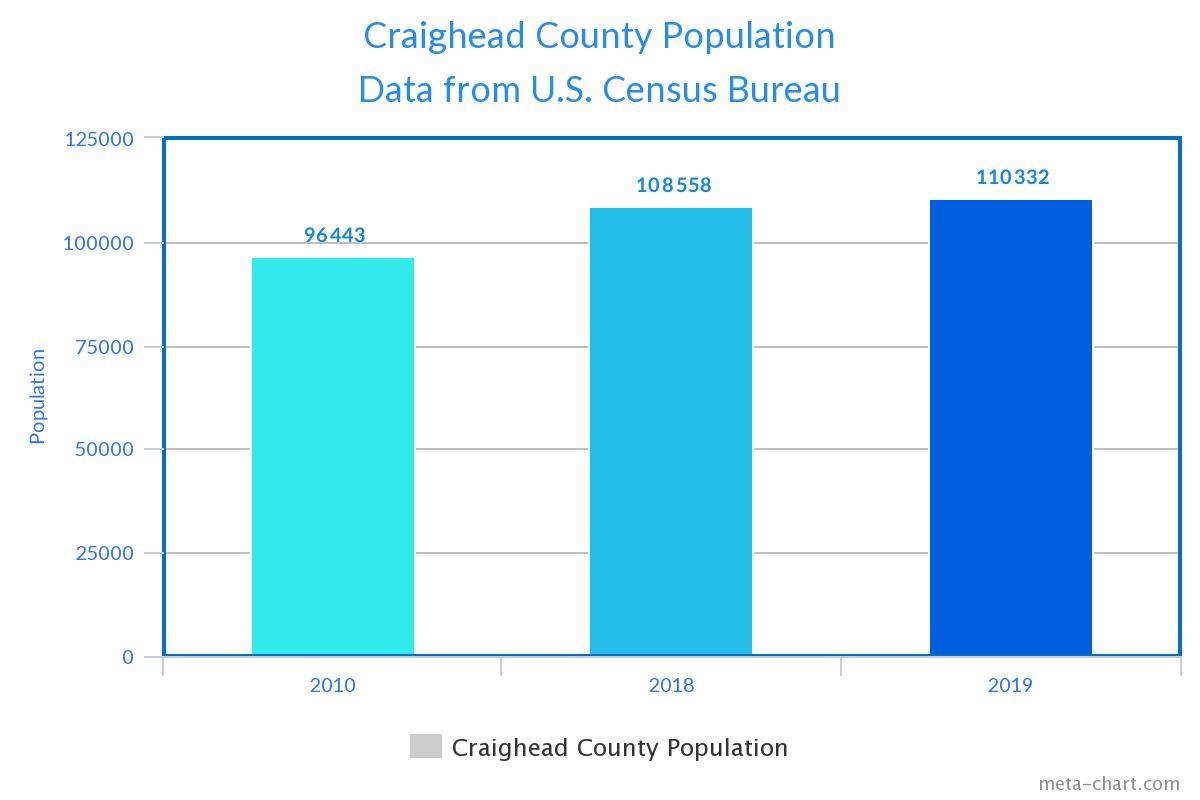
Holliday said because Jonesboro experienced a population boom since the last census in 2010, the city can expect a significant jump in federal funds, and that money will be used to build parks, bridges and roads as well as add to the police, fire and sanitation departments.

An accurate count is also important for elected officials. Shifts in population or growth can significantly change areas they represent.

“Let’s say there’s a situation where in Arkansas we picked up a fifth (congressman), or we lost one because the population went up so greatly in another part of the country. We would have to redraw the lines to create those districts to make sure they were equal in population, so one district doesn’t have more people in it than another,” Holliday said.

While some may be hesitant to give information to a government agency, Title 13 of the U.S. Code strictly prohibits the Census Bureau from sharing personal information. Responses can only be used to produce statistics, and no information can be used against the responder. The Supreme Court has even ruled that the Patriot Act does not override the law of confidentiality on the census, and addresses cannot be discovered through the Freedom of Information Act.

Hispanic community works to complete census among challenges

By Krishnan Collins
Delta Digital News Service

JONESBORO – With the 2020 census on the horizon, the Hispanic community faces an ever present and mounting number of challenges while trying to get as many people to complete the census as possible. 

   Challenges like technological issues, misconceptions, the political climate and the coronavirus all represent a hurdle for the Hispanic community, said Gina Gomez, executive director of the Hispanic Center in Jonesboro. 

   Most of these challenges were expected, but the coronavirus situation presented new challenges and dampened plans that Gomez and others had been working on for a while. 

   “Even though we have been planning this work with the census for months now, we didn’t expect this was going to happen,” Gomez. “Every activity that we had planned, like door-to-door canvassing and going out to events where we were going to promote the census have been canceled. That’s a big challenge. Right now we are looking into ways we can continue promoting the census using online resources and social media.”

   Gomez emphasized in the current political climate there are many misconceptions on what will be done with the information given by families in the census. The community is working on educating families that information given will not be used against them or given to law enforcement agencies and informants. 

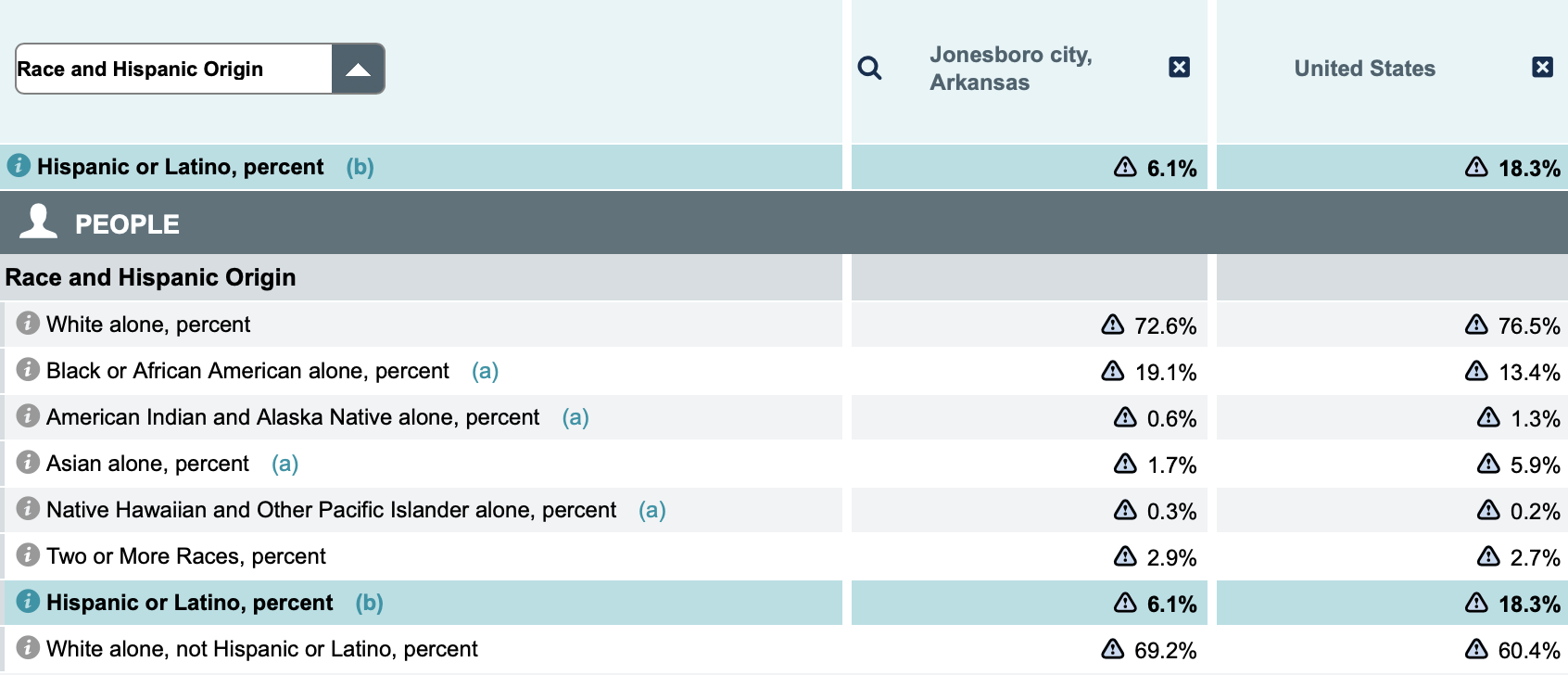
This graphic from Census.gov shows the percentages of various ethnic groups in Jonesboro and the United States.

   “Our people are afraid to provide information to the census,” Gomez said. “There’s been an educational phase where we have been trying to inform people about what the census is, how the census impacts them and also that there is not any risk by providing the information.”

   According to the census, counting children is a tough challenge for all families, no matter what ethnicity or race.

   “Children under 5 years old are among population groups historically undercounted in the census,” a Census Bureau press release said.

   Gomez said counting children in Hispanic families is a problem too. Gomez highlighted that many families completed a census in their home country, but once these families move to the United States they question whether they need to do the census or not.

   “Many families don’t understand what the impact the census has on your family or kids,” Gomez said. “If they don’t see the importance of bringing those funds to our city in order to have better schools, access to healthcare providers, improving our roads, it’s difficult to have people participating. A lot of this is education related. We need to educate our community.”

   This is the first year families can complete the census online. This makes it easier on some, but can also be a problem for others. 

   “For some of our families, they don’t have computer access, online access, they don’t have internet or they just don’t have the knowledge of how to do it,” Gomez said. “They can do it on a computer, an iPad or cellphone. It’s a little complicated for some of our people, especially for ones living in more rural areas. That’s one of the areas that we as the Hispanic Center were trying to work really hard on.”

   With the coronavirus dampening many ways to advertise the census, Gomez and the community have put a lot of emphasis on social media. Gomez noted just how important it is for Hispanic families to do the census as those families will see benefits moving forward. 

   “We hope by demonstrating the number of Hispanics we have in the area and in general the state, because we are part of the state coalition, we’ll be able to assure based on the percentage of Hispanics there are specific needs to target this minority in Arkansas by providing language services when it comes to healthcare or schools,” Gomez said. “But, if we are not able to demonstrate by how many people we have, the need will not be as evident even though we have the people here.”

   The coronavirus was not the only thing that affected the push towards the census. On March 28, an EF-3 tornado tore through Jonesboro. Homes and businesses were destroyed throughout the city. 

   “Now, more than ever, we need to bring funds to our city to help rebuild it,” a post on the Hispanic Center’s Facebook said. “You can help us with this, completing Census 2020.”

   Gomez worked with the Hispanic community in 2010 to complete the census but she said then the effort was not as widespread and did not have as many people involved. 

   “In 2010 Arkansas was really undercounted,” Gomez said. “We want to assure we are counting as many people as we can around the state this time so we are not letting those funds go.”

   According to the census, the Hispanic population makes up an estimated 6.1% of the total population in Jonesboro. The estimated total population in Jonesboro reads 76,990. 

   This time around the Hispanic Center created its own campaign with the city of Jonesboro and also created its own logo. There is also a state coalition called Arkansas Counts to spread the word about the census and efforts surrounding the census are more structured now.

   “When I moved here to this country, I didn’t understand why it was that important for me to fill out the census,” Gomez said. “But now that I have been educated on the topic I can educate others.”

Editor’s Note: Feature photo courtesy of the Jonesboro Hispanic Center: Members of the Hispanic Center and Jonesboro community work together to spread the message about the 2020 census.

Craighead County employment policy gets amended

Brooke Buckner
Delta Digital News Service

JONESBORO – An amendment was made to update ordinance 2014-3 regarding updating the Craighead County employment policy for “per hours paid” and “per hours worked.”

There was confusion in Monday’s Quorum Court meeting regarding whether or not the ordinance should be changed to per hour worked instead of what it was originally going to be, which was per hours paid.

County Clerk Kade Holliday said if it was changed to hours worked, he would need new software to configure time and hours worked. Jason Price said the time paid is all that should matter.

The court made a final decision to leave the ordinance as it originally was and to keep it to hours paid.

Editor’s Note: Photo by Katie Moum on Unsplash
Quorum makes changes to employment policy

Brooke Buckner
Delta Digital News Service

JONESBORO – An amendment was made to change Ordinance 2014-3 at Monday’s Quorum Court meeting.

The ordinance was made to update the Craighead County employment policy for vacation and paid time off, and for other purposes. The Court’s goal is to ensure a fair distribution of employees time.

There was some confusion in the room when the last line in the last paragraph in the ordinance was brought up. It read “Employees will be able to continue to accrue time up to a maximum of 720 hours but cannot be paid out more than what was recorded at the time of the ordinance.”

Judge Marvin Day said at the date of this ordinance passing, workers amount of personal time would freeze at that moment and be recorded. There was another concern about people who are under 480 hours right now can’t accrue up to 480. Jason Price clarified that they can use it but they will not be paid for it at the end.

“You get paid for what you have accrued at the time if you leave at that time. You can get up to 480 and use that time, but if you leave you will only get paid out at what your snapshot was of your personal time,” Judge Day said.

New employees will have no payouts on personal time going forward.

May 1 is the earliest the ordinance can be passed.

Editor’s Note: Photo by Katie Moum on Unsplash
Homelessness Grows in the Delta

By Colby Sigears
Delta Digital News Service

JONESBORO — Poverty and homelessness impact the Delta area, keeping people under the poverty line.

Hillary Starnes, an employee of the Jonesboro Grant Department, said approximately 1,800 homeless people live within Craighead County.

“We’re getting a homeless task force to help be resources for the people in the community to get them back on their feet,” Starnes said.

A preliminary meeting of the task force in mid-September discussed potential resources for the homeless. Limited resources contribute to homelessness in the area because people do not have jobs; some do not have a driver’s license. Starnes said the task force will help once they get a homeless shelter built; that way it will keep the homeless off the streets.

Todd Stovall, chief of police in Paragould, said the city does not have a lot of homelessness because of the community effort such as churches helping with the homeless with free meals.

“The mission outreach keeps a lot of people off our streets and other people in the community provide resources for the homeless,” Stovall said.

Lack of affordable housing in Arkansas for people with low incomes and secondary causes such as physical illness, substance abuse, lack of incentive to work, poor work ethic and lack of appropriate education also contribute to the homeless problem in the Delta.

Lisa Williard, director at Mississippi County Union Mission in Blytheville photo by Colby Sigears

Lisa Willard, director of the Mississippi County Union Mission, said it’s a broken system. People with mental illness get left behind because people don’t want to deal with them anymore, e.g. women being dependent and leaving their husbands without any resources or even men with children but no jobs.

“We get people their benefits when they check in such as Medicaid benefits, food stamps and driver’s license,” Willard said. “If they stay here, they must have a job and half their checks go to their savings. We provide other side jobs in the community to make extra money.”

MCUM provides a food pantry and clothing for people at the shelter, as well as help with people having trouble with water and light bills. Willard noted MCUM gives out food boxes to Mississippi County residents at 1 p.m. on Mondays, Wednesdays and Fridays. The food box program runs under the income-based guidelines of the U.S. Department of Agriculture.

A lot of homelessness occurs in the Jonesboro area because it is the center for most of the Delta. There are 600 known within the city. Places such as The HUB and Salvation Army provide resources in the community. Also, the food bank is the biggest in the area and sends help to places such as Mississippi County Union Mission.

“Volunteering in the community and help from government resources and getting jobs for people will help lower homelessness in the area,” Willard said.

Revenue Gains Spur Projects

By Chloe Short
Delta Digital News Service

JONESBORO — The Craighead County seat will see changes due to recent economic gains and plans for incoming jobs.

Sales tax revenues for Jonesboro have started strong in 2019 and could potentially pass the record-breaking 2018 totals. The increase in money means many new proposals for the city and the continuation of projects and population inflation. It also opens conversation for further development of the city.

“What we can see is that people spent money in 2019 in the city of Jonesboro, which is always a good thing,” said Craig Rickert, the director of communications for Jonesboro Unlimited, a company that works to bring new businesses to the Jonesboro area. “People are shopping, they’re going to restaurants … they’re buying cars and that money goes to a general fund and helps the city pay for the services for its citizens.”

Mark Young, president and CEO at Jonesboro Regional Chamber of Commerce, said these repairs and services would likely not be limited to police and fire protection, parks and recreation and road improvements. One service that is coming to Jonesboro is a new bike trail.

“I think It would benefit the community positively because it would provide more opportunities for people to get out and be active,” said Jordan Nash, a current Jonesboro resident.

Jonesboro Unlimited’s five-year plan focuses on attracting businesses and talent, business expansions, workforce development and community enhancement. Chris Barber, chairman for Jonesboro Unlimited, said they’re targeting jobs and businesses in health care, agriculture, manufacturing, logistics and professional services.  

“We’re not at liberty to say what businesses are coming due to confidentiality agreements that the companies have signed,” Barber said.  

The plan is two years ahead of schedule and the projected outcome is expected to bring 5,153 new jobs.

“Jonesboro is doing very well,” Barber said. “We are seeing a steady community, employment and population increase.”

A Plan for Downtrodden Properties

by Miranda Reynolds
Delta Digital News Service

JONESBORO — The Jonesboro City Council recently hosted the Little Rock Land Bank Commission to learn how it can positively impact the city.

Mayor Harold Perrin said he kept up with the Little Rock Land Bank Commission for two years and thinks that it could benefit the city.

“The biggest thing is that you are trying to clean up your entire area or neighborhood and concentrating on them. That’s the key,” Perrin said.

In 2008, the city of Little Rock started the Land Bank Commission in hopes of increasing home ownership, stabilizing property values, improving the health and safety of neighborhoods, and maintaining the architectural fabric of the community. The Commission sent Doug Tapp as a representative to inform Jonesboro’s City Council of its goals.

“The goal of the Land Bank in Little Rock is to take these properties that have issues, acquire those properties, have them cleaned up and get them back on the tax rolls,” Tapp said.

Tapp said the properties the Land Bank Commission prefers to have cleaned up include those with city liens, unsafe and vacant structures, vacant lots and properties that are being cleaned by the city.

Target areas in Little Rock include blocks with several properties or lots that need attention. Targeting specific areas allows for those communities to have a better selling point for potential buyers.

Neighboring houses to Land Bank Commission properties that are scheduled for demolition are offered to neighbors in the community for $500. Tapp said adding lots together can increase property values. If the property is between two neighbors, each neighbor can buy half of the property.

Selling these properties to neighboring citizens comes with regulations. Tapp said buyers must maintain the properties once they are bought to ensure that the properties do not fall into despair again.

“When we go in and do work on homes, we see neighbors see that and start doing the same thing,” Tapp said.

Crowley’s Ridge Development Council agreed to work with Jonesboro. Perrin said further research is needed and will then be presented to the council for further discussion.


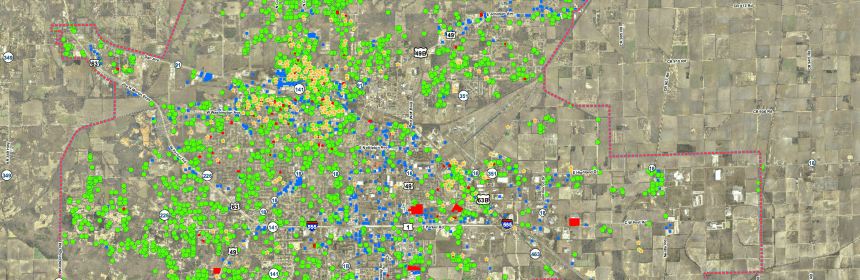
Editor’s Note: The featured photo depicts a representation of nearly 3,450 vacant commercial and residential properties in Jonesboro, based off records from Craighead County. (Courtesy of City of Jonesboro)

Paragould Plans New Greenway

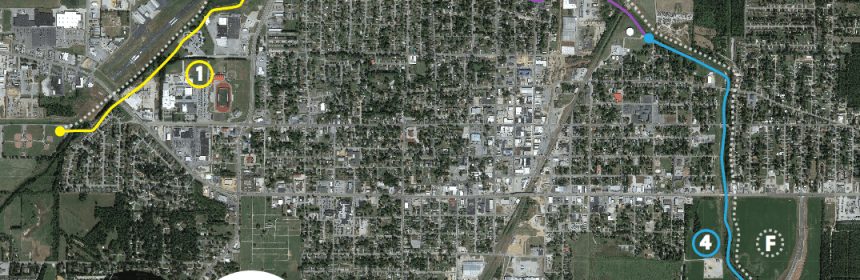
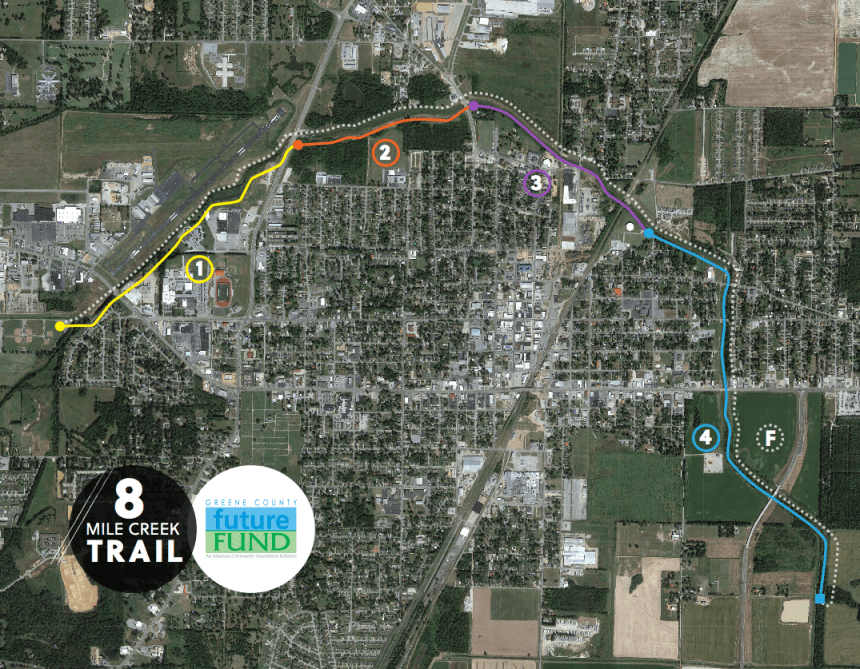
The proposed greenway that would run through Paragould. (Photo courtesy of the Green County Future Fund)

The proposed greenway that would run through Paragould. (Photo courtesy of the Green County Future Fund)

by Kimberely Blackburn
Delta Digital News Service

PARAGOULD – The Arkansas Highway Transportation Department recently approved a grant to partially fund the first leg of an urban greenway for the city of Paragould.

AHTD’s grant provides 80 percent of the approximately $580,000 project. Mayor Mike Gaskill and the City Council’s approval provides the remainder from the city’s reserve funds.

Greene County Future Fund‘s Kimberly Dale said the trail will begin at Rotary Softball Park, near the Sundale subdivision, and follow 8-mile Creek to Highway 49. Noting how the trail will connect the community, she said the project excites her.

“People my age and younger will move to a place for the quality-of-life amenities,” Dale said.

Conservation Tools‘ guide lists many of the economic benefits hiking trails bring to a city. Benefits not only include attracting homebuyers, but also attracting businesses looking for top-quality employees.

After AHTD and the Army Corps of Engineers approve the design of the hiking trail, Gaskill said the city will bid the job out. He expects the construction to provide a boost to the local economy.

Plans from the Past

Gaskill first wanted a trail 19 years ago, when he became mayor of Paragould. When the city widened 8-mile Creek for drainage issues, leaders considered a walking path, but thought it impossible due to the bridges it must cross. Later they discovered a path could be built under the bridges to alleviate any safety concerns.

Members of the Future Fund originally targeted private donors to raise the remaining funds, but Gaskill said he wanted every citizen to be involved. He said providing the money from the city’s reserve fund will not alter the city’s budget, and no other department or project will lose funds due to this project.

Gaskill said officials annually strive to improve community safety for citizens to exercise. For example, officials began sidewalk improvements in downtown Paragould in 2015.

Future Green Spaces

Greene County Judge Rusty McMillon said he first thought of a green space behind the courthouse when houses still stood on the proposed site. Although an annex to the courthouse was suggested after the county tore those houses down, McMillon said he believes Greene County needed more green spaces.

Working through “Healthy, Active Arkansas,” an initiative started by Gov. Asa Hutchinson in October 2015, McMillon said he hopes to not only educate county employees about living a healthy lifestyle, but provide a space for them to stay active. McMillon said he believes such a green space will help lower insurance premiums as well.

McMillon said he hopes to build green spaces throughout Greene County. He said he encourages all those throughout the county with ideas to contact him.

Dale said the Future Fund remains open to any ideas about future green spaces in Paragould. She said they would love the opportunity to purchase the land for a space downtown. Yet, Bolen said right now there isn’t a space in downtown Paragould where the community can gather outside during events.

Dale said with Paragould being such a pretty city, she hopes this trail will attract many to the community. Future Fund member Ashley Bolen said Paragould’s founding fathers planned for the growth when planning the city. She said Paragould’s citizens enjoy a great quality of life.

“Paragould is a well-kept secret,” Bolen said.

You can find more information on becoming a member of the Greene County Future Fund here.

Voters Give Officials More Time

by Kirsten May
Courtesy of A-State Department of Media

Arkansas voters passed an amendment to the Arkansas Constitution that will lengthen term limits for elected county officials from two years to four years. As Kirsten May explains, people in those positions think this will help them be more effective.

JONESBORO — Now even though the new term limits won’t go into effect until 2019, Craighead County Sheriff Marty Boyd said he is excited about what that means for the future of county officials.

“It’s going to be a great benefit to the operations of any department because you can set some long-term goals. Where in the past, just having a two-year office, it made it seem like you were always campaigning,” he said.

Boyd said he hopes the longer terms will let officials dig deeper to accomplish bigger goals, especially in a county that has a 2 percent annual growth rate. He said there are some things you just can’t get done in two years.

“Even though I know economically we can’t obtain maybe as many deputies as we want in the next 12 months, but I can look at the long-range plan and say in five years here is where we need to be,” Boyd said.

He said another benefit is being able to cut costs.

“Elections are expensive. I wish they weren’t, but in this day and time it takes a lot to run a successful campaign. Having to do that every two years, you get tired of the process and your supporters get tired of the process,” Boyd said.

There is also a better sense of job security for those in the department.

“It puts them in a better workplace knowing that they have at least four years to look at instead of two,” Boyd said.

Sheriff Boyd said there has been some concern about having an official in office that long. But he said as long as you research your candidates and know who you’re voting for before the election, that shouldn’t be a problem.

Issue 1 also states certain county officials cannot be appointed or elected to another civil office, and it allows unopposed candidates to be elected without their name appearing on the ballot.

Recent Entries »