JONESBORO – Small Business Saturday is a big deal for some, for others – not so much.
Small Business Saturday was first observed in the U.S. on November 27, 2010 and was trademarked by American Express.
Refinery Store Manager Amy Willhite said their company will be participating in Small Business Saturday, along with Black Friday and Cyber Monday.
“We want people to shop local and to keep business here in town,” Willhite said, “We want them to come into the store.”
On the contrary, Smoothie King Owner Linda Bradley said she did not know about Small Business Saturday and if she did, she would have participated.
Bradley does support shopping local. “Your helping those local businesses to stay in business,” Bradley said, “It gives a more ‘hometown’ feel. Instead of spending your money on cooperate businesses, you should shop local to help our community.”
Shop local supporter Jessica Blevins said she shops local because it supports the community and those who live there.
Blevins said, “It’s about being able to communicate about small businesses and being able to put a spotlight on a few of those locations on Small Business Saturday.”
“Black Friday absolutely helps us, and Small Business Saturday is just an extension of that,” Willhite said, “People are still wanting to shop local, but they are also wanting a deal.”
Bradley said, “We can’t offer that much of a deal on Black Friday, but if there was a small shop festival, where we could get our products into consumer’s hands, that would benefit us more.”
Willhite said that consumers should shop local because they have good customer service, people that wait on you and want to talk to you.
Willhite said, “You’re going to get a one-on-one experience and you’re going to talk to someone who has knowledge about the products in store.”
American Express also holds what is called “Neighborhood Champions,” which are towns or cities who have pledged to put small businesses first.
Conway, Paragould, Little Rock and West Memphis, to name a few, are part of Neighborhood Champions. Jonesboro is not included in this list.
Editor’s Note: Feature Photo taken by Maddison Smith
JONESBORO – The Foundation for Jonesboro Public Schools awarded a Jonesboro High School art teacher $1,000 so he could provide drawing tablets for his class and expand the abilities of his students.
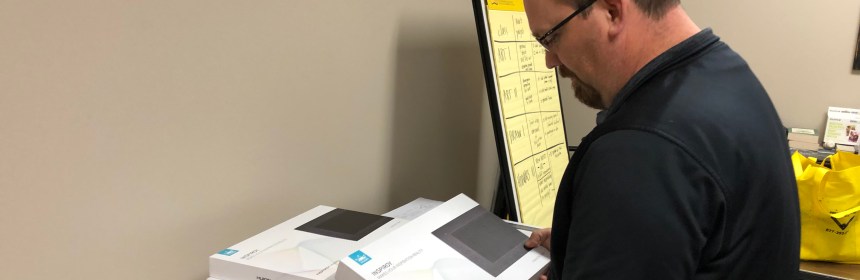
David Leggett used the money he received from a grant to purchase Huion 610pro tablets for his digital art media class. Although the tablets are a staple of the digital art media class, Leggett said other art classes should eventually be able to use them.
After applying for a grant from the foundation, Leggett did not find out he won until foundation members visited his class during a school day. The awarding of the money surprised the art teacher. Members of the foundation walked through the halls of JHS ringing a cowbell as they approached his door.
“They don’t tell you you’re awarded,” Leggett said. “You submit your thing and then you wait. If you’re lucky enough to hear the cowbell come to your door, then you’re like OK. I didn’t realize it until they opened the door. It was right outside the door, I was like, that noise seems to be getting louder. Then it dawned on me, it clicked. I might’ve won. I can be excited now.”
Leggett bought 17 tablets with the grant money and the tablets helped students achieve goals they might not have been able to achieve in the past.
“It helps a lot of the kids,” Leggett said. “A lot of kids feel like they can’t draw. So, they get into the computer side of it and know they can undo stuff and redo. They feel like they have a little bit more control over their media.”
In classes like digital art media, students now approach projects with more confidence.
“In the digital classes, if I was to set a piece of paper in front of them and say we’re going to draw a face, a lot of the kids would say I can’t do that,” Leggett said. “So what we’re doing right now is practicing on using the tools and then we’re learning how to trace the face and the contours of the face.”
Maddy Grubb, a junior at JHS, said she never really used a lot of technology in her art classes in the past and the tablets were her first experience with high-tech equipment when it comes to art. She noted how the tablets changed the game in her art classes recently.
“I feel like it definitely makes it easier for us,” Grubb said about the tablets. “When we have to use computers in our art class, it’s a little bit harder. It’s not as accessible as when you can use a tablet. The tablets definitely make it easier for us to draw and trace for our art projects.”
Grubb said she was nervous at first using technology to create art, but in the end, she realized how helpful the tablets were to use.
“I was a little nervous because I wasn’t really sure what it was going to be about,” Grubb said. “But it’s actually a lot easier than you think. You just plug it up to the computer and press a couple buttons. It’s very easy.”
Another student, Brian Holmes, held more experience with high tech art equipment. The JHS sophomore used other tablets in the past and commented on why tablets are so important for art students.
“Being able to undo and redo and free transform objects is really helpful,” Holmes said. “So I don’t have to manually go back and erase it.”
Holmes used a variety of tablets in the past and mentioned some of the advantages of the Huion tablets in Leggett’s art class.
“The hot keys are really simple and the pressure sensitivity is pretty good too,” Holmes said. “Overall it’s just a really nice, simple tablet.” JHS offers a variety of different art classes and both Grubb and Holmes acknowledged the focus on technology at JHS. The technology helps improve the classroom.
“The classes do care about the quality of the classes and what they give out,” Holmes said. “They know that higher quality things can help students produce higher quality work.”
The impact of the tablets on students shows in the classroom. Leggett noted how the tablets help create art in ways that just takes a lot of pressure away from his students.
“I do think it will actually help them in observation,” Leggett said. “(It will help them) in drawing something that they can always go back and undo a line and redo a line. They can do this much easier when they have a tablet in front of them by pushing a button. There are so many options they can do. Their anxiety is so much lower.”
Even with the success of the tablets in the classroom so far, Leggett still looked into the future and saw more ways to improve his classroom.
“Anytime I can get money for my kids, I’m definitely going to try and do that,” Leggett said. “I was not able to provide a classroom set of tablets this year. We got 17 with the money we got. I would love to be able to have a class set of 30. I would love to go back and just keep getting tablets or really anything.”
Leggett applied for a foundation grant for the first time when he applied for the tablet money. He noted how the foundation’s impact really matters.
“I think it’s great,” Leggett said. “We’re given a budget. We have 1,500 kids. We try our best and buy everything we can. When we needed to get something like those tablets, I was able to write that grant. They were able to get me the grant money to do that. (It’s great) to see the kids working with these things and just my overall excitement for being able to provide these for the kids.”
Leggett’s passion for teaching showed when he talked about the impact of the grant. It is clear JHS and the district as a whole has an organization on its side ready to chip in when needed most.
“They’ve provided grant, after grant, after grant,” Leggett said. It’s been great, that’s what we’re here for, we’re here to provide for the students.”
Editor’s Note: Art teacher David Leggett looks at a Huion 610Pro tablet. Leggett purchased the tablets for his class with money he received from a Foundation for Jonesboro Public Schools grant.
WALDENBURG – A young, female farmer is taking the Arkansas agricultural world by storm by acting as an ambassador and a role model for others like her.
Originally adopted from Russia, Jenna Martin grew up on her father’s, Dennis Martin, farm in Hickory Ridge, Arkansas. She went on to pursue a degree in agriculture business and continued her work in an industry dominated by men.
“This is just something in my gut. It’s just what I want to do,” Jenna said. “It’s what I think about all the time, it’s what I want to learn about, it’s what I talk to Dad about all the time.”
Men dominated the agriculture field for centuries, so a stigma surrounds women who work in the industry. However, the 2017 census stated 36% of U.S. farmers are female, and that number continues to rise. Jenna works as a role model for many young girls wishing to pursue a career in agriculture.
Both of her parents grew up around agriculture, so it became a part of Jenna’s life early on. She began helping Dennis on the family farm as soon as she could walk. Her mother homeschooled her, so the flexible schedule gave her plenty of time to spend where she said she really wanted to be: on the farm.
“When she first started, she would help us move equipment from field to field, and as she got a little bit older, she started driving tractors and putting out all the Polypipe,” Dennis said.
She solidified her choice to stay in agriculture while still in high school and began learning as much as she could and promoting the industry. Along with staying active in 4-H for 15 years, Martin also held the title of 2013 Miss Arkansas Rice. The Miss Rice program encourages agriculture education and promotes rice as a major part of Arkansas’ economy.
After graduation, Jenna chose to attend East Arkansas Community College in Wynne before transferring to Arkansas State University to pursue a degree in agriculture business and minor in strategic communication. Even though she wanted to farm, she said her parents wanted her to have a degree to fall back on.
“I chose community college because it was close to home and closer to the farm,” Jenna said. “EACC was a good transition before I went to A-State.”
During her time at A-State, Jenna remained involved in the College of Agriculture, held many leadership positions and created good working relationships with her classmates and professors. Bert Greenwalt, professor of agricultural economics at A-State, worked closely with Jenna during her time at A-State.
“She immediately became involved in all activities of the college,” Greenwalt said. “The thing about Jenna to me is she’s just so enthusiastic. Very positive, very enthusiastic and always ready to jump in, lend a hand and make a difference.”
Jenna served as the president of the A-State Collegiate Farm Bureau during her senior year, and worked as a teacher’s assistant under Greenwalt, assisting with the annual A-State Agribusiness Conference as well.
Jenna explored different careers in agriculture during her internships with Farm Credit Midsouth and Pioneer Seed, but ultimately returned to Dennis’ farm and chose to remain in production agriculture. During harvest, Jenna handles the grain carts as Dennis mans the combine.
“Usually day-to-day I go out to the shop, get everything ready and then go out to the field and stay there until 8:30 or 9,” Jenna said. “In the summer I go around and help Dad with all the water. Like I said, irrigation is huge.”
While she feels perfectly confident with her work in the field, Jenna still struggles with the business aspects of running a farm. Dennis runs his operation the old school way: everything on paper, and Jenna learned about how to handle finances on the farm from him. However, in a world where technology reigns, even farmers must adapt to new equipment and tools.
“Something I wish I could have done more of in my degree is more on the technology side,” Jenna said. “It’s growing so much, and I think that’s a big thing.”
As far as being a woman in a traditionally male industry, Jenna is not intimidated.
“I’m pretty good about just jumping in with the guys, and they’re pretty cool about responding,” she said.
More women pursue careers in agriculture today than ever before, and Jenna acts as a role model for each young girl.
“Jenna has an interest, ability and a passion for speaking about our industry,” Greenwalt said. “She is someone I know will continue to be a leader in the industry.”
Jenna said she hopes to take over the family farm someday. In the meantime, she continues to help Dennis on the farm and work on acquiring land to cultivate on her own.
“We’re leaving that 100% up to her,” Dennis said. “If she wants to pursue a future in farming, we’re behind her.”
Editor’s Note: Feature Photo shows Dennis, left, and Jenna Martin. Photo taken by Tristan Bennett
MOUNTAIN HOME – Local grocery store Truck Patch offers bulk foods and spices, all-natural beauty products and plant-based meals.
Named after small farmers’ markets from the 1800s, the Truck Patch grocery store opened May 23, 2010 in Mountain Home. From there, the store added a larger Jonesboro location.
“We don’t currently have plans for another location, but we’re always open to expand,” said Mountain Home Manager Virginia Embry.
Truck Patch sells ingredients by bulk, allowing customers to bring their own reusable jars, bags and containers with which to shop.
Tori Forkum, assistant manager at the Truck Patch Jonesboro, said they tare the container before the customer shops.
“You can bring your own jar and we weigh it,” she said. “Then we take the weight of the container off the final price.”
Many ingredients cost less to to buy in bulk than in individually packaged portions, such as spices and grains.
Olivia Simpson, an employee who works in the kitchen at the Jonesboro location, suggests reusable glass bottles and jars to cut back on waste.
“Buy bulk and ditch plastic,” she said. “Use glass whenever you can.”
The store carries plastic-free, plant-based and biodegradable household products. Products made from plants have a lower environmental impact than hard plastics made from oil, and paper packaging decomposes much faster than plastic wrapping.
They also sell pet products, like biodegradable doggie bags, organic treats and food.
Truck Patch focuses not only on reducing plastic packaging, but also increasing healthy eating. Employees at Truck Patch help customers find ingredients to suit any diet, from vegan to paleo. They also help those with allergies, diabetes and other health needs find appropriate meals.
“Our staff is well versed in different diets, and we are more than happy to help,” Embry said.
Camron Collins began working at Truck Patch as a cashier about four months ago. He said he was drawn to his job because of his interest in health-conscious eating and reducing environmental impact. “When we started damaging our environment, it was fast,” he said. “We’re starting to revert that now. It took a lifetime to realize it, but we’re a force.”
Truck Patch strives for zero-waste within the business and community, according to Embry. Because of the large population of farmers in the area, the Mountain Home location established a composting system.
“We are considerably smaller than the Jonesboro location, but we do pack a big punch,” Embry said.
The Truck Patch Jonesboro plans to carry composting supplies in the future.
When the Jonesboro location opened in 2015, the Stem and Spoon Cafe was added within the store. The cafe offers a variety of sandwiches, salads, sides and drinks. All the ingredients Truck Patch uses stay organic and hormone-free.
“We use ingredients from the store,” Forkum said. “The kitchen workers will ‘grocery shop’ for the cafe.”
To avoid waste, fruits and vegetables that aren’t as pretty as the rest are turned into smoothies. Food that doesn’t sell is often given to employees.
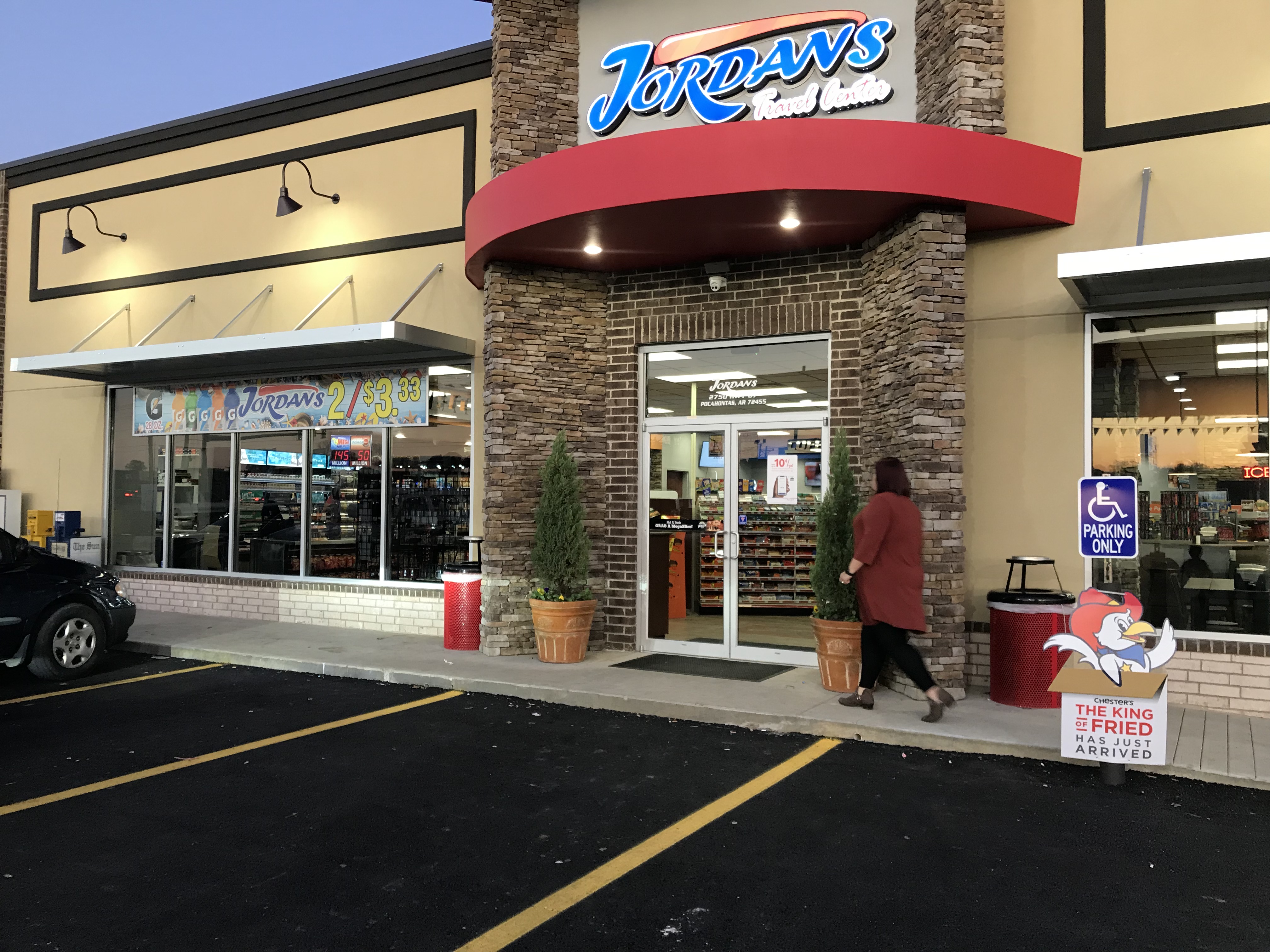
POCAHONTAS – A new convenience store opened its second location in Pocahontas.
The Jordans Kwik Stop #52 is located at Highway 67 and Carter Lane in uptown Pocahontas, beside Randolph Memorial Gardens Cemetery. Unlike the current convenience store, the new travel center contains a diesel truck stop, however, no showers are included.
Although the first store is still operating, Jordan’s Kwik Stop #52 Manager Devin Soles said more people are coming into the new travel center since it opened Nov. 1.
“It’s crazy. Many people are walking in from all the doors. They say they like the store because it’s new, clean and a family environment, so it’s good,” Soles said.
The store side doors open to a lounge with black leather couches where customers can relax and watch television or sit at the dining area next to the lounge with a restaurant-style setting. The service center has four diesel pumps and over 20 spaces for big trucks to park. Soles said they take Comdata, EFS, T- check and a variety of fuel cards.
Kenny Rasmussen, a driver associate working for Crete Carrier Trucking Company said he liked the travel center because it’s clean, the workers are friendly, the center has a large parking space for trucks as well as a clearly marked truck entrance and exit.
“It’s nice to have a place to park a big truck. There are not enough places to do that. This is our first time at this center; we definitely will keep it in the memory bank for being able to park here safely,” Rasmussen said.
Soles said, “Unlike a regular truckstop, the downside to the center is we currently do not have showers for the trucker.”
A.J. Parker, a customer traveling on his way to Texas, stopped at the store to charge his phone on the available plug-ins the store provides for customers.
Soles said store 52 is the first of the Jordans’ stores to sell Big Rock Pizza in its food deli inside the store while all its other stores are selling Hunts Pizza.
“People are loving the food and pizza. Our pizza is quick and takes only three minutes to make from scratch. Before those in the trucking business are even done fueling, we’ve made a fresh high-quality pizza. That’s hard to beat; people here are loving it,” Soles said.
He said they can custom make the pizza for a customer. The deli also makes specialty pizza with beer sauce wings. Pizza price ranges from $7.99 to $11.99.
The store offers free coffee for police officers on duty, so more police officers are visiting and helping with security.
Sara Caster, the nightshift lead at the store said it’s her first time working at a convenience store. She works with 20 other co-workers. She said the store runs three shifts.
“We get so busy at the deli; we are open 24 hours. There is a rush hour when Peco employees come to the store; they come in groups and they want hot food and energy drinks,” Caster said.
Peco is a chicken plant just a few blocks away from the store.
Caster said the minimum wage the store pays is $9.65 an hour but she is not worried about the salary competiton from Peco, which pays a minimum of over $13 an hour.
“Peco is a factory, they are mass producing and the workload is just not the same. Besides, I don’t and have not earned a minimum wage in a long time,” Caster said.
Soles said so far, the travel center filled all the employee positions.
T’Ricks, the closest convenience store is located just on the opposite side of the road to the new Jordans currently faces a lot of competition from the new Jordans Travel Center. T’Ricks also hosts the Citgo gas station. Citgo changed all its old and slow fuel pumps and replaced them with new ones a few weeks before the opening of the new Jordan’s Kwik Stop.
“The old pumps dispensed gas slowly. We went 50/50 with Citgo company on the new pumps,” Mohamed Zoro, the T’Ricks manager said.
With the more efficient fuel pumps, they may keep their old customers from running away to the new Jordans.
“Business is slow, we are headed to the holidays,” Zoro said.
Rancho Bravo, a Mexican restaurant and store also opposite the new Jordans gave its building a new face-look keeping up with the competition.
All three stores serve hot meals and are competing for the same customers, especially the customers from Peco food processing plant.
Presently, Exxon, the oil and gas company stationed at the new travel center, has a reward program giving its customers a discount of $.50 per gallon on gas. The station sells gas cheapest compared to all other fueling stations in Pocahontas.
“Everyone seems to be going to the new travel center, but, after the novelty dies down, we know they will be back,” Zoro said.
Soles said they foresee a brighter future for the travel center because it’s the only one currently in Pocahontas. They also look forward to getting a liquor license Nov. 13 and are expecting more customers to come to the store to utilize their lounge and dining area.
Editor’s Note-Feature Photo taken by Christine Miyawa
JONESBORO – Arkansas farmers continue a fight with a competitor halfway across the world. The trade war with China drags on with steady impact.
For the second harvest season, Arkansas farmers experienced lower prices for their crops as a result of a tariff war with China. Joe Christian, owner and operator of JOC Farms Partnership, sees first-hand the negative impact of the trade war.
“This summer, prices were down to $8.50 a bushel for soybeans and even less. That’s $2 below production costs,” he said.
The low prices stem from a decrease in demand for exporting agricultural commodities. Farmers across the nation struggle to make ends meet in the wake of harsh tariffs imposed by China to specifically hurt American agriculture.
Scott Stiles, an economist with the Cooperative Extension Service, said this all began when the Trump administration added tariffs to aluminum and steel imports in April 2018. In response, China imposed a 25% import tariff on U.S. soybeans, grain sorghum, cotton and several more agricultural commodities as well as several other industries.
“They chose to go after a segment of the U.S. population that would really get the president’s attention,” he said. “Hitting the ag (agriculture) sector could be something that could really be detrimental to the president’s political future,” Stiles reiterated.
As the top U.S. export market, China bought one-third of all U.S. soybeans before the trade war began. Arkansas grows around 3.4 million acres of soybeans each year and 610,000 acres of cotton, most specifically to be exported. Now, China buys hardly purchases any Arkansan crops.
“We can’t sell them commodities, but they want to sell us everything, and they don’t want tariffs,” Christian said. “So, in other words, they can put tariffs coming into our country but we can’t on ours.”
Because agriculture makes up a large part of the Arkansas economy, the effects can be felt in several more industries. Patrick Lenderman, Paragould Farm Credit Midsouth branch manager and vice president, works directly with Arkansas Delta farmers to finance their farms.
“This is kind of a trickle effect. When a farmer spends a dollar, it affects a lot of different people, whether it’s going to retail sales at the local Walmart or buying a new tractor or truck,” Lenderman said.
Stiles said the government cannot quantify the effects of the trade war beyond the growers because too many industries intertwine with the agriculture industry.
The federal government began providing trade aid to farmers in 2018 to help compensate for the low prices. According to the Congressional Research Service, the Market Facilitation Program offers farmers payments for “trade damaged” commodities. Arkansas farmers received $281 million in trade aid in 2018.
The U.S. Department of Agriculture increased funding to $14.5 billion and added many more crops to the list of those eligible for aid in 2019. Farmers may continue to sign up for these payments through Dec. 6.
“I think if every grower participated in that, then the amount of aid out of this 2019 round would be about $435 million,” Stiles said. “The payment rates are structured a little bit differently in 2019, and it covers more commodities, so there’s more aid available.”
Currently engaged in trade talks, the Trump administration and Chinese leaders began thawing their relationship, but export numbers remain lower than before the trade war.
Christian said other countries buy soybeans from the United States and then sell them to China to avoid the tariffs, so they still get the products. This could make it difficult to strike a deal between the countries.
He also said farmers in the area appreciate the actions of the Trump administration so far.
“We’ve been 20 plus years in the WTO (World Trade Organization) agreement, and we get rulings that are not far and against the United States all the time, and it’s time to do something different,” Christian said. “If we got to hurt a little bit to hopefully do some good, we’re willing to do it.”
Because many factors must be agreed upon by all countries involved for trade to resume, a solution to the trade war isn’t likely come soon.
“The solution will take time. There is no overnight solution to this,” Lenderman said.
The countries find themselves in a stalemate because the Trump administration interposed issues such as intellectual property disputes along with many others between the two countries over the past many years.
Negotiation talks were broken down into phases to address each issue, with agriculture as phase one.
Stiles said, “Ag is wrapped up in issues that are not ag-related, and it could be a casualty if we don’t ultimately get a complete, comprehensive trade deal.”
In the meantime, farmers continue the struggle to make ends meet. Arkansas growers, no matter how small the operation, cannot escape happenings halfway across the world and must fight through the current economic challenges.
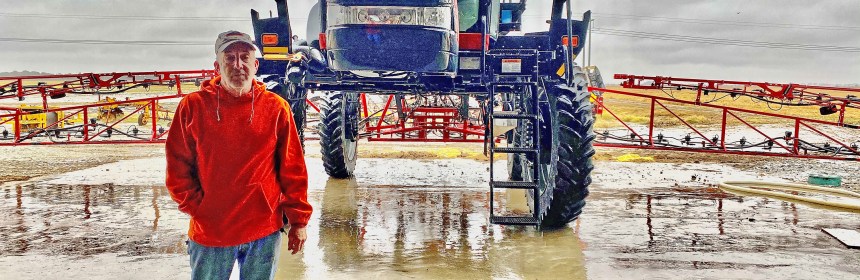
Editor’s Note/Feature Photo: Joe Christian, owner/operator of JOC Farms Partnership, is one of many local farmers affected by the U.S.-China trade war. Photo by Tristan Bennett.
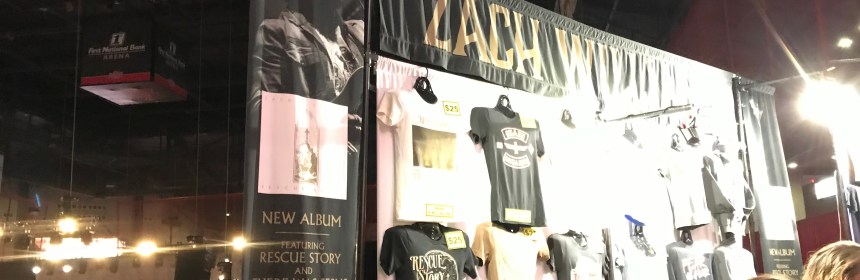
JONESBORO – Zachary Stephen Williams, commonly known as Zack Williams, treated fans to songs from his latest album ‘Rescue Story‘ at the First National Bank Arena, Jonesboro on Oct. 24.
Excited fans started flocking the venue as early as 5 p.m. Fans stood in the isles to get a glimpse of the rock star in the pact arena.
One of the event organizers, Mitchell Cole of By His Grace Entertainment, said his job was to bring the locals and the lost community to attend the concert.
“We are 80 tickets short of selling out there were 2,300 available, so, over 2,000 sold. We want to bring the community together to know there is a personal Savior out there and he could be even here tonight,” Cole said.
Micah, who is a strong fan of Williams’ music said she bought her ticket a month earlier and was just waiting for the day of the concert. She said she started listening to Williams songs a year ago and the songs have a positive influence in her life.
“I haven’t heard any of William’s music that I don’t like. My favorite right now is ‘Rescue story’; it’s on repeat all the time,” she said.
Micah said she was excited to watch Williams perform the ‘Rescue Story’ live. Her mother and daughter accompanied her to the concert.
Williams’ branded merchandise, which included T-shirts and all his albums saw a large volume in sales at the merchandise tables near the entrance as fans flooded each table trying to buy something.
While fans settled in the concert hall, Chef Paul Fields prepared food for the rock star and his team of 50 VIPs. Fields travels with the Zack William’s crew wherever the crew goes. The menu consisted of smoked pork ribs, barbecue beef, grilled chicken, potatoes, vegetables and salad. Fields said there are always four shows a week; every night in a different city.
“Williams likes to nibble on the ribs,” he said. Fields specializes in smoked ribs.
The concert hall burst into cheers when Williams hit the stage. Williams is an Arkansas Native, grew up in Bono although he now lives in Nashville, Tennessee with his wife and children.
Williams said he was terrified when he first signed his first record label because of fear from a constant reminder of his past.
He said he had this idea of the song he wanted to sing, a song that would put a face on fear and that’s how his hit song; ‘Fear is a liar’ was born.
His other hits included ‘Chain Breaker‘ and ‘Rescue Story‘, which he launched this year and is on tour to promote.
“I was the kind of guy you would shut your stores when you saw coming,” Williams said.
He struggled with alcohol and drug addiction. He said he is now a changed man.
Several policemen at every corner of the arena offered tight security during the concert.
Jim Brown, the director of the First National Bank Arena said, “We take security very serious for all our events and this is one of those events.”
They did not allow bags of any kind into the concert hall.
He said the University employs different security techniques for different shows depending on what’s going on with the elements of the show.
“I think we will be fine,” Brown said. “We have several events coming; the women’s basketball is still on, the Globetrotters are coming in February, we just announced a Broadway play for kids called the ’12th Night’ is coming, and Acoustic Rock Show is coming in February 4 as well.”
“Tonight, we could have a senior in high school come to the concert and say, ‘I like what Arkansas State has to offer; I want to make that the university I go to.'”
Williams closed the show but not without singing his hit song ‘Chain Breaker’ as the crowd applauded and sang along.
“The concert was fabulous,” David Specking, a fan at the concert said. “I could not wait; I bought the tickets the first time I heard Williams was coming to Jonesboro. I wanted to hear him sing the ‘Chain Breaker’ live.” His wife Ginger helped him ride his wheelchair as they leave the concert venue.
Williams said he never imagined playing music at the Convocation Center. He said it was good to come home and see the faces he hasn’t seen in many years. He has an extensive tour schedule to promote his new album “Rescue Story”. His next stop to perform was Austin, Texas.
BROOKLAND – Autumn in the Delta brought a business opportunity to many small family farmers.
Many farms in the area set up pumpkin patches and corn mazes as a family fall attraction to make a little extra cash after harvest. These farms draw in everyone from families to groups of college students. Jerry Whitten, who owns WF Mootown Corn Maze in Brookland, runs his business as a way to stay in the agriculture industry after retirement.
“I grew up on a farm, had cattle, my parents farmed, and I worked in the agriculture industry. So when I got a chance to retire from that job, this was something I thought I could do,” Whitten said.
Mootown offers a pick-your-own pumpkin patch, corn maze, bonfires, hayrides and a program for school children. Whitten credited great weather for the high turnout so far this year.
Matt and Anna Beth Presley visited Mootown to complete the corn maze and choose pumpkins to carve.
“She’s a nurse and I’m a cop, so our schedules are kind of busy. So this is date night,” Matt said.
The couple said they came to enjoy the fall festivity and the cool weather.
Whitten’s school program, “Spookley the Square Pumpkin,” tackles problems of bullying among young children and promotes agriculture.
Whitten said, “We have a trail set up in the woods, and it’s basically the book on boards that they read as they go through the woods, and they do a challenge at the end.”
When children visit the farm, they learn the process of growing pumpkins as well. Whitten talks to them about production and how to plant the seeds. Many teachers also prepare their students for the visit by actually growing a pumpkin in class.
Farmers who run these fall farms must start planning early in order to pull it off by the beginning of the season. Pumpkins can be especially difficult to grow. The Farmer’s Almanac suggests farmers wait until all threat of a frost is gone and water and fertilize often throughout the growing season.
“My analogy is they’re like a goat. They’re born looking for a reason to die,” Whitten said, “But they’re a lot of fun to watch because you always think there’s none there until the leaves start dropping, and you think, ‘wow there’s a lot of pumpkins out there.’”
The corn maze also draws people to the farm. Arkansas State University’s Catholic Newman Center brings a group of students to Mootown each fall. Zachary Ridgeway serves as the president of the CNC student organization.
“We do it to get all the new students to get to know each other better and have fun at the same time,” he said. “We’re doing the corn maze, which some of us have already successfully completed. We’re going to carve some pumpkins, and later we’re going to have a bonfire and hot dogs.”
Planning the corn maze also takes some time for Whitten to complete. In Arkansas, farmers plant corn in April or May and harvested in September. In order to keep it green throughout maze season, Whitten does not plant his corn until after the Fourth of July. Then, the maze must be cut out of the corn
“For years I did it the old-style way. Basically, the design is on graph paper, and every row of corn corresponds to a row on the graph paper. You just take marking paint and a lawn mower and start counting rows,” Whitten said.
Nowadays, professional corn maze cutters do the work for the farmer. They use GPS systems to mark the design in the field and cut it using a tractor and a tiller.
While a lot of hard work goes into it, Whitten said he enjoys the work he does.
He said, “I like raising it, but to me, watching the kids and the families come enjoy it and make memories. We’ve had several who have been with us every year, and it’s kind of a family tradition. That’s a lot of fun.”
Many farms like Mootown close for the season soon. Visit for family fun as well as to support local agriculture.
Editor’s Note: Feature photo and video by Tristan Bennettt.
POCAHONTAS – Law enforcement will be present during the first inaugural Novemberfest, making residents feel safer. The city will hold its first inaugural Novemberfest in historic downtown Pocahontas on November 1 through 2.
Co-Chairmen of the Novemberfest John Allen French said there will be law enforcement present during the festival. Pocahontas Chief of Police David Edington said there will be full-time officers, part-time officers and volunteer reserve officers at the festival. “Just for the general safety. It’s not anything dealing with the fact that we are afraid it’s going to get out of hand; there is still traffic around those areas, so it’s about safety and being visible.”
The streets that will be blocked off:
North Marr Street
West Pyburn Street
North Van Bibbber Street
West Everett Street
North Bettis Street
French agreed that there is a need for law enforcement at the festival, but doesn’t expect there will be any real need for them. “The last festival we had a police presence and nothing happened.”
Gypsy Girl owner Carrie Barnes said, “Its always good to have the police around during something like this; in case someone gets hurt or if something happens.” Barnes also said that Gypsy Girl will be opened during the festival and are expecting nothing to happen.
Another committee member Linda Bowling said, “We expect a large crowd. We have always coordinated with the city for any of our festivals in the event there is a problem.”
There will also be alcohol sold at the festival. Edington said he believes there will be an officer that will be assigned for alcohol beverage control.
“With regard to the festival tavern, we have all the proper permits, temporary alcohol sales and we’ve complied fully with the Alcoholic Beverage Control.” Bowling said, “I believe there will be paramedics there or at least easy access to our paramedics.”
French said there will be a lost and found and it will be held in the old court house. There will also be a member of the Novemberfest committee inside at all times.
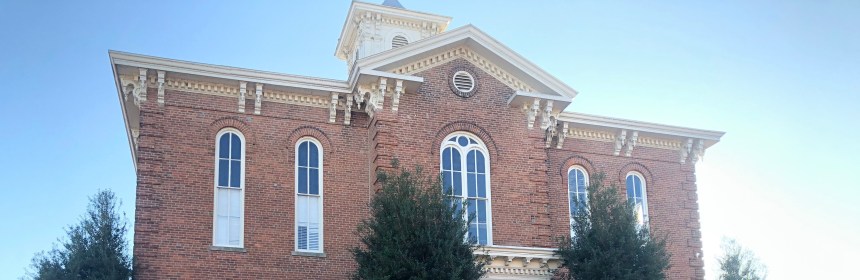
Editor’s Note: Feature photo shows Pocahontas Courthouse Square. Photo by Maddison Smith
JONESBORO – The Foundation for Jonesboro Public Schools hosted the inaugural A Stormy Night event Oct. 3 to raise funds for grants for students attending the Jonesboro Public School District.
Other events like this one existed in the past, but this was the first fundraiser of its kind in terms of the format and set up for the foundation. The foundation sold tickets at $50 each and a silent auction took place at the event. Sponsors also donated money to the cause.
Slade Mitchell, president of the Foundation for Jonesboro Public Schools, commented on the initial ticket sales.
“These are going to be estimates because I haven’t seen any final numbers, but I believe we have sold somewhere around 200 tickets,” Mitchell said. “But with sponsorships and everything involved, I expect this event will raise somewhere around $30,000 for our cause.”
The foundation hosts fundraisers like A Stormy Night because teachers in the district tend to put forward ideas of how they can educate their students in fun and creative ways. However, these teachers do not always have the means necessary to carry these plans out.
“We have great teachers,” Mitchell said. “They have great ideas for things they would like to do in their class: creative ways to educate their students. A lot of times with the ideas they have there’s a disconnect between the idea and the funding needed to pull that off. So what we do as a foundation is we award grants to those teachers in that situation. These types of events sustain that program.”
Joshua Miller, a math teacher at the Success Achievement Academy in Jonesboro, benefitted from multiple separate foundation grants. Miller is a testament to the success of the fundraisers the foundation hosts.
Miller’s students built roller coasters, rockets and bridges all thanks to grants from the Foundation for Jonesboro Public Schools. These projects made math engaging for the students and illustrated different ways math applies in the world outside of the classroom.
“If it weren’t for you all, the ideas and the dreams that we want to experience in our classroom would not become a reality,” Miller said in a speech to A Stormy Night attendees. “This dream of mine that I sit at home planning every once in awhile would not become a reality.”
A Stormy Night marks the first fundraiser the foundation created as a dinner during the middle of the week. Mitchell commented on how this could change the game for foundation fundraisers.
“We’ve always wanted to have an event like this,” Mitchell said. “We have board members now that have experience with doing this. While we’ve wanted to do it in the past, we’ve got the team that can do it now. We’re so excited to have something like this come together. In the past, rather than an evening banquet, we have done a brunch the Saturday following homecoming.”
The Foundation for Jonesboro Public Schools hosted the brunch for a few years, but an annual dinner has a chance to bring even more people to a fundraiser.
“We’ve always talked about doing an evening and doing something where we could maybe allow for more people to come,” Mitchell said. “Saturday mornings were tough because people were out of town or various things. We never really had the courage to try. This year, again, with the right board members in place, with the right team in place, we were able to pull it off.”
Many different people attended at A Stormy Night, including faculty from the Jonesboro Public School District along with various members of the community and sponsors.
Felicia Johnson represented New Door Real Estate Brokerage at the event, a local real estate company. Johnson’s daughter graduated from Jonesboro Public Schools.
“I think Jonesboro Public Schools are amazing and I would take any opportunity to support the schools,” Johnson said. “That’s why our company is here tonight. It’s wonderful to get here tonight and be with all these people that share the same goals.”
Johnson did four years of schooling herself with Jonesboro Public Schools and has been in Jonesboro for 32 years. She highlighted the importance a fundraiser like A Stormy Night plays in the lives of students.
“Oh my goodness, the funds that are raised here, can you imagine? Can you imagine the robotics team having what they need? The band having what they need? The cheerleaders? (For them) not to have to do tons and tons of fundraisers. This is amazing. We’re going to raise a lot of money to help our children.”
Editor’s Note: Feature photo shows Joshua Miller addressing attendees at A Stormy Night event.
JONESBORO – Arkansas Delta farmers harvested their crops and took them to market after a difficult growing season.
Farmers experienced many challenges this season as they planted crops and tended to their fields all summer. Chris Grimes, Craighead County Cooperative Extension agent, works with these farmers to ensure they use the most efficient growing methods possible.
“Right now, we are harvesting cotton, soybeans, peanuts, and there’s still a little bit of rice and corn,” he said. “We were delayed planting, which in turn pushed our harvest a little later than normal.”
Other than a few hiccups with rainfall, the harvest continues moving rather smoothly. Many rice farmers like Terry Gray, owner of Thomas Gray Farms, already finished cutting.
“We were probably off 15 bushels an acre from last year. Not a bad crop, but nothing to brag about,” he said.
The wet spring and late planting affected Gray’s crop just as it did many other growers in the area. Some, including Gray, even skipped out on growing soybeans all together rather than plant late.
The U.S. Department of Agriculture reported in the October Crop Production report a 14.3% nationwide drop in soybean acres planted from last season and a 7.3% drop in yield. Rice harvested experienced a 15% drop from last season.
While yields may be lower, growers report high qualities in their rice crop. Sample houses look at characteristics such as grain length, aroma and stickiness to determine the quality. Factors such as the amount of rainfall, heat and pests affect the quality of the finished product.
“The early part of the crop, the quality is good,” Gray said. “The middle part of the crop got so dry in the field the moisture content got down to 12%. As that grain sits in the bin, it’ll age and come up.”
“The early part of the crop, the quality is good…The middle part of the crop got so dry in the field the moisture content got down to 12%. As that grain sits in the bin, it’ll age and come up.” – Terry Gray, owner of Thomas Gray Farms
After harvesting the crops, farmers take truckloads of grain to driers so it can be properly stored and milled. Rice comes out of the field at a higher moisture content than it can be stored, so it must first be dried before it can be milled.
Riceland Foods markets agricultural commodities for its 6,000 member-owners in Arkansas and Missouri. The Jonesboro Grain Drier accepts both rice and soybeans from their members.
Freddie Gahr, drier manager, handles rice for the Jonesboro area and the mill.
“There was so much rain this past spring and so many acres that went into preventive planting acres that it really hurt our harvest receipts on rice this year,” Gahr said.
In Jonesboro, growers can take advantage of early sign up. They tell Riceland how many acres they intend to market through them, and they might get a better price than they would during the season.
“We can take those acres and convert them to bushels per acre, and we can determine, on rice, what we are going to get during harvest,” Gahr said. “We take soybeans basically as a service for our members.”
For rice, the Jonesboro mill includes four different processes. The parboil mill precooks and steams rice, and the traditional white rice mill removes the hull and polishes the rice. Rivland, a partnership between Riviana and Riceland, produces rice flour, and the by-products division takes bran, sends it to Riceland headquarters in Stuttgart, and they make rice bran cooking oil.
Riceland offers the farmer a certain price per bushel for their crop, and it takes care of drying the grain and milling it to be consumed by the public. The price they give changes daily, but on Friday, Oct. 11, they offered $5.51 per bushel of rough rice, an OK price.
“The prices could be a lot better,” Grimes said. “They vary depending on where they deliver, and they may have it contracted.”
Low prices mean especially difficult times for farm families. Overhead costs such as insurance, taxes and equipment payments never stop, so a low yield could lead to a financial stress for families who rely on farming.
Stress on a farmer could also contribute to family issues.
“When things aren’t going right, I’m sure my kids don’t think I’m quite as nice a dad,” Gray said. “You try not to take that home with you, but sometimes you just come home and you’re really frustrated.”
Despite tough seasons, low prices and stress, farmers like Gray continue to grow year after year.
He said, “Two famous words that come out of a farmer’s house are ‘next year.’ As a farmer, we love what we do, we love taking care of the soil and land, and we are always wanting to promote our vocation.”
Gray said next season may bring higher prices due to the interruption in the market, and many farmers will start out with land already worked, making it an easy planting season.
JONESBORO – New restaurants provide employment opportunities for job seekers however, many current restaurant employees are bracing for a negative impact often caused when new businesses within the same industry come to town.
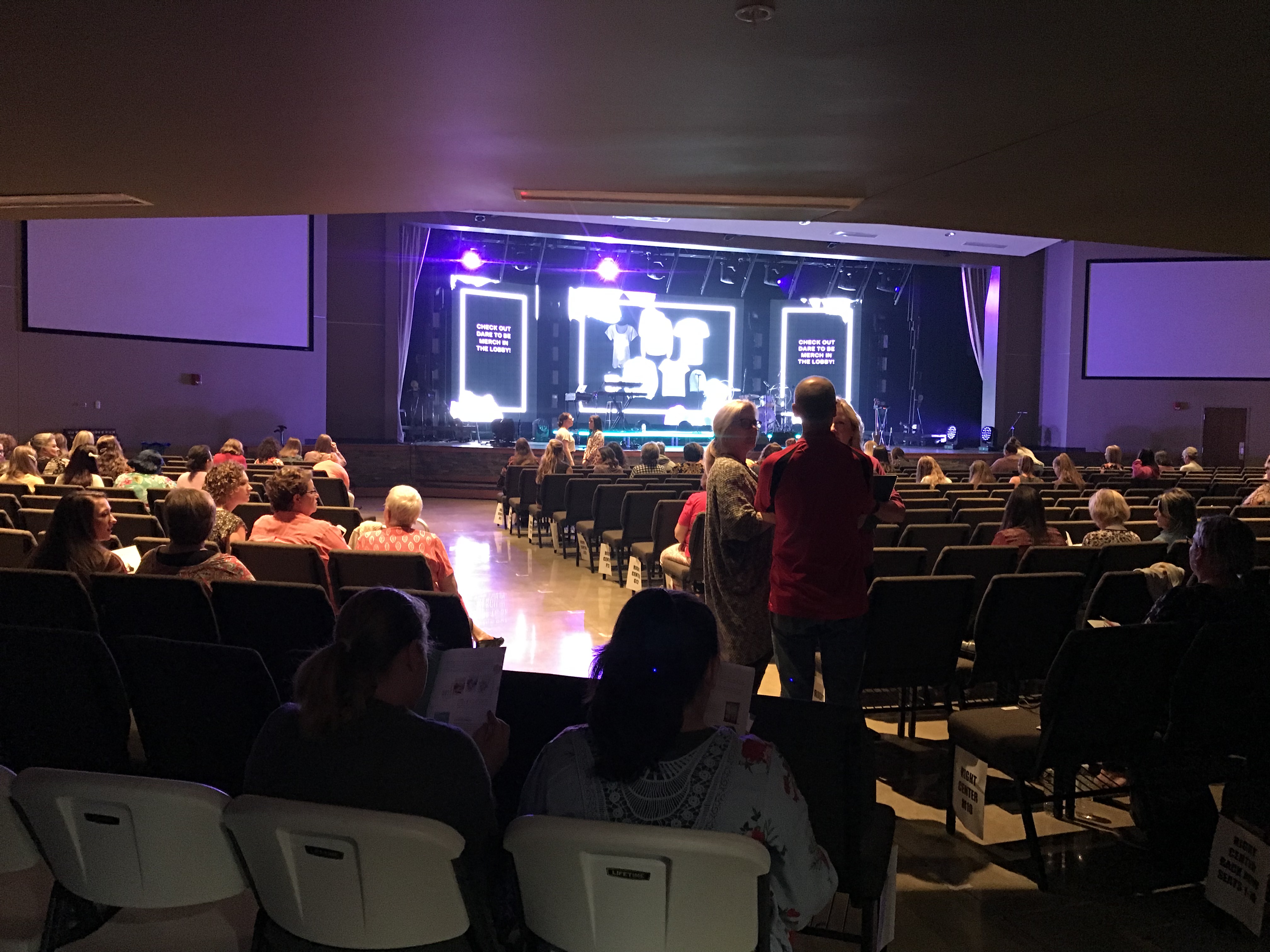
JONESBORO – In a fully packed Wesley Hall at the First United Methodist Church in Jonesboro, Dare To Be ministry held its first conference in Jonesboro on Oct. 3. Multi-Dove and Grammy Award winner Natalie Grant and author and Pastor Charlotte Gambil founded the ministry which seeks to empower women of all ages.
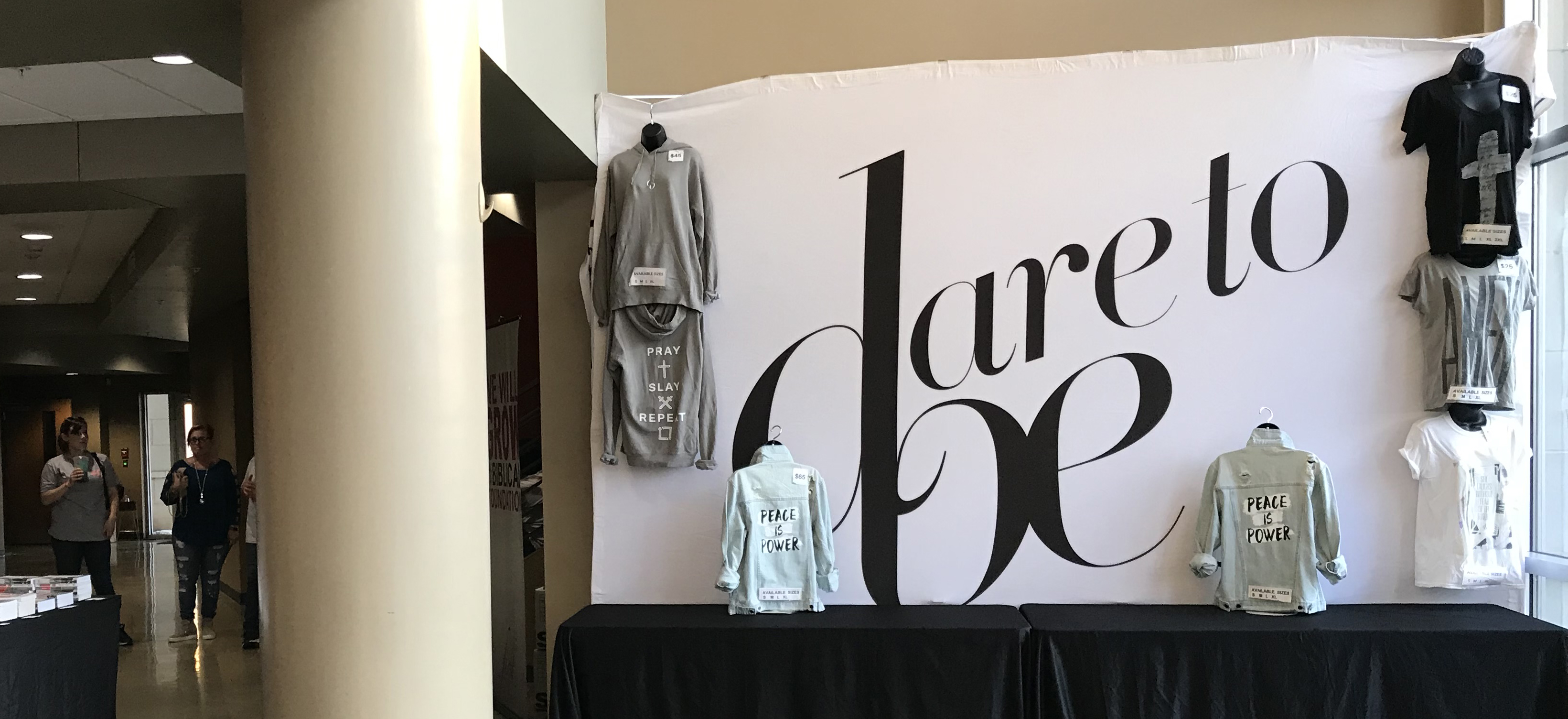
Shirts are displayed while on sale during the Dare To Be ministry concert.
Grant performed at the sold-out event and it was the first time for Gambil, who lives and pastors the Life Church in England, United Kingdom, to visit this part of the United States of America.
Gambil, together with Grant, started the ministry to empower women and to help them reach their potential and be whom God has called them to be. They do so through the ministry of music and preaching. “In the eye of the storm, there is calmness,” Gambil said.
Compassion International, a humanitarian organization helping needy children from developing countries, organized the concert. The theme of the event was “Speak to the Storm”.
Gambil gave a story of Eliezer, a 4-year-old Rwandese boy now a grown man in his 20s and a member of her church in England, whose parents and grandparents were slain by rebels during the Rwandan genocide at his watch.
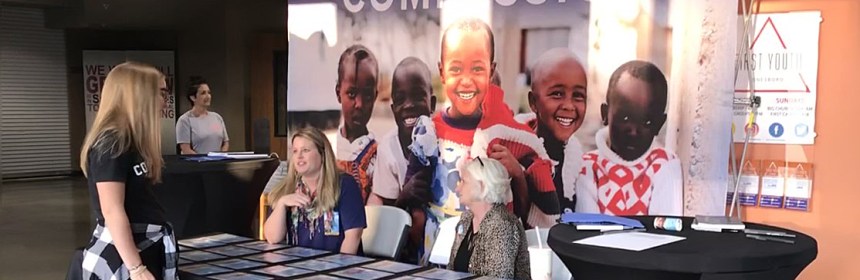
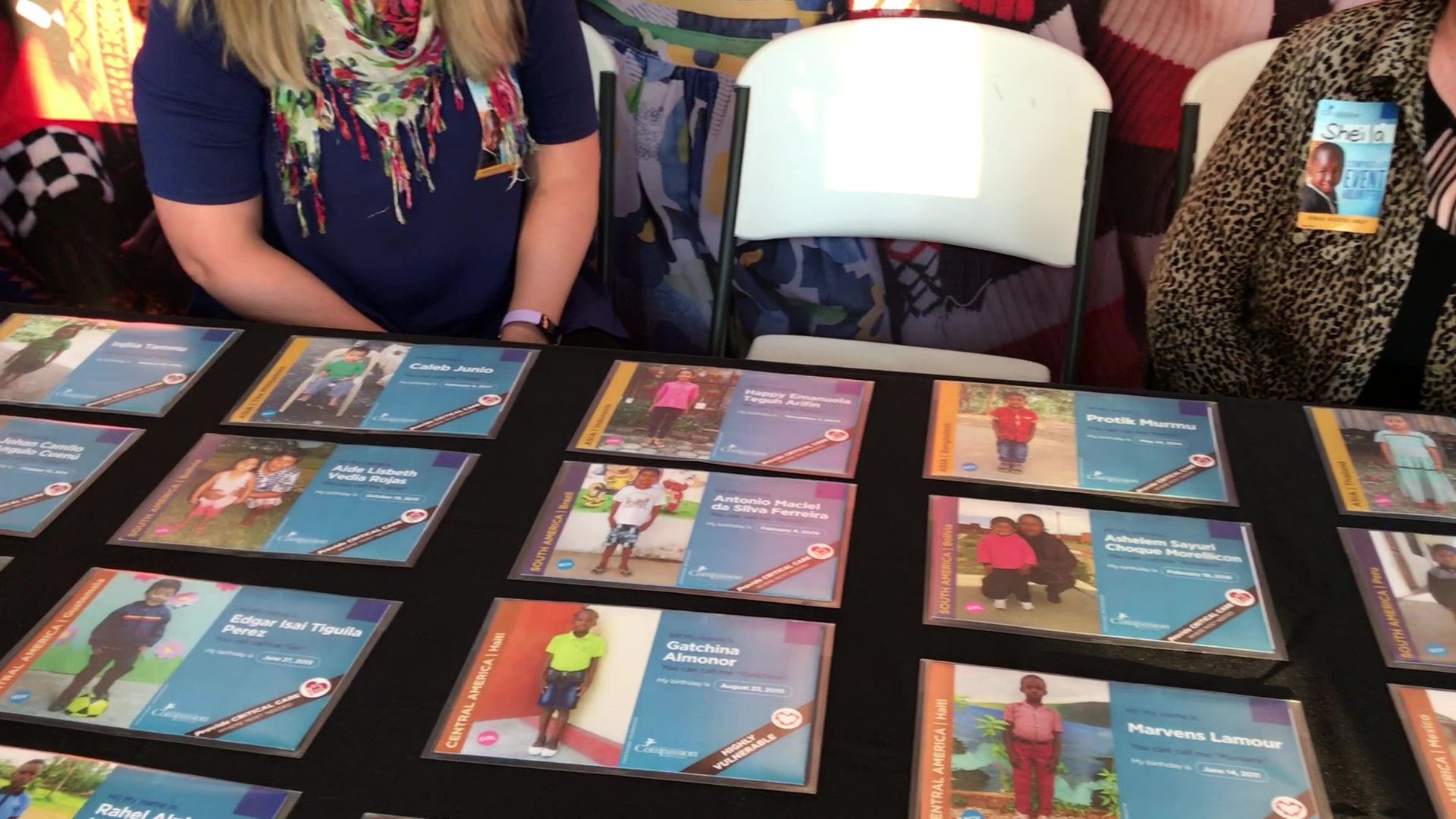
Profile packets of children seeking sponsors are on display during the Dare To Be ministry concert.
Eliezer’s mother asked him to climb a tree and keep silent should the rebels come to attack his family. When rebels finally did, Eliezer climbed the tree and observed as both his parents and grandparents were hacked to death by machetes. He did not say a word and hid on the tree for two days. When he finally came down, he walked to the street; someone saw he was a child walking alone and took him to Compassion International, where Eliezer was adopted.
That story inspired Gambil. Gambil said she saw in her storm; she was able to help someone else in their storm. Gambil’s storm was lack of a child. She struggled with infertility. When she realized the possibility of adopting a child through Compassion, she saw a way to saw a seed for a miracle she was asking God for, so she became a sponsor.
Grant implored the audience during the concert to support Compassion International by contributing $38 a month to sponsor a child. Profiles of children from several countries laid out in a packet on a table at the entrance, which she asked the volunteers to distribute to those who raised their hands.
“If you take a packet, this is a no-pressure deal. We just want to make you aware and invite you to be a part of it, but we don’t want to strong-arm you into it or anything,” Grant said. “So, if you take a packet and you are like, ‘you know what, I just don’t think I can do this right now,’ we just need the packet back. This is why, every packet represents a real-life, so if you accidentally take it home or slip it in your bag and it gets lost, it takes months for that child on the packet to go through the system and get back on the packet, to have an opportunity to get sponsored again,” Grant said.
Volunteers passed packets; some people in the audience wrote checks.
The lead organizer from Compassion International at the Jonesboro Concert, Rachel Knoop 25-years-old, from Minnesota, said, her organization is in partnership with the Dare To Be ministry to help reach out and support less fortunate children in the developing countries.
Rachel said Compassion International was founded in 1952 by Everette Swanson, a preacher who traveled to South Korea to preach the gospel to the Army troops during the war. In his travels, Swanson encountered children orphaned by war and started the organization to raise funds to help the children with a little money every month to survive on.
Rachel said she has worked for the organization for some time.
“We are in 25 countries; recently, I was in Tanzania, Africa. I have also been to the Dominican Republic,” she said.
She said the organization is taking a holistic approach to eradicating poverty, providing clean water, nutrition for kids and their families, education and catering for the health costs.
“Compassion International is releasing children from poverty in Jesus’s name,” she said.
Rachel said the organization works with the local churches to recruit children to the program. Before, they used to hire a local staff member to do the recruiting. She said the local staff knew which children are most vulnerable. Now, it’s open and children can apply directly at compasion.com. She said they must meet critical poverty guideline, which is living on a $1.25 or less per day.
Rachel said they take in children from birth and the sponsors stay with them until they graduate out of the program at ages 18 to 22.
Once a child gets connected to a sponsor, they write each other letters back and forth. They get to know each other.
Sheila Hinson, a volunteer at the organization, handling a table where an array of profiles of children were spread out, said she has sponsored a child for the past 12 years.
Hinson started sponsoring Martha Wanjiru from Kenya when Wanjiru was only 6-years-old. She said when she picked Wanjiru’s packet, she was the only child left on the waiting list who had not found a sponsor. She said every month she spends $38 on Wanjiru and has done so for the past 12 years.
She said Wanjiru talks a lot about education. She said she hopes she can help make her dream come true and is in a place where she hears about Jesus.
Wanjiru is now 18 years old and pursuing a career in nursing. Smiling broadly, Sheila said she was also in the medical field for a long time. She sends her birthday cards and Wanjiru writes to her at least four to five times a year.
Erick Bush, 52, from Memphis, another Compassion International volunteer at the event. Bush said the organization sponsors children from South and Central America, Asia and Africa. He said to sponsor a child you pick out a packet, on the package are a photo of the child, information about the child, the child’s specific needs, their birth date and the community from where the child originates. There is a place for the sponsor to include their name and their credit card numbers. He says anyone interested can go online on Compassion.com, fill out their information and become a sponsor.
Bush is sponsoring two children from Ecuador. This is his eighth year since he started sponsoring them and plans to continue until they are out of the program. Bush sponsors the children providing food, shelter and medical services. He said he is sponsoring the children as an overflow of gratitude to Jesus Christ for the grace. When he is not volunteering for compassion International, he runs a restaurant in Memphis.
Knoop said a graduate of the program, Jonathan Almonte, ran for a political office in the Dominican Republic. Almonte is also a founder of a ministry that provides leadership training to local churches in the Dominican Republic.
Faith Benson from Nashville, Tennessee, the merchandise manager for “Dare To Be” oversaw the sales team selling branded T-shirts, jackets that read, ‘Peace is Power,’ necklaces that read, ‘Faith over Fear’ and devotional books authored by Gambil and Grant.
Benson said every night in the course of the tour, they have an honoree moment, where women at the previous event give offerings which they use to bless a woman at the next concert. Volunteers passed baskets around in the concert hall and people made their offerings.
The Jonesboro event honored Tiffney Turner, a breast cancer survivor who has recovered from drug problems and is helping men and women who have drug problems beat the addiction through her ‘Breaking Bonds’ Ministry, was the Honoree. She received flowers, a black handbag made by women fighting addiction, and a two-day paid vacation at a hotel so she could celebrate her wedding anniversary, which fell on that same day and a 15-seater van to help transport the men and women in her ministry.
Gambil closed the event with a call on the audience to come forward and receive Christ Jesus, as Grant led the audience in a chorus of the song: ‘Whom you say I am,’ by Hillsong Worship.
The duo, together with their crew, headed to Dallas, Texas, for their “Dare To Be” performance the following day and after that to San Antonio, Texas.