Tag Archives: Arkansas State University

Damphousse Seeks Community Ties

By Kimberely Blackburn
Delta Digital News Service

Damphousse Window Art

Window art featuring Kelly, Beth and Maple Leif Damphousse decorated the window of the Chancellor’s office. Damphousse became A-State’s chancellor on July 1. Photo by Kimberely Blackburn

JONESBORO – A native Canadian and Montréal Canadians fan, Arkansas State University’s new chancellor aspired to become either a goaltender for the NHL or a Mountie before coming to Northeast Arkansas by way of Oklahoma.

Chancellor Kelly Damphousse said he planned to stay at his last position as dean of the College of Arts and Sciences at the University of Oklahoma until retirement, but an email sent by A-State President Chuck Welch prompted him to apply. When he first visited the campus, Damphousse saw the challenges but viewed A-State as a diamond in the rough. He said he can impact a community as a chancellor in a much different way than he could as a dean.

“It’s important for us to have a relationship with the people on our campus. Sometimes it’s easy for someone who in administration to get removed from the reality of the world that they’re serving,” Damphousse said.

Damphousse explained why he creates relationships:

Campus and Community

Damphousse said his main concern will always be the students, faculty and staff. He said he understands he can only see a few students per day due to his position. Yet faculty and staff members interact with hundreds.

Damphousse said he wants to use his position to help bridge the gap between campus and community. He said there seems to be a strain between the two due to past events. He said he believes strains occur due to a lack of communication, meaning people do not truly know each other.

To remedy this, Damphousse said he speaks to any community club that extends an invitation, as well as local merchants and companies to see how A-State can help their business. Jonesboro Mayor Harold Perrin said he and Damphousse agreed to work together on several projects.

Perrin said he hopes to help get the word out of what A-State offers the community. He said A-State remains a driving force in the Craighead County community.

Perrin said A-State can help employers by providing both new employees and education for existing workers. Perrin said he believes A-State and the Jonesboro community can achieve this by fine-tuning programs already on campus.

“I’ve always learned in business, you build and become strong on what you have. If you’ll continue to build and to redefine what you’ve got, you’ll be highly successful,” Perrin said.

Damphousse explained his plans to keep A-State movng forward:

United Way

Damphousse recently announced on his Facebook account that The United Way of Northeast Arkansas named him and his wife, Beth, as co-chairs of Arkansas State University’s United Way Campaign.

Nanette Heard, executive director of United Way of Northeast Arkansas, said the Damphousses will encourage the A-State community to designate part of their salary to help fund projects throughout the eight-county region.

UWNEA covers residents of Clay, Craighead, Cross, Greene, Jackson, Lawrence, Poinsett and Randolph counties. Heard said the projects include shelters, after-school programs and programs that help feed the hungry.

Damphousse said the community matters to him and to A-State. Because the campus and community will always be tied together, he said if one rises, they both rise. Damphousse said he and Beth plan to be around for the long run.

He mentioned an analogy about planting trees you never get to sit under. But Damphousse said he wants to sit under the trees he plants. He said he wants to see the efforts that come from the changes he implements.

This is why, Damphousse said, the motto “Every Red Wolf Counts” truly encompasses everyone.

“Every Red Wolf Counts. That means every student, every faculty member, every staff member, every alumnus, every member of the Jonesboro community,” Damphousse said. “I see them all as Red Wolves because we’re all tied together.”

He even let students name the family dog:

Listen to the entire interview:

Trump Puts DACA in Doubt

Canizales at protest

Daniela Canizales, a dreamer, attends a pro-DACA protest on the A-State campus. She remembers nothing of her birth country after coming to the United States as an infant. Photo by Kimberely Blackburn

By Kimberely Blackburn
Delta Digital News Service

JONESBORO – President Donald Trump announced his decision to discontinue the Deferred Action for Childhood Arrivals program, a decision placing those brought to the United States as children by undocumented immigrant parents, often known as “dreamers,” at risk for deportation.

Trump’s decision comes after lawmakers from 10 states demanded he take action against the program, which they called “unlawful and unconstitutional.” Texas Attorney General Ken Paxton sent a letter penned by himself and other officials, including Arkansas Attorney General Leslie Rutledge, giving the Trump administration until Sept. 5 to make a decision on DACA. After this date, the group would proceed to federal court.

In a prepared statement, Rutledge said, “While we are a compassionate country, the United States is a country of laws, and President Trump recognized that President Obama’s DACA program went far beyond the executive branch’s legal authority. Congress has always been the proper place for this debate, and I am pleased that the President is granting Congress an additional six months to legislatively address this issue.”

The Impact

One dreamer, Bryan Hernandez, said his parents decided to leave Mexico City after someone robbed his father at gunpoint. After coming to the United States at the age of 6, Hernandez said he does not remember much of his birth country.

Hernandez said his parents brought him and his sister to the United States for a better education and more work opportunities. He said his parents work as a roofer and a maid, having previously worked for low wages as migrant workers.

Edica Tamez, a friend of Hernandez, said she remembers when Hernandez’s 4-year-old brother worked as a migrant worker alongside his family. Tamez said the child knew his family needed money and wanted to help.

Tamez said she often saw a similar work ethic in the Hernandez family, remembering Hernandez’s now 16-year-old sister reacting to being approved for DACA, after being denied twice.

“She was so relieved she could finally work. She could finally help her family and go to school,” Tamez said.

Brought from Monterrey, Mexico, 18 years ago, now 19-year-old Daniela Canizales said she remembers nothing of her birth country. Canizales said she fears how the end of DACA affects her educational opportunities. While currently not in school, she said she wants to study social work.

Canizales said her parents brought her and her older brother to the United States for a better education. She says DACA also provided opportunities for her brother and sister-in-law to provide for their 6-year-old daughter.

Hernandez and Tamez at protest

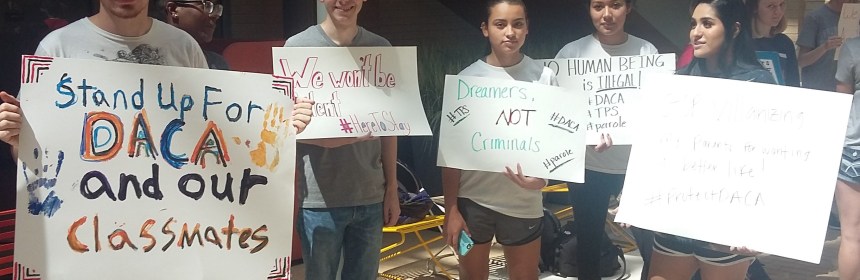
Edica Tamez and dreamer Bryan Hernandez protest the end of DACA. The A-State Young Democrats protested in the Humanities and Social Sciences Building. Photo by Kimberely Blackburn

The Aftermath

The Young Democrats of Arkansas State University staged a protest on the A-State campus. Those in attendance included Kayleigh Schalk of Poplar Bluff, Missouri. Schalk said she attended the protest because of her belief that it is unfair for children to be sent away from their home.

Schalk said she attended class with dreamers in a small Missouri university, finding them to be kind and hardworking. One, Schalk said, worked odd jobs and swept up the trash after all the events and ball games.

Special Sanders, outreach director of Arkansas Coalition for DREAM, said Arkansas requires dreamers to pay out-of-state tuition. This is often close to double what Arkansas residents pay. Sanders said when DACA ends, dreamers will most likely not be able to keep their identification or their jobs.

Sanders said she does not think Congress will pass legislation to help dreamers. She said if something does not change, she will return to the streets in protest.

Dylan Herekamp, also in attendance for the protest, said he did not know any dreamers personally. However, he said, that did not matter to him. Herekamp said his goal will always be to stand up and support dreamers, and he encourages everyone to write or fax their lawmakers and make their voices heard.

A Deal in Progress

Late Wednesday night, Senate Minority Leader Chuck Schumer and House Minority Leader Nancy Pelosi issued a joint statement after meeting with Trump which said “We agreed to enshrine the protections of DACA into law quickly, and to work out a package of border security, excluding the wall, that’s acceptable to both sides.”

Sarah Sanders, press secretary for the Trump Administration issued a Tweet which said, “While DACA and border security were both discussed, excluding the wall was certainly not agreed to.”

Uncertain Future

In response to DACA critics, Canizales said she wishes everyone would become fully informed on the issue. Canizales said everyone should do research and learn of the issue before making snap judgments.

Hernandez said the future of his family remains uncertain and his education remains a concern.

“(This decision) takes away the opportunity, the change for an education that we always wished for,” Hernandez said.

A-State Dedicates ‘The Circle’

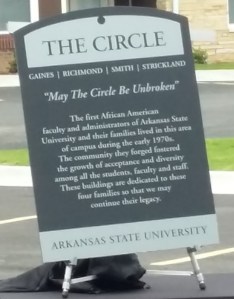
University officials unveiled a placard explaining “The Circle” during the dedication. The university named the apartment buildings for its first four black faculty. Photo by Kimberely Blackburn

by Kimberely Blackburn
Delta Digital News Service

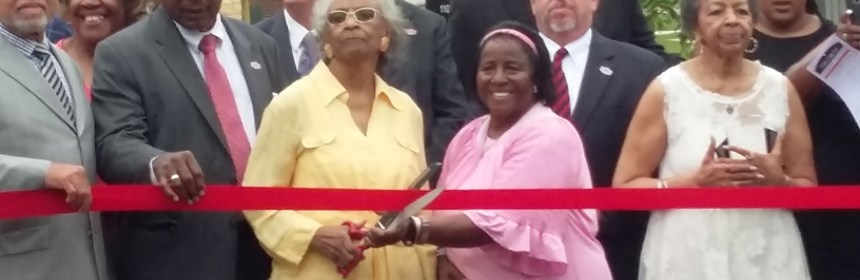
JONESBORO — Arkansas State University honored its pioneering black faculty Aug. 7 at the dedication of “The Circle,” a group of apartment buildings.

Chancellor Kelly Damphousse said such an honor sends a statement and begins many projects intended to make the campus a more welcoming place.

“We’ve come a long way in recognizing the important role that African-Americans play in our community, but we have a lot further to go,” he said.

A-State named the buildings — which will house A-State faculty, graduate students and New York Institute of Technology College of Osteopathic Medicine students — for the four men who taught at a time when many did not accept integration:

  • C. Calvin Smith, emeritus professor of history and A-State’s first black faculty member
  • Mossie Richmond, A-State interim president, vice president for student affairs and dean of University College
  • Herman Strickland Sr., emeritus associate professor of teacher education and dean of University College, and
  • Wilbert Gaines, emeritus associate professor of physical education.

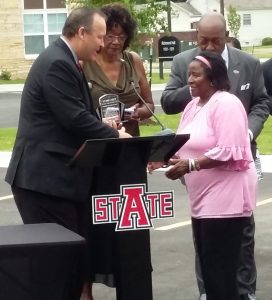
Chancellor Kelly Damphousse presents Earline Smith with a crystal award in honor of her late husband C. Calvin Smith. Each family received an award. Photo by Kimberely Blackburn

Smith lived in campus housing after being unable to find someone in Jonesboro willing to rent to his family. As the other families arrived, they became neighbors and formed “The Circle.”

Rick Stripling, vice chancellor for student affairs, said the dedication sends the statement that Arkansas State embraces diversity. He emphasized the importance of honoring the contributions of these men in the public eye.

Smith’s widow, Earline, said the families’ shared experience formed an extended family who truly loved each other. She said never in her wildest dreams did she expect so many people would attend the dedication. Richmond’s widow, Velmar, said the dedication honored and dumbfounded her.

Strickland said he came to A-State and found friends immediately. He said he gained acceptance as a teacher because of his friendship with Smith, who had done it first. He said he became a dean because Moss mentored him.

Gaines claimed the dedication shows A-State as, “a beacon of light to which other institutions can come for divine wisdom and insight.”

Richard Hartness Sr. authored a book illustrating the families’ lives called “The Circle: Coping With Integrated Life at AState, 1970-1978.” A former student of Smith’s, Hartness said he learned of the story at the celebration of Smith’s life after his death. Hartness said Smith brought important aspects of American and black history to his students that sometimes corrected the history books. Hartness said he now teaches these ideas to his students at East Arkansas Community College.

Richmond’s family member, Sandra Smith, works as principal of the BCH2 Academy at Wynne public schools. She said the dedication provided an opportunity for her to bring ideas to her students and teachers. Smith said she often quotes Frederick Douglass — who said, “Education can be an equalizer” — to show the importance of education to her students.

“In 2017 when we find there is still racial tension at times, this (dedication) establishes the fact hard work does pay off, and there is a facet of America that recognizes hard work,” she said. “As (Arkansas State) honored these founders and pioneers, they have honored themselves. As we lift others up, we lift ourselves up and if we understand that, we will be a greater America.”

Piano Competition Allows College Entrants

By Seth D. Cleveland
Delta Digital News Service

JONESBORO — Arkansas State University hosts the J.D. Kelly Piano Competition every year, but until this year, the competition never allowed students to participate.

Lauren Schack Clark, professor of Music at A-State and organizer of the competition, said the competition has evolved over the years. The competition’s roots started in a former summer music festival. Clark said the festival began as “really a camp for pre-college students.  We started the competition as part of that festival around 2007, and the last year of the camp was 2014.”

But the time came for a change and the camp, which proved “very successful” according to Clark, drew to a close. Clark did not want the competition to end. So she retained the competition, but held it during the school year to make it more accessible for students who participate in other summer camps and family travel.

Starting last yea, Clark decided to incorporate an undergraduate division into the competition. According to Instructor of Music and annual judge Brian Henkelman, “It adds another level.”

With the addition of a new division with a larger cash prize, talented students from A-State and the entire surrounding area have the chance to win. According to the website, the competition offers cash prizes ranging from $25 to $200 for first and second place in every division.

No collegiate participants outside of Jonesboro participated this year, but Clark said she hopes that will change. The goal is to increase participation in all of the divisions by next year.

“The cash prizes are an incentive that not every competition can offer,” she said.

Those cash prizes do not come so easily. As a judge, Henkleman said, “The difference is perhaps in level of expectation.”

With the addition of the collegiate division comes a higher level of “maturity and professionalism.” Henkleman said while “the collegiate level usually offers more difficult literature … the judges are still listening for accuracy, musicality, appropriate interpretation and all of the elements of music that the students in the earliest levels are beginning to explore.”

Clark said the addition of the division serves as somewhat of a recruiting tactic.

“The competitions are designed to encourage excellence in musicianship and to give the students a goal to work toward.  They are also a recruiting tool.  Allowing college students to participate brings potential graduate students onto campus,” she said.

Henkleman and Clark said they agree that the incorporation of the undergraduate division is a great way to expose other students and colleges to the caliber of the music program. In addition to the college division, the competition also began to accept video entries.

The winners of this year’s undergraduate competition were Samantha Holt and Xin Ying Kong.

Bicyclist Voices Safety Concerns

by Kirsten May
Courtesy of A-State Department of Media

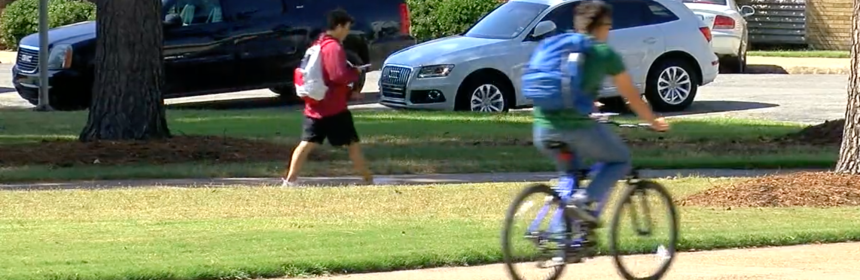
There are a growing number of cyclists in Jonesboro, but there are still no roads with designated bike lanes in the city and some cyclists feel there are not many safe places to ride. 
ASU TV’s Kirsten May looked into what is being done in Jonesboro to make it more bike-friendly.

JONESBORO, Ark. — “We need to wrap our heads as a community around the concept of a bicycle being part of our transportation mix.”

Bill Smith is the marketing and communications director for Arkansas State University and he is a cyclist.

Many people in Jonesboro are students or work in town who are now using a bicycle as their main form of transportation, and he said he thinks the city needs to focus on helping them ride safer.

“Certainly I think that we could see a greater commitment to bicycle infrastructure in our town, a greater commitment to a plan for how that will be moved around town, and not just in a parks and (recreation) mode,” Smith said. “I think that’s the future and I think that’s what millennials want.”

Jonesboro Parks and Recreation director Wixon Huffstetler said bike safety is a priority for the city and they are working to improve it.

“You know, the new trail obviously at Craighead Forrest that we are building that’ll connect eventually to the greenway that’s in town and we’re definitely looking at bike lanes on the outskirts of Jonesboro and on the bigger roads that we can fit them on,” he said.

Huffstetler understands cyclists want more done on the roads and said the city is looking at how to make that work.

“It’s just that Jonesboro is so grown together on the inside of the city, inner city, that it’s hard to figure out how to put bike lanes in without having to buy property or acquire ride away and stuff like that, which is a long process,” he said.

He said the city is constantly looking for grants to help improve infrastructure for bicyclists.

Both Huffstetler and Smith agree the best thing is for both riders and drivers to be aware of their surroundings and obey all traffic laws.

***

Smith said cyclists fare best when they act like drivers and are predictable.

Smith is teaching a vehicular riding course that teaches experienced cyclists how to be safer when riding in traffic. He said to message the Arkansas State University Facebook page or email him if you are interested in taking the class.

AState President Hosts Town Hall on Jonesboro Campus

AState President Chuck Welch

AState President Chuck Welch listens to concerns at a Town Hall meeting on the Jonesboro campus. He said he expects to have an interim chancellor in place within a few weeks. (Photo by Tucker Crain)

by Tucker Crain
Delta Digital News Service

JONESBORO, Ark. — Arkansas State University System President Chuck Welch addressed the Jonesboro campus in an open town hall following the resignation of chancellor, Tim Hudson.

“There is not going to be any formal presentation taking place, instead, I want us to have a conversation. This is going to be very laid back,” Welch said.

Over 50 people attended the Aug. 24 meeting, and questions ranged from the minutia of running the campus to transparency.

“ASU-Jonesboro lacks transparency. From the top to the bottom; this is nothing new. The recent audits have just exacerbated that. How do we let our shared governance come in and keep this from being the case?” asked Michael McDaniel, professor of communication disorders. “We, the faculty and staff – and even the students – have achieved a seat at the table. But having that seat does not seem to be the same as having a voice. We want to be heard. These shared governance committees do not work like this.”

Welch insisted things will improve.

“I have sat in on many of the shared governance meetings, and there are certainly very vocal people on every single one. If we need to go through extra steps to make sure everyone feels like their voice is being heard, then we will,” Welch said.

Welch then explained how such a shared governance committees could actually work out.

“We have an issue with clearly defining shared governance, its committees and how they are executed. When it seems like something is being done that not everyone at ASU-Jonesboro likes, you must remember that we make decisions that affect more than just the ASU-Jonesboro campus and its community,” Welch said.

While the crowd seemed satisfied by the answers on transparency, students in attendance brought concerns of their own.
Brett Dush, a junior at ASU-Jonesboro, went on a recent study-abroad trip to Spain.

“We were all given documents specifying the exact cost of everything and where all our money was going. But we looked into it. A lot of our money went to a travel agency and we had to pay for some of our meals out of pocket, which was not the original plan. I will email them to you,” Dush said.

“Please do,” Welch replied, “because I will provide transparency. I’ll show everyone the receipts I have that are under question. We are hiring a full-time study-abroad director. We will not carry out any trip that will not let students get the most possible from it. That is why we had to recently cancel the upcoming trip to France. And for that, I am truly sorry. But if we do these, we are going to do them right.”

History professor John Beineke, a distinguished professor of educational leadership and curriculum, questioned if Welch knew of the improprieties of the Hudson administration. Welch denied prior knowledge.

“I hear a lot of things. I hear a lot of things that just are not true. Was I aware the Dr. Hudson’s leadership style was different than mine? Yes. However, the word ‘bully’ never came up until after everything else came to light,” Welch said.

Paul Mixon, the interim dean of the College of Engineering, questioned when the Jonesboro campus would have new leadership. Welch suggested an interim chancellor would be selected in weeks rather than months.

“What we really need right now is a chancellor who can act as a healer,” Welch said. He continued by addressing concerns brought by audience members who thought the search committee might not have done the best job picking the last chancellor.

“I cannot predict the future, and hindsight is always 20/20. But the search committee will come up with numerous capable candidates,” Welch said.

Mary Jackson-Pitts, professor of communications, questioned if the search committees actually had input.

“On the last search committee I was on, we were not allowed to vote for who we really liked,” she said.

Welch noted that would not have been his instructions.

“I have never been on a committee where I said we could not vote. Instead, I say this: I want to protect both members of the committee and the candidates. But we do a heavy background check on all the candidates. I call people on and off the reference sheet. I talk to former students and coworkers. I bring all this information to the committee and we discuss,” he said.

Welch assured everyone the flagship campus still has the most consideration of any in the system.

“People question a lot of things we do by saying, ‘But won’t that hurt ASU-Jonesboro?’ The decisions we make at the central office always help the flagship campus the most. You can look and see that at the University of Arkansas, the University of North Texas, and other schools we compare our systems to,” he said.

Welch emphasized the openness he demonstrated in the town hall was something he was looking for in the next interim chancellor and, eventually, the long-term chancellor.

“I underestimated how little this sort of thing was taking place – this openness. I want the next chancellor to be a listener, have a calming influence, an external perspective and to help me stay honest with you all. Last time, I wanted someone who was aggressive, progressive and inventive. Well, we sure got that,” he said.

During the conversations, Welch did not forget to mention how much he loves his job and Jonesboro.

“This is my hometown. I was a first generation college student, and my dad did not even graduate from high school. This job is not just a paycheck for me – it is a chance for me to give opportunities to others that my parents did not have. It is my passion. We cannot undo some things that happened but we can heal. I may not be the brightest, but I can learn a few things,” he said.

Welch will also meet with the following campus governance committees next month:

  • Student Government Association—Sept. 13
  • Faculty Senate—Sept. 16
  • Staff Senate—Sept. 21

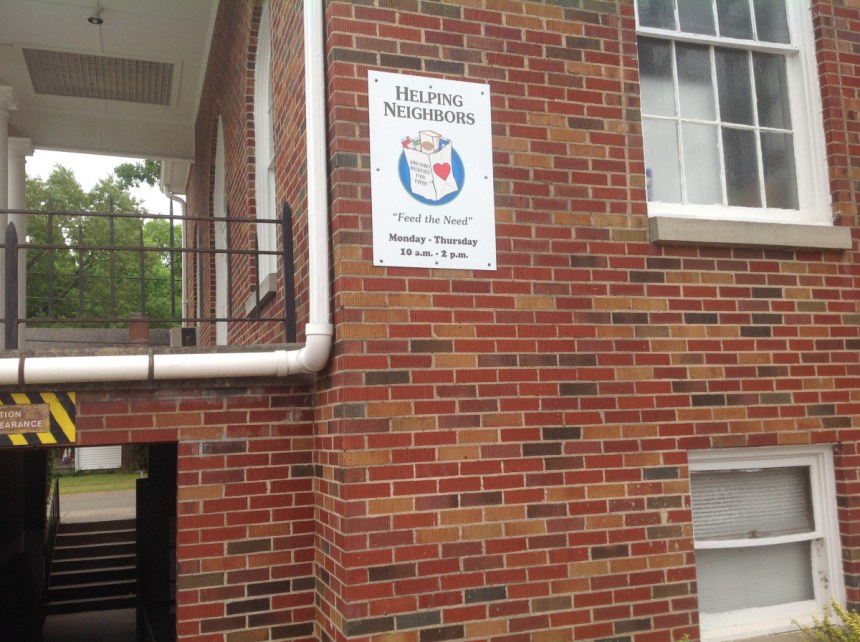
Phi Beta Lambda Helps The Helping Neighbors

Christopher Lee
Delta Digital News Service

JONESBORO, Ark.-  Every year, Arkansas State University’s Phi Beta Lambda chapter takes part in their annual Community Service Project, and for the last two years PB…

Source: Phi Beta Lambda Helps The Helping Neighbors

Recent Entries »