As childhood obesity rates rise in America, one school in the northeastern part of Arkansas actively works toward lowering the rates in their school.
Helping Hands provides to schools in need by helping financially disadvantaged students. A special committee formed in 2017 by Rector school district and Helping Hands addressed physical activity among students. Elementary principal Anthony Dowdy said Helping Hands contributes a lot to the school.
“Helping Hands is a tremendous help to our school. They give in a lot of ways, not only in volunteering their time, but they also provide extra funds when we need it,” Dowdy said.
The school’s teachers requested outdoor and indoor equipment for the students, including:
Basketballs
Hula Hoops
Kickballs
Skip-balls
Scooters
Basketballs
Balance Boards
Rector School District administrators knew about the high rates of obesity in Arkansas. While tackling the rates, they tried to keep the focus of the students in the classroom as well. Dyslexic Therapist Lynnette Trail said burning off energy helps the students focus.
“They’re getting up and using those large motor (skills) and developing those skills and that helps to burn off some of that energy so that when they go back to the classroom, they’re more focused,” Trail said.
For the younger grade levels, burning off energy before returning to the classroom helps the teachers, too. First grade teacher Sara Rabjohn said a break from the classroom helps.
“Once they get that brain break, you can pull them back in for a little bit longer rather than trying to do it all without a break,” Rabjohn said.
The school formed a Health and Wellness Committee to also help with obesity problems. The committee consists of a cafeteria supervisor, the elementary principal, school nurse and a few teachers.
The committee met to make plans throughout the year to address obesity and make sure the students get enough physical education, Dowdy said. Keeping the students active in the school helps see the plan through.
“We try to keep them active as much as we can. We have extracurricular activities and provide them opportunities to participate in physical education,” Dowdy said.
Schools addressing obesity in children helps redirect the outcomes for adulthood. Rector School District actively works toward keeping their students active and healthy.
JONESBORO – The changing of the seasons mess with everyone’s allergies; for furry friends, this is no exception.
Dogs and cats can be prone to allergies or sensitivities to proteins found in pet food. In Arkansas, the common allergies in the region affect pets as well. Archie Ryan, veterinarian at Southwest Drive Animal Clinic, said allergies for pets and humans can be different.
“Humans build up an immunity to some allergies over time. For dogs, they typically get worse every year,” Ryan said.
Certain breeds of dogs commonly associate with allergies, e.g.
Shih Tzu
Golden Retriever
Maltase
Labradors
“Allergies are a dysfunction in your immune system that affect all pets but allergies have a genetic component to them so you can inherit allergies from your breeding,” Ryan said.
Lauren Rhue, associate veterinarian at Jonesboro Family Pet Hospital, said keeping a regular visit for pets is key.
“We like to get them in here every four-to-six months to make sure everything is going OK,” Rhue said.
Pets can be allergic to any type of food. This can start as soon as six-to-eight weeks, Ryan said.
Some cases of skin disorders vary between different breeds. Genetics prove Labradors to be more prone to skin issues.
“My family had a Labrador. She was a dermatology train wreck, poor thing. She had allergies, ear infections, the works. We had to take her to a dermatology specialist and found out what she was allergic to,” Rhue said.
Veterinarians commonly speak about the commitment owning a pet takes.
“It’s a commitment. It’s a long-term commitment because they’re a puppy now but they’ll grow up and they’re going to live 10-15 years,” Rhue said.
April Morgan owns a Miniature Dachshund and works with animals. She says commitment to owning a pet should be taken seriously.
“People don’t take it seriously sometimes. They think, ‘Oh, I want a dog.’ Well it’s a big responsibility, it’s just like a child. I have three children and she is my fourth one,” Morgan said.
Pet owners can take some preventative measures to avoid allergies and food allergies.
– Use fresh food
– Store food in an air-tight container
– Never pour new food over old food
– Rinse your dog off with cool water after playing outside
– Do not bathe too frequently and dry out the pet’s coat
Keep in mind, one human year can be worth about seven to a dog’s life, Ryan said. Bringing in the family pet routinely can prevent serious health problems in the future for your pet.
Honey Bees in Arkansas from Miranda Reynolds on Vimeo.
***
by Miranda Reynolds
Delta Digital News Service
JONESBORO – Honey bees in Arkansas create endless benefits for agriculture and give economic opportunities for businesses.
The bee industry involves many different avenues for businesses to take advantage of:
Cultivating honey
Provide pollination services for farms
Raising bees to sell
Raising queen bees for people wanting to start their own beehives
David Coy with Coy’s Honey Farm grew up around honey bees from the age of 2.
“All of my life I’ve been around honey bees. A lot of people think of beekeeping as a hobby, but it’s a business for us,” Coy said.
Coy’s business revolves around family. His dad introduced him and his brother to beekeeping and they have created a business from it. The family owns 10,000 hives at their farm north of Jonesboro.
Providing pollination services allows the family business to assist farmers. They pollinate close to 1,000 acres of watermelons in portions of Northeast Arkansas.
The honey farm produces anywhere from 500,000 to 700,000 pounds of honey in Arkansas. However, the production of honey per hive continues to decrease and Coy sees the trend continuing.
The loss of bee habitat in the Delta region impacts the honey bees. Farm chemicals spreading to areas of wildlife impact the honey bees. Coy says only one type of crop in a single area also impacts bees.
“Bees need a variety of plants to gather nectar and pollen from to maintain their health,” Coy said.
Kim Pittcock, associate professor of horticulture at Arkansas State University, said there must be a preservation of bees.
“We need to preserve the diversity that we’ve got in all of the plants that we have to help the bees. It’s a mutual hand-in-hand relationship with it. We need to maintain part of their habitat to use them to continue to help us work and to continue their populations,” she said.
Pittcock noted certain crops must have pollinators to remain yielding.
“Some crops could not be pollinated at all without some insect of some sort, and bees are the biggest and most natural pollinator due to the structure and the type pollen that needs to be transported,” she said.
The Coy’s business tries to adjust to supply and demand. In California, the almond industry drives the beekeeping industry on a commercial level. Coy’s Honey Farm sends bees to California in February to provide pollination services for almond orchards.
“We try to have income from several different areas that the bees can give us income from so that we’re not totally reliant on bee production,” Coy said.
With the changing of the bees’ environment, Coy hopes to remain in the beekeeping industry for many years to come.
“I hope to continue to be a beekeeper. I hope to maintain the opportunity for my children, too, if that’s what they want to do,” he said.
A honey bee pollinates plants that makeup of one-third of humanity’s everyday diet. The reality is, without bees, humans will not have food.
JONESBORO – In a life-threatening situation where seconds matter, Craighead County’s dispatch service uses advances in technology to find someone’s location and provide them help.
Cellphones allow people across the nation to quickly access information at a touch of a button. In an emergency, it provides a lifeline to help. E911 Director Jeff Presley said GPS technology is vital for first responders in the line of duty.
“With smartphones that we’re using today, they’ve actually got GPS readers built into that phone. So when you activate a call for service or a 911 call, it automatically tracks that cellphone,” Presley said.
Dispatchers in Craighead County work around the clock, seven days a week. Mellenee Bennett actively works in emergency services and began her career in 2001. The public’s access to cellphones sometimes overflows the dispatchers.
“The thing is, if you’re going to take the time to call, give us pertinent information because our phone will just be ringing off the hook with everybody that has a cellphone,” Bennett said.
Last month, 90 percent of 911 calls came in from cellphones, Presley said. Sprint store sales associate Zach Vickers said the E911-texting option gives people another way to contact 911, but with a cost.
“It wasn’t just an inconvenience on consumers. I know it did raise cellphone bills up a small margin. But in doing so, it enabled consumers to be able to make emergency phone calls,” Vickers said.
Downloading emergency cellphone apps onto phones allow for third parties to be involved, not putting you directly with emergency services.
“I would be really weary of any third-party apps or anything that does not connect directly to your local 911 center because it could delay services getting to you,” Presley said.
The dispatchers in Craighead County rely on training and experience and are ready to take emergency calls, Bennett said.
“We’ve got probably 60-to-70 years of experience in here. So if I don’t know where they’re at, somebody’s going to know,” Bennett said.
When an emergency arises, remain calm and pay attention to surroundings, Bennett said. By listing personal information on smart911.com, first responders can use that to help police, fire and EMS in an emergency.
BROOKLAND, Ark. – With the progression of modern technology and increasing use of electricity, Craighead Electric Cooperative spread its initiatives in solar panels to help power part of Craighead County.
The ongoing project located off Highway 230 involves a total of 3,888 panels. From these panels, the power will supply 135 homes with electricity. The area chosen by Craighead Electric Cooperative did not happen by chance. Craighead Electric Cooperative predominately supplies Brookland’s electricity and met the criteria for the placement. Jon Carmack, communications coordinator with Craighead Electric Cooperative, gives the company’s outlook on the project.
“The goal is to provide a cheaper source of electricity for our members and to kind of get into this idea of community solar,” Carmack said.
In the near future, the company plans on leasing or renting solar panels out to specific homes in the area. This will allow for that panel’s electricity generated to go directly to the home owner’s electricity bill. A unique aspect of rented or leased solar panels resides in the maintenance and upkeep of the equipment. Craighead Electric will be solely responsible for the panels, meaning residents can rest assured with the rental.
For those interested in at-home panels, the company also has net metering to be installed on the side a house. This meter measures electricity used and the solar electricity a household is using in excess. Some homes in Craighead County run entirely from solar panels, Carmack said.
Steven Evans owns VanGuard Mechanical in Jonesboro, a company that installs solar panels for at-home use. An issue for solar panels revolves around supply and demand. Evans sees potential in the solar panels, but there must be demand from the public for it to become what he works on regularly.
“If enough people get behind and push this, yes, I see it’s coming and I know we have to make the change,” Evans said.
Tommy Sims, a 40-year resident of Brookland, said he appreciates Craighead Electric Cooperative’s efforts to reduce the town’s electricity use.
“I think it could be good for it if it works. They’ve got to do something to keep up with all of the technology nowadays. This world is so high-tech, they have to move forward,” Sims said.
JONESBORO – A changing of the guard will soon occur at KASU, Jonesboro’s public radio station as its current station manager retires after 32 years of service and a decade of leadership.
KASU staff members reflected on their time with Station Manager Michael Doyle positivity. Mark Smith, development director, said Doyle served as his mentor for many years. He said he hopes the community joins him in celebrating Doyle and his work throughout the region.
“He has been a good leader for KASU and his natural charm has endeared him to so many in his public appearances for the station throughout the region,” Smith said.
Michael Doyle (left) shares a laugh with KASU Morning Edition host Brandon Tabor. Doyle recently announced his retirement as KASU station manager. Photo by Kimberely Blackburn
Reflecting back on Doyle’s leadership in community involvement, June Taylor, KASU’s broadcast production specialist, said he understood the importance of connecting with the community. Doyle served the community in taking up the banner of both entertaining and educating the Jonesboro community. Concerts showcasing local acts include “Bluegrass Monday” in Paragould, “Bluesday Tuesday” in Newport and the Johnny Cash Heritage Festival in Dyess.
Helping local acts perform at the Johnny Cash Heritage Festival proved to be a source of pride for the station. Doyle said these acts performed on the concrete slab where the old commissary stood in Dyess. Cash’s childhood home — recently restored by Arkansas State University’s Heritage Sites — served as the backdrop during the concert.
Although local acts did not perform with headliners Rosanne Cash and Kris Kristofferson, Doyle said performing on that stage served as a source of inspiration and pride for these artists. Helping Arkansans find a sense of pride in the state proved to be important to Doyle. When Arkansas native Glen Campbell died, a social media post composed by Doyle noted while others portray Arkansans as ignorant hillbillies, the state’s rich musical heritage should be a source of pride.
Hear Doyle’s entire social media post and his thoughts on Arkansas music
Arkansas Roots
Doyle first considered a classical music program to fill the noon hour. But after brainstorming with KASU staff members, “Arkansas Roots” debuted. Program director Marty Scarbrough said Doyle shares his own personal knowledge of Arkansas musicians, resulting in the program greatly benefitting its listeners. He said those who tune into the program learn of pioneers who inspired not only Arkansans but many others.
“Without people like them, we wouldn’t have people like Bonnie Raitt or Sheryl Crow,” Scarbrough said. “There wouldn’t be a James Brown or a Ray Charles without people like Rosetta Tharpe or Louis Jordan.”
Not only does the show broadcast the state’s extensive musical history, it also plays current acts who make music for the love of making music. Taylor said the program quickly resonated with KASU’s listeners. Because the program focuses on the roots of Arkansas, people discover upcoming musical events and learn about their community. That, she said, fulfills the purpose of public radio.
Legacy
Doyle said he hopes he leaves KASU better because of his influence. He said 10 years ago, the station gave him an opportunity to do something other than teach four classes a day. This opportunity gave him a chance to make a difference.
KASU staff members said that change will be felt. Since Doyle established such a clear vision for KASU leadership, Scarbrough said he doesn’t foresee any large changes. Taylor agreed and said his leadership kept staff on the right track, continuing on to the goal. Smith said he plans to hold Doyle to his promise of continuing on working at the station as a volunteer.
Doyle told a story of a man he met while doing doctorate work at the University of Tennessee in Knoxville. After deciding to do something different for lunch one day, Doyle said he stopped in at the Wesleyan Center, a Methodist center for UTK students on campus. He said he found himself drawn to a man wearing a white shirt and tie and engaged him in conversation. After some time, Doyle learned the man served as the director of the center. Before the man’s tenure, very few students attended and the center appeared desolate and run-down.
The man worked to build the center up, performing repairs and engaging students in hopes they would visit. In doing so, the man’s doctorate work — the reason he first came to campus — fell by the wayside. Looking around, the man proclaimed the center became his doctorate. Doyle said he feels similarly about his work at KASU.
“I feel like I’ve left it better than I’ve found it,” he said. “So, this is my doctorate. I’ve never finished it, but I’m glad to have done something worthwhile. And I think this is it and I’m very appreciative of that.”
Kimberely Blackburn interviews Michael Doyle on NEA Expose’
JONESBORO – DICE and Electronic Arts recently updated its newest entry in the fan-favorite “Star Wars” franchise.
“Star Wars Battlefront 2” marks a rather controversial entry in the long-running first and third-person shooter franchise. Players fight in single-player and multiplayer, whether on the ground or in space in some of the best battles from the “Star Wars” films.
With an underwhelming predecessor and negative press connected to it, the game started off shaky. Over the months leading up to the game’s release, critics and fans alike flamed the game for the potential “pay to win” elements found in the game during the open multiplayer beta back in October.
The game went through many changes since then, with the game developers addressing many of the problems. This comprehensive review of the single-player and multiplayer campaigns determines whether the game lives up to its ancestors.
Single-Player Campaign
The “Battlefront” franchise provides an interesting history with single-player campaigns. The first “Star Wars Battlefront” in 2004 did not have a cohesive campaign.
The sequel, 2005’s “Star Wars Battlefront 2,” offered a great, dedicated campaign following the exploits of a clone trooper in various battles from the films.
The single-player campaign for 2017’s “Star Wars Battlefront 2” bears similarity to the 2005 “Star Wars Battlefront 2.” Players control a soldier taking part in important battles between “Star Wars Episode VI: Return of the Jedi” and “Star Wars Episode VII: The Force Awakens.”
The story revolves around Iden Versio, an Imperial special forces commander, as she leads her unit, the “Inferno Squad.” The campaign follows her exploits after the destruction of the second Death Star, during the Emperor’s mysterious “Operation Cinder.”
The “Star Wars Battlefront” of 2015 lacked a single-player campaign, earning points in the sequel’s favor. The campaign pleasantly surprised me with high quality, but some flaws stuck out.
The Good
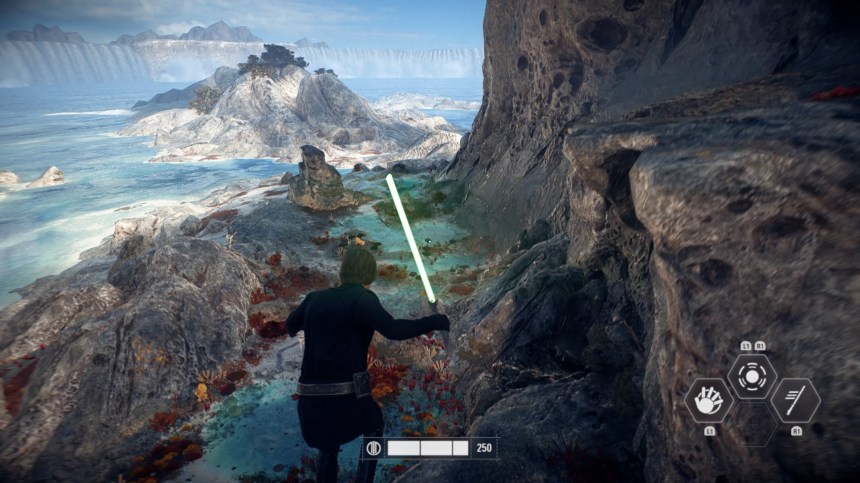
The creators designed one of the most beautiful games I ever played. From the characters to the environment, everything looks amazing and creates the feeling of actually being in a “Star Wars” film. The visuals, combined with the excellent sound design, create a truly immersive experience.
Luke Skywalker leaps into combat on a mysterious Imperial outpost. Photo by Christopher Lee
Along with Iden, players have the opportunity to play as and alongside famous “Star Wars” characters.
To avoid spoilers, this review will not go into much detail about the campaign’s story, instead focusing on the impressive campaign features.
As players travel through the campaign, they will see moments pulled straight from the “Star Wars” universe, both from films and other media like Marvel’s “Star Wars: Shattered Empire” comic series. These moments come to life from the perspective of Iden as she fights her way through memorable battles.
This brings me to one of the most impressive visual elements: character designs.
Many of the characters in this game look just like their real-world actors and actresses. Iden, portrayed by Janina Gavankar, provides one of the best examples. The motion-capture work and facial animations made her performance come to life.
Overall, the solid performances and great character chemistry round out the single-player. Misty Lee, one of my favorites, does a wonderful job filling in for the late Carrie Fisher as Princess Leia.
Great story and characters, however, do not make a game. Gameplay remains the most important part of a game, and “Star Wars Battlefront 2” does not disappoint.
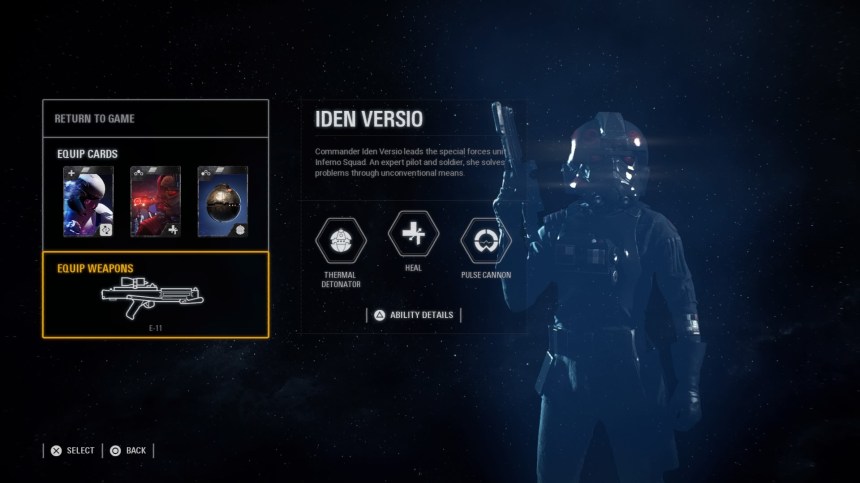
A small number of Iden’s many abilities. Photo by Christopher Lee
Iden utilizes several abilities available to her as she fights her way through the smooth and fast-paced combat.
DICE uses the single-player as an opportunity to introduce players to all the sides of combat they will face in the multiplayer game option.
The single-player section involves ground and space combat connected with vehicle sections and action. All this comes together to make the gameplay both fun and cinematic.
Very few game developers can make the gameplay feel like a movie like DICE can. Players really feel the seamless gameplay as they sprint, shoot and roll to victory.
I enjoyed the single-player campaign more than I thought I would. From the characters to the settings, it all came together to form a well-structured narrative. Unfortunately, the campaign possesses noticeable, unavoidable faults.
The Bad
Almost every bad thing about the campaign comes from its length. While I enjoyed every moment of the campaign, I must mention its disappointing length.
Clocking in anywhere from four-to-six hours (depending on the difficulty setting), the campaign comes across as too short. This short length brings one of the biggest problems of the campaign to the forefront: the pacing.
This game goes way too fast. The game seems to move at breakneck speed from one location to another, and this only hurts the story overall.
Important decisions, clashing loyalties and huge game-changing events seem to fly by. Spending more time developing the characters and their motivations would have been better.
Single-player Conclusion
DICE did a fantastic job with the campaign. Even with a short length and overly-fast pace, The story’s pros outweigh the cons. The way DICE integrated Iden’s story into the established “Star Wars” canon makes it a “Star Wars” experience.
The following video showcases “Star Wars Battlefront 2” at its finest. Watch Iden fend off the rebel attack on Fondor Station.
Multiplayer
The Good
Most of the good about the multiplayer gameplay comes across as “second verse same as the first.” The fluid, fast-paced combat shines in the multiplayer, rewarding skilled players without punishing newer players.
The multiplayer shines in the maps and the game modes, an area where its 2015 predecessor failed. It appears DICE listened to the complaints.
The game came out with 11 maps and five game modes. DICE planned to add more maps later through free downloadable content and updates – a major step forward after the rather disappointing 2015 release.
The addition of free content proved to be a step in the right direction, but it resulted in one the worst criticisms towards the multiplayer.
Overall, I found myself being fully immersed in the beautiful maps as I fought in some of the most iconic locations in the films. The maps and modes vary in terms of gameplay and should keep a player invested for many hours.
This review quickly lists and describes the different game modes. It also includes gameplay for the two largest game modes: galactic assault and starfighter assault.
Galactic Assault
The bread and butter of “Star Wars Battlefront 2,” — galactic assault — offers large-scale 40-player combat. The player fights across well-known battlefields piloting different vehicles and fighting as iconic heroes or villains. Focusing on multiple-objective gameplay, this game mode allows players to truly utilize all the game offers.
See an example of galactic assault gameplay. Watch the defense and attacking phase of the planet Jakku from “Star Wars Episode VII: The Force Awakens.”
Starfighter Assault
Similar to galactic assault, players accomplish multiple objectives while piloting powerful and iconic vehicles like X-Wings and TIE Fighters.
Watch the video below to see just what Starfighter Assault offers.
Heroes vs. Villains
Finally, players can find out who would win in a fight between Yoda and Darth Vader. The game mode proved to be pretty self-explanatory.
Hero Showdown
A small-scale take on the established heroes-versus-villains format. Find a friend and fight the forces of good or evil in two-vs-two combat. P.S. Don’t split up.
Strike
This mode boils down to a smaller-scale galactic assault match. Its fast-paced combat usually revolves around capturing an objective and getting it to a location for extraction.
Blast
Standard team deathmatch: score 100 eliminations before the enemy team to win.
Ewok Hunt
They may be fuzzy but they prove to be ruthless. Join a group of stormtroopers as they try and survive, or hunt them down as one of the cute little murderers. This mode will only be available for a limited time.The multiple maps and game modes come together to form a fun, exciting experience. This may be the most fun I experienced with a shooter in some time. But, even the best experiences have flaws.
The Bad
One of the biggest problems with the game tends to be balancing. While the game designers mostly balanced the weapons and vehicles, the maps provided the main problem.
More than a few maps seem to lean heavily to one side or the other. Winning on these maps can feel far more difficult than needed. Of course, this can vary greatly depending on the map, enemy team skill level and team composition.
Consistent updates alleviate annoying balancing problems, but “Star Wars Battlefront 2” lacked in new content.
Updates to “Battlefront 2” felt slow with many content updates being separated by months of waiting. Long wait times are ok if the final product lives up to it, but updates tend to fall flat.
The first large-scale update coincided with the release of “Star Wars Episode VIII: The Last Jedi.” Since then the majority of the patches have focused on balancing heroes, rebuilding the progression system and quality of life changes. All necessary and appreciated, but content felt lacking since December. Though it appears the waiting might be over.
As of the writing of this review, the two most recent updates from April and May have included the addition of a new temporary game mode, Ewok Hunt, and a new content update to coincide with “Solo: A Star Wars Story.”
With the inclusion of new monetization options after the removal of loot boxes maybe updates like these will become the norm. That brings me to the most important part of the review.
The Ugly, or What Used to Be
The character progression system brings the biggest problem. This sentence meant something entirely different with the game’s original release. Now it summarizes many the problems “Battlefront 2” currently face.
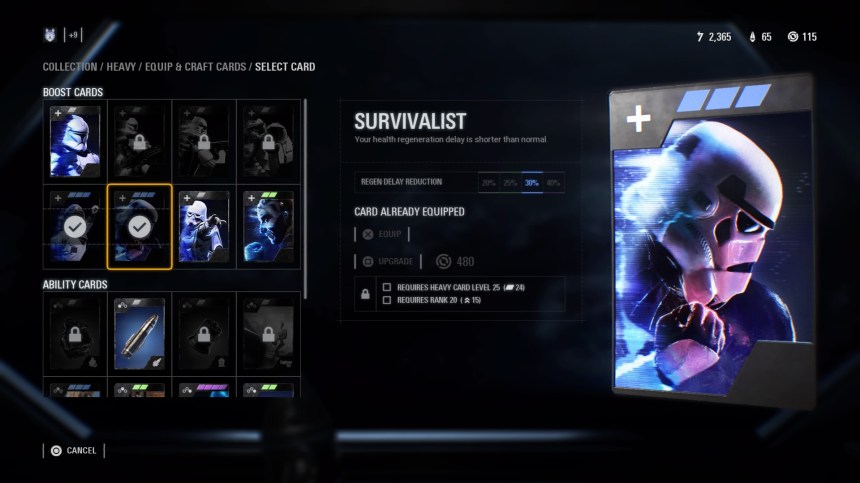
Originally, players could equip upgrades to their favorite classes, vehicles and heroes to fit their favorite play style. These upgrades, called “star cards,” could offer anything from a few seconds off an ability timer to completely changing how the character plays. While still true today, game creators changed how players unlock these upgrades.
Example of the old progression system. Photo by Christopher Lee
The Controversy
Players unlocked star cards in one of two ways, but both ways relied on the same system.
Players earned three forms of in-game currency: credits, crystals and crafting parts. All of it revolved around the “supply crate” system.
Supply crates describe items earned in the game that gave players random in-game items. These items included emotes, victory poses, star cards and crafting parts. The last two being of most importance.
Players could earn star cards from supply crates. Each crate gave the player the possibility of earning any star card up to a certain rarity. The real problem came from how players acquire supply crates.
Players earned credits just by playing the game. Credits purchased supply crates, which carried star cards and crafting parts. Crafting parts could craft and upgrade star cards, and the best star cards could only be gained through crafting.
While confusing to newer players, it also came with another, bigger problem.
When the game first released Nov. 17, players could purchase supply crates using real-world money. This created backlash from the fans.
Fans called this a “pay-to-win” system, where players could spend real-world money for in-game advantages. DICE answered by removing the option to purchase “supply crates” with money.
After several months DICE changed the progression system entirely to focus more on linear progression. Now players earn experience points to level up their account and classes unlocking new star cards in the process.
As players level up classes they earn skill points which are spent leveling up star cards. This new system stream-lined the progression and rewarded players for playing their favorite classes.
This change brought new life into the game and turned the ugliest mechanic into the simplest.
Multiplayer Conclusion
Despite its flaws, this game provides one of the best shooters I have played in a while. The fun and immersive game play makes me feel like my skill matters during fights, as my many deaths playing as a sniper showed me.
Overall, the multiplayer left a positive impression. I think DICE fixed many of the games biggest problems and could easily fix the rest.
The legacy the unrewarding progression system left behind leaves me more emotionally conflicted than Luke Skywalker after Darth Vader said, “Luke, I am your father.” On the one hand, DICE and EA acknowledged their mistakes and took action to change them, but on the other hand, they tried implementing a clear pay-to-win system in the first place.
Newer players should enjoy the multiplayer just fine, but I wonder how many of the original playerbase like myself left because of how bad it used to be.
Final Thoughts
My time with “Star Wars Battlefront 2” proved to be pleasant and immersive. Short-but-fun single-player combined with fast-paced multiplayer creates a delightful experience.
The game shows several good ideas, but, even with the potential of the progression system, things still need some ironing out.
With the recent changes to the game and the new reduced price, I don’t see any reason to not pick it up.
Even with all of its problems, I still consider it to be one of the best “Star Wars” games I’ve ever played. I just hope DICE and Electronic Arts learned from its mistakes.
JONESBORO — New interests in school safety have emerged with the mass shooting at Parkland, Florida, and the Westside Shooting’s 20th anniversary fresh on everyone’s mind.
In light of the Parkland shooting, President Donald Trump advocated for arming teachers in the hopes of preventing more mass shootings in a tweet.
Armed Educators (and trusted people who work within a school) love our students and will protect them. Very smart people. Must be firearms adept & have annual training. Should get yearly bonus. Shootings will not happen again – a big & very inexpensive deterrent. Up to States.
The debate of having firearms on campus is not isolated to public schools; it provides a point of contention for colleges and universities as well.
According to the National Conference of State Legislatures, 10 states including Arkansas currently have provisions allowing concealed carry on postsecondary campuses. Provided a person has passed the required courses — including the standard concealed-carry courses and the specialty enhanced-carry courses — gun owners may legally carry their weapon on college grounds.
Dr. Michael McDaniel, A-State Faculty Senate chair (photo by Christopher Lee)
Arkansas State University Faculty Senate chair Michael McDaniel explained how A-State’s Faculty Senate reacted to the new law.
“It’s hard to speak for the entire faculty. About the only thing I feel comfortable saying is that I believe that the faculty were reasonably comfortable with the situation we had prior to this new law,” McDaniel said.
Prior to House Bill 1249, now Act 562, colleges could opt out of allowing concealed carry on their premises, but with the passing of Act 562 this is no longer an option.
“With the new law we lost that option, so now we can’t opt out. It is the rule and it is the law,” McDaniel continued.
Bill Smith, A-State’s associate vice chancellor for marketing and communications, echoed the idea in a short but strong statement.
“The law is the law and we can’t change that,” Smith said.
Even though the law has officially gone in effect, understanding faculty and student opinions about the new conceal carry law is important for gaining insight into how the law and its implementation are perceived.
Some faculty members like associate professor of political science Richard Wang said they feel they were ignored.
“As you know, the university said, ‘No, we’ll opt not to have concealed carry on our campus.’ Joining with A-State are all the other universities in this state, plus junior colleges, plus the campus police forces, plus the local police, the county police and county sheriff offices all around the state, joining … It’s a coalition, and they all said, ‘No, we want to keep the local option, the option here,” Wang said.
Wang has taught at Arkansas State University for 31 years. He said he was surprised to hear the law passed. You can hear more of Wang’s opinions about the concealed carry law by watching the video below:
Dr. Brandon Kemp, interim Dean of associate engineering programs (photo by Christopher Lee)
Brandon Kemp, A-State’s interim associate dean of engineering programs, echoed this sentiment when he heard the new concealed carry law had gone into effect.
“My first opinion was that it was ridiculous. As a faculty we have voiced our opinions over and over again that we don’t want guns on campus,” Kemp said.
A Jonesboro native who has worked at Arkansas State University for over seven years, Kemp said allowing guns on campus added unnecessary risk to the campus. He said it also adds confusion to first responders during an active-shooter threat.
“If we have an active-shooter situation and we have people on campus — whether it be faculty or students — who are pulling out their firearms to combat the situation, then the first responders — the police and SWAT — now they have a much more difficult situation,” Kemp said.
Dr. Erik Gilbert, professor of history (photo courtesy of Arkansas State)
While concerns about increased gun violence with more guns on campus is rational, Erik Gilbert, professor of history at A-State, has already written two articles about the topic of concealed carry on college campuses.
Gilbert cited his articles as his opinion of the new concealed carry law.
In the article, Gilbert encouraged faculty to relax about the idea of guns being on campus.
I can almost guarantee that if you have a few semesters of teaching under your belt, at some point there have been students with guns in your classroom. If those illegally armed students were not moved to violence by the content of your course or the statements of their fellow students, it seems highly improbable that a new group of legally armed students will prove to be more volatile or violence-prone than their scofflaw peers.
Gilbert ended the article by stating, “Don’t worry about the presence of legally carried guns in your classrooms. If you are going to worry, worry about someone illegally bringing a gun on campus with the intention of causing mayhem, not someone who legally carries a gun in the hope of protecting himself from harm.”
In his second article, “Campus Carry Is Not About Preventing Mass Shootings,” Gilbert argued the choice to allow concealed carry on campus is less about the ability to stop mass shootings and more about letting individuals choose how they wish to defend themselves.
Gilbert wrote, “If you happen to be locked down in a classroom during a mass shooting, wouldn’t you rather be able to shoot back if the shooter comes through the door? If you would rather resort to throwing coffee cups or iPads, as some campus police might advise, that’s a valid choice and I would not try to dissuade you.”
The article, published by Inside Higher Ed in 2017, cites many sources to show how concealed carry has affected mass shootings in states where it is allowed, and how concealed carry benefits students.
College Republicans Rep. Chandler Jones (photo by Christopher Lee)
Members of both the College Republicans of A-State and the Young Democrats discussed their opinions on the topic of concealed carry on campus.
“I’m thankful for the state of Arkansas legislature to pass this because it shows that they think of us as humans, they think of us so that we’re allowed to protect ourselves,” College Republicans Rep. Chandler Jones, a pre-professional biology major, said. “I’m thankful and I do think it will be more of a preventative measure; someone who is mentally ill would know that they’re also going to be met with force.”
Jones said he sees the new law as an opportunity, ensuring students have the right to defend themselves if necessary during a mass shooting. You can listen to more of his points below.
Dominique Phillips and Anthony Sumlin of A-State’s Young Democrats discussed the organization’s opinion of the law.
Young Democrats Rep. Dominique Phillips (photo by Christopher Lee)
Phillips also serves as president of student diversity and recruitment.
“I feel like I speak not only for myself but for my party when I say that I feel like the new laws might cause a bit of a problem,” she said. “In general, you can’t fight violence with violence, you can’t fight fire with fire. You’re allowing guns to be on campus now, even going throughout the so many courses that you have. That doesn’t change when a person has a mental breakdown or a mental issue.
“As far as someone acting as a guardian, it’s a little tricky because I see that and I can see the positive side of how they will be able to fight back,” Phillips said. “But at the same time, is it guaranteed that someone will be able to muster up enough courage to go out and shoot someone back?”
While the College Republicans and Young Democrats sit on opposite sides of the concealed carry on campus debate, both parties agreed mental health reform is necessary to prevent mass shootings like Westside and Parkland.
“I feel that not only in public schools — in high schools and elementary, middle schools — but also in colleges there needs to be a more open discussion about mental health awareness,” Phillips said.
A-State’s Young Democrats Anthony Sumlin, a biology and chemistry major, echoed Phillips’ opinion.
“I think the response should not be, ‘Oh well, let’s give more people guns to hide on themselves.’ Personally I feel like we should do more with educating teachers on how to spot mental health issues and really getting rid of that stigma that mental health is something to be ashamed of,” Sumlin said.
You can listen to more of Sumlin’s statements below.
Jones also said he believes mental health reform provides the key to stopping mass shootings.
“Restricting buying guns now really isn’t going to slow down someone who wants to get a weapon from getting it cause they’re on the streets, they’re sold illegally. So I think it needs to be more mental health,” he said. “Screening these people, getting more help for these people, more … maybe facilities. More money distributed there, I think that’s what needs to be our first step.”
The new conceal carry law has clearly struck a nerve with faculty and students alike, but it is unclear how it will affect the educational climate of colleges and universities. Even with the division the new law has caused, what is clear is the law will continue to create debates about campus safety.
JONESBORO – Twenty years have passed since the shooting that changed the lives of so many in Northeast Arkansas.
On March 24, 1988, two middle school students shot and killed four classmates and one teacher. It still haunts the people of Jonesboro. Westside Superintendent Scott Gaunt said the threat of violence serves as a worry for superintendents everywhere.
“Any superintendent will tell you that’s a nightmare that all of us have. Bad people have bad intentions; they’re going to do bad things,” Gaunt said. You know, we can only hope that we can put protocols in place that can stop it.”
One thing that can be taken from tragedies like Westside’s involves how law enforcement handles active-shooter situations. Sgt. Lyle Waterworth, Jonesboro Police Department’s community outreach and recruiting coordinator, said 20 years ago police officials waited for special forces, a policy that changed after the Columbine school shooting. The Columbine shooting happened a year after the Westside shooting, and also involved two minors shooting and killing their classmates and one teacher.
In the last 20 years, officials placed active-threat procedures in place in schools all over the nation. Many schools put in place precautions like student resource officers and civilian response courses.
“It’s important for people to know that they can defend themselves,” Waterworth said.
Whether it’s a course like the one taught to incoming freshman at Arkansas State University or the training Jonesboro Police go through with local schools, current training procedures include the same basic concepts.
“Different programs use different names, but they all kind of break down to this: run, hide or fight,” said Bill Smith, A-State’s associate vice chancellor for marketing and communications.
Something Smith said improved over last 20 years include the willingness to create training programs and talk openly about what people need to do in active-shooter situations.
“I think one of the things that over time we’ve seen as a change in the response to active threats is more of a response toward the aggression,” Smith said.
The anniversary of the Westside shooting arrives with painful memories for Jonesboro residents, but it also brings with it valuable lessons and advances in procedures to prevent active threats in the future.
JONESBORO – Many Northeast Arkansans feel the influence of two educators long after they retired.
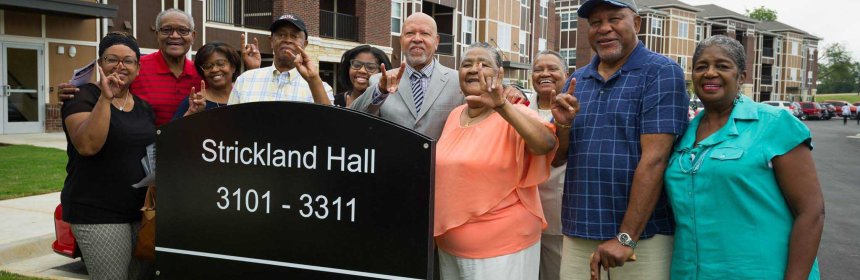
Herman and Maxine Strickland display “The Circle.” A-State dedicated apartment buildings to its first four black facility members, known as “The Circle.” Photo by Kimberely Blackburn
Herman Strickland Sr. taught elementary school in Blytheville and moved up to principal. He considered teaching at Arkansas State University to allow his wife to return to school.
The university made the decision easier with a simple addition to the offer: a house. Until then, the Stricklands lived in an apartment. The house and the low tuition for his wife helped prompt the move.
As A-State’s second black faculty member, Strickland said his family did not face many racial issues. History professor C. Calvin Smith faced difficulties when he came the year before. But Strickland said he believed the university worked out all the issues before he arrived. Showing his love of sports, he compared his and Smith’s journeys to those of baseball players.
“Jackie Robinson had all the problems, but they worked them out before (Roy) Campanella and Don Newcombe came,” Strickland said. “It was sort of that way before me, I think.”
Maxcine Strickland planned to study social work, but said the university did not offer that discipline at the time. She said she believed divine intervention caused her to choose elementary education. The decision, she said, remains one of the best she made in her life.
Herman served A-State as associate professor of teacher education and dean of University College. He said he never thought he would stay in higher education. After Maxcine earned her degree, they planned to return to Blytheville. He said he thought he would return to primary education.
But his students made him change his mind. Herman fell in love with higher education and decided to stay. He worked to mentor students, both in the department and in his fraternity, Alpha Phi Alpha.
Their Impact
Rickey Greer, principal of Jonesboro’s Math & Science Magnet School,said Herman and Maxcine greatly impacted his life. He still strives to pattern his life after them.
Greer learned professionalism from Herman. Greer said Herman always looks at everyone as if they had potential. Greer said Herman’s positivity struck him as well. Although Greer knew the Stricklands faced obstacles due to their race, Herman did not dwell on them.
Greer said he does not know many men like Herman.
Maxcine taught first grade in Jonesboro. Retiring after 26 years, she said her “children” still visit, bringing “grandchildren” along.
In her first year of teaching, Maxcine said she thought every child would pass — she would make sure if it. Maxcine said a wise mentor told her she could not make them learn. Instead, she could provide the information to the children and encourage them.
Although most turned out fine, the students who struggled broke her heart. She said she still wonders what she could have done differently.
Greer worked as a student teacher under Maxcine. He said her dedication to her job and her children greatly affected him.
“She felt like or treated every kid as if they were queens and kings, or they were the best, or they were (gifted and talented) kids,” Greer said. “No matter what level they were on, she treated them that way.”
Maxcine tried to treat every child the same. She set a high bar and encouraged each child to reach it. She told them to never underestimate their abilities. She said if she expected it, they did it.
The Circle
Although the Stricklands moved four houses down from the Smiths in the neighborhood now known as “The Circle,” both families left Jonesboro every weekend. They started going to each other’s homes with the university’s hire of Wilbert Gaines, emeritus associate professor of physical education. The Circle became a family following the arrival of Mossie Richmond, who became A-State interim president, vice president for student affairs and dean of University College.
Maxcine said she never expected what came from The Circle. She said they came to Jonesboro to do a job, but instead, gained nephews, nieces and friends they will love until the day they die.
Herman said he never thought A-State would dedicate buildings to them. The thought overwhelms him. He said he hopes it inspires black students to know if they work hard and find mentors, they can do anything.
Greer said he wished his students could understand how the Stricklands affected their lives. He said he hopes his students spread the positive impact forward.
Herman said he still looks ahead.
“I hope in the future it won’t make any difference about race. I’ll see you as a sister and you’ll tell me about your parent. I’ll feel your parent did a really great job with you and I’ll know you want to leave a legacy for your parent,” he said. “My parent did a great job with me, didn’t have many means, and I want to be a legacy for them.”
(Featured photo courtesy of A-State Media Relations)
CODC’s executive board attended the Arkansas Prescription Drug Abuse Prevention Summit in Hot Springs. CODC received a $175,000 Drug-Free Communities grant to apply to its goals. Efforts to receive the grant started five years ago.
“I started out as a community volunteer and was contacted by the board because they had heard that I was running another youth state program,” President Noelle Richardson said. “Last spring we wrote for the DFC grant through Substance Abuse and Mental Health Services Administration and we found out in the last week of September that we were awarded the grant.”
The DFC grant will provide CODC with full-time and part-time staff. The grant assists communities in connecting with 12 different sectors, from government to education.
Meeting the Community
Noelle’s husband and CODC chair Kevin Richardson thanked attendees of the November meeting at the NEA Food Bank for their support.
“Even though you haven’t heard a lot from us, a lot has been going on,” he said.
CODC challenged Craighead County fourth-graders to create drug-free posters. The top contestants attended the meeting and displayed their posters; Cason Kifer of Buffalo Island Central West Elementary won the competition. His poster can be seen on billboards throughout the city.
The Prevention Squad held its Christmas party at Lost Pizza Co. (back row, l. to r.) Melissa Ayers, Noelle Richardson, Zavier Roberts, Mia Goodrich, Lauren Lewis; (front row, l. to r.) Jackie Sosa, Rylie Fanning, Abigail Pausch. Photo by Kevin Richardson.
The Prevention Squad, made up of six high school students from the area, gave a rundown of the events held within the last year. The Prevention Squad hosted a Back 2 School Bash and the “Leave Your Mark” rally in October. It also participated in the Mud Ball Tournament, which benefits the St. Bernards’ NICU.
The CODC’s chapters curently include the Bay, Brookland, Buffalo Island Central, Nettleton, Riverside, Valley View and Westside school districts. Seventeen school chapters exist across Craighead County alone, as well as more than 250 students who attended a five-hour leadership training course put on by CODC. Noelle Richardson said she believes they will have a chapter in every school within the next year.
“People should be on the lookout for Out of The Dark,” Noelle Richardson said.
Benton police department Cpt. Kevin Russell from the Coalition for Safer Arkansas Communities showed a video created by a Colorado-based group, Smart Colorado that provided information on the negative effects of marijuana in Colorado since they legalized recreational marijuana use.
Russell said youths need to be taught the importance of the word “yes.”
“They not only need to say ‘no’ to drugs but ‘yes’ to life, which is a life free of drugs,” Russell said.
CODC also participated in the Arkansas Rx Drug Take Back, which collected over 60 pounds of old prescriptions during the four-hour period.
JONESBORO – A media relations specialist returned to Arkansas State University as a speaker in the Joel Gambill Alumni Speaker Series during Homecoming Week to talk about his media experiences.
Aaron Sadler, who graduated from A-State in 1999, currently works at Ghidotti Communications in Little Rock. As a third-generation A-State graduate, Sadler said his family’s history with A-State steered him toward the university.
“I’d heard so much – as someone who had an interest in journalism – of the College of Communications, and how well-received a diploma and a degree from ASU’s College of Communications and the journalism department was across the world,” Sadler said.
Before making it to Ghidotti, Sadler worked for various attorneys general in Arkansas, Louisiana, Mississippi and Pennsylvania. During his time at these offices, Sadler came to the forefront of consumer-awareness initiatives.
Sadler’s love for all things media and communication began at a young age. When he was only 5, Sadler said he asked for a typewriter for Christmas instead of more conventional toys.
Sadler’s grandfather was a justice of the peace in Arkansas, and his influence led him to initially pursue a career in law. After coming to A-State, Sadler said his interactions with department chair at the time, Joel Gambill, led him to instead pursue a career in media.
“When I was a freshman, (Dr. Gambill) asked me why I was majoring in political science. He said journalism is a more appropriate major for you, because you learn writing,” Sadler said.
As he became more involved in the department, Sadler said he realized journalism was indeed the right path for him.
While in college, Sadler said his biggest struggles came when he would try to cram before a test. Quoting Mark Twain, Sadler said if you must “eat a frog,” you might as well do it in the morning and get it over with.
Now, as a professional who interacts with clients every day, Sadler said he looks to John Brummett for inspiration. Brummett is a political columnist based in Little Rock. In addition, Sadler said he can always look to his boss, Natalie Ghidotti, for the know-how needed for accomplishing his goals.
Since Ghidotti is located in Little Rock, most of Sadler’s clients are based in the area. He said this location influenced how he interacts with the media, looking primarily toward Little Rock- and Arkansas-based news outlets.
Sadler said the most important evolution of modern media is the decline of newspapers.
“Reporters (need) to be fundamentally sound and comfortable in additional disciplines, like broadcast media and content marketing,” Sadler said. “Being a reporter in the 21st century involves much more than a pen, a pad and an ability to write.”
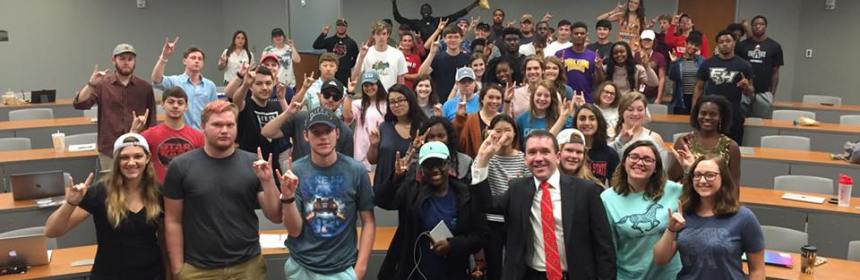
Editor’s Note: Sadler, pictured in tie, spoke with a Mass Communication in Modern Society class in the featured photo.
Window art featuring Kelly, Beth and Maple Leif Damphousse decorated the window of the Chancellor’s office. Damphousse became A-State’s chancellor on July 1. Photo by Kimberely Blackburn
JONESBORO – A native Canadian and Montréal Canadians fan, Arkansas State University’s new chancellor aspired to become either a goaltender for the NHL or a Mountie before coming to Northeast Arkansas by way of Oklahoma.
Chancellor Kelly Damphousse said he planned to stay at his last position as dean of the College of Arts and Sciences at the University of Oklahoma until retirement, but an email sent by A-State President Chuck Welch prompted him to apply. When he first visited the campus, Damphousse saw the challenges but viewed A-State as a diamond in the rough. He said he can impact a community as a chancellor in a much different way than he could as a dean.
“It’s important for us to have a relationship with the people on our campus. Sometimes it’s easy for someone who in administration to get removed from the reality of the world that they’re serving,” Damphousse said.
Damphousse explained why he creates relationships:
Campus and Community
Damphousse said his main concern will always be the students, faculty and staff. He said he understands he can only see a few students per day due to his position. Yet faculty and staff members interact with hundreds.
Damphousse said he wants to use his position to help bridge the gap between campus and community. He said there seems to be a strain between the two due to past events. He said he believes strains occur due to a lack of communication, meaning people do not truly know each other.
To remedy this, Damphousse said he speaks to any community club that extends an invitation, as well as local merchants and companies to see how A-State can help their business. Jonesboro Mayor Harold Perrin said he and Damphousse agreed to work together on several projects.
Perrin said he hopes to help get the word out of what A-State offers the community. He said A-State remains a driving force in the Craighead County community.
Perrin said A-State can help employers by providing both new employees and education for existing workers. Perrin said he believes A-State and the Jonesboro community can achieve this by fine-tuning programs already on campus.
“I’ve always learned in business, you build and become strong on what you have. If you’ll continue to build and to redefine what you’ve got, you’ll be highly successful,” Perrin said.
Damphousse explained his plans to keep A-State movng forward:
United Way
Damphousse recently announced on his Facebook account that The United Way of Northeast Arkansas named him and his wife, Beth, as co-chairs of Arkansas State University’s United Way Campaign.
Nanette Heard, executive director of United Way of Northeast Arkansas, said the Damphousses will encourage the A-State community to designate part of their salary to help fund projects throughout the eight-county region.
UWNEA covers residents of Clay, Craighead, Cross, Greene, Jackson, Lawrence, Poinsett and Randolph counties. Heard said the projects include shelters, after-school programs and programs that help feed the hungry.
Damphousse said the community matters to him and to A-State. Because the campus and community will always be tied together, he said if one rises, they both rise. Damphousse said he and Beth plan to be around for the long run.
He mentioned an analogy about planting trees you never get to sit under. But Damphousse said he wants to sit under the trees he plants. He said he wants to see the efforts that come from the changes he implements.
This is why, Damphousse said, the motto “Every Red Wolf Counts” truly encompasses everyone.
“Every Red Wolf Counts. That means every student, every faculty member, every staff member, every alumnus, every member of the Jonesboro community,” Damphousse said. “I see them all as Red Wolves because we’re all tied together.”